History & heritage
In Rabat, a city of power, gardens and memory, the arrival of a Ritz-Carlton address feels almost natural. Morocco’s capital has long cultivated an elegance that is more restrained than showy. Prestige here is not loudly declared; it is read in the order of its avenues, the presence of institutions, and the proximity of ramparts, museums, gardens and historic districts. In this context, The Ritz-Carlton Rabat occupies an interesting position: that of a contemporary grand hotel drawing on the classical language of international hospitality while allowing Moroccan references to surface in its atmosphere, materials and sense of welcome.
This is not a historic palace in the European sense, with a narrative of royalty or social seasons dating back to the Belle Époque. Its heritage is of another kind. It lies first in the brand behind it, synonymous with a certain ritual of service, a codified attention to detail and a promise of consistency sought by business travellers and leisure guests alike. It also lies in Rabat itself, a capital with a singular cultural continuity, where one moves almost seamlessly from heritage sites to more recent architecture, from Andalusian gardens to administrative perspectives, from peaceful neighbourhoods to a lively medina.
In that reading, the hotel acts as a bridge. It offers a contemporary version of the grand urban stay in Morocco: refined, calm and structured, yet never cut off from its surroundings. The Moroccan touches appreciated by guests make particular sense here. They do not necessarily rely on ostentatious décor, but rather on a way of bringing warmth into elegance, of setting clean lines against craftsmanship, soothing palettes against locally inspired details. It is often in this restraint that a contemporary luxury address succeeds.
The heritage of a place like this is therefore built through experience rather than age. It is measured by the quality of rhythm it gives a stay, by its ability to provide a credible refuge in an active capital, and by the ease with which it accommodates different purposes: a couple’s retreat, a business trip, a cultural break, a family stay. In that sense, The Ritz-Carlton Rabat belongs to a generation of hotels that do not seek to imitate the grand houses of the past, but to define a present-day classicism. A classicism of service, comfort and discretion.
For the traveller, this matters. It means one comes here less to tick off an iconic address than to inhabit, for a few days, a certain idea of Rabat: more serene than spectacular, greener than many first imagine, and deeply attached to a form of quiet distinction. It is precisely in this balance between international signature and local context that the hotel finds its personality.
The hotel
The first strength of The Ritz-Carlton Rabat lies in its setting: leafy and peaceful, a quality that takes on particular value in a capital city. Rabat is not frenetic in the way some major metropolises are, yet it still has its own administrative, diplomatic and cultural tempo. Staying in a calm neighbourhood therefore allows guests to enjoy the city without absorbing its pressures. The hotel answers that expectation precisely: offering a sense of retreat while remaining close enough to key cultural and historic sites for movement around the city to feel easy and natural.
This relationship between retreat and proximity shapes the experience of the place. One returns at the end of the day to a feeling of space, relative quiet and visual continuity with the landscape. Greenery plays an essential role here. It is not merely decorative; it contributes to the impression of a slower, more breathable, almost residential stay. For a traveller discovering Rabat, that dimension can change one’s reading of the city. It is a reminder that the Moroccan capital is not defined solely by institutions or monuments, but also by its pauses, its gardens, its more discreet districts and its art of preserving distance.
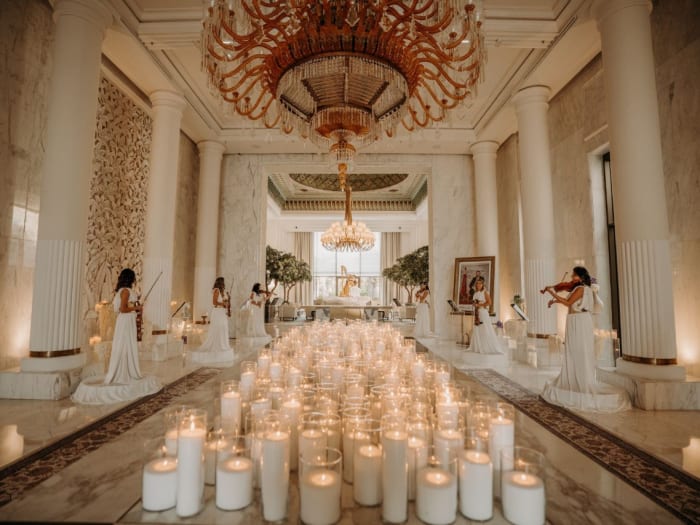
Aesthetically, the hotel embraces classical elegance enriched with Moroccan touches. Here again, the interest lies in balance. International luxury can sometimes smooth away local character; conversely, an overly literal interpretation of local décor can trap the experience in cliché. The ambition here appears instead to be the creation of a coherent atmosphere, one that combines the comfort expected from a grand address with a subtle reading of the Moroccan context. That may be expressed through materials, motifs, the treatment of light or the relationship between interiors and outdoor spaces.
The hotel particularly suits travellers seeking a sense of control over their stay. Couples will find a setting conducive to privacy and rest without excessive isolation. Business travellers benefit from clear service standards, suitable facilities and the ability to reach the city’s points of interest before returning to a calmer environment. Families, meanwhile, may see it as a comfortable base for an urban stay without sacrificing space or serenity.
What stands out, ultimately, is the way the hotel belongs to Rabat without trying to compete with it. It does not present itself as a sealed world. Rather, it serves as an anchor point from which the capital can be discovered with greater ease. Guests set out towards cultural and historic sites, then return to a quieter setting where the hotel experience takes over again. This alternation between exploration and retreat is often what distinguishes a good stay from a genuinely successful one. The Ritz-Carlton Rabat appears to have been conceived with exactly that logic in mind: allowing guests to experience Rabat fully, then letting the city settle gently afterwards.
Rooms and suites
In a hotel of this standing, the room is not merely a place to sleep; it is the true centre of gravity of the stay. At The Ritz-Carlton Rabat, one expects it to extend the property’s broader qualities: calm, elegance, legible comfort and discreet local touches. Even without detailing a precise room typology, the experience can be understood through a few essential principles that make a difference in the five-star segment.
The first is the sense of calm. In a capital city, a good room must create an immediate slowing down. That comes through sound insulation, certainly, but also through spatial composition, the quality of the bed, ease of movement and the way light accompanies different moments of the day. The best rooms do not try to impress at all costs; they establish a feeling of obviousness. One quickly feels at ease there, whether preparing for a meeting, recovering from a flight, reading in the late afternoon or simply extending an unhurried morning.
The second principle lies in the balance between international codes and local identity. In an address such as this, travellers find the expected markers of a grand house: well-considered volumes, bathrooms designed for comfort, suitable storage, turndown service, daily housekeeping and constant attention to presentation. Yet the real interest often comes from subtler details: a colour palette inspired by the landscape, materials that evoke Moroccan craftsmanship without excess, or a way of framing views and light that recalls the importance of the outdoors in local living.
Suites generally answer a different logic: that of longer stays, informal hosting or the need for a clearer separation between rest and activity. For couples, they offer additional privacy and rhythm. For business travellers, they make it possible to work or receive in a setting that remains fully hotel-oriented. For families, they may provide a more flexible solution, especially when space is a priority without compromising service standards.
It is also worth underlining the importance of invisible services in shaping the room experience. Daily housekeeping, evening preparation, the responsiveness of the team, the handling of special requests and the ease with which practical needs are resolved all contribute as much to comfort as the furnishings themselves. In contemporary luxury, the excellence of a room is measured less by the accumulation of objects than by the absence of friction.
At The Ritz-Carlton Rabat, the room therefore appears to be conceived as an ordered refuge rather than a stage set. That is an essential distinction. In a city such as Rabat, where one may alternate between cultural visits, meetings and moments of strolling, it is particularly welcome to return to a space that no longer demands attention but simply receives it. A space where elegance remains present without becoming performative, and where comfort is expressed through proportion, sleep quality and the rare feeling that everything has been considered so the stay unfolds without effort.
Dining
In a grand urban hotel, dining plays a role that goes far beyond the practical. It sets the rhythm of the day, gives tone to the stay and can become one of the journey’s most vivid memories. At The Ritz-Carlton Rabat, the culinary interest lies first in this ability to support several uses: breakfast establishing the morning’s pace, a lighter lunch between meetings or visits, dinner turning the hotel into a destination in its own right, and those in-between moments when what one seeks above all is an elegant pause without effort.
In the context of Rabat, dining takes on a particular resonance. The city does not always carry the immediately gastronomic image of Marrakech or Fez in the minds of some travellers, and that is precisely what makes it interesting. One often discovers a scene that is more discreet and measured, where execution, freshness, service precision and the intelligence of the setting matter greatly. A hotel of this category therefore benefits from offering a culinary proposition that speaks both to the international traveller and to the local context, without falling into either uniformity or superficial exoticism.
The Moroccan touches present in the hotel’s wider identity naturally extend to the table. They may appear in certain flavours, in the handling of spices, in the use of herbs, in pastries inspired by local traditions or in the art of making service itself part of hospitality. The point is not to multiply references, but to integrate them with accuracy. In a luxury hotel, the best reading of a terroir is often the one that remains clear, precise and contemporary.
Breakfast deserves particular mention, as it is often the first true sensory contact with a hotel. In a leafy, calm setting, it readily becomes a suspended moment, especially when one can settle into a bright and relaxed atmosphere before heading into the city. For business travellers it is a time of organisation. For couples, a ritual. For families, an anchor point. In every case, the quality of a grand breakfast is measured by variety, freshness and the fluidity of service.
In the evening, the challenge changes. The hotel must be able to offer an experience compelling enough to encourage guests to stay in, without cutting them off from Rabat. The right tone is to provide a table that echoes the city itself: elegant, serene, open to conversation and attentive to detail. Service is decisive here. In the best houses, it is not merely efficient; it knows how to read the pace of a meal, accompany without interrupting and maintain that impression of naturalness which is one of luxury’s most difficult forms.
In short, dining here fits into a wider philosophy of stay. It does not necessarily seek a spectacular signature effect, but rather coherence with the overall experience: a luxury of comfort, precision and continuity. It is often this approach that builds the most lasting loyalty.
Spa & Well-being
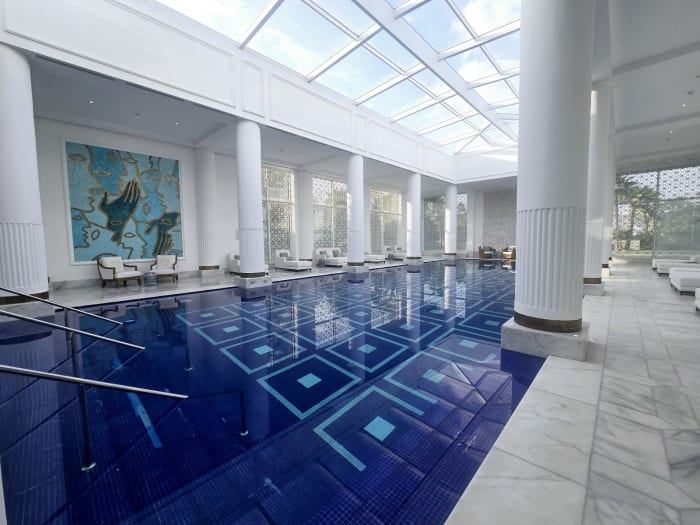
Booking a treatment upon arrival speaks volumes about the emphasis on well-being at The Ritz-Carlton Rabat. In this contemporary five-star hotel, the spa is integral to the overall experience. In Rabat, this aspect takes on a unique significance. The city invites a measured exploration, balancing cultural visits, leisurely strolls, appointments, and gentle transitions. The spa provides a counterpoint, a sanctuary where the body can catch up with the mind.
What distinguishes a good wellness space is not merely the treatment menu; it is the quality of the overall experience. There is a desire for continuity with the rest of the hotel, a shared attention to detail, a similar sense of calm, and an ability to make one forget the logistics of travel. The journey begins before the treatment itself: straightforward booking, a warm welcome, time to settle in, precise advice, and adjustments based on one's current state. In the finest establishments, the luxury of the spa is as much about this personalisation as it is about the technical expertise of the protocols.
In a Moroccan context, well-being evokes certain traditions of care, purification, warmth, and slowness. A hotel of this calibre benefits from embedding its offerings within this sensory memory. The international traveller finds familiar comforts here, while the space retains a local depth that avoids anonymity.
The spa caters to diverse expectations. Couples find a moment of suspension, business travellers can reset their day, and families may experience individual moments of respite. In all cases, success hinges on the venue's ability to create a credible bubble, free from excessive theatricality.
Well-being extends beyond the treatment room. It encompasses the quality of sleep, the opportunity to slow down, the presence of greenery, attention to silence, and the fluidity of services. A comfort-oriented hotel understands that recovery is a holistic experience. The spa is its most visible expression, but far from the only one.
At The Ritz-Carlton Rabat, the promise is clear: to offer a space where one comes not just to receive a treatment but to regain a sense of alignment. After a day spent exploring the capital, working, or discovering its cultural and historical sites, this interlude transforms the quality of the stay. It is no longer merely about visiting Rabat, but about experiencing it at a pace one can truly inhabit.
Concierge & Services
Hotel luxury is often measured by what is not immediately visible. Striking architecture or a comfortable room creates an initial impression, but it is the services that ultimately determine the true quality of the stay. At The Ritz-Carlton Rabat, 24-hour concierge service, round-the-clock reception, daily housekeeping, turn-down service, luggage storage, laundry services, wake-up calls, and multilingual staff collectively shape a seamless hospitality experience.
The concierge occupies a central role here. In a capital like Rabat, it serves not only to organise transfers or respond to practical requests but also to help navigate the city. A good concierge knows how to tailor a day based on available time, desired pace, interests, and the season. They can suggest a coherent sequence of a historical site, a stroll, a meal, and a return to the hotel before heading to the spa. For business travellers, they can simplify all aspects surrounding appointments.
The continuously open reception and multilingual staff contribute to this same ethos. In an international hotel, the quality of the welcome is reflected in how late arrivals, early departures, and special requests are handled with ease. True service is not performed for show; it resolves issues calmly.
Daily housekeeping and turn-down service fall into another category, that of repeated comfort. A prestigious establishment does not merely provide a beautiful room at check-in; it maintains it in a state of perfection throughout the stay. Returning in the evening to a space prepared for the night fosters a lasting attachment.
Laundry services, luggage storage, and wake-up calls may seem secondary but become crucial as the stay becomes more complex. A business trip, a multi-stop itinerary, an early arrival, or a late departure to the airport can elevate the value of these attentions. Luxury here lies in the elimination of ordinary frictions.
The services at The Ritz-Carlton Rabat thus support a variety of stays without losing coherence. They do not seek accumulation but rather aim to make the experience simpler, more flexible, and more comprehensible. In a city like Rabat, this quality of support often makes all the difference.
The Art of Living in Rabat
Staying at The Ritz-Carlton Rabat means entering the Moroccan capital through a measured lens. Rabat does not reveal itself at a glance; its charm unfolds gradually, almost literarily. One must embrace its rhythm, its light, and its institutional elegance, which coexists with ancient neighbourhoods, gardens, and open vistas.
For the traveller, it is a city that is easy to inhabit. One can progress through the day in sequences: a cultural visit in the morning, a leisurely lunch, a stroll through a historic district, a return to the hotel to unwind, followed by a relaxed dinner. Rabat rewards moderation and suits those who prefer nuance over spectacle.
The proximity of cultural and historical sites gives the hotel a clear advantage, allowing for flexible days without excessive logistics. Rabat is discovered through its heritage, museums, ramparts, gardens, avenues, and its unique relationship with the ocean. Even without a flurry of visits, the city offers a distinctive quality of presence, where one can sense a continuity between past and present, power and everyday life.
The peaceful and green neighbourhood where the hotel is located plays a crucial role, allowing for a more residential approach to the capital. One does not feel merely transient; there is a sense of having a stable anchor point. This feeling is invaluable, especially during a short stay, as it helps balance the time dedicated to exploration with that reserved for rest.
For couples, Rabat provides a pleasant setting conducive to strolls and conversations. For business travellers, the city presents an orderly and functional face, while also allowing for genuine cultural respites. For families, it can serve as an accessible introduction to urban Morocco, with its density of interest not becoming overwhelming.
Finally, the art of living in Rabat is characterised by a form of discretion. One appreciates the details: the quality of a garden, the softness of a late afternoon, the presence of history without overwhelming monumentality, and the ability to move from a place of memory to a moment of calm in a short time. In this context, The Ritz-Carlton Rabat finds its true purpose, becoming a foundation for experiencing the city with greater balance and attention.
Book via MyConciergeHotel
Booking The Ritz-Carlton Rabat through MyConciergeHotel means preparing for your stay with precision. In luxury hospitality, the difference lies not only in the price but also in the quality of advice and the alignment between the traveller and the rhythm of the place.
The Ritz-Carlton Rabat is suitable for couples, business travellers, and stays that blend culture and relaxation. It is chosen for a more tranquil capital, a green environment, proximity to cultural and historical sites, and structured service.
Booking with MyConciergeHotel allows for anticipating important details. Certain spa slots fill up quickly, making it beneficial to organise this wellness time upon arrival or even in advance. A stay in Rabat also benefits from being considered in its overall rhythm, including moments of visiting, time for rest, logistical needs, arrival and departure times, laundry, luggage, or room service.
For couples, the support helps prioritise the most harmonious sequences: a serene arrival, dinner either on-site or in the city, a spa treatment, and balanced days between discovery and retreat. For business travellers, the focus is on optimising the stay: securing a reliable environment, simplifying practical aspects, and preserving recovery time. For families, the challenge is to ensure a comfortable stay without overwhelming them.
MyConciergeHotel operates within this logic of precision. The goal is not merely to confirm a room but to orchestrate a stay in harmony with the promises of the venue. In a place where calm, quality service, and cultural proximity are as important as standing, this preparation enhances the experience, allowing for a well-prepared arrival.
By choosing The Ritz-Carlton Rabat through MyConciergeHotel, one favours a more attentive way of travelling—an informed, personalised experience that aligns with what the hotel offers most compellingly: a luxury of serenity, continuity, and a balanced distance from the city.