History & heritage
Waldorf Astoria Orlando belongs to a hotel lineage that is instantly recognisable: one that has long associated the idea of luxury service with a certain aesthetic restraint. This is not a historic palace in the European sense, with listed salons or royal anecdotes, but rather a contemporary interpretation of a great hospitality name, set within Orlando’s distinctive landscape. That distinction matters. The appeal of the address lies precisely in the meeting point between the grand-hotel imagination shaped by the Waldorf Astoria name and a destination often viewed chiefly through the lens of entertainment.
In Orlando, the challenge for a property of this calibre is less about summoning aristocratic memory than about creating a sophisticated refuge within a highly frequented setting. Waldorf Astoria Orlando answers that expectation with a mood that is more hushed than theatrical. The refined shared spaces, among its known hallmarks, help establish an atmosphere of calm, control and continuity from the outset. Guests will recognise what seasoned travellers expect from a Waldorf Astoria address: a sense of formal welcome without stiffness, attention to the rhythm of a stay, and the impression that each detail is designed to simplify the experience rather than burden it.
Its heritage, then, is above all a heritage of standards. It is expressed through the perceived quality of service, the presence of a concierge available around the clock, in-room rituals such as turndown, and the way the hotel balances private comfort with the life of its communal spaces. That continuity of service matters especially in a destination such as Orlando, where days can be dense, planned, family-oriented or business-led. The hotel becomes more than a place to sleep: it serves as a point of decompression, capable of absorbing the intensity of the outside world.
The American context also matters. Luxury hospitality in the United States, particularly in major resorts, often rests as much on fluidity and efficiency as on display. Waldorf Astoria Orlando sits firmly within that tradition: a property that combines scale, organisation and discretion. Its identity is not that of a frozen monument, but of a house designed for contemporary use, welcoming couples on a short escape, families exploring the region’s attractions, and business travellers seeking a calmer setting than the city’s busiest areas.
In that sense, its heritage is twofold. On one hand, it extends the Waldorf Astoria language, synonymous with international elegance. On the other, it adapts that language to Central Florida, its climate, its pace, and the idea of a stay in which one moves easily from active days to restorative evenings. It is this capacity for adaptation, more than any patrimonial narrative, that defines the property’s personality. Waldorf Astoria Orlando does not attempt to imitate the palaces of another continent; it asserts an American version of the grand hotel, structured, comfortable and serene, with consistency rather than spectacle as its guiding principle.
The Establishment
At the Waldorf Astoria Orlando, the address strikes a perfect balance with its destination. Close to Orlando's attractions, it maintains a peaceful atmosphere, away from the hustle and bustle.
The hotel is well-suited for travellers who wish to easily access the major points of interest in the region. In the evening, they find a more relaxed setting. Here, the transition is gentler. The architecture, spaciousness, and refined communal areas create a sense of retreat. It is not about isolation, but rather about creating distance. This nuance allows guests to enjoy Orlando without constantly feeling its pace.
The establishment displays a clear elegance, devoid of ostentation. The lines remain clean, the circulation coherent, and the comfort well thought out. The shared spaces extend the stay. One can gather, wait, read, work for a while, or simply unwind.
This quality of use caters equally to leisure stays and business trips. It helps balance busy days. The address welcomes couples, families, and business travellers alike.
The relationship with nature and the Floridian climate also contributes to the identity of the place. The light, warmth, and vegetation influence how one inhabits the hotel. The resort provides breathing spaces, unobstructed views, and areas where one can experience the destination from a more distanced perspective.
The establishment is not solely defined by its five-star category or brand signature. It stands out for its precise positioning within the Orlando landscape. Close enough to make the destination accessible, yet far enough to preserve the quality of the stay. For many travellers, the value of this address lies in its tranquillity.
Rooms and Suites
In a destination where days begin early and often stretch late into the night, the room becomes an essential component of the stay. At the Waldorf Astoria Orlando, it must cater to multiple uses.
For couples, it provides a serene setting conducive to rest and intimacy. For families, it remains practical and accessible without sacrificing elegance. For business travellers, it allows for occasional work, efficient preparation, and recovery in comfortable conditions.
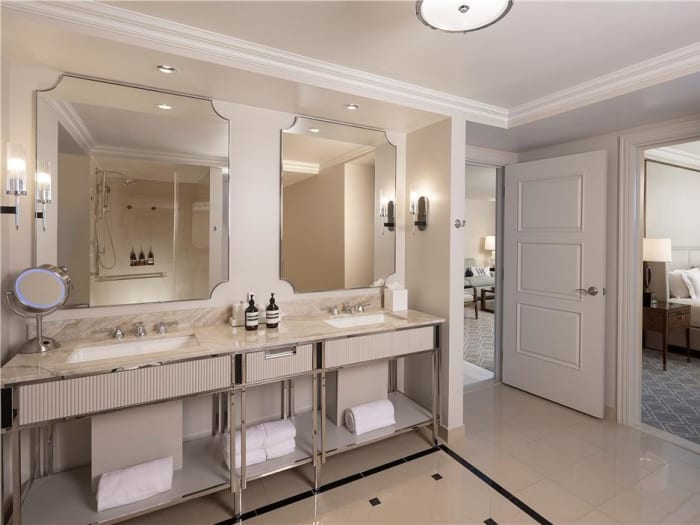
While amenities are important, functionality takes precedence. This necessitates a clear organisation of space, storage solutions suitable for extended stays, bedding that meets expectations, and a bathroom designed as a transition between activity and relaxation. A successful room is one where nothing is lacking and nothing feels superfluous.
Service also plays a crucial role. Daily housekeeping and turn-down service significantly contribute to the overall sense of comfort. After a day spent at Orlando's attractions or in meetings, returning to a meticulously prepared room transforms the pace of the stay.
The suites extend this philosophy with more space and better separation of functions. They allow for hosting, retreating, or organising a family or professional day with greater flexibility.
In Orlando, the room also serves as a refuge. The city demands much, with its travel, queues, heat, and constant activity. In this context, the quality of private space becomes a discreet luxury. Here, comfort is designed to be controlled, elegant, and crafted to accompany the guest from the first night to the last.
The Dining Experience
In a grand destination hotel, gastronomy extends beyond a single restaurant. It plays a vital role in how one inhabits the space. At the Waldorf Astoria Orlando, dining serves as an essential balancing act. In a city where the outside world is constantly demanding attention, meals become anchor points. They structure the day, offer moments of respite, and help maintain the calmer tempo that the hotel seeks to preserve.
The primary challenge in an establishment of this calibre is the diversity of dining options. A hotel that welcomes couples, families, and business travellers must consider dining as a comprehensive response. Breakfast serves different functions depending on the day's rhythm. Lunch can be quick or signify a genuine break. Dinner often takes on a more ceremonial dimension, especially when one chooses to dine on-site.
In the Waldorf Astoria universe, one expects attentive and clear dining experiences. This hinges as much on the quality of service as it does on the food itself. What matters is not just sophistication, but accuracy. A good hotel restaurant avoids unnecessary displays and bland standardisation. It should provide an elegant experience while remaining flexible. In Orlando, this flexibility is particularly important. Guests may return late, travel with children, dine early, or make dinner a central moment of their day.
The resort aspect also influences expectations. In such establishments, dining is not merely functional. It contributes to the autonomy of the stay. Having meals in a setting that aligns with the overall experience enhances the feeling of being settled somewhere. Dining spaces become transitional areas between the intensity of the outside world and the regained calm. Here, one seeks quality service and the right atmosphere. Controlled lighting, a measured pace, and attentive yet unobtrusive staff.
In contemporary luxury hospitality, dining remains one of the primary vectors of memory. A too ostentatious decor is quickly forgotten. A smooth service, a well-executed breakfast, or a dinner that unwinds the day are long remembered. The Waldorf Astoria Orlando provides the ideal setting for such experiences. A refined, peaceful address, designed as a counterpoint to the energy of the destination.
Here, gastronomy is envisioned as a natural extension of the stay. A successful grand hotel dining experience adapts to moods and schedules. It supports the quality of rest and encourages guests to linger. In a city as active as Orlando, this capability is significant. It transforms meals into special moments.
Spa & wellbeing
Even when a brief does not detail the full range of wellness facilities, it remains legitimate to address this dimension in the case of a five-star resort hotel, as it has become central to the experience of a stay. At Waldorf Astoria Orlando, wellbeing should be understood broadly: not only as a possible set of treatments or dedicated spaces, but as a general quality of environment. The calm claimed by the property, its setting away from immediate bustle and the attention paid to room comfort already contribute to a form of structural wellbeing.
This point is often underestimated. In high-intensity destinations such as Orlando, the first luxury is not necessarily the accumulation of options, but the genuine possibility of slowing down. A hotel may offer many facilities; if it does not allow the traveller to release pressure, the effect remains superficial. By contrast, a property that organises the stay around a sense of fluidity, relative quiet and controlled service creates the conditions for deeper recovery. Waldorf Astoria Orlando appears to sit precisely within that logic.
Wellbeing therefore begins the moment one returns to the hotel. After a day spent at the region’s attractions, in the Florida climate, or after a dense professional schedule, one expects an address of this kind to provide a setting in which body and mind can shift register. That depends on simple circulation, communal spaces that do not create visual fatigue, a room prepared with care, and service attentive enough to remove unnecessary friction. The presence of turndown, daily housekeeping and a concierge available at all hours contributes to that soothing continuity.
Within the imagination of the high-end resort, the spa naturally holds a particular place. Even without detailing unconfirmed protocols or facilities, one can say that a treatment space in a hotel such as this first answers a need for rebalancing. It is not merely about indulgence, but about restoring the stay to the right internal temperature. A treatment, a quiet interlude, a moment of silence or a more personal routine can turn a highly active trip into a more harmonious experience. For couples, this is often a moment of reconnection; for families, a welcome pause; for business travellers, a very practical recovery tool.
The Floridian climate also invites a broader view of wellbeing in relation to the outdoors. Light, heat and seasonal rhythm influence how one rests, hydrates and alternates between inside and outside. A grand hotel in this region must know how to accompany those parameters, offering an experience neither cut off from its environment nor entirely subject to it. Wellbeing here likely lies in that balance: sensing the destination without absorbing its excess.
Ultimately, the wellbeing promise at Waldorf Astoria Orlando reads less as an isolated selling point than as a discreet thread running through the entire stay. It resides in sleep quality, in the ability to recover calm after stimulation, and in the feeling of being looked after without being interrupted. This is a mature definition of hotel luxury: not multiplying signs, but creating the conditions for genuine release. In Orlando, that capacity is almost a destination in itself.
Concierge & Services
In luxury hospitality, service is never an add-on. It is the very essence of the stay. The Waldorf Astoria Orlando makes this clear.
With 24-hour concierge service, 24-hour reception, daily housekeeping, turndown service, luggage storage, laundry service, wake-up calls, and multilingual staff, these services together create a seamless and adaptable stay.
The 24-hour concierge service is one of the most significant markers. In Orlando, days are often organised around reservations, transport, family activities, or professional obligations.
Having a contact available at all hours transforms the experience. A good concierge lightens the journey. It helps organise the stay, resolve unforeseen issues, and adjust plans.
The continuously open reception extends this logic. Late arrivals, early departures, changes of plans, and occasional needs are all part of the real life of a destination hotel.
Daily housekeeping and turndown service represent a more intimate form of service. They pertain to the room, the most personal space of the stay.
In Orlando, guests often return tired, sometimes laden with bags. Finding a room restored to order takes on very concrete value.
Luggage storage, laundry service, and wake-up calls provide another essential quality: the flexibility of the stay. They facilitate flight schedules, transitional days, and the needs of longer trips.
The multilingual staff underscores that an establishment of this category welcomes an international clientele. It makes communication simple, precise, and reassuring.
Ultimately, the Waldorf Astoria Orlando offers hospitality that removes friction. In a destination that demands organisation, this flexibility makes a difference.
For the traveller, this translates into an immediate impression. The feeling of being supported without being slowed down.
The Orlando way of life
Speaking of a way of life in Orlando may seem paradoxical to those who reduce the city to theme parks and the entertainment industry. Yet staying at an address such as Waldorf Astoria Orlando makes it possible to perceive a more nuanced reading. Orlando is not only a destination of attractions; it is also a territory of climate, light, carefully arranged landscapes, ritualised family stays and escapes in which one seeks to combine intensity with comfort. The local way of life lies in this particular composition of energy and release.
The first element is, of course, time. In Central Florida, light structures the day differently. Mornings often begin early, with a sense of openness that encourages full use of the gentler hours. Afternoons, warmer and more demanding, call for another rhythm made of pauses, returns indoors and moments of conserving energy. Evening then becomes a time of recomposition: dining, gathering and returning to calm. A peaceful hotel, close to the attractions yet removed from immediate bustle, fits perfectly within that temporality.
The Orlando way of life also rests on a certain logistical intelligence. That may sound unromantic, but it is a reality of the destination. To have a successful stay here often means knowing how to alternate sequences, avoid saturation and choose one’s moments. A grand hotel then plays a decisive role: it allows a potentially exhausting city to become a more harmonious experience. Waldorf Astoria Orlando, through its positioning, seems to offer exactly that possibility. One can experience Orlando intensely without having to prolong its agitation into the night.
For families, this way of life translates into calmer organisation. For couples, it opens the way to a softer reading of the destination, less centred on programme performance than on the quality of shared time. For business travellers, it offers a way of staying in Orlando without being entirely absorbed by its utilitarian rhythm. In every case, the aim is to recover a form of comfort in the sequence of days.
There is also, in this part of Florida, a particular relationship to space. Distances, infrastructures, large hotel complexes and landscaped breathing areas create an environment very different from historic European city centres. The local art of living is not found in urban strolling in the classical sense, but in the intelligent use of territory: knowing when to go out, when to return, when to enjoy the resort and when to explore further afield. A well-located, well-serviced hotel then becomes a genuine vantage point from which to inhabit Orlando.
By choosing a Waldorf Astoria address, the traveller ultimately opts for a more composed version of the destination. One does not renounce what makes Orlando famous; one simply gains the possibility of approaching it with greater measure. Perhaps that is the local way of life when properly understood: not doing everything, but organising the stay so as to keep the best of it. In that perspective, Waldorf Astoria Orlando appears as an excellent mediator between the city’s spectacle and the very contemporary need for calm, comfort and continuity.
Book with MyConciergeHotel
Booking Waldorf Astoria Orlando through MyConciergeHotel means choosing a more editorial and more guided way of approaching a five-star address. In a destination such as Orlando, that approach is particularly valuable. A stay here is rarely neutral: it is often tied to a specific programme, with strong expectations, calendar constraints, sometimes additional reservations and very different travel profiles. A couple’s weekend, a family holiday and an extended business trip do not share the same priorities. The issue, therefore, is not simply to book a room, but to book well.
MyConciergeHotel fits precisely within that logic of accuracy. The value of a specialised platform lies not only in access to a strong hotel selection; it also resides in the ability to contextualise a property, explain its true positioning and help travellers understand whether it genuinely suits them. In the case of Waldorf Astoria Orlando, that perspective is essential. The hotel is not merely a luxury address in Orlando; it is a particularly relevant option for those who wish to remain close to the attractions while preserving a genuine quality of calm on return.
Booking through an editorial player such as MyConciergeHotel also makes it easier to read the nuances of a stay. A strong brand such as Waldorf Astoria can generate high, sometimes abstract expectations. The role of a well-made recommendation is to translate those expectations into concrete benefits: a peaceful atmosphere, refined shared spaces, well-appointed rooms, and service that is structured and available. These are the elements, more than slogans, that determine the success of a stay.
In a city shaped by seasonality, school holidays, major tourist flows and local events, the timing of a reservation also matters greatly. Planning ahead often makes it easier to choose the right stay type, rhythm and priorities. The advice already given in the short description — to book in advance in order to make the most of offers and hotel activities — remains highly relevant here. The more intelligently the trip is prepared, the more fully the hotel can play its role as an organised refuge.
Booking with MyConciergeHotel also means favouring a certain idea of high-end travel: a luxury that is less demonstrative than considered, where one seeks alignment between place, moment and use. Waldorf Astoria Orlando will not be suitable merely because it bears a recognised name, but because it answers a very specific need within Orlando’s landscape: to experience the destination without being overwhelmed by it. When a reservation accurately reflects that intention, the stay already begins under the right conditions.
For the discerning traveller, this booking stage is therefore not administrative; it is part of the experience itself. Choosing well is already travelling better. And in the case of an address such as Waldorf Astoria Orlando, the quality of the stay depends largely on that initial fit between promise, context and personal expectations. That is exactly the kind of reading MyConciergeHotel aims to provide: clear, selective and focused on the real quality of experience.