History & heritage
Arizona Biltmore belongs to that rare category of hotels whose name extends beyond accommodation alone. In Phoenix, this address has long stood as an architectural and social landmark, where the history of American hospitality meets the imagery of the desert. Its identity rests first on an immediately recognisable silhouette, shaped by a modernist approach adapted to the Arizona climate and to a distinctly local way of inhabiting light, shade and outdoor space. Here, architecture is not a decorative layer applied to the landscape: it converses with it, echoing its lines, mineral tones and climatic logic.
The property’s heritage also lies in its place within a tradition of grand-style hospitality, now carried by Waldorf Astoria. That affiliation brings a framework of service and a certain sense of occasion, without erasing what makes the resort distinctive: an atmosphere more horizontal than theatrical, more sunlit than ceremonial, deeply rooted in the American South-West. Arizona Biltmore is not merely a historic hotel; it is an address that conveys an idea of travel in the West, somewhere between resort life, architecture and an outdoor way of living.
Over the decades, the hotel has welcomed travellers seeking rest, sociability and a form of cultivated escape. It retains the spirit of the great American resorts where one stays as much for the property itself as for the destination. The gardens, pathways, terraces and shared spaces all contribute to that collective memory: a hotel conceived almost as an elegant campus, where one moves from lounge to pool, from patio to restaurant, with the sense that each part of the stay has been designed to extend the previous one.
What remains striking today is the timelessness of the whole. Arizona Biltmore does not attempt to appear old; it embraces its heritage while allowing it to breathe. Historical references are legible in the volumes, in certain geometric motifs and in the way the buildings open onto the landscape rather than withdrawing from it. That continuity gives the stay a particular depth. One does not enter an interchangeable address here, but a place that has developed its own aesthetic vocabulary and its own rhythm over time.
For European travellers, this history translates into a very clear experience: that of a heritage resort with genuine personality. The appeal of the Biltmore lies not in freezing its past, but in making it liveable. Its legacy is felt in the balance between prestige and ease, between memory and contemporary use. That combination explains its singular place in Phoenix’s hotel landscape: a historic address, certainly, but above all a living place still defined by its architecture, its light and its direct relationship with the desert.
The property
Staying at Arizona Biltmore means choosing an urban resort that achieves an uncommon balance: being in the heart of Phoenix while still conveying a sense of retreat. The estate unfolds in a sunlit setting shaped by low-rise buildings, gardens, patios and outdoor walkways that give the climate a central role. This layout creates an immediate feeling of space. One is not in a tower or a conventional city-centre hotel, but in a property that embraces an open relationship with the sky, vegetation and desert perspectives.
A first impression of the place often comes from Arizona’s very particular light. It sculpts the façades, sharpens the geometric reliefs and turns the hours of the day into distinct visual sequences. In the morning, the whole appears crisp, almost graphic; by late afternoon, the tones become warmer and more mineral, and the outdoor spaces take on an almost cinematic dimension. This quality of light is not merely an amenity: it is part of the experience of the place, just as much as the architecture or the service.
The property also stands out for its atmosphere. Despite its status as a grand address, it retains a degree of ease that suits Phoenix well. The shared spaces are not designed to intimidate; they favour fluid movement, practical comfort and the pleasure of lingering. One can move from the lobby to a terrace, from a garden to a pool, without any break in tone. That continuity creates a more organic stay, in which moments of rest, meetings or discovery follow one another naturally.
The desert setting here is more than a backdrop. It influences the materials, the colours, the way shade is distributed and how outdoor spaces are conceived. The resort thus offers a refined reading of the Arizona landscape: not a folkloric reconstruction, but an elegant interpretation of its climate and geography. For travellers discovering Phoenix, it is a particularly apt way into the city: not only through its districts or roads, but through what is most essential about it, its light and its relationship with the land.
The location is also a practical advantage. Being in Phoenix makes it easy to combine a restful stay with business appointments and urban exploration. The hotel therefore suits a variety of profiles: couples, families, business travellers or guests on a shorter stopover. Each finds a clear, comfortable base from which to shape the stay either around the resort itself or around the city.
Perhaps the best way to summarise the property is this ability to offer a resort experience without isolation. Arizona Biltmore proposes a way of staying built on space, light and the gentleness of the climate, while remaining connected to Phoenix. For travellers seeking an address with real physical presence, a strong architectural identity and a calm atmosphere, it feels less like a fashionable statement than a quietly obvious choice.
Rooms and suites
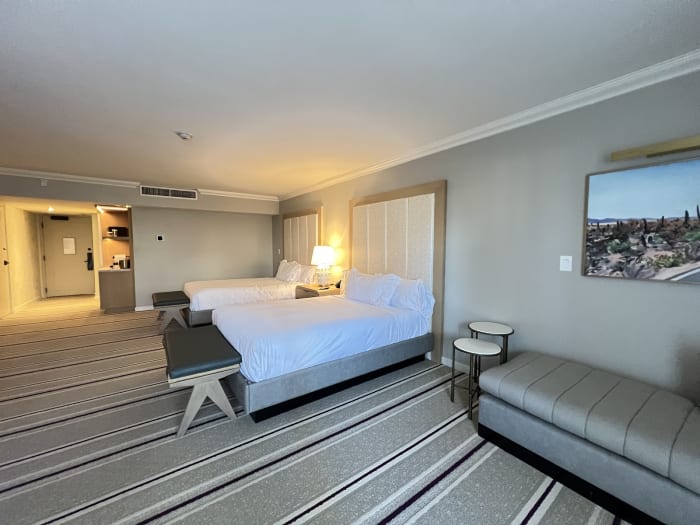
In a resort of this nature, the room is not merely a place to sleep; it must extend the sense of space and breathing room felt throughout the estate. At Arizona Biltmore, the residential experience follows that logic. Accommodation is conceived as a light-filled refuge, suited to the rhythm of the local climate and to a way of staying that alternates between indoor and outdoor time. The emphasis is less on ostentation than on lasting comfort, clarity of volume and an immediately perceptible sense of calm.
The overall aesthetic naturally aligns with the identity of the place. Lines, materials and tones evoke the desert without resorting to literal illustration. The palettes are intended to soothe, to welcome light and to maintain continuity with the gardens, patios and resort architecture. In the best rooms as in the suites, that coherence matters: it allows guests to feel they are staying in a property conceived as a whole, rather than in a collection of standardised spaces.
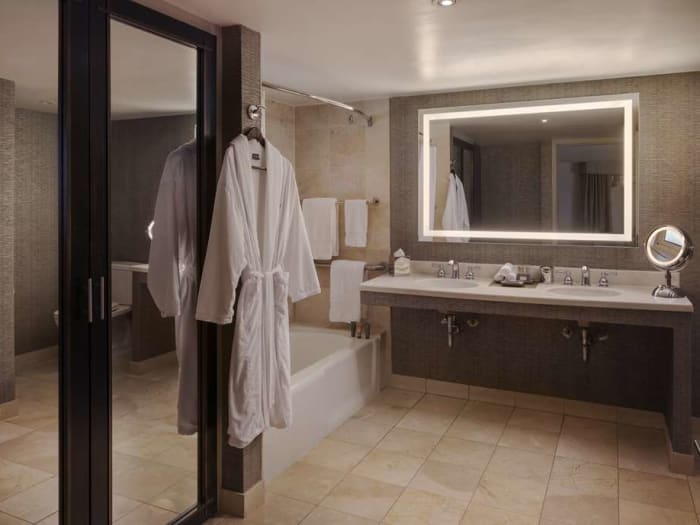
For international travellers, this type of accommodation has an obvious advantage: it offers a clear reading of high-end American comfort, often more generous in scale and more flexible in use. One finds here an idea of hospitality that values everyday ease: simple circulation, comfortable seating, bedding designed for proper rest and bathrooms conceived for unhurried routines. Luxury, in this context, lies largely in ease. It is expressed through the ability to slow down, settle in, read, work or recover from a long-haul flight in a stable, well-calibrated environment.
The suites, meanwhile, answer several needs. They suit longer stays, family travel, couples seeking greater privacy or business trips requiring an informal entertaining space. In a Phoenix resort, that additional amplitude makes particular sense: one can shape the day at one’s own pace, return between activities, enjoy a cool pause before dinner or simply watch the light change across the landscape.
Part of the appeal of such a property also lies in the relationship between the room and the rest of the resort. One does not hide away in it; one returns to it. The room becomes a serene base between pool time, walks, appointments and meals. This articulation is especially successful in warm destinations, where thermal comfort, effective blackout, bedding quality and a sense of retreat all play a decisive role in the success of the stay.
Ultimately, the rooms and suites at Arizona Biltmore are best appreciated for their ability to translate the spirit of the property into daily experience. They do not seek to impress through accumulation, but to establish a form of wellbeing consistent with the architecture, the light and the climate. For the traveller, this results in a simple yet valuable impression: that of genuinely inhabiting the resort, rather than merely sleeping in it.
Dining
In a grand resort, dining plays a broader role than that of a mere ancillary service: it structures the day, creates appointments and sets a tone for the stay. At Arizona Biltmore, food and drink naturally belong to this logic of sunlit resort living. One imagines mornings beginning early over coffee in already bright light, continuing with relaxed lunches between activities, then drawing in towards evening around a more subdued atmosphere. The pleasure of dining here lies as much in the setting as on the plate: terraces, patios, open views and an easy flow between indoors and outdoors.
At a property of this level, the point is not simply to multiply options, but to offer formats suited to the actual rhythm of travellers. A resort in Phoenix must answer several temporalities: the leisurely breakfast, the light meal after the pool, the more composed dinner, the drink taken at dusk or the need for simplicity after a day of meetings. The success of such an offering depends on its clarity and on its ability to accompany the stay without overcomplicating it.
Arizona naturally invites a style of cooking that values freshness, seasonality, produce suited to a warm climate and preparations that leave room for texture, citrus, herbs, grilled dishes or lighter plates. Without presuming a specific menu, one can say that a resort of this category finds its balance when it combines local grounding with international comfort. Travellers expect both a reading of the territory and the reliability of a grand house. It is that balance which separates merely correct dining from a genuine sense of destination.
Atmosphere matters just as much. In Phoenix, dinner does not necessarily mean formality. Luxury may take the form of attentive service, a well-judged tempo and a setting that allows the evening to unfold without stiffness. The best resort meals are often those that seem simple while being meticulously orchestrated: a well-positioned table, a smooth transition from aperitif to dinner, a terrace where the air softens, service capable of being present without becoming heavy.
For families, dining must remain flexible; for couples, it should offer more intimate moments; for business travellers, it should allow efficiency without sacrificing setting. Arizona Biltmore, through its layout and atmosphere, lends itself well to that plurality of uses. One can experience dining here as an interlude, a ritual or simply an extension of time spent outdoors.
In practice, it is often in this kind of resort that one rediscovers the value of a meal well placed within the day. An unhurried breakfast, lunch in the shade, dinner after the heat has passed all become markers. Dining then becomes a full part of the experience of the place: it translates the climate, rhythm and sociability specific to Phoenix, while maintaining the standards of comfort and service expected from a Waldorf Astoria address.
Spa & wellness
Wellness in Phoenix is not limited to a spa in the strict sense. It begins with the climate, with the dry light, with the possibility of living outdoors for much of the day, and then extends into spaces designed for slowing down. In that spirit, Arizona Biltmore is particularly well suited to an experience of relaxation built on rhythm, recovery and the quality of the environment. The resort, by its very structure, encourages a form of gradual decompression: one walks between buildings, lingers by the gardens and alternates between sun and shade, activity and rest.
At a five-star address, the world of wellbeing must answer varied expectations. Some travellers seek a targeted treatment after a flight or a day of meetings; others wish to organise their stay around a fuller routine combining movement, relaxation, pool time and quiet intervals. The setting of the Biltmore allows precisely that flexibility. Wellness here need not be spectacular; it can be discreet, integrated into the natural flow of the day, which often makes it more effective.
The desert inspires a particular approach to rest. In warm climates, the body responds differently: one seeks hydration, coolness, muscular recovery, enveloping treatments and pauses away from the sun. A resort spa in this context fulfils its purpose when it knows how to accompany those very concrete needs. It is not simply a matter of offering protocols, but of creating continuity between outdoors and indoors, between the bright energy of the day and the return to calm.
Pools and relaxation areas play an essential role here. In the Phoenix imagination, the pool is not an extra; it is part of the local way of life. It structures afternoons, offers a counterpoint to the heat and establishes a slower rhythm. For families, it becomes a centre of gravity; for couples, a setting for escape; for business travellers, a very tangible decompression chamber between work sequences. The resort then gains depth: it is no longer merely a place to sleep and dine, but an environment that physically supports the stay.
Wellness also depends on details of service. Attentive staff, smooth organisation, the ease of finding one’s bearings and the sense that everything is designed to simplify the day all matter as much as a treatment itself. In the best houses, the luxury of the spa lies in that quality of continuity. One does not come only for a treatment, but for a better quality of presence to oneself, made possible by the setting.
At Arizona Biltmore, that promise takes a very credible form. The open architecture, the desert landscape, the gardens and the relaxed atmosphere create favourable conditions for wellbeing without emphasis. For many travellers, that is precisely the value of the place: the possibility of truly resting, not in isolation, but in a living resort where everything seems designed to make time feel more spacious.
Concierge & services
In high-end hospitality, the quality of a stay is often measured less by the accumulation of facilities than by the way services genuinely support the traveller. Based on the information provided, Arizona Biltmore offers the essentials expected of a major international address: 24-hour concierge, 24-hour front desk, daily housekeeping, turndown service, luggage storage, laundry, wake-up service and multilingual staff. Taken individually, these services may seem standard; brought together in a resort of this scale, they form the invisible infrastructure that makes a stay feel seamless.
The concierge, in particular, takes on a specific importance here. In a destination such as Phoenix, it is not only there to solve logistical requests. It can help organise time, prioritise wishes, adapt an itinerary to the climate, recommend more suitable timings for outings or guide guests towards experiences compatible with a stay as a couple, as a family or in a business context. True luxury lies not merely in securing a booking, but in receiving relevant advice at the right moment, with a fine understanding of the rhythm of travel.
The 24-hour front desk responds to a very concrete reality of contemporary travel, especially international travel. Late arrivals, early departures, jet lag, changes of plan: in a resort welcoming a varied clientele, that continuity of presence is both reassuring and practical. It also allows guests to approach the stay with greater flexibility, without having to organise everything around administrative hours.
Daily housekeeping and turndown service contribute to another dimension of comfort: consistency. In warm destinations, where one comes and goes several times a day, returns from the pool or from an excursion, finding a room refreshed, orderly and prepared for the night genuinely changes the perception of the stay. These are discreet gestures, yet they shape the experience in a deep way.
Laundry and luggage storage also answer very practical needs. For a long weekend, a road trip through the American West or a journey combining business and leisure, these services offer welcome freedom. They make transitions easier, allow guests to extend their time on property before a flight and simplify travel in a climate that often calls for several changes of clothing over the course of a single day.
Lastly, the presence of multilingual staff reflects the property’s international vocation. For French or European guests, this helps make the experience clearer and more comfortable, particularly when arranging transfers, understanding local habits or expressing a specific request.
Ultimately, the Biltmore’s services matter because they are coherent with the spirit of the place. They do not overplay formality; they support a resort style of hospitality that is flexible and well calibrated. It is that quality of execution, more than any grand announcement, that allows a great hotel to fulfil its promise day after day.
The Phoenix way of life
Phoenix does not always reveal itself at first glance, especially to European travellers accustomed to denser cities that are more immediately legible on foot. Its appeal lies less in classical monumentality than in a particular relationship between urban life, climate and landscape. Staying at Arizona Biltmore offers precisely the right point of entry into that local logic. The resort acts as an interface between city and desert, between metropolitan energy and an outdoor culture that deeply shapes everyday life.
The Phoenix way of life begins with light. It dictates schedules, contrasts and habits. One quickly learns to value the morning, to temper the middle of the day and to rediscover late afternoon and evening as moments of opening up. This temporality influences everything: walks, meals, activities and even the way one dresses and moves about. For a visitor, understanding this changes the experience of the destination. One does not explore Phoenix against its climate, but with it.
The city also offers another reading of luxury, one based less on display than on space, ease and a relationship with the outdoors. Amplitude, terraces, gardens, open views and the ability to move effortlessly from an air-conditioned interior to a shaded outdoor area are all part of the desired comfort. Arizona Biltmore embodies that idea well. It allows guests to grasp what Phoenix can be at its most appealing: a sunlit, relaxed elegance that gives up neither refinement nor practicality.
A stay can then be built around a simple balance. On one side, the discovery of the city, its districts, cultural institutions, dining addresses or shopping, depending on individual interests. On the other, the pleasure of returning to a resort that offers a calming counterpoint. That alternation is essential. Phoenix is often better understood in sequences than through continuous immersion. One goes out, observes, returns and lets the city settle.
For business travellers, this way of life translates into a more breathable way of inhabiting a work trip. For couples, it opens the possibility of a stay that is both urban and contemplative. For families, it offers a setting that is easy to read, where active time and rest time can both find their place. In every case, the relationship with the climate remains central: it invites one to slow down without becoming static, to organise the day intelligently rather than simply fill it.
What gives Phoenix its lasting charm is perhaps precisely this pedagogy of rhythm. The city teaches one to choose the right moments, to appreciate shade, to look further and to treat landscape as a component of urban life. In that sense, Arizona Biltmore is not merely a well-located hotel; it is a privileged vantage point on a particular way of living Arizona. For travellers wishing to understand the destination without reducing it to a handful of desert clichés, this address makes an especially apt starting point.
Book with MyConciergeHotel
Booking Arizona Biltmore through MyConciergeHotel means approaching the property with a finer level of preparation than a simple online reservation. In a historic and expansive resort, the quality of a stay often depends on details that are not always visible when choosing a room: where one is positioned within the estate, how well the accommodation suits the profile of the trip and the desired balance between relaxation, discovering Phoenix and any professional obligations. Editorial and concierge guidance helps refine those parameters before arrival.
This approach is particularly useful in a destination such as Phoenix. The climate, the most pleasant times to enjoy outdoor spaces, the logic of getting around the city and the role of pools and rest periods within the day all influence how the hotel is experienced. Booking thoughtfully therefore also means thinking about the stay as a whole. A couple will not seek the same atmosphere as a family; a business traveller will not have the same priorities as a guest coming for a few days of disconnection. The role of MyConciergeHotel is precisely to help turn a fine address into a stay that is genuinely well calibrated.
The value of such a booking also lies in reading the property correctly. Arizona Biltmore is not a standardised hotel; its architectural identity, heritage and resort layout call for a more nuanced understanding. It may be wise to favour certain atmospheres, to preserve time on property rather than overloading the external programme, or to anticipate logistical needs linked to a late arrival, an early departure or a stay split between several American stops. When made in advance, these choices often change the perceived quality of the journey.
MyConciergeHotel also brings the value of mediation. For French-speaking guests, organising a stay in a major American resort can raise very practical questions: how to make the most of a few days on site, how to combine relaxation and exploration, which services to use, when to call on the concierge and how to adapt one’s plans to the heat. Clear guidance helps avoid approximations and makes the experience smoother from the moment of arrival.
Beyond the reservation itself, the aim is to place the hotel within a coherent travel narrative. Arizona Biltmore can be a destination in its own right, a stop within a broader itinerary through the American West, or a point of balance between professional obligations and personal time. In each of these cases, the right booking is not merely the one that confirms a room; it is the one that anticipates the actual uses of the stay.
Choosing MyConciergeHotel for this address therefore means favouring a more editorial, more attentive way of travelling. It is not about adding discourse to the stay, but about giving it a better structure. In a place where architecture, light and rhythm matter as much as facilities, that preparation often makes the difference between a pleasant stop and a fully inhabited experience.