History & heritage
Waldorf Astoria Costa Rica Punta Cacique belongs less to the tradition of a historic grand hotel than to that of a contemporary luxury address shaped around an exceptional setting. Its heritage lies not in an aristocratic residence or a centuries-old palace, but in the meeting point between an internationally recognised hospitality name and one of the most compelling stretches of Costa Rica’s Pacific coast. What defines the property is precisely this balance between the polished service associated with Waldorf Astoria and a location designed to engage with Guanacaste’s topography, light and vegetation.
For many travellers, the Waldorf Astoria name suggests a particular vision of the grand hotel: discreet service, careful attention to detail, an effortless rhythm to the stay, and a focus on experience rather than display. In Costa Rica, that hospitality culture takes on a distinct tone. The tropical setting, the openness to the outdoors and the immediate proximity to nature all reshape the way the hotel is experienced. Guests do not come only to stay in a high-end property; they also seek a comfortable immersion in an environment still largely defined by hillsides, beaches and the dry forests of the region.
Punta Cacique, in Guanacaste province, is one of those places where contemporary luxury hospitality must respond to a strong geography. The architecture, circulation and viewpoints are expected to accompany the landscape rather than compete with it. That is what gives the hotel its identity: a form of luxury grounded not in ornament, but in a sense of space, in the quality of the views, and in the ability to offer calm without complete seclusion. This approach reflects the evolution of high-end travel in Central America, where a great hotel is now expected to be both a retreat, a vantage point and a base for discovery.
The property’s heritage is therefore being written in the present. It lies in the way the hotel interprets the codes of a globally known brand within a Costa Rican context. That means paying attention to materials, climate, airflow, shade and the transitions between indoors and outdoors. It also means understanding the local rhythm: early mornings shaped by daylight, late afternoons turned towards the horizon, and quieter evenings in which nature gradually reclaims the foreground.
For French and European travellers, the hotel can be read as an entry point into a more refined side of coastal Costa Rica without losing sight of the country’s spirit. It offers a stay in which comfort does not erase the territory, but makes it more legible. That is perhaps where its true lineage lies: not in an ancient past, but in a distinctly contemporary way of bringing together grand hospitality, tropical landscape and a serious desire to disconnect.
The property
In Guanacaste, Waldorf Astoria Costa Rica Punta Cacique draws its character from its direct relationship with the site. This part of Costa Rica is sought after for its Pacific coastline, clear light, tropical vegetation and a sense of space that contrasts with denser beach destinations. The hotel is positioned within this environment through an architectural approach described as being in harmony with nature, a key element in understanding the experience on offer. Here, the setting is not merely a backdrop: it shapes the stay, directs the eye and encourages a slower tempo.
The overall atmosphere is presented as peaceful and elegant, two qualities that take on a very concrete meaning in a tropical context. Peacefulness begins with the relationship to the landscape: open views, abundant greenery and a feeling of relative remove without sacrificing comfort. Elegance, meanwhile, is not measured by decorative excess, but by coherence. A property of this level is judged by the quality of its proportions, the flow of its public spaces, and the way materials, colours and light respond to the local climate. When that harmony is achieved, the stay becomes immediately more intuitive: guests understand where to settle, when to step outside and how to enjoy the warmth without being overwhelmed by it.
Guanacaste’s tropical natural setting is central here. This north-western region of Costa Rica is often chosen for the beauty of its shores and for a dry season particularly appreciated by travellers between December and April. That does not mean the hotel is simply a sun destination; rather, it benefits from an environment that encourages a life largely lived outdoors. Terraces, walks around the grounds, quiet pauses facing the landscape and departures for regional activities all contribute to making the hotel both a place to breathe and a point of anchorage.
For couples, the address may appeal through its restraint. Romance here is not necessarily theatrical; it emerges from calm, the quality of service and the possibility of sharing time together without unnecessary bustle. For families, the appeal lies in the balance between hotel comfort and access to a setting that invites discovery. In both cases, the desired feeling is that of a luxury that simplifies life rather than stages it.
What ultimately sets the property apart is the way it translates the Waldorf Astoria promise within a tropical setting. Travellers familiar with the brand will recognise a certain discipline of service, personalised attention and a desire to make every stage of the stay more seamless. Those discovering the name may simply see a hotel capable of delivering a high level of comfort without cutting guests off from the territory. That combination is what gives the place its value: a strong setting, a controlled atmosphere and a form of luxury rooted in the quality of one’s relationship with the landscape.
Rooms and suites
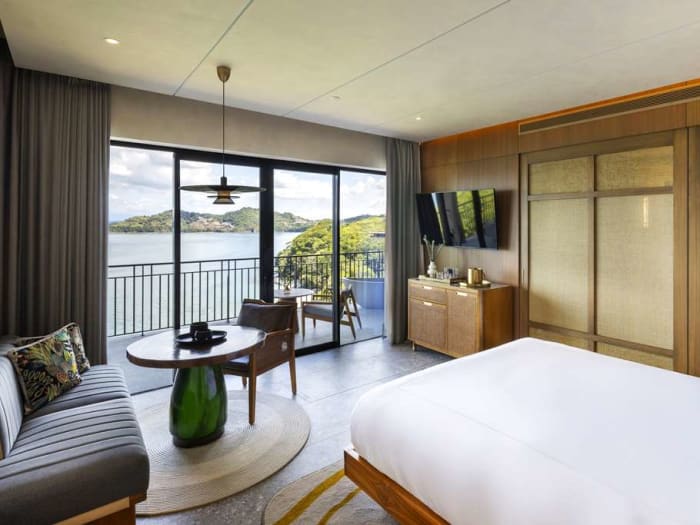
At a property such as Waldorf Astoria Costa Rica Punta Cacique, the room is not merely a private space; it extends the reading of the landscape and gives the stay its scale. Even without detailing specific categories here, one can understand what is expected from a five-star hotel of this kind: rooms designed for rest, intuitive circulation, immediately perceptible comfort and a constant relationship with the outdoors. In a tropical environment, the success of a room often depends on very concrete details: the quality of the bedding, certainly, but also the management of light, coolness, privacy, acoustics and the ease with which one can settle in.
Architecture described as being in harmony with nature suggests accommodation conceived not to break with the site. That may translate into generous openings, terraces or transitional spaces between indoors and outdoors, as well as a palette of materials and tones that avoids any sense of applied décor. In the best tropical designs, luxury is expressed less through excess than through accuracy: well-proportioned furniture, calming lines, materials that feel pleasant to the touch, and a bathroom conceived as a genuine space for recovery after a day in the sun or out exploring.
For couples, the room should offer a sense of retreat. It is expected to allow guests to slow down, read, have coffee early in the morning, return from an outing and immediately find a calm atmosphere. For families, expectations shift slightly: functionality, storage, ease of use and the ability to organise the day without friction. A major international hotel brand generally meets these needs through attentive design and daily housekeeping that keeps the space in a constant state of comfort.
The turndown service, listed among the known amenities, contributes to that feeling of discreet care that distinguishes a high-level address. It is not merely a formal gesture, but a way of accompanying the rhythm of the stay. Returning in the evening to a room that has been prepared, with softened ambience and the space reset, changes one’s perception of rest. Likewise, reliable daily housekeeping is essential in a climate where life moves constantly between indoors and outdoors, between beach, terrace and excursions.
Ultimately, the rooms and suites in such a property should answer a simple requirement: to provide a refuge that never entirely erases Costa Rica. Guests seek coolness after the heat, silence after movement, comfort after exploration. Yet they also seek continuity with the place, a way of remaining connected to Guanacaste even while withdrawing from it. It is this balance between protection and openness that gives a well-designed tropical room its lasting quality.
Dining
At the Waldorf Astoria Costa Rica Punta Cacique, the culinary experience naturally complements the location. The cuisine is tailored to the climate, with attentive service and tables that open up to the stunning landscape enhancing your stay.
In the morning, breakfast is enjoyed in a bright and airy atmosphere, buoyed by the warm air and lush vegetation. In Guanacaste, this first meal prepares you for both excursions and leisurely hours.
A five-star establishment is expected to provide flexible service, accommodating early departures as well as late risers.
At lunchtime, the dining philosophy shifts: freshness, apparent simplicity, and precision in execution take centre stage. Under the tropics, dishes benefit from remaining clean, legible, and enjoyable over several days.
Here, luxury is defined by the quality of the ingredients, the clarity of the flavours, and a service that is present without interrupting the flow. After a morning spent outdoors, the cuisine enhances the experience without weighing it down.
In the evening, the mood changes with the softer light. The dining experience can become more ceremonial, yet retains its flexibility.
At a Waldorf Astoria address, the experience is built on a seamless welcome, a perfect tempo, and an atmosphere conducive to long conversations. For couples, dinner often becomes a central moment. For families, it remains adaptable.
The success of a dining experience hinges on the harmony between cuisine, architecture, and service. A pleasant terrace, a well-located restaurant, and a menu designed for multiple days shape the memory of your stay.
In Guanacaste, gastronomy finds its place when it aligns with the landscape and the rhythm of the journey.
Spa & wellness
Even when spa details are not explicitly provided, the wellness dimension is almost inseparable from a property such as Waldorf Astoria Costa Rica Punta Cacique. The context lends itself naturally to it: warm climate, tropical surroundings, a stay often divided between exploration and retreat, and a need for recovery after travel or activities. In this kind of hotel, wellness is not limited to a treatment menu; it begins with the way the place itself allows guests to slow down. Relative quiet, the presence of nature, the light, the openness of the spaces and the quality of service already contribute to a form of rebalancing.
Travellers choosing Guanacaste for a few days or longer are often looking for a stay that feels restorative as much as it feels different. That may happen through simple gestures: sleeping deeply, taking time over an unhurried morning, walking through the grounds, sitting with the view, moving between sun and shade, and rediscovering a fuller breath. A great hotel knows how to turn these ordinary gestures into a coherent experience through invisible logistics. This is where personalised service becomes particularly valuable: recommending the right moment for a treatment, organising the day smoothly, removing unnecessary friction and preserving the sense of inner availability that separates a merely comfortable stay from a genuinely restorative one.
In a tropical environment, the idea of wellness is also tied to the body’s relationship with a different climate. Life on Costa Rica’s Pacific coast is not lived in the same way as in a European capital. Time stretches, needs shift, and greater attention is paid to hydration, rest and recovery. A well-conceived spa responds precisely to that reality: it offers not only treatments, but a way of accompanying the traveller’s adaptation to the place. After an excursion, a day outdoors or simply several hours in the sun, expectations are clear: soothing, coolness, muscular release and a sense of recentering.
For couples, the wellness space often becomes a shared pause, less theatrical than dinner yet sometimes more memorable. For solo travellers, it may become a central axis of the stay. For families, it allows each person to recover their own rhythm even when the days are spent together. In every case, the quality of a wellness programme is measured by its ability to integrate naturally into the wider hotel experience.
At Waldorf Astoria Costa Rica Punta Cacique, wellness can therefore be understood as a continuation of the place itself: a luxury of recovery, calm and attention. More than a promise of transformation, it is an invitation to rediscover physical and mental availability. In a landscape this strong, that is often enough to give the stay its depth.
Concierge & services
In high-end hospitality, services matter not only because of what is listed, but because of the way they organise a stay without ever making it feel heavy. According to the known information, Waldorf Astoria Costa Rica Punta Cacique offers a service base in line with expectations for a major international address: 24-hour concierge, 24-hour front desk, daily housekeeping, turndown service, luggage storage, laundry, wake-up service and multilingual staff. Considered individually, these may seem self-evident; taken together in a tropical resort setting, they form the invisible structure that allows guests to travel with genuine ease.
The concierge is likely to be the most strategic service in a destination such as Guanacaste. A successful stay depends not only on the room or the landscape, but on the quality of daily decisions: choosing the right departure time, arranging transfers, reserving activities, adapting plans to the weather or to one’s energy level. A good concierge team does more than execute requests; it helps prioritise desires, avoid wasted time and make the stay more fluid. This is especially valuable for travellers discovering the region and wishing to balance rest, exploration and time spent at the hotel.
A continuously staffed front desk brings its own sense of security and simplicity. On a long-haul trip, with late arrivals or early departures, that availability matters greatly. It absorbs the unexpected without tension and contributes to that essential impression, in the best hotels, that everything remains possible without becoming complicated. Luggage storage serves a similar purpose on transition days, particularly when flight schedules do not align neatly with room timings.
Daily housekeeping and laundry take on particular importance in the tropics. Guests change clothes more often, live more fully between indoors and outdoors, and appreciate a hotel able to maintain a constant sense of freshness. As for wake-up service, it may seem almost old-fashioned in the age of smartphones; in practice, it remains useful for very early departures, excursions or days when one wishes to rely entirely on the hotel’s organisation.
Finally, multilingual staff and the personalised attention associated with Waldorf Astoria contribute to a subtler form of comfort. Being understood quickly, being able to express a preference, adjusting a detail of the stay without effort: these are the micro-experiences that distinguish service that is merely correct from service that is genuinely high-end. Ultimately, the success of service here lies in its discretion. It exists to free mental space, allowing guests to focus on what matters most: enjoying Guanacaste, the calm of the setting and the quality of the moment.
The Guanacaste way of life
Staying in Guanacaste means discovering a different rhythm. This north-western region of Costa Rica has long appealed for its coastal landscapes, its climate shaped by a much-valued dry season and its direct relationship with nature. Yet beyond images of beaches and tropical vegetation, it offers above all a way of life defined by space, light and simplicity. Waldorf Astoria Costa Rica Punta Cacique belongs to that logic: it seeks not only to provide high-level accommodation, but to offer access, in very comfortable conditions, to a particular way of inhabiting time.
One of Guanacaste’s pleasures lies in the quality of its mornings. The light is often crisp, temperatures still gentle, and one quickly understands the value of beginning the day early, if only to enjoy the landscape in its calmest phase. This relationship to the morning changes the structure of a stay. Lunch comes earlier, activities are organised differently, and the hottest hours are reserved for rest, reading or swimming. A well-positioned hotel is precisely what allows that rhythm to be followed without ever imposing it.
The dry season, generally favoured between December and April, naturally attracts many travellers. It offers particularly favourable conditions for exploring the region, enjoying the coastline and multiplying outdoor activities. That said, Guanacaste’s appeal is not limited to a climatic calendar. What leaves a lasting impression is the sense of openness: broad horizons, omnipresent vegetation and constant transitions between built spaces and the natural world. For a visitor arriving from Europe, that feeling of spaciousness may be one of the journey’s greatest luxuries.
The local art of living is also expressed in its relationship to free time. Here, it is entirely legitimate not to fill every hour. Watching the light change, lingering over a meal, returning to one’s room in mid-afternoon, asking the concierge for an outing suited to one’s mood rather than to a rigid plan: these are often what make a stay successful. Contemporary luxury, especially in a destination like this, does not lie in accumulating activities, but in being able to choose with discernment.
For couples, Guanacaste offers a setting conducive to a gentle form of retreat without austerity. For families, the region allows discovery and relaxation to be alternated with great flexibility. For everyone, it is a reminder that a great journey can also be a matter of inner climate. Waldorf Astoria Costa Rica Punta Cacique makes full sense in that perspective: as a point of balance between the demands of international comfort and the self-evident pull of a territory that invites one to slow down. Perhaps that is, ultimately, the Guanacaste way of life: allowing oneself to be guided by light, landscape and a more accurate tempo.
Book with MyConciergeHotel
Booking Waldorf Astoria Costa Rica Punta Cacique through MyConciergeHotel means approaching the stay not as a simple transaction, but as an experience to be prepared with care. A property of this nature deserves to be considered according to travel rhythm, season, the type of stay desired and the level of support expected on site. A romantic escape, a few days of sunshine and disconnection, a family trip or a longer Costa Rican journey all involve different expectations. The value of editorial and concierge guidance lies precisely in helping to clarify those priorities before departure.
In a destination such as Guanacaste, certain choices have a real impact on the quality of the stay. First, the travel period: the dry season, from December to April, is often preferred in order to enjoy the region fully. Then comes the question of duration: if too short, the stay may feel dominated by transport; if well judged, it allows guests to settle into the rhythm of the place. Finally, there is the matter of activities. The existing advice to book in advance is especially relevant here, particularly in high season. Whether for experiences organised by the hotel, outings in the region or simply moments one wishes to structure with precision, anticipation avoids disappointment and preserves the flow of the journey.
MyConciergeHotel can play a useful role in this preparation by focusing on the coherence of the stay. It is not merely about securing a room, but about ensuring that the experience truly matches what one is seeking: calm, privacy, easy access to services, flexible organisation for a family, or a balance between rest and discovery. In high-end hospitality, practical details often have very concrete consequences for the pleasure of travel. Good guidance helps address them in advance, so that the stay itself feels simple and natural.
Booking through a specialist also means benefiting from a perspective that places the hotel within its proper context. Waldorf Astoria Costa Rica Punta Cacique is not only a prestigious brand name; it is a property to be understood through its setting in Guanacaste, its peaceful atmosphere, its architecture in dialogue with nature and its personalised service. Understanding that helps one choose better, but also experience the hotel more fully once on site.
In practical terms, the aim is straightforward: to arrive with the right frame of reference, the right expectations and, where necessary, key reservations already secured. That is often what transforms a beautiful trip into a genuinely seamless stay. In a place chosen for space, calm and a form of effortless luxury, this discreet preparation makes all the difference.