History & Heritage
In Jerusalem, few addresses engage with the city as directly as Waldorf Astoria Jerusalem. The hotel belongs to a setting where every street seems layered with memory, and it is precisely this historical density that shapes the stay. Here, luxury is not built on display, but on continuity: a contemporary hotel set within a context defined by stone, light and urban heritage. The building, with its carefully considered architectural presence in central Jerusalem, conveys a strong sense of place. Its intention is clear: to offer the comfort of an international grand hotel without losing touch with local identity.
This relationship between heritage and hospitality is essential to understanding the property. Jerusalem is not a city one experiences casually; it asks for attention, context and a certain awareness of rhythm. Waldorf Astoria Jerusalem answers that expectation through a measured use of materials, volumes and atmosphere. Guests find a refuge here, but never one detached from its surroundings. On the contrary, the hotel feels designed to extend the experience of the city rather than erase it. References to local tradition, whether architectural, decorative or simply atmospheric, coexist with the codes of a contemporary luxury address.
The hotel also stands out in the way it accommodates very different kinds of travellers. Some come to Jerusalem for spiritual reasons, others for history and culture, others still for business or family travel. The property manages to welcome these varied purposes without losing coherence. That versatility is part of its modern heritage: to serve as an elegant base, a central landmark and a place of retreat all at once. In a city where symbolic and emotional intensity can be high, that sense of balance matters.
The Waldorf Astoria name naturally suggests a tradition of exacting hospitality, discreet service and high standards. In Jerusalem, that signature takes on a particular tone. It does not attempt to impose a uniform model, but allows itself to be shaped by the character of the place. That is what gives the hotel its sense of rightness. Guests do not simply choose a room or suite; they choose an address capable of translating the complexity of Jerusalem into a language of comfort, calm and precision. In that sense, the hotel belongs less to the category of accommodation than to a form of cultural hospitality, where the stay begins the moment one crosses the threshold.
The Hotel
The first strength of Waldorf Astoria Jerusalem is its central location, allowing guests to experience Jerusalem largely on foot. In a city where distances are measured less in kilometres than in intensity, staying in the heart of things changes the quality of a visit. From the hotel, access to key sights and districts is straightforward, making it easy to alternate between visits, meetings, walks and moments of rest without heavy logistics. For first-time visitors and returning travellers alike, that centrality is a practical luxury.
The property itself balances presence with restraint. It carries the stature of an international luxury hotel while remaining connected to Jerusalem’s distinctive atmosphere. The historic setting associated with the address is not merely decorative; it shapes the sense of space, the way light enters, the relationship between indoors and outdoors, and the calm that defines the public areas. This blend of modern style and local tradition is central to the hotel’s identity. Contemporary lines, five-star comfort and smooth circulation are paired with a sensitivity to the city’s materials, mood and mineral elegance.
For business travellers, this arrangement is especially valuable. The hotel supports an efficient rhythm while offering a serene pause between engagements. For couples, it provides a setting suited to a more contemplative discovery of Jerusalem, with the ease of returning to the hotel throughout the day. For families, the location simplifies movement and reduces the fatigue that can come with navigating a dense and demanding city. This ability to suit several styles of travel without losing coherence is one mark of a well-conceived address.
The overall atmosphere rests on service, clarity of layout and a quiet idea of comfort. Guests do not come here for theatricality, but for control and ease. The public spaces are designed to support the natural flow of an upscale urban stay: early departures, returns after sightseeing, informal meetings and restorative pauses. Everything feels arranged so that guests are looked after from the outset, without attention ever becoming intrusive.
In a destination as singular as Jerusalem, the choice of hotel means more than an aesthetic preference. It shapes the way the city is experienced. Waldorf Astoria Jerusalem is compelling because it offers a refined, stable and central base, one capable of absorbing the intensity outside while making it easier to engage with. It suits travellers who want the comfort of a grand hotel while remaining in direct contact with Jerusalem’s urban spirit.
Rooms & Suites
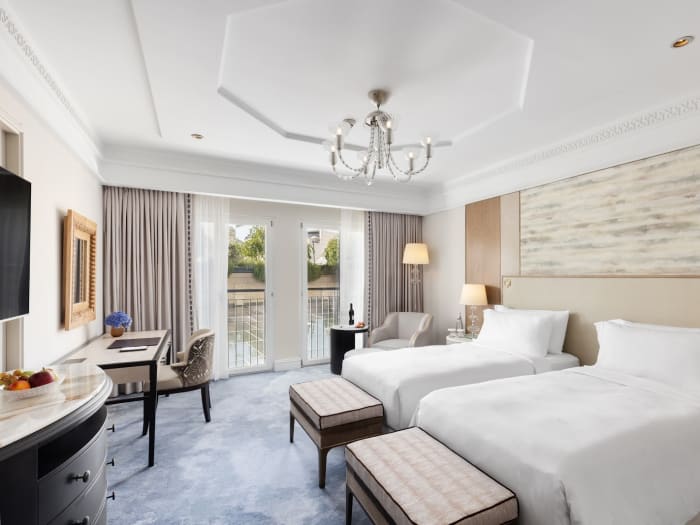
In a hotel of this calibre, the room is not simply where one sleeps; it becomes a space for recovery, privacy and recalibration. At Waldorf Astoria Jerusalem, that role takes on particular importance, as the city itself can be dense, emotional and full of stimuli. Returning to one’s room after a day of historic sites, professional engagements or walks through Jerusalem should bring an immediate sense of ease. That is the promise the hotel appears to make: interiors designed to slow the pace without breaking from the property’s overall elegance.
The spirit of the rooms and suites follows the rest of the hotel, seeking a balance between contemporary comfort and more local references. One can expect carefully composed spaces where quality materials, clear layouts and visual calm play an essential role. In a city where the outside world is charged with history, symbolism and contrast, the interior benefits from clarity, softness and function. Such restraint does not exclude refinement; it is, in fact, one of its more lasting forms. Luxury here is measured by how naturally everything seems to fall into place.
Business travellers typically look for a room that supports several uses: rest, work, calls, preparation and quiet. Couples tend to seek a setting that encourages disconnection and a sense of shelter from the urban intensity outside. Families need fluid organisation, dependable service and a level of comfort that makes daily routines easier. An international five-star address such as this generally answers those expectations through consistent attention to practical details: daily housekeeping, turndown service, round-the-clock assistance and that essential feeling that needs are anticipated without unnecessary theatre.
What matters most in a room in Jerusalem is the quality of refuge. A good hotel should not compete with the city; it should offer a counterpoint. The room then becomes a breathing space, somewhere to revisit the day, plan the next one or simply enjoy a moment of quiet. In that sense, suites usually add another layer of comfort and autonomy, especially valued for longer stays, family travel or trips that combine business with leisure.
Choosing to stay here is therefore also choosing a particular way of inhabiting Jerusalem for a few days: with a stable, polished and protective base. The rooms and suites at Waldorf Astoria Jerusalem will appeal to those who believe true luxury lies in the quality of rest, the discretion of service and the coherence of the whole. In a destination as singular as this, that quality of interior hospitality is not a detail; it shapes the entire travel experience.
Dining
In a city such as Jerusalem, dining is never merely an added pleasure. It belongs to a wider cultural landscape shaped by tradition, overlapping influences and deeply rooted habits. Staying at Waldorf Astoria Jerusalem therefore also means expecting the culinary experience to act as a bridge between the international comfort of a grand hotel and the local identity of the destination. Without claiming to summarise the city’s culinary richness, dining in such an address should provide reliability, careful execution and an atmosphere worthy of the setting.
The first challenge in an urban five-star hotel is versatility. Breakfast must suit travellers with very different rhythms: early departures for sightseeing, business meetings, family stays or slower mornings for those who prefer to linger. Lunch and dinner must likewise respond to several kinds of expectation, from practical meals to more considered occasions. In this type of property, success often lies in making these uses feel seamless without compromising comfort or perceived quality.
A leading address is also expected to understand atmosphere. In Jerusalem, that often means favouring understated elegance, calm service and a clear reading of the offer. Guests appreciate being able to rely on a setting where they immediately feel at ease, whether for a coffee between appointments, a meal as a couple or a restorative pause after a full day. Hotel dining then serves a very practical purpose: it avoids unnecessary movement, extends the sense of comfort and allows guests to maintain their preferred rhythm.
The appeal of a property such as Waldorf Astoria Jerusalem also lies in its ability to welcome an international clientele while remaining attentive to local context. That requires subtlety in flavour, presentation and the way the overall experience is composed, avoiding both standardisation and artificial local colour. The best form of culinary luxury is often the one that feels natural: precise service, well-handled ingredients, a legible atmosphere and the sense that the meal fits harmoniously into the day.
For many travellers, the dining spaces of a grand hotel become a point of orientation. One starts the day there, returns to it, arranges informal meetings and comes back willingly when the city has been intense. In Jerusalem, that function is all the more valuable because the experience outside can be dense and emotionally charged. Returning to a controlled, elegant and welcoming setting is part of the stay’s overall comfort. At Waldorf Astoria Jerusalem, dining therefore contributes to a broader form of hospitality: making the city easier to inhabit without diminishing it, and offering guests a place to pause with style and simplicity.
Spa & Wellness
In an urban destination as meaningful as Jerusalem, wellness takes on a particular dimension. It is not simply about relaxation in the conventional sense, but about a genuine need to slow down, recover a form of inner quiet and create moments of restoration between often intense days. Even on a well-planned trip, the city asks a great deal: walking, emotion, concentration, movement and contrast. In that context, the presence of a wellness area within a grand hotel is not a mere extra; it is a structuring part of the experience.
At Waldorf Astoria Jerusalem, the idea of wellbeing fits naturally within the hotel’s broader promise: to provide a refined refuge in the heart of the city. The spa, or more broadly the spaces devoted to relaxation, are expected to function as transitional places. One moves there from the pace of the outside world into a slower rhythm, more attentive to the body and to breathing. For some travellers, this may take the form of a treatment booked after a day of sightseeing; for others, a more regular ritual integrated into the stay, helping to maintain balance between discovery and recovery.
What distinguishes a strong wellness space in a luxury hotel is not only the quality of the facilities, but the coherence of the whole. Calm, discretion, impeccable upkeep, fluid circulation and the staff’s ability to adapt the experience to each guest’s pace matter as much as the treatment menu itself. In a city such as Jerusalem, that coherence is especially valuable. It creates a pause that feels neither disconnected from the trip nor treated as a superficial indulgence. Wellness becomes a way of inhabiting the journey more fully.
Couples often find in it a shared moment of recalibration, business travellers an effective way to release pressure, and families a breathing space within a full itinerary. Even a short treatment or a brief visit to a quiet area can transform the feel of a stay. The body recovers, the mind clears, and one returns to the city with renewed openness.
In contemporary luxury, wellness only matters if it feels right. The point is not to accumulate promises, but to offer an environment in which guests genuinely feel better. Waldorf Astoria Jerusalem appears to answer that expectation through an approach that privileges comfort, attentiveness and continuity with the rest of the hotel experience. For travellers, that means something simple yet essential: the possibility of making a stay in Jerusalem not only a time of discovery, but also a period of regeneration. In a city of such intensity, that dimension often matters more than one imagines at the time of booking.
Concierge & Services
The true marker of a great urban hotel is not only its design or address, but the quality of its day-to-day service. At Waldorf Astoria Jerusalem, that dimension is central. In a city where logistical, cultural and practical considerations can be more complex than elsewhere, the presence of a 24-hour concierge and round-the-clock reception is a tangible advantage. Luxury here begins with availability: a team able to respond quickly, guide accurately and simplify the stay without making it feel rigid.
For international travellers, that constant support is especially valuable. Jerusalem can require last-minute adjustments, whether arranging a visit, handling a transfer, confirming a schedule or simply understanding the rhythm of the city. An effective concierge does more than provide information; it helps turn a theoretical itinerary into a smooth experience. That skill matters all the more in a hotel welcoming couples, families and business travellers with tightly structured agendas.
The known services of the hotel outline precisely this level of continuous attention: daily housekeeping, turndown service, luggage storage, laundry, wake-up service, multilingual staff, and reception and concierge available at all hours. Considered separately, each of these elements may seem standard in a five-star property. Taken together, however, they create the difference between a stay that is merely comfortable and one that feels genuinely controlled. Guests do not have to think of everything; they can focus on the purpose of their trip, whether personal, family-related, cultural or professional.
Turndown service, for instance, is a detail that is not really a detail. It signals attention to the actual rhythm of the stay, to the way the room supports the transition from day to night. Laundry and luggage storage answer very practical needs, especially useful on longer itineraries or with inconvenient flight times. Multilingual staff also play an essential role in an international destination where the precision of communication often shapes the quality of the experience.
What one expects from a major house such as this is a form of frictionless service. Requests should be handled seriously, answers given clearly, and the whole kept discreet. The best service is often the kind one barely notices, because it makes everything easier. In the context of Jerusalem, that fluidity has particular value. It allows guests to devote themselves to the city, its encounters, its visits or their obligations, while knowing that a reliable point of support is always available. It is this operational confidence, more than ceremony, that defines the comfort of a contemporary grand hotel.
The Jerusalem Way of Life
Staying in Jerusalem is not simply about ticking off major landmarks. The city is also discovered through its daily texture, its light, its shifts in pace and the coexistence of ancient traditions with very contemporary habits. From Waldorf Astoria Jerusalem, that experience becomes especially fluid thanks to the hotel’s central location. Days can be organised around key visits, but there is also room for the unexpected: a detour, a slower walk, a pause in a neighbourhood, a return to the hotel before heading out again. That freedom of movement is part of real luxury.
The Jerusalem way of life lies in the ability to accept the city’s plurality. One moves from one atmosphere to another within a few streets, from near-meditative quiet to livelier energy, from monumental heritage to a living urban scene. For travellers, this requires a certain openness. The best stay is not necessarily the busiest one, but the one that allows for breathing space. That is where a well-located, well-run hotel becomes essential: it lets guests shape their own rhythm rather than submit to the destination’s.
Couples will particularly appreciate the possibility of experiencing Jerusalem with nuance, alternating cultural discovery with more intimate moments. Families benefit from a central base that simplifies movement and makes the city easier to navigate. Business travellers, meanwhile, can extend a professional trip into a more personal experience of the city without having to rethink the whole structure of their stay. In every case, the hotel acts as a discreet mediator between the intensity outside and the need for comfort within.
It is also worth noting that Jerusalem experiences periods of high demand, especially during certain holidays and peak travel times. Planning ahead not only helps secure accommodation, but also allows the city to be approached with greater calm. This preparation is all the more useful because Jerusalem’s cultural richness takes time. There is little to gain from trying to see everything too quickly. It is better to choose a few experiences, a few districts, a few moments, and let the city reveal itself gradually.
From this perspective, Waldorf Astoria Jerusalem suits travellers seeking an approach to the destination that is both comfortable and sensitive. The address allows Jerusalem to be experienced without excessive simplification, while providing a stable and elegant setting. Perhaps that is, in the end, the local art of living when one travels well: not setting discovery against rest, heritage against comfort, or intensity against softness. Jerusalem lends itself to that subtle reading, and a hotel of this nature offers ideal conditions for embracing it. The stay gains depth, fluidity and a sense of proportion.
Book with MyConciergeHotel
Booking Waldorf Astoria Jerusalem through MyConciergeHotel means choosing editorial and concierge support that goes beyond a simple transaction. In a destination as singular as Jerusalem, preparation matters almost as much as the hotel itself. The aim is not merely to confirm a room in a leading five-star address, but to ensure that the stay aligns with your pace, expectations and the nature of your trip. A business journey does not call for the same needs as a couples’ stay, a family visit or a more in-depth cultural exploration. The value of a specialist concierge service lies precisely in helping to define those nuances in advance.
Waldorf Astoria Jerusalem is among the hotels that may experience strong demand, especially during holiday periods and peak travel times. Planning ahead is therefore a sensible approach, not only to secure preferred dates but also to preserve greater choice in the overall structure of the stay. Booking several months in advance, when possible, often makes it easier to organise the other aspects of the trip with confidence: transfers, sightseeing rhythm, rest time and any specific requests. This anticipation is particularly useful in a city where cultural context and the local calendar can shape the experience.
Booking through MyConciergeHotel also means benefiting from a more qualitative reading of the property. The goal is not to multiply promises, but to guide you accurately towards what genuinely suits your way of travelling. Do you want absolute centrality so that most of the city can be explored on foot? Are you primarily looking for an elegant refuge after very full days? Do you need especially smooth service for a business stay? Are you travelling with family and hoping to simplify logistics as much as possible? These seemingly simple questions can significantly affect the relevance of a reservation.
The value of an expert intermediary also lies in its ability to provide context. Jerusalem is not a standardised destination. Its intensity, cultural diversity and busy periods sometimes require practical advice, a degree of nuance and close attention to detail. Good support turns a booking into a considered stay. That is where MyConciergeHotel’s added value becomes clear: creating a link between a major international address and the very personal expectations of each traveller.
By choosing this route, you favour a more controlled, more legible and more serene approach to travel. Waldorf Astoria Jerusalem offers a central, refined setting suited to different kinds of guests; MyConciergeHotel helps place it within a stay that is genuinely well matched to your needs. In a city such as Jerusalem, that precision is far from incidental. It allows you to travel not only in greater comfort, but with greater accuracy.