History & heritage
Waldorf Astoria Dubai International Financial Centre belongs to a particular chapter in contemporary luxury hospitality: that of an internationally recognised name translating its service culture into a district shaped by vertical architecture, global finance and Dubai’s own idea of modernity. This is not a historic palace in the European sense, with listed façades or aristocratic lineage. Its heritage is of another kind: one of codified hospitality, discretion, precision and comfort, and of a brand able to create a true address rather than merely a place to stay.
In Dubai, that identity takes on a distinctive resonance. The city has emerged over recent decades as a crossroads between Europe, Asia and Africa, and its financial district is one of the clearest expressions of that role. Glass towers, regional headquarters, destination dining and a perpetually international clientele define the setting. A Waldorf Astoria address here offers a more residential, more composed reading of the metropolis.
The brand’s heritage is most evident in the rhythm of the stay and in the tone of service. Luxury is not overly theatrical; it rests instead on smoothness, elegance and a form of hospitality suited equally to business travellers and couples seeking an urban base in Dubai. That dual vocation shapes the property’s identity: neither beach resort nor purely corporate hotel, but a sophisticated foothold from which to inhabit the city.
This positioning matters in Dubai, where high-end hospitality often sits between leisure-driven resorts and highly functional city hotels. Waldorf Astoria Dubai International Financial Centre occupies a rarer middle ground: metropolitan luxury for travellers who value skyline views, nearby appointments, uncomplicated late returns and a seamless transition from business schedule to evening plans.
In that sense, the hotel also reflects Dubai’s own evolution. Long seen through the lens of icons and records, the city now asserts its districts, scenes and everyday rituals more clearly. DIFC, with its restaurants, art spaces and economic importance, has become as much a place to live as a place to decide. Staying here means choosing a more contemporary reading of the emirate: connected, urban and closer to the habits of those who live and work in it.
The property’s heritage is therefore less about age than about coherence: between a storied brand and a district with a strong identity; between efficiency and refinement; and between Dubai’s international image and a style of hospitality able to present a more measured, enveloping version of the city without losing sight of the exacting service expected from a grand address.
The hotel
Staying at Waldorf Astoria Dubai International Financial Centre means choosing a property that fully embraces its urban character. The hotel sits in the heart of Dubai’s financial district, an environment where one can move within minutes from a meeting to dinner, from a gallery to an architectural stroll, from a hushed lobby to the city’s distinctly contemporary energy. This location is one of its defining strengths: it allows guests to experience Dubai not as a series of distant excursions, but as a city organised around districts, uses and rhythms.
DIFC has become one of the clearest choices for travellers seeking both efficiency and sophistication. Its atmosphere differs markedly from beach areas and leisure-led developments. Here, lines are sharper, addresses speak to one another, days begin early and evenings often continue over dinner or informal appointments. For an international clientele, this centrality has practical value: shorter journeys, easier scheduling and direct access to major business hubs.
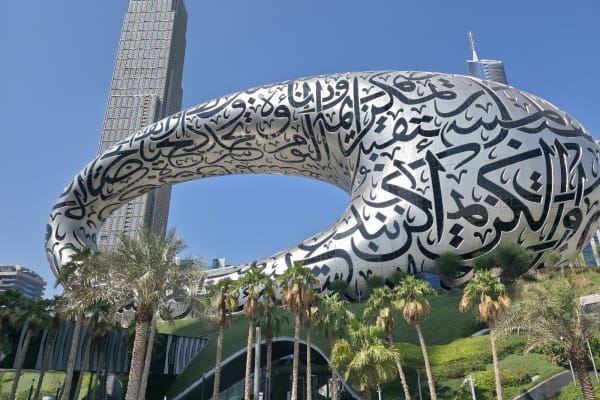
The hotel also benefits from being close to local attractions, broadening its appeal beyond business travel alone. From this base, it is easier to discover Dubai between commitments, to reach key neighbourhoods or to devote a few hours to culture, shopping or dining elsewhere in the city. In a destination where distances and traffic can quickly shape the experience, that versatility matters.
Inside, the property favours a sophisticated, contemporary atmosphere. The decorative language avoids excess and supports the idea of urban luxury: carefully chosen materials, controlled volumes, elegant tones and the sense of organised calm sought by seasoned international travellers. The aim is less spectacle than immediate comfort.
This measured elegance suits Dubai particularly well. In a city where many addresses favour grand gestures, Waldorf Astoria Dubai International Financial Centre offers something more composed and inward-looking. Not austere, but balanced: the city provides the intensity outside, while the hotel offers a clear, restful and finely calibrated setting within.
The property therefore speaks to several types of guest without losing focus. Business travellers find a coherent base close to decision-making centres. Couples appreciate the cosmopolitan character of the district, the ease of reaching restaurants and attractions, and the hotel’s quieter mood at day’s end. Regular visitors to Dubai often see it as a more grown-up way to experience the city.
What truly distinguishes the place is its ability to reconcile downtown intensity with a sense of equilibrium. Guests come here to be fully in Dubai, not removed from it; yet they return each evening to continuity, comfort and discretion, turning a strategic location into a genuine address.
Rooms and suites
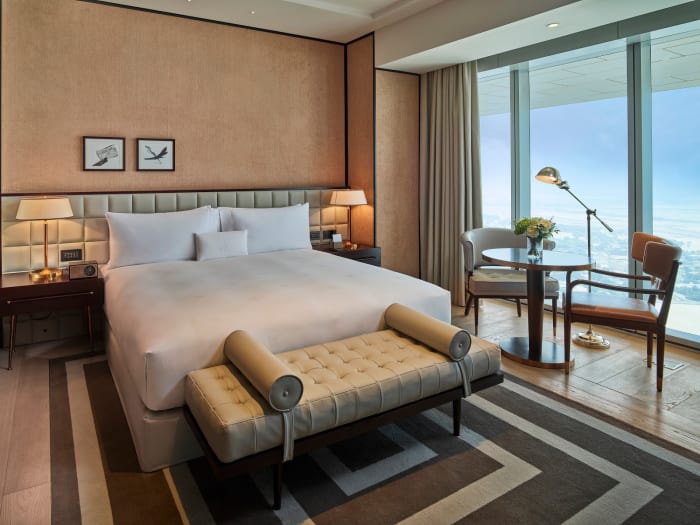
At a property such as Waldorf Astoria Dubai International Financial Centre, the room is more than a place to sleep. It becomes a vantage point over the city, a transition space between demanding days and slower evenings, and at times a temporary office when work extends beyond formal appointments. The value of a hotel like this lies in its ability to support several uses at once without sacrificing aesthetic coherence or comfort.
The spirit one expects here is that of contemporary luxury: composed, calming and precise. Generous proportions, a restrained palette, tactile materials and furniture designed for real travel habits all matter. In a district such as DIFC, where the outside world is defined by pace and movement, the room must provide a counterpoint. It need not be theatrical; it needs to feel right.
That sense of rightness is often measured in details seasoned travellers notice immediately: effective sound insulation, bedding that genuinely restores after a long-haul flight, a bathroom conceived as a place to reset, sufficient storage for a multi-day business stay, and an overall impression of ease without decorative excess.
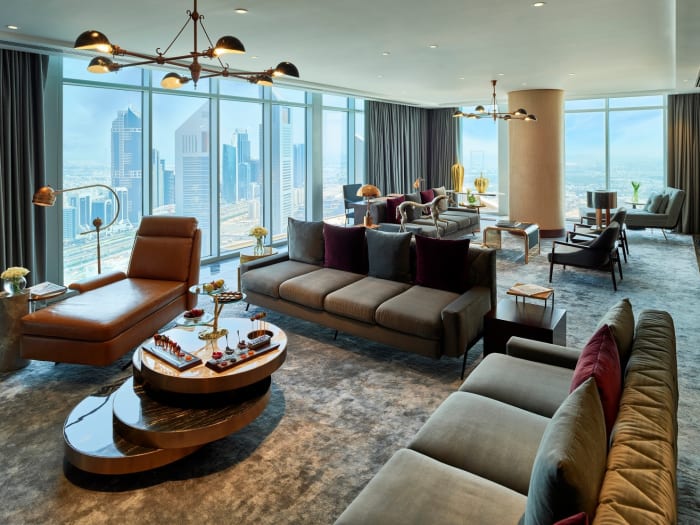
Suites take on a particular significance in this context. They are not simply about status; they provide meaningful additional space for guests who wish to separate the different moments of a stay. A sitting area allows for informal meetings, work or simply the comfort of not living entirely in the bedroom. For couples, this creates a more residential feeling. For business travellers, it offers obvious practical advantages, especially on longer stays.
Part of the pleasure of high-rise hotels in Dubai also lies in their relationship with the skyline. Without over-specifying what may vary by category, it is fair to say that the city’s lines, lights and horizon are integral to the experience. By day, the view reflects the ambition of the metropolis; by night, it accompanies that distinctive moment when Dubai shifts from business tempo to a more social, luminous energy. A well-designed room frames that presence without being overwhelmed by it.
Service is equally decisive. Turndown, daily housekeeping, the availability of reception and concierge, luggage handling and the management of last-minute requests all contribute to the sense that everything is quietly taken care of. In a hotel of this level, comfort depends not only on design, but on how spaces are prepared, maintained and adapted to each guest’s rhythm.
Rooms and suites here are therefore best understood as spaces for travellers who know the codes of international luxury and expect more than a flattering décor. They seek composure, calm, clarity and genuine usability. In a city naturally inclined towards spectacle, that well-executed restraint often proves more valuable than overt staging.
Dining
In Dubai, gastronomy is an integral part of the urban experience, shaping the rhythm of days, meetings, and evenings. This dimension is particularly pronounced in the DIFC, where lunch is often squeezed between meetings, discussions are extended over drinks, and tables are chosen for their atmosphere as much as for their cuisine.
At the Waldorf Astoria Dubai International Financial Centre, the culinary offering is designed to cater to these practices. It aims to impress a discerning local and international clientele while adapting to varied rhythms, all with an elegance befitting the establishment.
In a grand urban setting, dining plays a vital role in the overall experience. Breakfast is especially significant here. In Dubai, where days often begin early, it must be both efficient and enjoyable, suitable for a tight schedule as well as for a more leisurely morning. This requires attentive service, careful presentation, and an ambiance free from unnecessary commotion.
Lunch and dinner meet different expectations. For business travellers, these meals can serve as opportunities for representation or informal negotiations. For couples and leisure visitors, they provide a welcome respite in a city with a vast and competitive dining scene. The challenge is to offer a setting that is neither too formal nor interchangeable—a place one is eager to return to, seamlessly integrated into the stay.
This continuity is reflected in the tone. In a sophisticated and contemporary venue, the dining experience must mirror the same level of mastery found in other areas of the hotel. Smooth service, a subdued atmosphere, attention to detail, and flexibility according to the time of day are essential. Whether it’s a quick coffee, a discreet meeting, a more relaxed dinner, or a final drink before heading back to the room.
The neighbourhood also enriches the experience. Staying in the heart of the financial centre means being surrounded by an active culinary scene. The hotel thus becomes both a starting point and a return point. One can dine on-site for convenience and coherence, or rely on the concierge to explore other dining options in the area.
In Dubai, dining remains linked to international sociability. The codes are cosmopolitan, the influences numerous, and the expectations for service are high. The rhythm, welcome, lighting, acoustic comfort, and attentiveness of the staff are just as important as the food itself.
For the traveller, this translates into a simple impression: the ability to rely on the hotel at any time of the day. Whether it’s breakfast before a meeting, a break between appointments, a dinner without additional logistics, or wise advice on reservations in the area, dining here is part of a comprehensive urban experience designed to accompany real life with elegance.
Wellbeing & the rhythm of the stay
In a high-end urban hotel, wellbeing is not limited to the existence of a spa in the traditional sense. More broadly, it concerns the way a property helps travellers recover a balanced rhythm in an intense city. In Dubai, this matters particularly. Long-haul flights, time differences, constant air conditioning, packed meeting schedules and evenings that easily run late all place demands on the body. A grand address must therefore offer more than a soothing décor; it must allow for genuine recalibration.
At Waldorf Astoria Dubai International Financial Centre, this sense of wellbeing begins with the overall atmosphere. The calm of a well-run lobby, the quality of a carefully prepared room, the availability of turndown, and the efficiency of reception at any hour all contribute to a form of physical and mental ease. Contemporary luxury, at its most convincing, often lies in the reduction of friction: less waiting, less uncertainty, less logistical fatigue, and more time to recover, focus or simply breathe.
In a destination such as Dubai, wellbeing also depends on managing transitions. Returning from a demanding day to an ordered, quiet and temperate environment is already restorative. Taking time for a bath, a personal care routine, a moment of reading, a light in-room meal or a genuinely restful night can matter as much as a formal treatment. Frequent travellers know that the balance of a stay often rests on these simple gestures made possible by good hospitality.
For those seeking a more structured approach, a hotel of this level generally belongs to a service culture attentive to individual needs. Staff can guide, organise and adapt where possible, helping make the stay smoother. This discreet intelligence is essential in an international context where needs vary widely: recovering from a flight, preparing for an important day, seeking calm before an event or simply wanting to slow down between engagements.
DIFC adds an interesting nuance to the question of wellbeing. Because it is such an active environment, the hotel becomes all the more valuable as a refuge. The contrast between the energy outside and the inwardness of the stay heightens the sense of rest. Guests go out to experience the city and return to recover a sense of measure. When well orchestrated, that alternation creates a deep comfort, less theatrical than a resort spa perhaps, but often better suited to the realities of urban travel.
Seasonality also matters. The most pleasant months to visit Dubai are generally between October and April, when temperatures are milder and moving around the city is more comfortable. This directly influences how one experiences the hotel: outings are easier, thermal fatigue is reduced and the balance between activity and rest feels more natural.
Ultimately, wellbeing in an address like this rests on a simple promise: enabling guests to remain effective without exhaustion, elegant without visible effort and available without undue strain. It is a distinctly urban, contemporary definition of luxury.
Concierge & Services
The true luxury of an urban hotel is often measured by the seamlessness of its operations. At the Waldorf Astoria Dubai International Financial Centre, this quality is embodied in services that simplify city life, ease schedules, and alleviate unforeseen circumstances. In Dubai, where arrivals can occur at any hour, this human infrastructure is invaluable.
The 24-hour concierge and continuously open reception provide a reassuring foundation. For a business traveller arriving late, a couple planning an outing, or a guest in transit, this availability transforms the experience. The hotel becomes a reliable interface with the city.
The daily room service and turn-down service further enhance this sense of care. The room remains in tune with the rhythm of the stay. Guests leave it prepared in the morning and return to find it refreshed in the evening.
The luggage storage, laundry service, and wake-up calls cater to practical needs. The first facilitates early arrivals and late departures, the second allows for lighter travel, and the third is invaluable for morning appointments.
The multilingual staff also deserves special mention. Dubai attracts a highly diverse clientele. An hotel's ability to communicate clearly and courteously enhances requests and prevents misunderstandings. In the DIFC, this skill is a significant asset.
Finally, the concierge plays a mediating role with Dubai. Pre-booking an airport transfer allows guests to begin their stay without friction. The concierge can also recommend restaurants, organise transportation, guide guests to local attractions, and tailor the stay to their agenda.
What distinguishes great hotels is not merely the sum of their services, but how they are integrated. At the Waldorf Astoria Dubai International Financial Centre, these services create a destination designed for travellers who value precision as much as comfort. Here, one finds constant, discreet, and competent support.
The Dubai art of living
Choosing Waldorf Astoria Dubai International Financial Centre also means choosing a particular way to experience Dubai. Not merely as a destination of sunshine or shopping, but as an international metropolis with highly codified habits, where one can move from one world to another with remarkable speed. In the morning, the financial district sets the tone: quick coffees, purposeful silhouettes, meetings in the towers. The day then opens onto other scenes — cultural, commercial, gastronomic — before closing in evenings when the city becomes more luminous, more social and at times almost cinematic.
From DIFC, that diversity is especially legible. The district concentrates much of Dubai’s contemporary energy. People come here to work, but also to dine, see exhibitions, meet friends and observe the codes of a city constantly inventing itself between regional influences and a globalised language. For visitors, staying here offers a more urban, more sophisticated and more everyday reading of the emirate.
This art of living depends greatly on the management of time. In a sprawling city, choosing the right base determines the quality of the stay. Being in the heart of the financial district, with easy access to business hubs and close to local attractions, makes it possible to shape more intelligent days. One can start early, pause, change register without losing hours in transit, and return to the hotel before heading out again for dinner or a quieter close to the evening.
Dubai also has a seasonal dimension worth noting. Between October and April, the city reveals its most comfortable self: milder temperatures, easier walks, more inviting terraces and a more natural desire to move from district to district. This is often the best period to appreciate the urban side of a stay.
For couples, Dubai offers an interesting blend of precision and spectacle. For business travellers, it offers rare efficiency, provided the base is well chosen. In both cases, this hotel answers the same expectation: to make the city easy to inhabit, without sacrificing composure.
Ultimately, the Dubai art of living is neither uniformly ostentatious nor simplistic. It can be precise, comfortable, cosmopolitan and distinctly contemporary. It depends on knowing where one sleeps, from where one departs and to where one returns. That is precisely where this address finds its meaning.
Book with MyConciergeHotel
Booking Waldorf Astoria Dubai International Financial Centre through MyConciergeHotel means approaching the stay as a curated experience rather than a simple transaction. For an urban address of this calibre, the difference rarely lies only in the room category. It also depends on how the journey is prepared, sequenced and adapted to the traveller’s profile. Dubai, in particular, rewards well-organised stays: late-night arrivals, variable traffic, business agendas that must be balanced with leisure time, and the need to choose the right district for the purpose of the trip.
In that context, the value of assisted booking is clear. Airport transfer is often the first point of attention, and the existing concierge advice is especially relevant: arranging it in advance makes arrival smoother, calmer and immediately more coherent after a long-haul flight. It removes hesitation and supports a better transition into the stay.
Booking with MyConciergeHotel also helps define priorities more accurately. A business trip does not call for the same focus as a couple’s escape. Some travellers will prioritise direct access to business hubs and service flexibility; others will care more about atmosphere, ease of reaching local attractions or building a balanced programme between city life and downtime. The value of editorial and concierge guidance lies precisely in reading the property correctly, without overstatement.
This hotel is particularly well suited to guests seeking a central, elegant and contemporary base. It makes sense for those who wish to experience Dubai from its cosmopolitan economic core, with straightforward access to meetings, restaurants and points of interest. It is a strong choice for travellers who prefer the controlled intensity of downtown to the relative remove of a resort.
Anticipation matters too. Dubai sees periods of strong demand, especially during the most pleasant season between October and April. Booking ahead not only secures the stay but also allows for better planning of the details that genuinely improve it: arrival and departure timings, transport, dining recommendations and the use of free time between commitments.
MyConciergeHotel finally provides an editorial filter. In a destination where luxury supply is abundant, it is useful to distinguish properties by the kind of stay they truly deliver. This address does not promise a beach retreat; it offers sophisticated urban luxury in a prime location, suited to travellers seeking comfort, efficiency and contemporary elegance.