History & Heritage
Verride Palacio de Santa Catarina belongs to a layered, hilly and deeply storied Lisbon. Set in one of the city’s historic quarters, the hotel occupies an urban palace that recalls the aristocratic face of the Portuguese capital, when grand residences still dominated the heights overlooking the Tagus. Its appeal lies less in overt monumentality than in a sense of continuity: period architecture, noble volumes, generous light, and that constant relationship with the river which has shaped Lisbon’s identity for centuries.
Santa Catarina itself is one of the city’s most evocative districts, perched above the water and at the meeting point of neighbourhoods that each reveal a different side of Lisbon. The area is defined by viewpoints, sloping streets, stairways, sudden vistas and a relative calm once you step away from the busiest routes. Within this setting, the palace retains a distinctive presence: not a museum-like relic, but a historic address made liveable for the contemporary traveller.
Historic architecture combined with contemporary touches is the hotel’s clearest signature. The intention is not reconstruction for its own sake, but a dialogue between heritage elements and modern comfort suited to a high-end city stay. This balance between past and present gives the property its tone: refined without stiffness, elegant without theatrical excess. The public spaces appear designed to let the building speak through its proportions, materials and rhythm, while offering the ease expected of a five-star hotel.
Scale is equally important to understanding the hotel. Unlike larger institutions, Verride Palacio de Santa Catarina cultivates an intimate, peaceful atmosphere. Here, luxury is not about excess, but about the feeling of being received in a place of human scale, where details matter more because they are never lost in anonymity. The personalised service often associated with the house makes particular sense in this context: it supports the spirit of the palace rather than overpowering it.
Its membership of Small Luxury Hotels of the World also places the property within a family of independent hotels where individuality matters more than standardisation. For guests, this usually means an experience that feels more rooted, more local in expression, and more attentive to atmosphere than to repetitive international codes. In a city where many addresses now foreground design or scene, Verride Palacio de Santa Catarina offers another reading of Lisbon: that of a historic retreat, open to the city, to the river and to a rarer form of urban calm.
The Establishment
Choosing the Verride Palacio de Santa Catarina means residing in Lisbon from a location deeply rooted in its historical fabric. The Santa Catarina neighbourhood immediately reveals the city's topography. The streets rise and fall, ancient façades line the way, and the gaze often returns to the Tagus River. Here, the river provides orientation, a breath of fresh air, and depth to the stay.
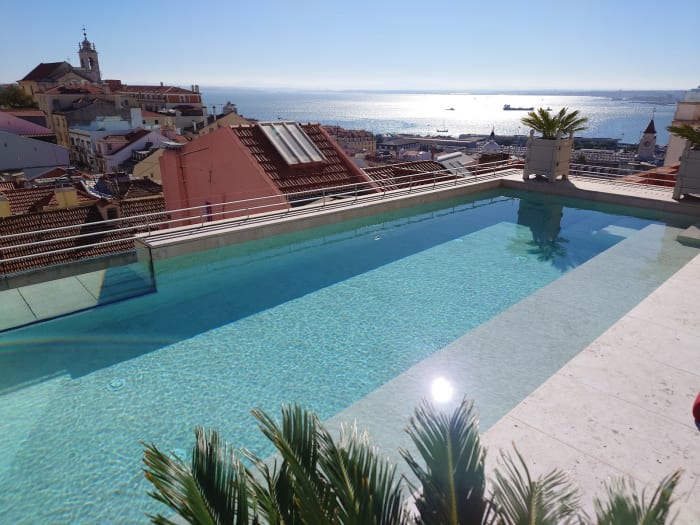
The hotel maintains a special connection with water. The view of the Tagus guides the experience. In Lisbon, views are as significant as monuments. They narrate the city through its changing light, pale rooftops, hills, and the opening towards the estuary. In a palace situated at a height, this perspective invites one to slow down and observe.
The address is also distinguished by its intimacy. In a heavily visited capital, an hotel's ability to preserve tranquillity is invaluable. The Verride Palacio de Santa Catarina serves as a refuge. Guests return here after a day spent navigating steep streets, museums, trams, cafés, and miradouros, to find a restrained, almost domestic atmosphere, upheld by the standards of a five-star establishment.
The historical architecture, accented with contemporary touches, reinforces this balance. The traveller moves through a space that embraces its age while meeting current expectations. The ancient elements provide a backdrop for a more refined aesthetic. The heritage remains a living material. The whole prioritises coherence over spectacle.
Common areas are designed to encourage interaction and conviviality. Lounges, passageways, and resting spots invite both contemplation and conversation. For couples, the venue offers a naturally romantic setting. For business travellers, it provides a calm and central environment. For city enthusiasts, it allows for experiencing Lisbon at a comfortable distance from the hustle and bustle while remaining close to its essential rhythms.
The Verride Palacio de Santa Catarina cannot be reduced to its view, its status, or its affiliation with an international collection. Its strength lies in the assembly of these elements: a historic palace, a characterful neighbourhood, an intimate scale, a peaceful atmosphere, and a constant relationship with the Tagus.
Rooms and Suites
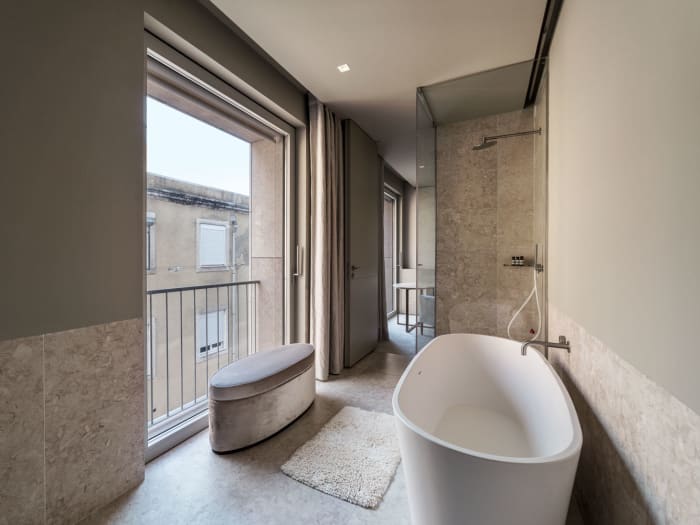
In a hotel like the Verride Palacio de Santa Catarina, the room extends the promise of the place. The architecture of the palace, the historic neighbourhood, and its affiliation with Small Luxury Hotels of the World create a personal experience, attentive to the atmosphere.
The spirit of the rooms and suites strikes a balance between heritage and contemporary comfort.
In a historic residence, the volumes, openings, and light play a significant role. In Lisbon, light transforms the interiors. It glides over the pale walls, highlights textures, and alters the perception of spaces.
In a palace overlooking the Tagus, some rooms offer a unique quality of stay. Awaken to the clarity of the river, suspended in time between city and horizon, anchored in the Lisbon landscape.
Even without a dominant view, the historic environment lends the rooms a rare depth.
The charm of such a venue often lies in its lack of uniformity. The rooms are not experienced as identical modules, but as variations of a common language.
This diversity is characteristic of hotels situated in ancient buildings. Varying ceiling heights, better-oriented windows, preserved architectural details, and different circulation paths contribute to this.
For the traveller, this creates a sense of genuine occupation of the place, almost residential, far removed from the anonymity of large chains.
Contemporary touches suggest interiors designed for the fluidity of the stay. Clean lines, discreet comfort, and integrated amenities without ostentation.
Here, the contemporary clarifies the experience without competing with the building. It makes the room restful, comprehensible, and easy to inhabit after a day spent in the hills of Lisbon.
Luxury is then measured by the quality of sleep, tranquillity, the precision of lighting, and a sense of order.
The intimate and peaceful atmosphere of the hotel finds its most direct expression in the rooms. For a couple's stay, they invite retreat and leisure.
For a business traveller, they offer a balance between focus and recovery. For all, they provide a rhythm to the stay.
Daily service, evening turndown, and attention to detail enhance the experience. In a small house, these gestures take on a particular significance.
At the Verride Palacio de Santa Catarina, the room becomes a Lisbon refuge, both historic and contemporary, oriented towards calm.
The Dining Experience
At the Verride Palacio de Santa Catarina, dining extends the experience of the stay. It aligns with the rhythm of the place, set in an intimate atmosphere that is sensitively connected to the city.
In Lisbon, dining at the hotel takes on a special resonance. The city boasts a vibrant culinary scene, blending Portuguese traditions, Atlantic produce, pastries, historic cafés, and contemporary dining.
A well-located hotel in a historic neighbourhood primarily offers a grounding point. It provides a moment of calm before or after exploring the city.
Breakfast often ranks among the highlights of the stay. In Lisbon, starting the day facing the light of the Tagus or in a peaceful historic setting alters the perception of time.
The morning becomes a ritual of entering the city. Coffee, fruits, pastries, or local specialities accompany the day's agenda.
The rest of the dining offerings follow the same spirit. A light lunch, dinner, or a drink punctuates the day with discretion.
In a human-sized establishment, dining operates as a local service. It suits both a pause between meetings and an extended evening spent on-site.
The historical décor, contemporary touches, and river views create a refined setting.
A concierge available 24/7 can also guide guests to local dining options. They can recommend a culinary route through Lisbon or arrange a reservation tailored to the stay.
At the Verride Palacio de Santa Catarina, gastronomy is part of the art of hospitality. Here, luxury lies in the quality of the moment, from breakfast to the evening drink.
Concierge & Services
In characterful hospitality, services are measured not only by their list but by the way they integrate into the stay. According to the confirmed information, Verride Palacio de Santa Catarina offers a 24-hour concierge, 24-hour front desk, daily housekeeping, turndown service, luggage storage, laundry, wake-up service and multilingual staff. Taken individually, these facilities correspond to what one legitimately expects from a five-star hotel. Taken together, in an intimate and peaceful address, they suggest a style of hospitality based on continuity, availability and discretion.
A round-the-clock front desk matters in a city such as Lisbon, where arrivals may be late and departures very early. It guarantees welcome flexibility, especially for international travellers or short urban stays. In a hotel of human scale, however, this availability has another value: reassurance. One knows that someone is there at any hour to facilitate a transfer, answer a simple request or resolve an unforeseen issue without administrative heaviness.
The 24-hour concierge is likely one of the most decisive services for making the most of the address. In a historic quarter, well placed for exploring Lisbon, a good concierge saves time and refines the experience. They can suggest the best walking routes, recommend a viewpoint at the right hour, propose a restaurant according to the desired mood, arrange a car, a guided visit or simply help guests read the city’s rhythm. In a capital made up of hills, vistas and micro-neighbourhoods, this human mediation often matters more than an accumulation of generic information.
Daily housekeeping and evening turndown contribute to a sense of continuous care. In an urban palace, where one alternates between going out and returning to the hotel, these attentions ensure the room is always ready to be rediscovered. The gesture may seem classic, yet it takes on particular resonance in a house that values calm and detail. One returns to an ordered space, a peaceful atmosphere and a gentle transition between city and rest.
Luggage storage, laundry and wake-up service belong to a more discreet but essential layer of logistics. They allow the stay to adapt to the real constraints of travel: arriving before check-in, spending a final afternoon in the city after vacating the room, maintaining a wardrobe for a business trip or longer escape, or leaving early for the airport. It is often these unspectacular but perfectly executed services that distinguish a well-run house.
Finally, multilingual staff enhance the accessibility of the experience. In an international destination such as Lisbon, this naturally eases communication, but it also improves the quality of the relationship. Part of the luxury of a hotel like Verride Palacio de Santa Catarina lies in this fluidity: being able to ask, understand, adjust and improvise. More than a set of amenities, the services form an invisible framework that supports the elegance of the stay without ever weighing it down.
The Lisbon Way of Life
Staying at Verride Palacio de Santa Catarina means entering Lisbon through one of its most subtle languages: height, light and slowed time. The city never reveals itself in a single gesture. It is discovered in fragments, through neighbourhoods, viewpoints and daily habits. From Santa Catarina, that reading becomes especially natural. The district belongs to that Lisbon geography where one moves almost effortlessly from a residential street to an open panorama, from a discreet café to a lively square, from near-domestic quiet to the energy of the city.
The Tagus plays a central role here. More than a river, it is an atmospheric presence. It widens the horizon, reflects the light and softens perspectives. Seeing it from the hotel or finding it again during a walk gives the stay a rare continuity. Lisbon is not a city to be ticked off; it is a city to be watched, listened to and crossed at one’s own pace. This way of experiencing the destination corresponds perfectly to the spirit of Verride Palacio de Santa Catarina, whose intimate and peaceful atmosphere invites attention rather than tourist performance.
From the hotel, one can imagine very Lisbon-like days: walking down towards neighbouring districts, stopping at a café, observing façades and azulejos, reaching a viewpoint, stepping into a church, continuing towards the waterfront, then climbing back by another street to discover another face of the city. Lisbon rewards flexible itineraries. It favours detours, pauses and changing light. A well-located hotel in a historic quarter makes precisely this possible: setting out without an overly rigid plan and returning with the feeling of having truly inhabited the city.
Spring and autumn, mentioned in the short description as particularly pleasant seasons, are indeed well suited to this approach. The mild climate encourages walking, terraces, long evenings and unhurried exploration. Yet Lisbon also has a broader quality of welcome: even when lively, it retains a kind of luminous melancholy, a slightly weathered elegance and a sensitive relationship with time that appeals to travellers seeking urban authenticity rather than simple entertainment.
For couples, the city offers a romance without cliché, made up of viewpoints, late dinners, walks through sloping streets and gentle returns to the hotel at night. For business travellers, it provides a stimulating setting in which meetings, culture and moments of pause can coexist. For lovers of architecture and heritage, it reveals a discreet richness, often more felt than displayed. In every case, Verride Palacio de Santa Catarina acts as a well-judged filter: it allows Lisbon to be experienced intensely, but without saturation.
That may be the property’s real success. It does not try to replace the city or to summarise it. Instead, it offers an ideal position from which to grasp its rhythm, nuances and contrasts. From this palace overlooking the Tagus, Lisbon appears as it is at its most truthful: historic yet alive, luminous yet complex, elegant without affectation.
Book with MyConciergeHotel
Verride Palacio de Santa Catarina is for travellers seeking more in Lisbon than a simple place to stay. Its appeal lies in a precise combination: a historic palace, a setting in one of the city’s most evocative quarters, views over the Tagus, an intimate and peaceful atmosphere, and a level of service consistent with five-star expectations. Booking such an address therefore requires more than a rate comparison; it means choosing a style of stay. This is exactly where MyConciergeHotel’s guidance becomes valuable.
A well-considered reservation begins with a clear reading of the trip. Is it a romantic escape, a cultural long weekend, a business stay requiring calm, or a first visit to Lisbon where location must allow for an easy discovery of the city? Verride Palacio de Santa Catarina does not answer each of these scenarios in quite the same way, even if its strengths are broad. For couples, views and intimacy often come first; for business travel, service quality, a 24-hour front desk and logistical ease become essential; for heritage-minded guests, it is the coherence between building, neighbourhood and city experience that matters most.
Booking through MyConciergeHotel allows this choice to be framed in a more editorial and personalised way. The aim is not merely to secure a room, but to guide guests towards the configuration best suited to the rhythm of the stay. Depending on availability and priorities, this may mean favouring a category with a stronger relationship to light or quiet, planning a smoother arrival from the airport, anticipating needs linked to flight times, or arranging certain concierge requests in advance. In a hotel of human scale, such adjustments can have a tangible effect on the quality of the experience.
The value of an expert intermediary also lies in preparation. Lisbon is best enjoyed when some elements are thought through in advance without making the trip rigid. A guided visit, as suggested in the existing concierge tip, can be an excellent introduction, especially for understanding the logic of the neighbourhoods and avoiding an overly superficial first impression. In the same way, a few well-targeted recommendations for restaurants, walks or the best times of day can transform a simple city break into a stay that feels genuinely inhabited.
Booking Verride Palacio de Santa Catarina also means choosing an address that favours nuance. It will particularly suit those who appreciate character hotels, intimate scale, open urban views and places where history is not decorative but structural. It will appeal less to travellers seeking constant animation than to those who want to return in the evening to a calm refuge in the heart of a vibrant capital.
With MyConciergeHotel, this fit between place and traveller can be refined in advance. That is the difference between an efficient booking and a truly well-judged stay: understanding why this hotel, at this moment, in this city, corresponds to a specific expectation. Verride Palacio de Santa Catarina rewards that attention, because it reveals itself most fully when chosen for the right reasons.