History & heritage
In San Francisco, some addresses tell the story of the city as much as they host it. The Ritz-Carlton, San Francisco belongs to that category of hotels whose presence is part of a broader urban continuity. Set in a central district, the property speaks to the city’s architectural and institutional history, where prestigious buildings have long accompanied the development of the Bay Area’s financial, cultural and civic life. Without turning itself into a museum piece, the hotel cultivates a sense of permanence: that of a grand American establishment where guests come as much for the quality of the stay as for a certain idea of service, composure and refinement.
The Ritz-Carlton name immediately suggests an international language of luxury hospitality, yet here that language takes on a distinctly San Franciscan tone. This has never been a static capital; it was built in successive waves, shaped by the Gold Rush, maritime trade, reconstruction, innovation and cosmopolitan exchange. In that context, a hotel of this calibre does more than offer elegant rooms: it becomes an anchor point. Guests find the pleasures of a grand arrival, volumes designed for receiving, attentive yet measured service, and an atmosphere that favours serenity over spectacle.
The property’s heritage is also expressed in the way it inhabits the city. In San Francisco, the most sought-after addresses are often those that allow one to move easily between business and leisure, residential hills and shopping districts, cultural institutions and contemporary dining. The Ritz-Carlton, San Francisco answers that expectation with understated elegance. Its identity rests less on display than on coherence: architecture with a strong presence, public spaces designed to endure, and a sense of detail rooted in the tradition of grand hotels rather than passing trends.
That idea of heritage extends into the stay itself. Travellers will find what is expected of a benchmark five-star hotel: a front desk available around the clock, a concierge team able to unlock the city, rigorous daily housekeeping, and evening turndown that restores the room to its role as a retreat at day’s end. Beyond these amenities, however, there is a way of doing things. The staff, often multilingual, assist without intruding; the spaces encourage a slower pace; the address reassures through clarity and poise. In a city as layered as San Francisco, that sense of order is valuable.
To stay here is therefore to choose a form of timelessness. Not an ostentatious luxury, but a luxury of continuity: that of a hotel that understands the expectations of business travellers, couples on a city break and guests accustomed to the world’s great addresses. The Ritz-Carlton, San Francisco belongs to that rare tradition of properties able to move through changing eras while remaining faithful to the essentials: the quality of the setting, the precision of the service, and the feeling, from the moment of arrival, that one is exactly where one ought to be in the city.
The property
The first strength of The Ritz-Carlton, San Francisco lies in its location. Being in the heart of San Francisco does not simply mean having a central address; it means being able to read the city on foot, through a handful of well-chosen journeys, and to move easily between meetings, sightseeing and moments of pause. The hotel sits in a lively, accessible area close to several of the urban landmarks that shape the San Francisco experience. For first-time visitors and returning travellers alike, that centrality changes everything: it simplifies the day and gives the stay a more fluid rhythm.
The district itself is one of those parts of San Francisco where the city appears at its most legible. One feels the energy of a vertical city made of perspectives, intersections and contrasts, but also a certain institutional elegance typical of historic central neighbourhoods. From the hotel, it becomes natural to reach shopping streets, business districts, well-known hills or cultural venues that punctuate the city. This proximity to the main sights does not reduce the address to a mere tourist base; it makes it a genuine vantage point from which to understand the geography and tempo of San Francisco.
The property responds to this strategic position with an architectural and interior presence designed for calm. In a city often shaped by wind, gradients and urban intensity, it is particularly welcome to find, once across the threshold, a sense of order and continuity. The public spaces are conceived to accommodate different uses: an early arrival after a long-haul flight, a return from meetings, an informal appointment, a quiet reading moment, or the wait before a late departure. When done well, that versatility is one of the hallmarks of a great city hotel.
The comfort of such a place also lies in what it makes possible without effort. A day may begin with a quiet coffee before heading out to explore the city, continue with professional engagements, and then extend into an evening stroll through nearby districts before returning to a more composed setting. Staying in an area that is lively yet easy to reach allows precisely that flexibility. One enjoys the energy of San Francisco without feeling overwhelmed by it.
For international visitors, this accessibility is reinforced by the quality of the core services: a 24-hour front desk, concierge assistance at all times, luggage storage that proves useful for early arrivals or late departures, and multilingual staff who make exchanges easier. These may seem like simple details, yet they often determine the true quality of an urban stay. In a destination where days fill quickly, knowing that the hotel operates with consistency and clarity brings a real sense of freedom.
The Ritz-Carlton, San Francisco is therefore compelling for its rare balance: a central address without excessive bustle, prestigious without stiffness, practical without banality. The property does not attempt to compete with the city; it accompanies it. It offers a stable setting in the midst of an environment that is always in motion, which is perhaps one of the most accurate definitions of luxury hospitality in an urban context.
Rooms and suites
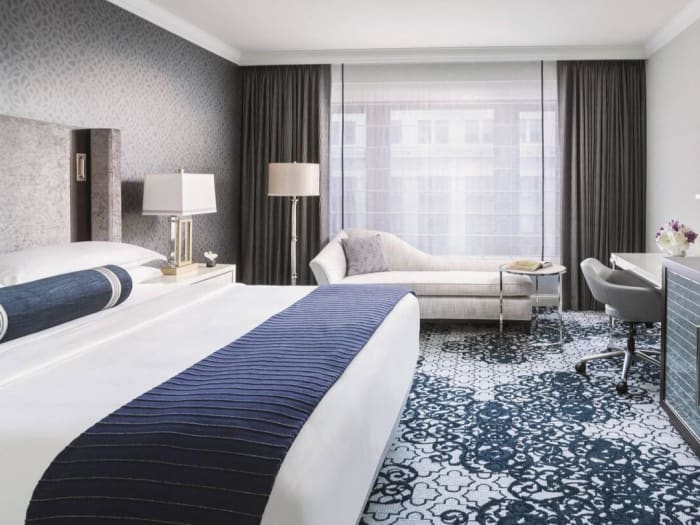
In a great city hotel, the room is never merely a place to pass through. It must absorb the contrasts of the day, act as a buffer between the intensity outside and private time within, and serve both the business traveller and the guest who has come to discover the city. At The Ritz-Carlton, San Francisco, that role as a refuge is essential. After the hills, the wind, the movement and the pace of downtown, returning to a room that is well kept, calm and immediately comfortable is part of the experience itself.
What one expects from the rooms and suites of an address of this calibre is, first of all, clarity. Balanced proportions, easy circulation, furnishings designed for real use, and a decorative palette that does not tire the eye all matter. In the context of San Francisco, where the city constantly demands attention, such restraint is especially welcome. Luxury here is measured by quality of execution: carefully prepared bedding, rigorous daily housekeeping, evening turndown, practical storage, and that overall sense of order that allows one to settle in at once.
Travellers staying several nights generally appreciate the way great hotels create a fluid routine. One leaves early, returns late, leaves a few belongings behind, and finds the room restored with precision. This discreet comfort is often more decisive than any demonstrative décor. It allows one to work, rest, prepare for an evening out, or simply watch the city light shift through the day. In a destination where schedules can be full, the room becomes a point of balance.
Suites, meanwhile, answer to a different rhythm. They suit those seeking more space, wishing to host an informal meeting, travelling as a couple with an added degree of comfort, or extending a stay in a more residential spirit. In a leading hotel, a suite is not simply a higher category; it is a different way of inhabiting the city. One gains breathing room, privacy, and sometimes a clearer separation between moments of rest and moments of activity.
The care devoted to service completes the experience. Daily housekeeping, evening preparation of the room, the responsiveness of the front desk and housekeeping teams, and practical services such as laundry or wake-up calls all contribute to a sense of continuity. Nothing interrupts the stay unnecessarily; everything is designed to reduce friction. It is one of the surest signs of a well-run establishment.
For a couple, the room becomes the place where calm returns after a day spent exploring neighbourhoods, viewpoints and museums. For a business traveller, it offers a stable setting between appointments. For a first encounter with San Francisco, it serves as a reassuring base, almost a point of orientation. The Ritz-Carlton, San Francisco understands that variety of uses. Its rooms and suites belong to the tradition of great international hotels: spaces designed to endure, to welcome without effort, and to remind guests that in the city, true luxury often begins with the quality of rest.
Dining
In a city such as San Francisco, dining is never merely about what a hotel serves. The local culinary scene is one of the most diverse in the United States, shaped by Pacific influences, the proximity of Napa Valley and Sonoma, the abundance of Californian produce, and a culture of taste that ranges from neighbourhood counters to major dining rooms. For a five-star hotel in the heart of the city, the challenge is therefore not simply to feed its guests, but to offer a coherent reading of that local standard: precise service, settings suited to different moments of the day, and the ability to guide travellers towards the right experiences, both within and beyond the property.
At The Ritz-Carlton, San Francisco, dining naturally follows the logic of a grand urban hotel. In the morning, it supports the start of the day, whether through breakfast before meetings or a more leisurely moment before heading out to explore. At lunch and dinner, it must answer varied needs: business meals, informal appointments, dinner for two, or a lighter pause after a full day. In this kind of address, the essentials often lie in consistency: the quality of the welcome, the pace of service, acoustic comfort, a clear menu, and the ability to adapt to expectations without losing composure.
Contemporary luxury hospitality does not always depend on multiplying concepts. It may also reside in a certain rightness. A well-considered dining room, an atmosphere that is hushed yet alive, a menu that favours seasonality and controlled simplicity, and a wine and spirits selection in tune with the Californian context: these are the things one expects from a property of this standing. Because San Francisco is a city of movement and meetings, the hotel also plays a social role. It becomes a place to gather for a drink, a coffee, a business conversation or a transitional moment before an evening in town.
The other essential dimension is culinary concierge service. In a destination this rich, knowing where to book matters almost as much as the booking itself. A good concierge does not simply suggest the best-known addresses; they refine recommendations according to neighbourhood, desired atmosphere, available time, dietary preferences and travel style. For a successful stay, that mediation is invaluable. It allows guests to move from a contemporary table to a local institution, from a formal dinner to a more spontaneous address, without wasting time or falling into obvious tourist choices.
For guests who prefer the discretion of dining in their room or who arrive on an unusual schedule, hotel services take over with the same logic of comfort. In a great establishment, dining is not limited to the restaurant; it forms part of a broader set of services designed to keep the stay fluid, whatever the demands of the programme.
At The Ritz-Carlton, San Francisco, dining is therefore best understood as an extension of the stay itself: a space of rhythm, sociability and comfort. The address benefits from its central position to open the door to the city’s gastronomic energy, while also offering on site the setting expected of a leading international hotel. Between San Francisco’s culinary vitality and the understated elegance of a grand five-star property, the balance is that of hospitality properly understood.
Concierge & services
What distinguishes a great city hotel over time is not only its address or décor, but the quality of its daily operation. In that respect, The Ritz-Carlton, San Francisco answers one of the fundamental expectations of high-end travel: making everything feel simple, even when the days themselves are complex. In a city where one may move between meetings, visits, transfers and reservations at a brisk pace, precision in service becomes a genuine luxury.
The presence of a 24-hour concierge is central here. In a property of this calibre, the concierge is not merely an intermediary; they are an interpreter of the city. They help organise a coherent stay, prioritise plans, secure the right table, optimise an itinerary, and suggest the right neighbourhood according to the time of day or the desired atmosphere. In San Francisco, where distances are measured less in miles than in gradients, traffic and micro-neighbourhoods, that expertise is especially valuable. It helps avoid over-ambitious schedules, better structure visits and save precious time.
The 24-hour front desk completes this promise of continuity. Late arrivals, common on transatlantic or domestic routes, do not disrupt the stay; early departures are handled with the same regularity. This permanent availability contributes to a sense of calm. The traveller knows the hotel can be relied upon at any hour, whether for a practical request, a reservation adjustment or an unexpected need.
Housekeeping and room-related services also play an essential role in the overall perception of the stay. Daily housekeeping ensures consistency of comfort; evening turndown restores the room to its role as a retreat; laundry simplifies longer stays or business trips; wake-up service provides discreet but welcome reassurance when a tight schedule requires it. Luggage storage, often underestimated, becomes especially useful on transition days, when one wishes to enjoy the city until the last moment without material constraints.
Multilingual staff are another important asset for an international clientele. In a great hotel, the quality of an exchange is measured as much by the precision of the answer as by the way it is delivered. To be understood immediately, to express a preference or constraint without approximation, to receive a clear recommendation: all these elements make the experience smoother and reinforce the feeling of being properly looked after.
Ultimately, the best services are often those one barely notices because they integrate so naturally into the stay. They do not seek visibility; they reduce friction, anticipate needs and leave the traveller with the impression that the city is more accessible. That is exactly what one expects from a major international house. At The Ritz-Carlton, San Francisco, concierge and services are not an add-on; they form the very framework of the experience, the element that turns a good address into a true base for the stay.
The San Francisco art of living
Staying at The Ritz-Carlton, San Francisco also means choosing a particular way of inhabiting the city. San Francisco does not reveal itself like a linear metropolis; it is discovered in sequences, through neighbourhoods, shifting light and changing viewpoints. Its art of living lies in that singular combination of urban sophistication and Californian ease, of historic institutions and contemporary creativity. A well-located hotel allows one to enter that rhythm without forcing it.
In the morning, the city often belongs to those who move through it early, before traffic and daily flows intensify. It is the moment when the hills are most legible, when the air from the Bay still retains its sharpness, and when the façades of downtown recover a certain calm. From a central address, it becomes easy to shape the day according to one’s mood: a walk towards shopping districts, a detour to a museum, exploration of a more residential area, or simply observing the city from its sloping streets. San Francisco rewards flexible itineraries, those that leave room for the unexpected as much as for established landmarks.
By afternoon, the experience changes tone. The city breaks into distinct atmospheres: more taut business districts, livelier shopping streets, cultural enclaves, cafés worth lingering in, and sudden perspectives over the Bay or the urban hills. This is where the advantage of a hotel in the heart of the city becomes clear. One can return to pause, drop off purchases, rest for a while, and then head out again. That ability to breathe between sequences changes the way one visits. It avoids the fatigue of an over-continuous programme and allows the contrasts that define San Francisco to be appreciated more fully.
In the evening, the city takes on a particular elegance. Light settles differently on façades, restaurants and bars fill up, and some districts become more hushed in tone. For couples, it is a time for dinners and walks; for business travellers, for informal meetings; for culture lovers, for performances, concerts or events. In every case, returning afterwards to a calm, well-run grand hotel extends that sense of balance between exterior energy and interior comfort.
The San Franciscan art of living also rests on a form of openness. The city blends Asian, European, Latin American and Californian influences into a whole that is immediately perceptible in its dining, neighbourhoods and habits. One moves easily from one register to another, from a classic institution to a more experimental address, from a very lively street to an almost residential enclave. For the traveller, that diversity is a richness provided it is well navigated. The concierge team at a hotel such as The Ritz-Carlton, San Francisco then becomes especially valuable: helping guests make choices, avoid dispersion and shape a stay that genuinely reflects their interests.
Ultimately, San Francisco is appreciated less through accumulation than through accuracy. A few well-chosen routes are better than an overloaded programme. A central and reliable address is better than a succession of unnecessary journeys. In that sense, The Ritz-Carlton, San Francisco is perfectly aligned with the spirit of the city: an elegant base from which to explore, return, set out again, and gradually understand what gives this great Pacific coast city its singular character.
Book with MyConciergeHotel
Choosing The Ritz-Carlton, San Francisco through MyConciergeHotel means approaching the stay with a logic of precision rather than simple availability. In a city such as San Francisco, where location, the rhythm of the programme and the quality of outside reservations strongly shape the experience, booking should never be an isolated act. It is best understood as the starting point of a coherent stay, adapted to the traveller’s profile and to the city’s own tempo.
For a couple, the priorities will not be the same as for a business trip or a first discovery of San Francisco. Some will favour a room or suite conceived as a refuge after days of exploring; others will need a particularly fluid organisation, with late arrivals, early departures, quick laundry, restaurant recommendations and optimised movements around the city. The value of booking with MyConciergeHotel lies precisely in placing the hotel within a broader whole: that of the actual stay, with its constraints, wishes and trade-offs.
Booking this address with an editorial and concierge perspective also makes it easier to make the most of its objective strengths. The hotel benefits from a central location, close to the city’s main sights, in a lively and accessible area. These elements may seem obvious on paper, yet they take on different value depending on the length of the stay, the desired level of mobility, the season, or the nature of the planned activities. A short cultural break, a romantic escape or a dense professional agenda do not call for the same recommendations. Guidance in advance allows those parameters to be adjusted with greater nuance.
There is also everything that happens around a reservation without always appearing in the displayed rate: the advantage of arriving with a strategy for dining already identified, the relevance of planning certain visits at specific times, the need to coordinate luggage, transfers and free time, or simply knowing what to expect once on site. In a great international hotel, the services exist; the question is how to activate them intelligently. That is where an expert intermediary brings genuine value.
MyConciergeHotel fits within that approach of curation and support. The point is not merely to confirm a room, but to prepare a stay that is clearer, smoother and more personal. For The Ritz-Carlton, San Francisco, this means being able to connect the property with the best uses of the city: walks, meetings, restaurant bookings, moments of pause, late departures or transition days. The aim is not to overdo things, but to get them right.
In luxury hospitality, the difference often begins before arrival. A well-considered booking reduces friction, improves the rhythm of the stay and allows guests to make the most of what both the hotel and the destination have to offer. For an address such as The Ritz-Carlton, San Francisco, that preparation makes particular sense because the city rewards precise choices. Booking with MyConciergeHotel therefore means favouring a better-composed experience, where excellence in service begins with the organisation itself.