History & Urban Presence
In San Francisco, the idea of a grand hotel has never quite mirrored that of Europe’s capitals. Here, luxury is expressed less through display than through a confident, discreet and highly considered way of inhabiting the city. Four Seasons Hotel San Francisco belongs precisely to that contemporary tradition: an address designed for travellers who want to experience downtown while retaining serenity, comfort and a certain aesthetic restraint. More than a hotel of ceremony, it is a sophisticated urban base in a city in constant motion, equally suited to business stays and to those wishing to take the measure of one of the West Coast’s most influential destinations.
The hotel belongs to a generation of luxury urban properties that accompanied the transformation of central San Francisco around the turn of the 21st century. Within that landscape, it occupies a distinctive position: that of an international house capable of speaking a local language. This is reflected in a particularly San Franciscan reading of refinement, shaped by clean lines, light-filled interiors, service that is precise without being stiff, and a constant awareness of the actual rhythm of a stay. There is no cultivation of ceremony for its own sake; instead, the emphasis is on fluidity, intelligent hospitality and the rare feeling of being immediately at ease.
That urban presence is also evident in the way the hotel engages with its surroundings. San Francisco is a city of contrasts, where neighbourhoods shift in mood within a few blocks, and where contemporary verticality sits alongside Victorian heritage and major civic landmarks. In that context, Four Seasons Hotel San Francisco embraces a resolutely metropolitan identity. It appeals to guests who wish to stay at the heart of things, close to key routes, cultural venues, shopping and business districts, while returning at day’s end to a calm, ordered and carefully managed retreat.
The Four Seasons name carries a clear promise: service recognised internationally for consistency, discretion and personalisation. Here, that promise takes on a particular tone. In a city where elegance is often less demonstrative than in other major destinations, the experience rests on accuracy. Accuracy in the welcome, in the proportions, in the materials and in the daily attentions. It is that coherence that gives the hotel its true stature. Not theatrical grandeur, but a form of quiet distinction especially well suited to San Francisco.
For European travellers, the address offers an immediately legible way into the city: contemporary luxury without excess, allowing attention to remain on what matters. For business guests, it is a reliable, central and efficient base. For couples, it provides a hushed urban setting well suited to short breaks as well as longer interludes. That versatility is telling. It reflects something essential about the recent history of high-end hospitality in San Francisco: a luxury that does not seek to dominate, but to accompany the life of the city with precision.
In that sense, Four Seasons Hotel San Francisco is not merely a well-located hotel. It is a way of understanding San Francisco from within: a demanding, inventive and cosmopolitan city where excellence matters, and where the greatest sophistication often lies in the apparent ease with which it is delivered.
The Establishment
Staying at the Four Seasons Hotel San Francisco means choosing a location that transforms downtown into a true haven. The hotel is situated in the heart of San Francisco, allowing guests to seamlessly combine business meetings, cultural discoveries, shopping, and urban strolls without the need for a car.
This centrality is one of its most obvious advantages, significantly enhancing the experience of being in the city. Travel becomes simpler, days gain flexibility, and spontaneity is more easily embraced.
The surrounding neighbourhood offers an immediate and rich insight into San Francisco. Just a few steps away lie the major landmarks of the city centre: bustling shopping streets, cultural institutions, lively squares, dining establishments, office zones, and connections to other iconic districts.
For first-time visitors, this location facilitates exploration. For regular guests, it allows for a direct approach to the essentials, starting from a reliable and well-connected base. Access to public transport further enhances this freedom. In a city where topography, traffic, and microclimates influence daily experiences, the ability to navigate on foot, utilise public transport, and make targeted trips is a true comfort.
The hotel embraces a contemporary aesthetic that resonates well with its context. An elegant and urban atmosphere prevails, devoid of excessive decoration. The common areas prioritise clarity, calmness, and a sense of order.
After the sometimes intense energy of the street, this mastery of ambiance plays a crucial role. It provides a clear transition between the city and the hotel, allowing travellers to find a sense of respite, particularly appreciated in a destination where days can fill up quickly.
This address is particularly suited for couples and business travellers. The former will find a refined base to explore San Francisco together, while the latter will appreciate the logic of a hotel designed to meet the demands of a busy schedule. Continuous reception, essential services, a strategic location, and consistent quality of service are all part of the offering.
This dual purpose does not compartmentalise the experience. It gives the hotel a balanced tone, neither exclusively corporate nor strictly leisure-oriented.
In San Francisco, a central address alters the rhythm of one’s stay. The city is not merely a succession of iconic sites; it is experienced in fragments, through atmospheres, and through transitions between neighbourhoods. From the hotel, moving from a meeting to a museum visit becomes easier, as does transitioning from lunch to a shopping session, or from an afternoon stroll to a restful return before dinner.
The Four Seasons Hotel San Francisco does not seek to isolate its guests from the urban fabric. Instead, it empowers them to engage with it comfortably. Comfort is not solely measured by visible amenities; it also lies in how the hotel simplifies the city and makes it more enjoyable to navigate.
Rooms and Suites
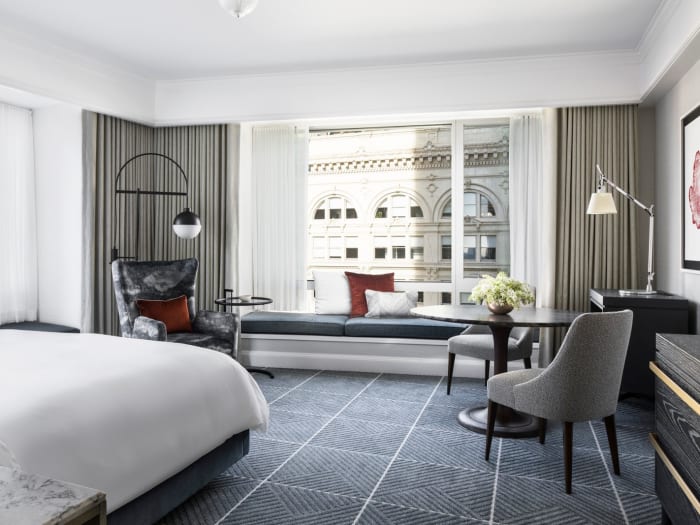
In a large city, the quality of a room is judged as much by its comfort as by its ability to create a suitable distance from the outside world. At the Four Seasons Hotel San Francisco, this refuge function is at the heart of the experience. After the visual intensity of San Francisco, one expects a room to soothe without neutralising, to envelop without confining. Here, guests seek a contemporary, well-appointed space designed for rest, occasional work, and moments of retreat.
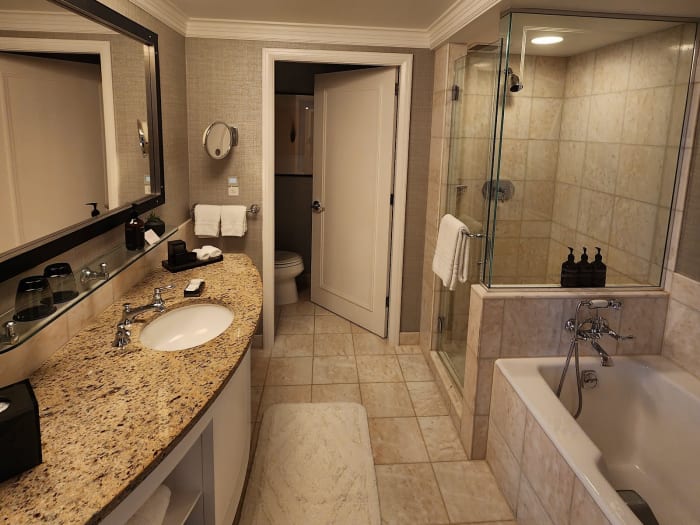
The overall atmosphere reflects a controlled contemporary elegance. Clear lines, comfortable materials, and a palette conducive to relaxation define the space. Luxury is evident in the quality of execution: inviting bedding, smooth circulation, thoughtfully designed lighting, ample storage, and bathrooms conceived as extensions of comfort. Even when one spends only a few hours awake in the room, a well-designed space can transform the perception of travel.
For business travellers, the room must offer silent efficiency. It should allow for quick preparation, conducive working conditions, effortless organisation of personal belongings, and a return to an immaculate space in the evening thanks to daily service and turn-down service. In a hotel of this calibre, the room accommodates the rhythm of the guest, whether they are early risers, night owls, or navigating a packed agenda.
For couples, the experience takes on a different tone. A well-designed room in San Francisco becomes an intimate observation post of the city or a cocoon to return to after a day spent among hills, museums, shops, and lively eateries. The appeal of an address like this lies in offering a luxury that does not distract from the city but rather enhances its enjoyment. Here, one finds calm, the right temperature, and a sense of an ordered space.
The suites extend this logic with added ease. They cater to longer stays, trips that blend work and personal time, or the desire for a more spacious setting to host, relax, or experience the city at a more leisurely pace. In a destination like San Francisco, having a more generous space significantly enhances the quality of the stay.
What distinguishes the rooms and suites of a great urban hotel is their ability to make the logistical complexities of travel fade away. One sleeps well, prepares easily, and quickly regains a sense of familiarity. At the Four Seasons Hotel San Francisco, this promise of clear and consistent comfort is an integral part of the experience. In a city as stimulating as San Francisco, it is often this type of luxury that lingers in the memory the longest.
Dining
In San Francisco, dining extends far beyond the confines of the hotel. The city has established itself as one of the great culinary laboratories of the United States, drawing on the terroirs of Northern California, a rich diversity of influences, and a strong culture of quality produce.
In this context, a luxury hotel in the downtown area need not overdo it. Instead, it should offer an experience that aligns with the rhythm of its guests, catering to a clientele accustomed to good food, whether quickly or more leisurely, depending on the moment.
At a Four Seasons property, one expects a mastery of the fundamentals. A well-orchestrated breakfast, attentive service, flexible hours, and reliable dining options are essential. This discreet yet vital culinary comfort is part of a grand urban stay.
Mornings often begin with a breakfast that is both efficient and enjoyable. For business travellers, this is a strategic moment, sometimes a quick affair. For couples or leisure travellers, the pace is more relaxed. A hotel of this calibre knows how to cater to both needs, balancing precise service with the comfort of ritual.
At lunchtime and in the evening, a centrally located address in San Francisco keeps all options open. Guests can enjoy the surrounding culinary scene and then return to the hotel for a sense of calm and continuity in service. Alternatively, they may opt for the simplicity of dining on-site or in their room. Here, the quality of execution matters more than grand announcements. A clear menu, well-prepared ingredients, and punctual service make all the difference.
In-room dining deserves special mention in a grand urban hotel. It caters to late arrivals, early risers, and long working days. It is also ideal for those who prefer to dine in the privacy of their room after exploring the city. In a venue designed for both couples and business travellers, this flexibility is invaluable.
Discussing dining at the Four Seasons Hotel San Francisco also serves to highlight that the city is part of the experience. The hotel provides a reliable base at any time of day, while also serving as a starting point to a scene where fine dining, local cafés, historic establishments, and more contemporary venues coexist. Here, luxury lies in that freedom.
Wellness & Rhythm of Stay
Wellness in an urban hotel is not limited to a spa; it often hinges on more subtle factors.
The quality of sleep is paramount, as is the efficiency of services, along with the opportunity to slow down between the day's activities.
At the Four Seasons Hotel San Francisco, this concept is primarily reflected in the physical and mental comfort that unfolds throughout the stay.
San Francisco is an invigorating yet demanding city. Its hills, distances, and temperature fluctuations challenge both the body and the mind.
In this context, a well-designed hotel becomes a point of equilibrium. Guests return to centre themselves, rest, and regain a calmer pace.
The room plays a central role, as do the daily services.
Daily housekeeping, turn-down service, round-the-clock reception, and 24-hour concierge lighten the stay, allowing the day to flow more smoothly.
For business travellers, this aspect is crucial. With time zone changes, meetings, and travel, a stable environment aids in recovery.
For couples, wellness takes on a more sensory form. Finding a calm setting after the hustle of the city alters the rhythm of the stay.
The climate of San Francisco, temperate yet changeable, reinforces this need for grounding. Guests appreciate returning to warmth, silence, and continuity.
This is achieved through textiles, ambience, and the precision of maintenance. The body relaxes effortlessly.
At the Four Seasons Hotel San Francisco, wellness is thus understood as a holistic quality of stay. In San Francisco, these moments of recovery are integral to the experience.
Concierge & Services
In luxury hospitality, services are not merely a list of options; they form the invisible architecture of the stay. At the Four Seasons Hotel San Francisco, this dimension is particularly significant. The hotel caters to a clientele that values responsiveness, discretion, and continuity. A 24-hour concierge, 24-hour reception, daily housekeeping, turn-down service, luggage storage, laundry, and wake-up calls create a seamless experience.
The 24-hour concierge plays a central role. In San Francisco, days often involve last-minute reservations, logistical needs, neighbourhood recommendations, transport arrangements, and itinerary adjustments. Having a contact available at all hours transforms the experience. The concierge simplifies the city and makes it more navigable. For first-time visitors, this saves time; for regular guests, it allows for fine-tuning their plans.
The continuously open reception caters to the rhythms of contemporary travel. Late arrivals, early departures, time zone changes, and plan alterations demand constant presence. Being welcomed with the same attentiveness at any hour remains a true marker of reliability, particularly for international business travellers.
Daily housekeeping and turn-down service represent a more intimate luxury. Returning to a perfectly tidied room alters the perception of the stay. Coming back in the evening to an atmosphere prepared for the night enhances this sense of continuity. In a bustling city like San Francisco, this quality of return to one’s room is highly valued.
Luggage storage, laundry, and wake-up services are more functional yet equally crucial. Luggage storage frees up arrival and departure times, laundry supports longer stays, business trips, and multi-stop itineraries, while the wake-up service remains invaluable, especially in the face of time zone differences.
What distinguishes a great establishment is not just the presence of services but how they are interconnected. When well thought out, they create an almost imperceptible continuity. At the Four Seasons Hotel San Francisco, this fluidity is one of the strengths of the property.
The San Francisco Way of Life
Choosing Four Seasons Hotel San Francisco also means choosing a particular way into the city. San Francisco does not reveal itself as a linear destination. It is discovered in layers, through hills, contrasts of light, shifts of scale between the major arteries of downtown and more residential districts. Its way of life lies precisely in that diversity: cultural sophistication, economic energy, maritime heritage, a taste for innovation and a strong attachment to distinctive neighbourhood scenes. From a central address, that plurality becomes easier to grasp, because one can compose a personal reading of the city without losing time to logistics.
Downtown San Francisco first offers a distinctly urban experience, shaped by rhythm, verticality and movement. One comes here for meetings, shopping, institutions, major hotels and civic landmarks. Yet the city never stops there. Very quickly, it invites one to turn aside: towards more residential streets, neighbourhood cafés, viewpoints, museums and walks where the air of the bay changes one’s sense of space. It is this alternation between intensity and breathing room that gives San Francisco its particular charm.
For couples, the city lends itself especially well to a stay built on gentle contrasts. A morning devoted to exploring a neighbourhood, an unhurried lunch, a cultural visit, a few hours of shopping, then a return to the hotel before going out again for dinner: all of this forms a very natural rhythm here. Business travellers can make use of the same urban structure by inserting moments of the city between obligations. That is one of San Francisco’s privileges: even a short stay can feel rich, provided one is well located.
The climate also plays an essential role in this way of life. The seasons are relatively mild, yet the city is famous for rapid shifts in temperature, fog and wind. That light instability forms part of its identity. It encourages life outdoors without ever quite allowing one to forget the value of a comfortable refuge. A well-run, central hotel therefore comes into its own: one can go out often, return easily, and adjust plans according to the sky, one’s energy or the mood of the neighbourhood being explored.
It is also worth remembering that San Francisco is a city of culture as much as of landscape. Its architecture, institutions, creative scenes, and relationship to technology and innovation form a rare whole. One may seek out icons, certainly, but also details: a façade, a bookshop, a view down a steep street, late-afternoon light on the buildings of the centre. The luxury of a successful stay often lies in this openness to detail, in the ability to let the city surprise.
In that sense, Four Seasons Hotel San Francisco acts as a point of balance. It does not claim to summarise San Francisco; it allows guests to live it more fully. Through its central location, practical access to public transport, and positioning suited alike to couples and business travellers, it supports an experience of the city that is flexible, elegant and open. That may be the best definition of the San Franciscan way of life: a real sophistication, never rigid, always in dialogue with the movement of the city.
Book with MyConciergeHotel
Booking Four Seasons Hotel San Francisco through MyConciergeHotel means approaching the property with the right level of preparation. In a city as in demand as San Francisco, where stays often combine professional obligations, urban breaks and tightly structured schedules, the quality of the booking matters almost as much as the quality of the hotel itself. A good booking is not merely about securing a room; it aligns the type of stay, the rhythm of travel and concrete expectations with the actual strengths of the property.
This address lends itself particularly well to several traveller profiles. Couples will find an elegant and central base from which to discover the city at their own pace, with the freedom to move easily towards major points of interest and return to a calm setting at day’s end. Business travellers, meanwhile, benefit from a strategic location and continuous services that support both short stays and more complex schedules. Booking thoughtfully therefore begins with identifying the room or suite best suited to the real use of the stay: need for space, importance of rest, arrival and departure times, length of stay, and the balance between work and leisure.
MyConciergeHotel makes it possible to place that reservation within a more editorial and more guided framework. The value lies not only in choosing a recognised luxury hospitality brand, but in understanding why this address works for a certain kind of journey. Here, centrality, access to public transport, suitability for couples and business travellers, and continuity of service form a coherent whole. It is that coherence one should seek at the moment of booking.
In an urban destination, certain details carry particular weight. Arrival time may shape the comfort of the first day. An early arrival or late departure makes luggage storage especially useful. A business trip of several days gives real meaning to laundry and wake-up service. A stay for two, more flexible by nature, may benefit more from a rhythm that leaves room for returning to the hotel during the day, for spontaneous dinners or for periods of rest between outings. Booking intelligently means anticipating these uses rather than discovering them only once on site.
It is also advisable to book ahead, especially during busier periods, as the existing concierge tip already suggests. This anticipation not only helps secure the preferred room category, but also allows for a calmer and more assured stay in a city where hotel demand can be strong. For a property of this level, availability is never a minor detail: it directly influences the quality of the experience.
Finally, booking through MyConciergeHotel means choosing an approach that values clarity. Luxury is not only a matter of prestige; it is a matter of suitability. Four Seasons Hotel San Francisco will particularly appeal to those who wish to experience San Francisco from its centre, with a high level of comfort, simplified logistics and consistent service. Booking this address is therefore less about seeking a backdrop than about choosing a rhythm of stay. And when a hotel succeeds in making a great city more fluid, more accessible and more pleasurable to inhabit, the booking itself already becomes part of the experience.