History & heritage
In Guangzhou, a city shaped by trade, river routes and exchange, luxury hospitality follows a different logic from that of Europe’s grand historic palaces. Here, prestige is often expressed through contemporary representation: receiving guests with precision, ease and a strong sense of detail at the heart of a fast-moving metropolis. The Ritz-Carlton Guangzhou belongs to this modern reading of luxury. The property does not rely on an aristocratic past or on the mythology of an ancient palace; rather, it is part of a generation of international grand hotels conceived to accompany the rise of Asia’s major business capitals, offering a setting that is formal, comfortable and immediately legible to a cosmopolitan clientele.
Its identity therefore rests more on brand heritage than on a monumental history specific to the building itself. The Ritz-Carlton name suggests a particular hotel language: attentive service, classically inflected codes, a preference for noble materials, and a sense of continuity between public spaces, guestrooms and dining venues. In Guangzhou, that international grammar meets a local anchoring visible in public areas inspired by regional culture, not as a folkloric gesture but as a way of placing the hotel within its urban and cultural setting. The result is an address that seeks balance between instant recognition and local context, between business efficiency and the art of receiving.
This positioning is especially relevant in a city such as Guangzhou. Long known in the West as Canton, the metropolis has for centuries played a major role in maritime and commercial exchange in southern China. It remains one of the country’s principal economic centres, with an energy distinct from Beijing or Shanghai: more southern, more pragmatic, often more discreet in its self-presentation, yet no less significant. A hotel of this calibre therefore serves a precise purpose. It is not simply a place to stay; it is a dependable point of anchorage for demanding travel rhythms, whether for business, a shopping-focused city break or an urban discovery stay.
The property’s heritage can also be read in its ability to accommodate different uses without blurring them. Business travellers find the codes they expect: efficiency, round-the-clock reception, available concierge support, careful daily housekeeping and smooth organisation. Leisure guests, meanwhile, benefit from a more residential sense of calm through refined public spaces, a hushed atmosphere and contemporary wellness facilities. This dual vocation is not a compromise; it is one of the most persuasive signatures of a well-conceived urban grand hotel.
From this perspective, The Ritz-Carlton Guangzhou embodies a luxury of continuity rather than display. Its heritage is that of international hotel discipline applied to a major Chinese city, with enough attention paid to local context to avoid anonymity. That is precisely what gives it its place: not a fixed stage set, but an address that accompanies Guangzhou as it is lived today, between business, movement, hospitality and the desire for lasting comfort.
The Establishment
One of the primary assets of The Ritz-Carlton Guangzhou lies in its location, right in the heart of the Tianhe business district. Tianhe is a vital hub for the economic, commercial, and contemporary life of Guangzhou. Office towers, major thoroughfares, significant shopping centres, and international addresses create a dense and vibrant urban landscape. Staying here means choosing a coherent starting point to understand modern Guangzhou.
The hotel responds to this context with a presence that is both accessible and comfortable. From the communal spaces, the tone is set. Elegance remains structured, with a focus on flow, the quality of welcome, and visual coherence. References to local culture add depth to the overall experience, reminding guests that Guangzhou is not just a business centre but also a city rich in traditions and strong regional identity.
This location in Tianhe also offers a tangible advantage for leisure travellers. The proximity to major shopping centres allows for easy organisation of a day filled with shopping, gourmet breaks, and exploration of lively neighbourhoods. In a metropolis of this size, travel times matter. The ability to quickly reach several points of interest transforms the experience of the stay. The Ritz-Carlton Guangzhou thus provides a retreat without straying far from the bustling centres.
The establishment caters to various travel rhythms. For business stays, it serves as a stable base, balancing meetings, returns to the hotel, and evening appointments. For couples or city breaks, it allows for a blend of urban immersion and peaceful retreat. This versatility is supported by the services expected from a grand five-star hotel: 24-hour reception, continuous concierge service, and daily housekeeping.
Beyond its location, the establishment captivates with its ability to shield guests from the external pace while maintaining a connection to the city. It embodies what one expects from a prestigious metropolitan address: order, mastery, and spaces designed to soothe the urban density. In Guangzhou, where the city's energy can be intense, this quality is as significant as material comfort.
Rooms and Suites
In a large urban hotel, the room is never just a place to sleep. It becomes a temporary office, a refuge after a busy day, or a silent observatory of the city. At The Ritz-Carlton Guangzhou, comfort and precision structure the daily experience.
The turndown service, daily maintenance, 24-hour reception, and concierge services create an environment that is meticulously attended to. Here, comfort relies as much on the invisible as on the visible. A successful room cannot be reduced to its furnishings; it also depends on its preparation, upkeep, and consistency throughout the day.
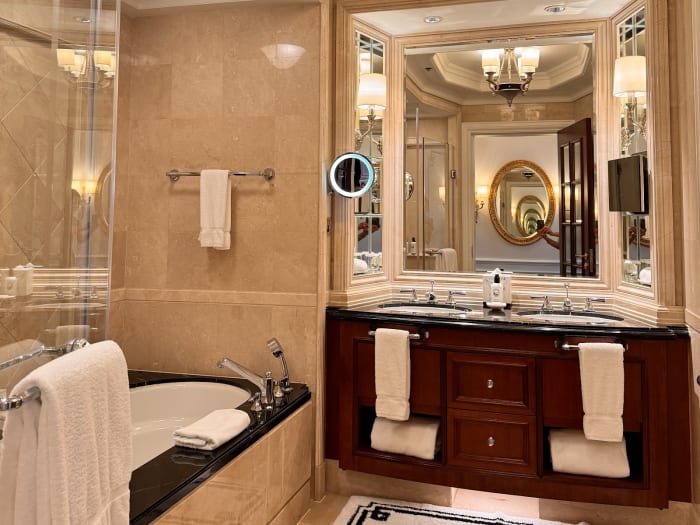
The hotel's positioning, catering to both business and leisure stays, calls for rooms that are adaptable to various uses. Business travellers expect a clear workspace, comfortable seating, effective lighting, and practical storage. Leisure travellers seek tranquillity, quality materials, a generous bathroom, and a genuine sense of retreat. The best rooms seamlessly combine these two expectations without rigidity.
In Guangzhou, days can be punctuated by meetings, traffic, sightseeing, or shopping. The return to the room then takes on particular significance. One expects a hotel of this calibre to provide well-maintained bedding, satisfactory sound insulation, well-regulated air conditioning, and an aesthetic continuity with the rest of the hotel. Luxury often lies in the absence of friction.
The suites extend this logic with more space and a clearer separation of functions. They are suitable for long stays, trips that blend work and personal time, or for those wishing to entertain in a more private setting. In a district like Tianhe, this flexibility is invaluable.
The rooms and suites at The Ritz-Carlton Guangzhou are envisioned as controlled transitional interiors. They aim for stable comfort, immediately comprehensible, that accompanies the traveller without imposing a decor.
Dining
In a prominent urban establishment, gastronomy transcends mere dining. It punctuates the stay, hosts meetings, and extends business conversations. It also offers a first sensitive insight into the local culture. At The Ritz-Carlton Guangzhou, the culinary offerings align with this philosophy. They meet the expectations of an international clientele, attentive to the coherence between cuisine, service, and setting.
In Guangzhou, this issue takes on particular significance. The city is one of the great centres of Cantonese culinary tradition, distinguished by balance, precision in cooking, and freshness of ingredients. In a hotel of this category, one expects accurate execution and a nuanced understanding of the local context. This encompasses regional flavours and dining customs that must coexist naturally, from a structured breakfast to a business lunch, a more ceremonial dinner, or informal breaks.
Breakfast deserves a special mention. It often reveals the rhythm of the hotel. The quality of the welcome, the fluidity of service, the diversity of offerings, and the freshness of preparations set the tone. For business travellers, it must be efficient without feeling rushed. For leisure travellers, it can be a leisurely affair before heading out into the city.
Other dining occasions cater to specific needs. A large hotel in Tianhe must accommodate discreet meetings, professional meals, or intimate dinners. The atmosphere should never feel interchangeable. Service remains central. Attentive presence, accurate reading of expectations, and mastery of pace make all the difference.
The appeal of such an establishment also lies in its ability to offer an alternative to the city. Guangzhou is brimming with culinary options, but after a busy day, it is delightful to dine on-site in a well-regulated setting. Acoustic comfort, continuity of service, and the possibility of extending the evening contribute to this. For some travellers, this simplicity is part of the luxury.
Thus, dining at The Ritz-Carlton Guangzhou extends the hotel experience. It articulates international demands and local sensitivity, quick moments and more leisurely meals, efficiency and pleasure.
Spa & Wellness
In Guangzhou, wellness plays a tangible role in the experience of the stay. Amidst jet lag, appointments, urban travel, heat, and humidity, it helps to regain a rhythm.
In major international hotels, the spa now extends the room and service. It offers the same precision of welcome and attention to detail.
At The Ritz-Carlton Guangzhou, the modern wellness facilities reflect a contemporary approach. The effectiveness of the equipment is as important as the atmosphere.
This offering caters to a clientele that blends business and leisure. After a long-haul flight or a day of meetings, a few laps in the pool or a moment of relaxation can transform the stay.
For leisure travellers, the spa becomes a part of the journey. It provides a pause between two explorations of the city or simply a moment to slow down.
Luxury also lies in the quality of the experience. Smooth circulation, silence, cleanliness, and attentive staff create a sharp contrast with the intensity outside.
In Guangzhou, the seasons also influence life at the hotel. Summer and humid periods enhance the appeal of air-conditioned indoor spaces and recovery times.
Thus, the spa, fitness, and recovery contribute to the balance of the stay at The Ritz-Carlton Guangzhou. A great hotel is also measured by its ability to support its guests.
Concierge & Services
The quality of a grand hotel often reveals itself in the precision of its services. At The Ritz-Carlton Guangzhou, several fundamentals shape the portrait of a property attentive to the continuity of the experience: 24-hour concierge, 24-hour reception, daily room service, evening turndown service, luggage storage, laundry service, wake-up calls, and multilingual staff.
The permanent concierge plays a central role here. In Guangzhou, having a contact who can organise a transfer, direct you to a neighbourhood, or facilitate a reservation is a tangible advantage. Luxury also lies in not having to manage everything yourself.
The continuously open reception contributes to this same logic. Late arrivals, early departures, and changes in plans are part of the daily routine of a hotel of this calibre. A constant presence brings stability and fluidity.
The turndown service and daily maintenance belong to another dimension, more silent yet essential. Returning in the evening to a space that has been tidied up contributes to a feeling of ongoing care. The laundry service, luggage storage, and wake-up calls extend this practical logic.
The multilingual staff also deserves a mention. In an international address in Guangzhou, the ability to communicate clearly with guests from diverse backgrounds is a hallmark of quality. It avoids misunderstandings and allows for a more precise service.
The services at The Ritz-Carlton Guangzhou embody a certain idea of contemporary hospitality: being present without being intrusive, efficient without being brusque, available without theatrics. For the traveller, this translates into a smoother stay and a more liberated mind.
The Guangzhou way of life
Staying at The Ritz-Carlton Guangzhou also means entering a city whose way of life does not always reveal itself immediately, yet rewards attentive travellers. Guangzhou does not have Beijing’s political monumentality or Shanghai’s international theatricality; its appeal lies rather in a form of everyday density, in the coexistence of commerce, gastronomy, modern architecture and an older southern culture. It is a city understood as much through its rhythms as through its landmarks, as much through its tables and districts as through its major urban perspectives.
From Tianhe, one first encounters contemporary Guangzhou: the city of shopping centres, towers, professional flows and a highly structured urban life. For many visitors, that dimension is already an experience in itself. Shopping occupies an important place here, not only as a practical activity but as an expression of metropolitan lifestyle. Being close to major retail centres allows guests to grasp this facet of the city, between international brands, dining, sociability and carefully controlled indoor climates, particularly welcome depending on the season.
Yet Guangzhou is not reducible to modern efficiency. Its deeper identity is also visible in Cantonese culture, in its relationship to food, in its historic openness to the world and in the way it articulates tradition and transformation. A walk through different districts, attention to markets, older houses, temples or the riverfront reveals a city of layers, where old and new coexist less through staging than through daily use. That may be what makes it so compelling: it does not always seek to charm directly, but gradually imposes its own coherence.
For a traveller staying in a grand hotel in Tianhe, the ideal experience often lies in alternating intensities. Morning may be devoted to meetings or urban exploration; afternoon to a more comfortable pause at the hotel; evening to dinner, an outing or simply the pleasure of returning to a well-managed setting. This rhythm suits Guangzhou well, a city that is active without necessarily being spectacular at every moment, and where carefully handled transitions are especially appreciated.
Climate also plays its part in this way of life. Spring and autumn, being milder, favour movement and discovery on foot. Hotter or more humid periods encourage a stay structured around interiors, regular pauses and moments of recovery. In every case, choosing a well-located and well-serviced hotel allows one to experience the city with greater ease and less fatigue.
The Ritz-Carlton Guangzhou supports this reading of the destination by offering a stable point of anchorage within a moving environment. It allows guests to approach Guangzhou not as a merely functional stop, but as a city to inhabit for a few days, to observe, taste and gradually understand. That is perhaps where the true luxury of the stay lies: in having a setting reliable enough to open oneself, at one’s own pace, to the complexity of a major metropolis in southern China.
Booking via MyConciergeHotel
Booking The Ritz-Carlton Guangzhou through MyConciergeHotel means approaching your stay with a preparation that is already part of the experience. In Guangzhou, location, the rhythm of travel, and practical organisation are as important as the choice of hotel. It is not merely about confirming a room; it is about constructing a coherent stay, tailored to the purpose of the trip, the season, the arrival time, and comfort expectations.
The benefit of a guided reservation first appears in the right tempo of the stay. A business trip does not call for the same priorities as a romantic getaway or a shopping and urban discovery stopover. Depending on the case, the focus may be on the fluidity of transfers, flexibility of schedules, proximity to activity centres, or more relaxation time. MyConciergeHotel allows for a refined understanding of this, to choose an address suited to a particular way of travelling.
In the case of The Ritz-Carlton Guangzhou, several elements support this tailored approach. The hotel is located in the Tianhe business district, close to major shopping centres. It caters to both business and leisure stays, with continuous services and modern wellness facilities. Their relevance varies according to the traveller's profile. The support then consists of transforming these assets into tangible advantages. Organising a serene arrival, anticipating concierge needs, recommending the best time to stay, or suggesting a transfer from the airport.
Booking with an editorial and concierge intermediary also means benefiting from a more qualitative reading of the experience. Beyond standardised descriptions, the challenge is to understand what the hotel truly offers. An effective grounding in Guangzhou, continuous service, an environment suitable for busy days, and a refined atmosphere. This perspective is useful in large metropolises, where the abundance of options makes the choice less clear.
Finally, MyConciergeHotel operates within a logic of saving time and ensuring peace of mind. For an international traveller, reducing uncertainty before departure is already a form of comfort. Knowing that certain aspects can be anticipated, clarified, or facilitated allows for a more liberated arrival. In the luxury hotel sector, this preparatory serenity is almost as important as the welcome on-site.
Choosing The Ritz-Carlton Guangzhou via MyConciergeHotel prioritises a reservation conceived as a service, rather than a mere transaction. In an active and vast city like Guangzhou, this difference is immediately felt. The stay begins earlier, in the quality of the organisation, and continues on-site with greater fluidity.