History & Heritage
In Guangzhou, the Mandarin Oriental embodies the essence of a contemporary urban hotel. Its identity is immediately apparent.
Mandarin Oriental has built its reputation on a precise understanding of hospitality. Attentive service, refined aesthetics, and an accurate interpretation of the destination.
In a metropolis like Guangzhou, this approach takes on a particular significance. Here, luxury is defined by fluidity, discretion, and quality of execution.
The hotel embraces the codes of the brand, with spaces designed to soothe the pace of travel. Attention is given to materials, light, and flow.
The result appeals to both business travellers and guests seeking to explore the city, without compartmentalising their experiences.
This versatility is crucial in Guangzhou, a city of commerce for centuries. Long open to maritime exchanges, it retains an energy of a crossroads.
The Mandarin Oriental naturally finds its place here, serving as an anchor within a city in motion.
Contemporary design engages in dialogue with local references, subtly woven into certain lines, patterns, and atmospheres.
In Guangzhou, this approach avoids international uniformity while maintaining the clarity and comfort expected from a grand five-star establishment.
The hotel does not recreate an imaginary past; rather, it offers a contemporary interpretation of Asian elegance—calm, structured, and welcoming.
Formerly known in the West as Canton, Guangzhou was one of the major entry ports of southern China. Its identity blends Cantonese tradition, architectural modernity, and a culture of trade.
Staying here means inhabiting a city of contrasts, where contemporary towers stand alongside ancient districts. The local gastronomy remains a strong marker, while the Pearl River continues to shape the urban imagination.
The Mandarin Oriental navigates this complexity with restraint. It does not simplify it; it frames it.
The hotel is not a backdrop disconnected from the city; it is a refuge that allows for a deeper engagement with the urban landscape.
In this tension between urban intensity and inner calm lies an essential part of its identity. The stay here unfolds at an ordered, precise, and serene pace.
The Establishment
The first impression one has of the Mandarin Oriental, Guangzhou, is that of an urban hotel designed as a point of suspension. In the vast, dense, and contemporary landscape of Guangzhou, this quality is significant. The hotel enjoys a convenient location for accessing the main areas of interest, accommodating various rhythms of stay. Whether for a business trip, a more contemplative urban escape, or a mixed stay, it caters to all.
The view of the Pearl River greatly contributes to this sense of grounding. In a city like Guangzhou, the river structures the imagination and introduces a breath of fresh air into the vertical landscape. When a hotel opens its perspectives to this waterway, it offers its guests a clearer relationship with the city. The gaze extends further, and the overall geography of the destination becomes more apparent. This visual connection to the water also brings a sense of calm, which is appreciated after a busy day.
The overall atmosphere rests on a dialogue between modern luxury and traditional touches, resulting in a sensation of balance. Nothing is overly ostentatious, and nothing is left to chance. The common areas are designed for relaxation. A lobby, a lounge, or a transitional space are not merely functional; they are crafted to slow down the pace. Movement feels more fluid, the volumes more legible, and the materials more enveloping.
The establishment cultivates a form of serenity that does not exclude efficiency. This is an important point in Guangzhou, where many travellers come for business reasons. A large hotel of this calibre must facilitate a seamless transition from a meeting to a moment of retreat. The Mandarin Oriental meets this requirement with a calm atmosphere, attentive staff, and high-end facilities. Here, elegance is defined by mastery, not by staging.
For travellers discovering Guangzhou, the hotel also serves as a filter. The city can be overwhelming with its scale, activity, and diversity of neighbourhoods. Returning to a coherent, tranquil, and well-orchestrated environment allows for a richer urban experience. Guests are more inclined to venture out and organise their days with ease.
In summary, the establishment holds together several promises: to be central without being chaotic, refined without being cold, contemporary without being interchangeable. It is a hotel that understands the logic of Guangzhou and responds with a controlled international language, enriched with more local signs. For the traveller, this translates into a sense of accuracy.
Rooms and Suites
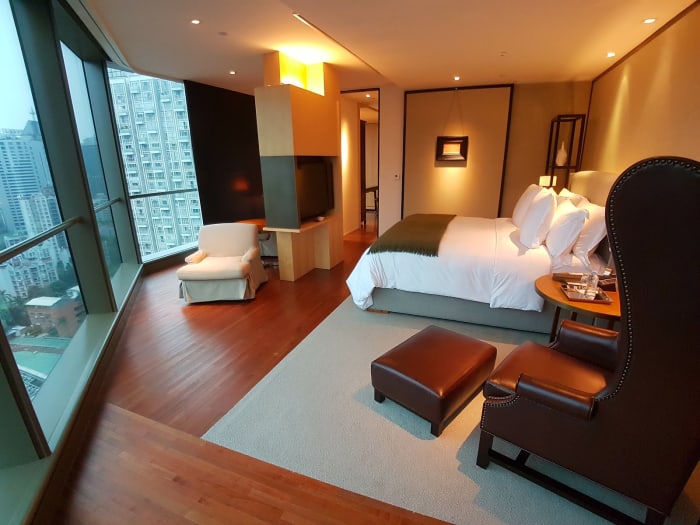
In a grand urban hotel, the room is not merely a place to sleep. It becomes an observation point, a space for recuperation, and sometimes a discreet office. At the Mandarin Oriental, Guangzhou, the rooms and suites prioritise refinement, comfort, and a soothing atmosphere. Together, they create a coherent universe where every element feels in its rightful place.
Certain categories of accommodation offer views of the Pearl River. In a vertical city like Guangzhou, a view transforms the perception of the stay. It opens up the space and situates the room within the geography of the destination. In the morning, it accompanies the awakening; in the evening, it provides a calmer perspective on the urban energy.
The style combines modern luxury with traditional touches. Contemporary lines are softened by discreet cultural references. The sought-after balance prioritises high-end comfort with a clear identity. Here, one expects silent rooms, well-proportioned spaces, and thoughtful design for everyday activities. A work desk, a proper armchair, well-designed storage, quality bedding, and a bathroom conducive to relaxation.
The turndown service extends this impression of continuous care, preparing the room for the night with discretion. The daily service maintains this consistency without ever imposing itself. The quality of service is reflected in the outcome, not in interruptions.
The suites extend this philosophy with greater space, suitable for long stays, for travellers wishing to host, or for those who separate rest from work. The essence remains the same: a sensation of calm, precision, and lasting comfort.
The rooms and suites at the Mandarin Oriental, Guangzhou, thus adhere to a sober definition of luxury—spaces that simplify life, protect rest, and accompany the stay with precision.
Dining
In a city such as Guangzhou, gastronomy is never a secondary subject. The capital of Guangdong holds a major place in the culinary imagination of China, and Cantonese tradition remains a defining reference there: popular, technical and refined at once. For a leading international hotel, the challenge is therefore not simply to offer several dining options, but to find the right tone in a destination where food is taken seriously. At Mandarin Oriental, Guangzhou, one can reasonably expect an approach that is both cosmopolitan and attentive to local context, in keeping with the spirit of the brand: precision, comfort, fluid service and a strong sense of the overall experience.
Even without listing specific restaurants or culinary signatures that are not confirmed here, one can describe what dining represents in such a property. First, it extends the hotel’s language. If the public spaces are designed for relaxation and the overall atmosphere favours modern luxury softened by traditional references, the dining venues are likely to follow the same continuity. One looks for readable rooms, carefully handled light, service that is present without becoming heavy, and the ability to support very different moments: a grounding breakfast before a demanding day, a business lunch, a more settled dinner, or a simple afternoon pause.
In Guangzhou, breakfast often takes on particular importance for international travellers as well as for those accustomed to the rhythm of major Asian cities. It must be efficient without feeling rushed, varied without becoming excessive. In a hotel of this level, one expects clear execution, well-presented products, smooth circulation between offerings and staff able to anticipate needs. It is a revealing moment because it concentrates logistics, service and atmosphere into a single experience.
The relationship with local cuisine is another point of interest. Guangzhou is one of the great territories of Cantonese cooking, known for its attention to freshness, texture, precise cooking and balance of flavour. A major hotel always benefits from acknowledging that heritage, whether through certain specialities, a contemporary reading of regional classics, or simply a genuine understanding of local expectations. For the traveller, this becomes a way of entering the city without leaving the comfort of the hotel; for the property, it is a mark of cultural accuracy.
Yet dining at a Mandarin Oriental cannot be reduced to the local. It must also respond to an international clientele: mobile, sometimes pressed for time, sometimes seeking a more ceremonial dinner. True quality lies in the ability to maintain the same level of attention whatever the register: destination cuisine, more universal fare, a light meal, in-room dining or a more festive occasion. Luxury here is defined by consistency.
It is also worth noting the social role of hotel dining spaces. In major urban hotels, they are places for meetings as much as for meals. Guests gather there before appointments, extend conversations there, and observe the city through its clientele. If the hotel enjoys views over the Pearl River or a privileged relationship with urban light, those moments gain an added dimension. Dining becomes another way of inhabiting Guangzhou.
Ultimately, dining at Mandarin Oriental, Guangzhou should be understood as a natural extension of the hotel experience: a sequence of well-orchestrated moments attentive to local context yet designed for a demanding international audience. More than a convenience, it contributes to the quality of the stay and to a more sensitive reading of the city.
Spa & Wellness
In a grand urban hotel, the spa serves a different purpose than in a beach resort or mountain retreat. It introduces an essential counterpoint to the intensity of the city. In Guangzhou, where days can be dense, this retreat takes on particular value. It allows one to regain a rhythm and transforms the stay into more than just a series of movements.
Within the Mandarin Oriental universe, wellness holds significant importance. The expected spirit is one of a serious yet flexible approach, where the environment is as important as the treatment. The spa in a hotel of this calibre first creates a threshold effect. One leaves the city, the noise, and obligations behind. Entering a space where light, materials, scents, and tempo shift. This transition is already a form of care.
At the end of the day, the experience often finds its true meaning. After meetings, visits, or a long journey, the body retains traces of accumulated tension. A treatment, a moment of rest, or a few minutes in a calm environment can reset the stay. For business travellers, it is a way to preserve energy and focus. For leisure travellers, it is an opportunity to carve out a genuine pause in a busy urban schedule.
Wellness in a grand hotel extends beyond treatment rooms. It encompasses the quality of sleep, the fluidity of service, and the atmosphere of common areas. This coherence is essential. A spa only fully fulfills its role if it belongs to a broader framework designed for tranquillity. The return to the room after a treatment, the silence of a corridor, and the discreet attention of the staff contribute to the same continuum.
In a city like Guangzhou, wellness also takes on a strategic dimension. It helps to better manage jet lag, recover after long-haul flights, and absorb climatic intensity. The best urban spas understand this. They do not promise a spectacular transformation but rather a tangible improvement in the quality of the stay. One departs feeling lighter, clearer, and more rested.
For couples, the spa can become a shared moment of respite. For solitary travellers, a time for re-centering. For frequent flyers, an almost indispensable ritual. In all cases, it adds depth to the stay, reminding us that a grand hotel is also judged by its ability to care for the traveller as a whole.
At the Mandarin Oriental, Guangzhou, the spa appears as a natural component of the experience. Not a decorative addition, but a space designed to rebalance the stay. In the context of an active metropolis, it represents one of the most genuine luxuries.
Concierge & Services
The quality of a grand hotel is often measured less by what it showcases than by what it makes possible. At the Mandarin Oriental, Guangzhou, this promise of fluidity relies on essential services: 24-hour concierge, 24-hour reception, daily room service, turndown service, luggage storage, laundry, wake-up service, and multilingual staff.
The 24-hour concierge is one of the most significant markers. In an international city like Guangzhou, being able to rely on a dedicated team at any time transforms the experience. The concierge acts as a bridge between the hotel and the city, assisting in organising travel, prioritising desires, and resolving unforeseen circumstances.
The continuously open reception extends this logic of availability. Late arrivals, early departures, and changes in plans are part of contemporary travel. Comfort also lies in this silent continuity: never having to wonder if assistance will be available.
The daily room service and turndown service contribute to a well-maintained domestic comfort. The room remains tidy and ready to accompany the various moments of the day. These discreet gestures have a tangible effect on the perceived quality of the stay.
Laundry and luggage storage meet very concrete needs, especially during an urban stay or multi-stop journey. The wake-up service also underscores the importance of the fundamentals.
The multilingual staff deserves special mention. In an international hotel, language conditions the quality of relationships, the clarity of information, and trust. Being welcomed and assisted effortlessly in several languages immediately reduces travel friction.
The services at the Mandarin Oriental, Guangzhou, thus create a hospitality of high precision. A series of well-thought-out provisions that make the stay simpler, more flexible, and more enjoyable.
The Art of Living in Guangzhou
Staying in Guangzhou means accepting a city of layers, rhythms and contrasts. Long known in the West as Canton, it remains one of southern China’s major centres: a historic trading hub, a contemporary metropolis and a key home of Cantonese culture. For the traveller, the destination’s appeal lies precisely in that plurality. Guangzhou does not always reveal itself instantly; it is understood in fragments, between recent architecture, older districts, waterside walks, food addresses and scenes of daily life. A hotel such as Mandarin Oriental therefore provides a particularly useful framework: it allows one to enter the city without being overwhelmed by its scale.
One of the clearest threads remains the Pearl River. The hotel’s views over this landscape are a reminder that Guangzhou was built in constant relation to water, exchange and movement. For the visitor, the river offers mental orientation. It helps one read the city, understand its axes and place its different faces. Walking nearby, observing the changing light on the water, watching the city shift in tone from day to evening—these are simple but revealing experiences. They show a metropolis less monolithic than one might imagine.
The art of living in Guangzhou also naturally passes through the table. Cantonese culture gives a central place to the meal, not only as pleasure but as a form of sociability and attention to ingredients. Even a short stay benefits from embracing that dimension, whether through a precise lunch, a more expansive dinner, or a gradual discovery of local flavours. For many travellers, cuisine is the point at which the city becomes immediately more legible. One finds there a sense of balance, freshness and nuance that in some ways echoes the measured elegance of a well-conceived luxury hotel.
Guangzhou is also a city of movement. Business travellers cross paths with admirers of contemporary architecture, visitors drawn to southern Chinese urban culture, seasoned followers of major Asian cities and those discovering the region for the first time. This diversity of profiles creates a particular energy. Local art de vivre does not rest on a fixed image of refinement, but on an ability to make efficiency, modernity and attachment to certain traditions coexist. It is a city where one can move quickly from a highly contemporary environment to something more rooted, and that is precisely what makes it compelling.
In this context, Mandarin Oriental acts as a privileged observatory. Its calm atmosphere, public spaces designed for relaxation and well-known service allow guests to shape a stay at their own pace. One may choose to explore extensively or to filter more carefully, to alternate appointments with moments of rest, to enter the city through its broad outlines or through subtler details. Luxury here also lies in the ability to modulate one’s experience.
It is also worth remembering that certain periods, notably the summer holidays and Chinese New Year, correspond to heavier demand. This affects the rhythm of the city as much as that of the hotel. Booking ahead not only secures the stay, but also makes it easier to approach Guangzhou under better conditions, with a more thoughtful programme and greater freedom to enjoy it.
To experience Guangzhou from Mandarin Oriental is therefore to adopt a balanced posture: opening oneself to the intensity of a major Chinese city while preserving spaces of calm. It is perhaps the best way to grasp its richness, between urban power, Cantonese culture and contemporary elegance.
Book via MyConciergeHotel
Booking the Mandarin Oriental, Guangzhou, through MyConciergeHotel means opting for a more personalised approach to a prestigious international hotel. This esteemed establishment is known for its exceptional service, convenient location, stunning views of the Pearl River, a tranquil atmosphere, and top-notch facilities. However, there is often a gap between the image of a hotel and the actual experience. This is where our guidance becomes invaluable. A successful stay also hinges on the category booked, the pace of travel, the client's expectations, and the synergy between the hotel and the destination.
MyConciergeHotel enables a more precise approach to this booking. For a trip to Guangzhou, this could involve selecting a room or suite tailored to the stay, considering the significance of a view, prioritising a serene setting after busy days of meetings, or incorporating spa treatments into the itinerary. This level of insight is particularly beneficial in large metropolises, where planning ahead is essential. The aim is to make the reservation more accurate.
The value of an editorial and concierge intermediary also lies in its ability to provide context. Guangzhou is not a destination that all travellers are intimately familiar with. Some may be visiting for the first time, while others return regularly for business. Needs vary. A couple on a city getaway may seek tranquillity, comfort, and a seamless exploration of the city. A business traveller will place significant importance on the smoothness of services, quality of rest, time management, and the efficiency of the concierge. In both cases, MyConciergeHotel's role is to align the hotel’s promises with the actual use of the stay.
Booking through MyConciergeHotel also allows for a discerning editorial perspective. It involves identifying what makes a location unique: a way of experiencing Guangzhou that balances urban intensity with retreat, international modernity with traditional touches, and efficiency with relaxation. This insight helps determine whether the hotel aligns with one's desires.
Peak periods of demand typically occur during the summer holidays and Chinese New Year. Anticipation becomes essential to secure availability and maintain greater flexibility in category choices. Pre-booking assistance allows for better calibration of dates, expectations, and priorities.
Booking through MyConciergeHotel means viewing the stay as a cohesive whole rather than a mere transaction. The hotel, the city, the rhythm of travel, moments of wellness, practical needs, and desires for exploration combine to create a comprehensive experience. The Mandarin Oriental, Guangzhou, is well-suited to this approach, as it blends the qualities sought in a major urban address with a genuine capacity for providing tranquillity.
For the discerning traveller, this mediation holds tangible value. It saves time, avoids approximate choices, and allows for a clearer approach to the stay.