History & Heritage
In Chengdu, The Ritz-Carlton Chengdu stands as a prominent contemporary urban address. It embodies international hospitality within a Chinese metropolis that possesses a unique character.
The charm of this location lies in its balance. On one side, the Ritz-Carlton codes; on the other, a genuine integration into a city rich in cultural identity. Chengdu is a city of rhythm, tea, gardens, and cuisine. The hotel captures this atmosphere without resorting to folklorism.
The establishment offers a refined anchor in the heart of a city where ancient traditions, architectural modernity, and a bustling daily life coexist. The Ritz-Carlton Chengdu caters to various uses of the city. Guests stay here for business trips or to explore Chengdu at a more leisurely pace. This versatility enhances its identity. The hotel remains immediately accessible to the international traveller while also providing subtle local touches.
The heritage here is not that of a historic palace but rather of an art of hospitality. In the Ritz-Carlton universe, this translates into a focus on arrival, support, and the seamlessness of services. In Chengdu, this promise takes on a special significance. The city is renowned for its hospitality, its appreciation for the long game, and its sociability. A hotel of this calibre offers a contemporary interpretation of these qualities, without any grandstanding.
Its contemporary elegance, enriched with Chinese touches, encapsulates its identity well. It engages in a dialogue between an international language of luxury hospitality and more local references. These can be perceived in the atmosphere, certain decorative details, and the way spaces are inhabited. This is not a place of ostentation but of continuity. The hotel filters the energy of Chengdu to retain its warmth, courtesy, comfort, and a certain urban serenity. For the traveller, it is often these elements that create lasting memories. An address that understands its city and knows how to introduce it with tact.
The Establishment
The foremost quality of The Ritz-Carlton Chengdu is its location. Situated in the heart of Chengdu, it immediately transforms the way one travels. Time is saved, and movement is simplified. Meetings, visits, shopping, cultural breaks, and relaxation flow more easily.
For a short stay, this is crucial. For a longer visit, it allows one to experience the city without distraction. The hotel thus meets an essential expectation: to provide a central, accessible, and comfortable base.
This centrality is not merely practical; it also imbues the establishment with a distinctly urban tone. It resembles a grand metropolitan hotel, a refuge above the city's hustle and bustle. In Chengdu, the contrasts between modern districts, bustling thoroughfares, commercial spaces, and cultural venues are pronounced. This ability to offer an orderly retreat is significant.
Here, one finds a form of constructed calm. An environment designed to absorb the external intensity and transform it into a more fluid stay. This is one of the most compelling traits of the address.
The contemporary style, punctuated by Chinese touches, contributes to this impression. It is not an overloaded décor but rather an elegant and measured interpretation. The design also serves to guide the eye, establishing a sense of space and creating rhythms between public areas and more intimate moments.
This approach prioritises clarity and warmth over spectacle. The result is one of calm luxury, more attuned to use than to display.
In an establishment of this calibre, warmth is found in a collection of details. The way common areas invite lingering, the quality of circulation, and the feeling of not being lost in an impersonal vastness. For business travellers, this means a habitable setting between meetings. For couples or leisure visitors, it creates a pleasant base to return to after a day in the city.
Easy access to local attractions further enhances this relevance. Chengdu attracts visitors for its tea culture, culinary scene, temples, shopping districts, museums, and the allure of giant pandas. From a central address, these various facets can be approached without excessive logistics. This is a tangible advantage and also a way to better experience the city.
One does not remain confined within the hotel. It is used as a comfortable observation post, a place for return, preparation, and respite.
Ultimately, The Ritz-Carlton Chengdu achieves what is expected of a grand urban five-star hotel: to provide a strong presence without overshadowing the destination. The establishment does not replace Chengdu; it facilitates its understanding. This nuance is essential. The best city addresses become discreet interpreters of their environment. This is what makes such hotels valuable, whether for a first discovery or a more comfortable return.
Rooms and Suites
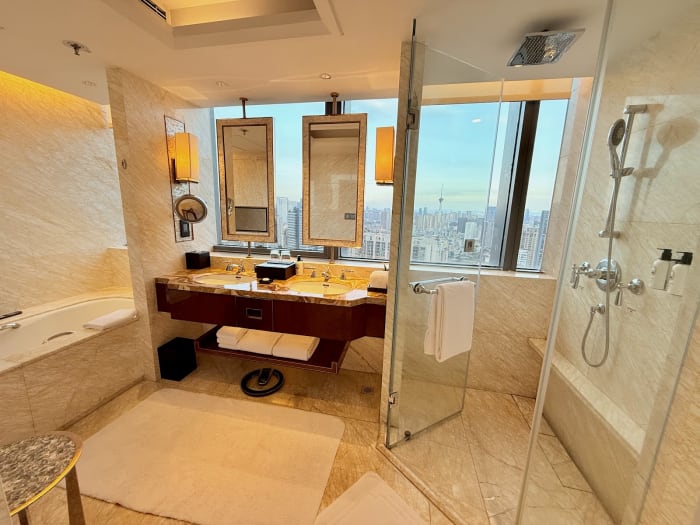
The 353 rooms are designed to enhance the overall experience of your stay. The hotel prioritises generous volumes, with sizes ranging from 49.9 to 323.5 square metres.
This spaciousness immediately alters the perception of the surroundings. Even in the more accessible categories, the space allows for smooth circulation and a natural arrangement.
The largest rooms offer a different scale altogether. They are ideal for extended stays, slower rhythms, or for those seeking an apartment-like feel.
The appeal of this collection lies in its coherence. With 353 keys, the hotel maintains a clear understanding of its offerings, based on capacity, spatial comfort, and a variety of configurations.
Here, the room is not merely a transit point. It becomes a complete living space, where the area directly contributes to the quality of rest.
In Chengdu, this generous metric lends a unique tone to the stay. It immediately instils a sense of calm, ease, and a rediscovery of time.
Dining
In Chengdu, to discuss a hotel without discussing food would be to miss an essential part of the local experience. The city occupies a singular place in the Chinese culinary imagination: it immediately evokes the depth of Sichuan cuisine, the precision of seasoning, and the balance between intensity, aroma, texture and freshness. In that context, the dining offer of a major international hotel is always watched closely. It must answer the expectations of a cosmopolitan clientele while acknowledging the importance of the place in which it stands. The Ritz-Carlton Chengdu seems particularly well positioned to play that mediating role between international comfort and local grounding.
In a property of this category, dining is never limited to a single main restaurant. It usually forms a sequence of moments: breakfast, business lunches, lighter pauses, more structured dinners, in-room dining, and informal meetings over tea or a drink. For a hotel suited to both business and leisure stays, that plurality is essential. Travellers do not simply expect good food; they expect appropriate responses to different rhythms of the day. An efficient, calm breakfast before a meeting does not follow the same codes as a slower dinner after a day of sightseeing. Success lies in that ability to adjust.
In Chengdu, one naturally hopes to find references to local culinary traditions, whether through certain emblematic dishes, the use of spices, the care given to regional flavours, or the way contemporary Chinese cuisine is presented. A grand hotel does not need to compete directly with the city’s most specialised dining rooms; that is not its primary function. It should, however, know how to introduce the traveller to a taste of place, with enough finesse to inspire further exploration. A successful hotel often acts as a gastronomic gateway: it reassures, contextualises and whets the appetite for the city beyond.
The other issue, in a house such as The Ritz-Carlton Chengdu, is the setting itself. Luxury hospitality is judged not only by what is on the plate, but by the entire scene: the tempo of service, the attention to preferences, the ability to create intimacy without stiffness, and the quality of the spaces in which one dines. In a dense urban environment, these moments take on particular value. A well-conceived lounge, a calm restaurant, or reliable in-room dining can transform the experience of a stay, especially when professional obligations alternate with personal time.
For international visitors, hotel dining also plays the role of cultural transition. After a long journey, between appointments, or on a first evening in the city, it offers familiar ground from which local flavours can be discovered gradually. For regular visitors to Chengdu, it may represent the opposite: a more cosmopolitan, neutral and restful interlude. The best hotels know how to accommodate both expectations without contradiction.
Ultimately, dining at The Ritz-Carlton Chengdu should be understood as a structuring component of the stay rather than a mere ancillary service. In Chengdu more than in many places, eating forms part of understanding the city. A great hotel therefore has the responsibility to offer a credible, flexible and elegant reading of that culinary culture. When it succeeds, it does more than feed; it accompanies the traveller in discovery, providing bearings, comfort and sometimes the simple desire to linger at the table a little longer.
Spa & Well-being
Booking treatments upon arrival speaks volumes. Well-being here is not merely an add-on but a sought-after component of the stay.
In a large urban hotel, the spa serves a specific role. It creates a decompression zone in the heart of an active city. In Chengdu, this opportunity to slow down takes on real significance. The spa becomes a tool for balance.
Its value lies in its ability to reorganise time. A treatment at the end of the day, a morning interlude, a moment of recovery after a flight. These sequences restore continuity to a stay that is often fragmented.
For business travellers, they help regain physical presence after meetings, journeys, and screens. For leisure travellers, they provide a counterpoint to the sensory intensity of Chengdu.
In high-end hospitality, well-being is not limited to the treatment menu. It also depends on the welcome, punctuality, and how the spaces prepare one for relaxation.
The best hotel spas avoid two pitfalls: the clinical coldness on one hand and artificial exoticism on the other. They favour a sober aesthetic, clear protocols, and genuine attention to the client's needs.
At The Ritz-Carlton Chengdu, this form of understated professionalism provides a reassuring experience. It suits travellers who neither have the time nor the desire for a complex ritual.
Personalisation is also crucial. The relevance of a treatment often hinges on its adaptation: pressure, duration, recovery, deep relaxation, or re-energising.
When slots fill up quickly, a reality sets in. In large city hotels, wellness spaces respond to a concrete need. They offer a luxury of time as much as a luxury of care.
Booking early guarantees this breathing space in the agenda. This hour, or these two hours, can change the tone of a trip.
For a stay in Chengdu, the spa at The Ritz-Carlton naturally extends the hotel experience. It does not oppose the city; it allows one to inhabit it more fully.
Concierge & Services
In luxury hospitality, services are valued for the way they interconnect to create a sense of fluidity. The Ritz-Carlton Chengdu combines solid fundamentals: 24-hour concierge, 24-hour reception, daily housekeeping, turndown service, luggage storage, laundry, wake-up service, and multilingual staff. Together, they form the backbone of a successful stay, especially in a large foreign city where logistical simplicity becomes a luxury in itself.
The concierge deserves to be placed at the centre of the experience. In Chengdu, a good concierge does not merely book a car or provide directions. They help prioritise the city. They distinguish what is worth visiting based on available time, current energy levels, the season, and the traveller's profile. For a first visit, this mediation is invaluable. Between cultural sites, shopping districts, gourmet addresses, panda-related excursions, and practical needs, the city can be interpreted in multiple ways. An effective concierge transforms this abundance into a coherent itinerary.
The multilingual staff plays an equally important role. In an international destination, the quality of a stay often hinges on the precision of exchanges. Being able to express a preference, a time constraint, a transport request, a dietary need, or a change of plans without friction profoundly alters the comfort experienced. This type of service is not always noticeable when it functions well. This is precisely the hallmark of its success. It creates an invisible continuity between the client, the hotel, and the city.
Daily housekeeping and turndown services represent another form of attention, more silent yet equally decisive. They remind us that a grand hotel accompanies the real rhythm of its guests. The room is not merely cleaned; it is prepared for the next sequence of the stay. After a day outside, returning to an orderly, adjusted space ready for the evening or night directly contributes to the sensation of rest. In a journey that combines time zone changes, appointments, and discoveries, this regularity holds concrete value.
Laundry, luggage storage, and wake-up services belong to those amenities that are often underestimated until they are needed. Yet, they are essential in an urban hotel frequented by on-the-go travellers. Arriving early, departing late, juggling multiple stops, or facing an unexpected wardrobe issue before a dinner or meeting: all of this is part of the travel reality. The best establishments absorb these constraints with calm efficiency.
Ultimately, the services at The Ritz-Carlton Chengdu seem designed for a clientele that expects more than just an elegant setting: a meticulous attention to detail. This is often where the difference lies between a beautiful hotel and a great address. The décor may impress for a few moments, but the service structures every hour of the stay. When executed well, it provides the traveller with a rare sensation: that of being free because the essentials have already been anticipated.
The Chengdu way of life
Staying at The Ritz-Carlton Chengdu also means coming into contact with a city whose way of life often surprises visitors by its relative softness. Chengdu is a major metropolis, yet it retains a particular relationship with time. One senses less of the harshness associated with some economic capitals and more of a coexistence between active urban life and a deeply rooted culture of ease. That nuance matters greatly to travellers. It helps explain why the city attracts both business trips and leisure stays: one can work seriously here without losing access to the pleasures of strolling, eating, sitting and observing.
One of Chengdu’s guiding threads is tea. More than a drink, it is a way of inhabiting the day. Tea houses, extended pauses, the taste for conversation and for watching daily life unfold all give the city a distinctive rhythm. Even on a short stay, it is worth seeking out this dimension, less spectacular than major sights perhaps, but more revealing of local culture. A central and comfortable hotel such as The Ritz-Carlton Chengdu makes that possible: alternating between the essentials and those more atmospheric moments that often become the best memories.
Food is the other obvious point of entry. Chengdu is discovered as much through its neighbourhoods as through its tables. Without reducing the city to its most famous flavours, one must acknowledge that eating here is a cultural activity in its own right. Markets, restaurants, regional specialities, and the contrasts between popular addresses and more contemporary settings create a highly animated culinary landscape. For the traveller, the point is not to see or taste everything, but to understand that food structures local sociability. One does not merely visit Chengdu; one also shares it around a table.
The city also possesses a cultural depth that deserves to be approached beyond familiar images. Temples, public spaces, museums, shopping districts and urban walks all offer different levels of reading. Some visitors come first for the giant pandas, a legitimate and often moving attraction, only to discover a city far more complex than expected. Others are drawn by the region’s economic energy and leave with the memory of a surprisingly liveable metropolis. In both cases, the experience benefits from being conceived as a balance between known landmarks and more subtle discoveries.
This is where the role of the hotel becomes meaningful again. A great urban address does not impose a programme; it gives guests the means to compose their own. From The Ritz-Carlton Chengdu, the city can be approached at different intensities: a dense day of meetings, a cultural morning followed by a return to calm, an outing focused on major sights, or simply a few hours spent absorbing the atmosphere of different districts. Luxury here lies not only in material comfort. It also resides in this freedom of use, in the ability to modulate one’s relationship to the city without excessive fatigue.
Ultimately, the Chengdu way of life rests on a rare combination of vitality and nonchalance, culinary sophistication and the simplicity of certain everyday pleasures, assertive modernity and the persistence of older gestures. A well-located, well-serviced hotel allows that combination to be grasped without forcing it. It is perhaps the best way to approach the city: not as a sequence of tourist obligations, but as an environment to be experienced at one’s own pace, with curiosity and a taste for slower transitions.
Book with MyConciergeHotel
Booking The Ritz-Carlton Chengdu through MyConciergeHotel means choosing a more editorial, more guided approach to the stay. For an urban address of this category, a reservation is not simply a matter of comparing rates or confirming dates. It shapes the way the hotel will be experienced and, more broadly, the way one prepares to engage with the city. Chengdu can be discovered in many ways: as an efficient business trip, a couple’s interlude, a stop on a wider Chinese itinerary, a first exploratory stay, or a more considered return. In each case, priorities differ. That is precisely where useful guidance makes a difference.
The value of a carefully considered booking lies first in clarifying the right tempo of the stay. In a central hotel such as The Ritz-Carlton Chengdu, it may be wise to anticipate a few simple but structuring points: arrival and departure times, any need for concierge assistance in advance, organisation of first transfers, spa reservations, and the balance between work and sightseeing. These details may seem secondary while planning a trip; they become decisive once on the ground. A well-framed stay is not a rigid one. It is a stay in which the essentials have been secured, leaving more room for pleasant spontaneity.
That is precisely the role of MyConciergeHotel: to place the experience back at the centre. For a major international address, this means helping travellers identify what matters most to them: centrality, calm, service fluidity, quality of rest, access to local attractions, and the possibility of carving out wellness time. In a city such as Chengdu, where the offer may appear broad and sometimes difficult to read from afar, an editorial point of view helps one choose more accurately. One is not simply booking a name or a category; one is booking a fit between a place and an intention for travel.
This approach is particularly relevant for mixed stays combining business and leisure. The Ritz-Carlton Chengdu appears well suited to that kind of use, and it is often in such hybrid configurations that guidance proves most valuable. Should one favour a dense rhythm or preserve recovery time? Include a major visit on the first day or allow the stay to unfold more gradually? Schedule the spa on arrival or towards the end? These choices may seem modest, yet they profoundly affect the quality of the journey.
Booking through MyConciergeHotel also means benefiting from a more qualitative reading of the hotel. Rather than limiting the decision to a list of amenities, the property is considered in context: its location, style, suitability for different traveller profiles and overall atmosphere. In the case of The Ritz-Carlton Chengdu, that reading highlights what appears most persuasive: a central setting, contemporary elegance with Chinese references, a warm ambience, and genuine relevance for discovering Chengdu without giving up the comfort of a major five-star hotel.
In short, booking becomes the first gesture of a successful stay. Choosing well is already a way of beginning the journey. And in a city such as Chengdu, where urban intensity is best filtered through a reliable and well-positioned address, that preparation has concrete value. MyConciergeHotel allows the hotel to be approached not as a room to occupy, but as a temporary base of life, designed to make the city more legible, more enjoyable and more fully accessible.