History & heritage
In New York, few high-end addresses combine a distinctly residential approach to hospitality with formal heritage status. The Lowell belongs to that rare category. Set on the Upper East Side, the hotel is part of a wider urban story rather than simply a hotel narrative: that of elegant apartment buildings, private clubs, cultural institutions and a discreet, old New York sensibility. Its listing on the National Register of Historic Places is not a decorative line in the marketing copy; it signals a genuine place within Manhattan’s historic fabric and gives the property a depth that is felt before one even reaches the room.
That heritage dimension matters all the more in a city defined by reinvention. In a hotel landscape often driven by headline-grabbing openings, short-lived concepts and highly performative luxury, The Lowell operates on another rhythm. Its appeal lies in continuity: a way of preserving human scale, proportion and restraint that feels closer to a private residence than to a transient hotel. Guests do not come here for spectacle, but for the sense of settling in, as though the address had been conceived for regulars rather than image-seekers.
Heritage here is not limited to a façade or an administrative designation. It is legible in the relationship between architecture, neighbourhood and use. The Upper East Side has long represented a particular idea of New York life: elegant, cultivated, residential, close to Central Park and major museum collections, yet removed from the more demonstrative energy of Midtown or creative downtown. The Lowell belongs to that social and cultural geography. It adopts its codes without caricature: muted refinement, attentive service and interiors that privilege comfort over display.
This historical depth is reinforced by another defining element of the hotel’s identity: Café Boulud. The pairing of a heritage address with a dining room associated with Daniel Boulud gives the property a distinctive character at the crossroads of New York and French tradition. Again, the interest lies not in showmanship but in coherence. Architectural heritage brings stability; culinary ambition brings vitality. Together they shape an address that is less concerned with fashion than with lasting correctness.
For French and European travellers in particular, The Lowell offers a familiar yet deeply New York reading of luxury. One finds hallmarks prized in traditional grand hotels — intimacy, service, continuity, attention to detail — within an American context where those qualities take on particular resonance. That helps explain the loyalty of many repeat guests: the hotel does not merely host a stay, it offers temporary belonging within a more residential, cultivated and quiet version of New York. In a city that changes quickly, that permanence has value in itself.
The property
The Lowell is best understood through its address. The Upper East Side is not merely one of Manhattan’s prestigious neighbourhoods; it is a territory with its own rhythms, habits and particular way of inhabiting the city. One moves differently here. The avenues are more residential, elegance feels more internalised, and the proximity of Central Park, Madison Avenue and several major cultural institutions creates a stay defined as much by quality of life as by access to New York essentials. Choosing The Lowell therefore means choosing a quieter, more settled New York, closer to an upscale neighbourhood life than to a purely touristic base.
The hotel makes full use of that location without overstating it. It does not attempt to compete with Midtown’s large-scale luxury machines or with the highly theatrical addresses of lower Manhattan. Its identity rests instead on restraint. Guests arrive with the impression of crossing the threshold of a well-kept private house, where the quality of materials, the precision of service and the calm of the spaces matter more than monumentality. That more intimate scale is central to the experience. In a city as dense, vertical and sonically charged as New York, a sense of proportion becomes a tangible luxury.
The relationship with the neighbourhood is equally important. The Upper East Side allows for very different kinds of day without ever feeling as though one is crossing the whole city. One can reach Central Park for an early walk, spend hours among the museums of Museum Mile, shop along Madison Avenue, return for lunch at the hotel or nearby, and come back to an environment that remains legible and residential. That fluidity is valuable for travellers who already know New York and wish to approach it differently, but also for first-time visitors who prefer a calm anchor to an overly abrupt immersion.
The Lowell also appeals because of the coherence between its external setting and internal atmosphere. The neighbourhood calls for a certain poise, and the hotel answers with a discreet form of luxury. One does not come here to collect spectacular public spaces, but to recover a sense of order, comfort and continuity. This suits business travellers seeking a stable pied-à-terre as much as couples, families and seasoned New York visitors who want to stay in an area where one can still feel one is living the city rather than consuming it.
This residential reading does not exclude social life. The presence of Café Boulud within the hotel introduces a particular energy, creating movement between hotel guests, informed New Yorkers and admirers of French cooking. The property gains density without losing calm. It is one of the address’s most compelling balances: offering the intimacy of a very high-end neighbourhood hotel while remaining connected to the city’s cultural and gastronomic life. For many travellers, that combination is exactly what makes The Lowell stand apart in New York.
Rooms and suites
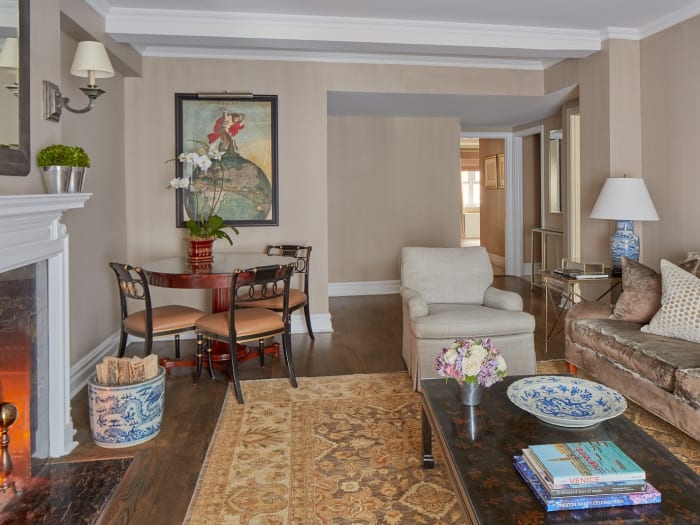
At The Lowell, the promise of the rooms and suites lies less in an accumulation of effects than in a very precise idea of urban comfort. In a city where high-end hospitality can sometimes privilege views, assertive design or density of offering, this address defends a more residential approach. A stay here is conceived as settling in. That changes the way one inhabits the space: guests do not simply sleep there between meetings or museum visits, they return to it as to a private interior, with the feeling of a stable refuge in the heart of Manhattan.
That sensation rests first on scale and tone. At a hotel such as The Lowell, rooms and suites are expected to deliver poise rather than surprise. The essential point is not immediate effect but quality of use: fluid circulation, a muted atmosphere, furniture chosen to last, lighting considered for different moments of the day, and an overall impression of intimacy. In the New York context, that residential reading has particular value. It answers the desire of many travellers to recover, after the intensity of the city, a space that soothes without ever becoming impersonal.
The hotel’s five-star positioning is expressed here through sustained attention to the fundamentals of a stay. Daily housekeeping, turndown service, a round-the-clock front desk and concierge all contribute to that continuity of comfort. Such elements may seem expected at this level, yet they become meaningful when integrated into a genuinely seamless experience: returning late after dinner, leaving early for the airport, requiring discreet assistance, or organising a dense day in the city. In this setting, luxury is not theatrical; it lies in making things easy.
The suites are especially relevant for travellers staying several nights or wishing to receive, work or simply keep a freer rhythm. In a neighbourhood such as the Upper East Side, that ability to inhabit the hotel rather than use it merely as a logistical base is essential. It suits family stays, senior business travel, longer escapes and repeat guests seeking an address capable of offering consistency. The sense of temporary residence is one of The Lowell’s major strengths.
It is also worth noting the coherence between the rooms and the rest of the experience. The relationship to heritage, the discretion of the neighbourhood, the presence of a major French dining room and the quality of service all contribute to making the private spaces the true centre of the stay. Here, the room is not simply an adjunct to the hotel’s public life; it is its culmination. That is where the correctness of the address is measured. For travellers accustomed to major international luxury hotels, The Lowell offers a valuable alternative: less demonstrative, more personal, and particularly suited to those who believe that a great hotel must first know how to provide the rare feeling of truly being at home, elsewhere.
The Dining Experience
For many travellers, the culinary aspect of The Lowell is a decisive factor. The presence of Café Boulud within the hotel provides a rare culinary foundation in New York. The restaurant boasts a Michelin star, immediately setting a high standard of expectation. Its offerings are rooted in a French interpretation of dining, framed within the New York context, and brought to life by the vision of Daniel Boulud.
Café Boulud is not merely a convenient option for hotel guests; it is a destination in its own right, celebrated for the reliability of its cuisine and an elegance that eschews rigidity. The restaurant possesses its own legitimacy, attracting an external clientele as well, which firmly anchors the hotel within the New York social scene.
The name Daniel Boulud evokes a French tradition interpreted with precision, a keen sense of ingredients, and a mastery of fine dining codes. For a hotel guest, this proximity offers a tangible advantage, allowing for a high-level dinner reservation without leaving the premises. It also facilitates a business lunch in a recognised setting.
The Lowell also features other dining spaces, including the Pembroke Room for a classic and refined afternoon tea. This variety allows guests to structure their day without the need to venture out. Breakfast, informal meetings, tea breaks, and gourmet dinners: the hotel caters to multiple needs, maintaining a consistent tone throughout.
It is often here that the attachment to the address is forged. A grand table in a prestigious hotel is valued not only for its distinction but also for its ability to transform a stay by simplifying choices and enriching experiences. One can return from a day in Manhattan, find a familiar setting, dine on-site, and then retire to their room without a break in rhythm. At The Lowell, gastronomy is an integral part of the identity of the place.
Concierge & Services
At The Lowell, services are less about a checklist of amenities and more about a seamless system of fluidity. In the Upper East Side, the quality of service becomes a central criterion. The hotel appears designed to simplify New York without altering its rhythm.
The 24-hour concierge plays a crucial role here. Restaurant reservations, transfers, last-minute requests, tailored recommendations: a precise team profoundly transforms the experience. They eliminate time-wasting, offer credible alternatives, and adjust the day's itinerary according to the client's priorities.
The continuously open reception, luggage service, laundry, wake-up calls, daily housekeeping, and turn-down service form the fundamentals of a great international hotel. Their value lies in the consistency of their execution. The multilingual staff enhances this clarity for an international clientele.
This type of service caters to travellers accustomed to New York, couples, families, or clients balancing professional obligations with social life. All seek reliable, discreet, and well-calibrated assistance.
In New York, the value of hotel service is often measured by the time and energy it preserves. A well-managed reservation, an easy departure, a handled luggage, a late return welcomed with simplicity: these gestures directly influence the quality of the stay. The Lowell embodies a hospitality founded on continuity, availability, and discretion.
The Upper East Side way of life
Staying at The Lowell also means adopting, for a few days, a particular way of living New York. The Upper East Side does not present the city at its most spectacular, but at one of its most liveable. It is a neighbourhood that privileges habits over performance, lasting addresses over novelty effects, and well-composed walks over frenetic itineraries. For travellers who already know Manhattan, that tone is often a relief. For first-time visitors, it offers a calmer, more structured and more elegant introduction.
The proximity of Central Park sets the rhythm. In the morning, the city can begin with a walk, a light run or simply a turn through the tree-lined paths before breakfast. That immediate relationship with a major landscaped space changes the quality of an urban stay. It allows one to breathe, to slow down, and to place New York within a more sensitive scale. Added to this is the presence of museums and cultural institutions for which the area is known. Without multiplying journeys, one can shape days in which art, architecture, fashion, shopping and gastronomy answer one another with remarkable fluidity.
Madison Avenue and the surrounding streets extend this idea of a less demonstrative luxury. Here, retail is often based on selection, advice and loyalty rather than agitation. For an international clientele accustomed to major capitals, the Upper East Side is a reminder that New York can also be a city of details, chosen appointments, quiet cafés and shop windows observed without urgency. The Lowell fits naturally into that geography. It does not overplay it; it is one of its most coherent hotel expressions.
In the evening, the experience takes another form. One may dine at Café Boulud and remain within a highly controlled register, or use the hotel as a base from which to reach other cultural and gastronomic scenes across Manhattan before returning to a neighbourhood that quickly recovers its calm. That ability to alternate intensity and retreat is part of the address’s privilege. New York remains available, but it does not invade everything. The hotel acts as an intelligent filter between city and traveller.
This is perhaps where the singularity of The Lowell’s art de vivre lies. It does not promise a fantasised version of Manhattan, but provides access to a more accurate, more lasting and more personal experience of the city. One learns to appreciate short distances, returns to calm, well-paced days, meals that matter, services that simplify, and neighbourhoods with memory. For those who associate luxury not with excess but with quality of use, The Lowell offers a particularly convincing way of inhabiting New York.
Book with MyConciergeHotel
Booking The Lowell through MyConciergeHotel means approaching the property with a stay logic rather than a purely rate-driven one. A hotel such as this is rarely chosen at random. Its appeal lies in subtle balances — neighbourhood, atmosphere, style of service, heritage dimension, the presence of a Michelin-starred dining room — that need to be properly understood in order to deliver their full value. Editorial and concierge guidance makes exactly that possible: shaping the booking around the right use of the place, the right travel rhythm and the guest’s actual expectations.
The Lowell does not answer every profile in the same way. Some travellers will seek a residential refuge for a cultural stay on the Upper East Side. Others will prioritise the proximity of Café Boulud and the possibility of making gastronomy a central axis of the trip. Others still will value the address for its discretion, continuity of service and ability to offer a calmer New York without giving up access to Manhattan’s major appointments. Booking intelligently therefore means clarifying what one expects from the stay: neighbourhood immersion, a romantic escape, high-end business travel, a family interlude, or a return to a familiar address.
MyConciergeHotel helps place those expectations in perspective with the property’s concrete strengths. The presence of a one-Michelin-star restaurant on site, listing on the National Register of Historic Places, a 24-hour concierge and an Upper East Side location are not interchangeable selling points; together they define a very precise type of experience. The value of dedicated guidance lies in turning those elements into real advantages: securing the right table at the right time, organising coherent days, anticipating service needs, or simply choosing the hotel in full awareness rather than in response to a generic image of New York luxury.
For regular New York travellers, this approach is especially useful. It allows them to move beyond habitual reflexes — Midtown for convenience, downtown for energy, major chains for reassuring standardisation — and consider an address that offers something else: a more personal relationship with the city. For first-time visitors, it provides a legible framework capable of making the stay smoother and more enjoyable. In both cases, the aim is not merely to book a room, but to shape a stay correctly.
That is the point of booking through MyConciergeHotel: restoring the hotel to its context, qualifying the experience, and ensuring that each detail truly matters. The Lowell lends itself particularly well to that reading. Because it rests on nuance, guest loyalty and a discreet form of luxury, it benefits from being chosen with discernment. When it matches the journey being sought, it does not simply become a good New York address; it becomes a very precise, very comfortable and very coherent way of staying there.