History & Heritage
In Kyoto, hospitality is never merely a list of services: it is a language, a rhythm, a way of welcoming the traveller into a broader cultural continuum. Kanamean Nishitomiya belongs to this Japanese tradition in which attention to detail, restraint in form and respect for the seasons shape the experience as much as the stay itself. As a member of Relais & Châteaux, the property favours character and authenticity over any ostentatious display of luxury. Refinement here lies in balance, in precision, and in the coherence between interiors, service and cuisine.
The address evokes the heritage of Japanese houses of welcome, places where one sought not only shelter but also a setting for rest, conversation and contemplation. In Kyoto, the former imperial capital, that idea carries particular resonance. Over centuries, the city has cultivated an aesthetic of measure: natural materials, softened light, fluid transitions between indoors and out, the value of silence, and a deep regard for time. Staying at Kanamean Nishitomiya means entering that heritage without feeling as though one is visiting a museum. The experience remains alive, supported by contemporary comforts and present-day expectations.
What makes the property compelling is precisely this dialogue between Japanese tradition and the needs of an international traveller accustomed to attentive service. It has the spirit of a distinctive address, where each space appears designed to preserve privacy and encourage a gradual slowing down. Luxury is not expressed through excess but through rightness: a room prepared with care, a welcome available at any hour, cuisine shaped by seasonal produce, and an atmosphere that invites repose. In a city as symbolically dense as Kyoto, such a sense of breathing space is invaluable.
Kanamean Nishitomiya also reflects a Japan that transmits culture without turning it into performance. The immersion promised by the hotel does not rely on theatrical gestures, but on daily contact with materials, flavours and manners that belong to Japanese life. Guests come to understand Kyoto almost by osmosis: in the way a space is ordered, in the attention paid to the season, in the discreet service, and in the room left for quiet. This fidelity to an art of receiving explains the enduring appeal of such houses for travellers seeking meaning as much as comfort.
For those familiar with grand international hotels, Kanamean Nishitomiya offers another definition of five-star hospitality: less spectacular, more inward. One comes here for a distinctly Japanese sense of ease, where nothing feels contrived and everything contributes to a rare impression of coherence. It is this coherence, profoundly Kyoto in spirit, that forms the property’s true heritage.
The Property
One of Kanamean Nishitomiya’s chief qualities is that it offers a human-scale address in a city often approached through its major landmarks. Kyoto draws visitors for its temples, gardens, shrines, historic districts and seasonal rituals; yet the quality of a stay also depends on how one inhabits the city between excursions. In that respect, the hotel’s peaceful setting matters greatly. It provides what many discerning travellers seek in Kyoto: the ability to remain within easy reach of the city’s historic treasures while returning each day to genuine calm.
The property feels conceived as a counterpoint to the intensity of the destination. Kyoto can be exceptionally busy, especially during the coveted spring and autumn periods, and the hotel offers a welcome sense of retreat. This is not isolation, but rather a more subtle way of experiencing the city. One begins to understand that Kyoto reveals itself as much in its interstices as in its monuments: a quieter neighbourhood, a side street, late-afternoon light on a façade, softened footsteps, a sense of time moving more slowly. Kanamean Nishitomiya’s location supports precisely that more nuanced reading.
Inside, the atmosphere rests on a carefully judged balance between Japanese tradition and modern comfort, one of the property’s defining strengths. The point is not to juxtapose old-world codes and contemporary amenities for decorative effect, but to allow them to converse naturally. The shared spaces appear composed with care, favouring serenity over display. One imagines restrained lines, materials chosen for their discreet presence, and a treatment of light that follows the rhythm of the day. This quality of ambience is essential: it prepares the guest to settle into a different tempo, one that is more attentive and receptive.
Its membership of Relais & Châteaux also clarifies the hotel’s positioning. Guests expect a strong sense of identity, a real feeling for place, cuisine that matters to the overall experience, and service capable of anticipating needs without heaviness. Kanamean Nishitomiya seems to answer that brief through intimacy rather than grandeur. It is an address particularly well suited to travellers drawn to Japanese culture, couples seeking a hushed stay, or anyone who prefers characterful houses to standardised large-scale hotels.
The property also makes an excellent base from which to explore Kyoto thoughtfully. From a peaceful neighbourhood, days can be arranged with flexibility: an early departure to enjoy a site before the crowds, a return in mid-afternoon for a pause, dinner at the hotel or an evening stroll. That freedom changes the nature of the trip. Rather than simply moving from one attraction to the next, guests can shape a more inhabited stay in which the hotel is not merely somewhere to sleep, but an integral part of the Kyoto experience.
Rooms & Suites
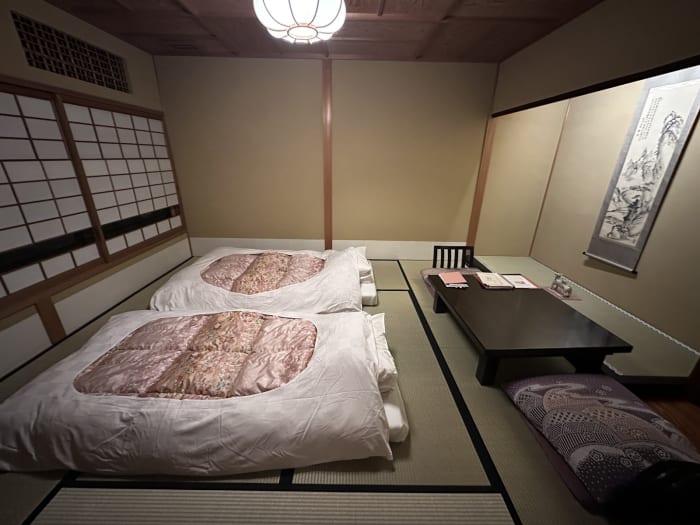
At a property such as Kanamean Nishitomiya, the room is not merely a private space; it is the heart of the experience. In Kyoto, where days are often spent exploring temples, historic lanes, gardens and museums, returning to the hotel should bring an immediate sense of release. That is precisely what one expects here: rooms and suites designed to extend the calm that permeates the house as a whole. Modern comfort is present, yet it is expressed through an aesthetic of restraint that remains faithful to the Japanese spirit associated with the property.
The appeal of such accommodation lies in the way it reconciles two expectations that are not always easy to balance: authenticity and ease of use. Many travellers wish to experience Kyoto through something other than an interchangeable international décor; at the same time, they expect a five-star standard in bedding, service, housekeeping and attention to detail. The hotel’s known amenities — daily housekeeping, turndown service, laundry, wake-up service on request, and a 24-hour front desk and concierge — support that promise. They ensure a discreet fluidity, essential in a house that values serenity over display.
One can imagine rooms in which materials play a central role: wood, textiles, understated surfaces and a soothing palette. In Kyoto, beauty often arises from controlled simplicity, from the breathing space between elements, from the absence of excess. This approach is particularly well suited to travellers seeking a more sensitive relationship with space. A successful room here is not one that accumulates obvious signs of luxury, but one that allows the guest to recentre after a full day. Silence, clarity of layout, the quality of evening preparation, and a sense of order and cleanliness all become part of comfort.
The hotel seems especially well suited to couples. Its intimate character, already evident in the overall description, naturally carries through to the room experience. It offers the conditions for a romantic stay without overstatement: the feeling of being sheltered, the ability to slow down, to take time over tea, a bath, a book, or a conversation after a walk. This kind of intimacy is all the more valuable in Kyoto, a city that invites aesthetic emotion; it is a pleasure to be able to extend that emotion in surroundings that feel consistent with it.
Where suites are available in a house of this kind, they are generally sought not for grandiosity but for the additional space they lend to the stay. They allow guests to inhabit the hotel more fully, to create moments of pause, or simply to enjoy a more generous setting. Whether one chooses a room or a suite, the essential point remains the same: Kanamean Nishitomiya appears to offer accommodation conceived as a cultural and sensory refuge, where Japanese tradition is never a static backdrop, but an atmosphere placed in the service of rest.
Dining
Dining is one of the most important dimensions of a successful stay in Kyoto. In a city where seasonality, precision of gesture and respect for ingredients are central, the table is never merely practical; it extends one’s understanding of place. Kanamean Nishitomiya highlights seasonal cuisine prepared with local ingredients, a particularly apt positioning in the Kyoto context. More than a culinary promise, it is a way of anchoring the meal within the cultural landscape of the city and its surroundings.
In Kyoto, attention to the natural calendar has deep roots. Flavours, textures, colours and even the presentation of a meal often respond to the time of year. Spring, summer, autumn and winter are not simply climatic markers here; they shape the way people cook and receive. A property that embraces this seasonal sensitivity therefore places itself within a demanding local tradition. For the traveller, this means the dining experience is not fixed; it changes with the period of the stay and reflects, in its own way, the state of the world outside. It is one of the most subtle pleasures of a characterful hotel in Japan.
The use of local ingredients strengthens this sense of rootedness. In Kyoto, the idea of terroir takes many forms: vegetables, condiments, broths, delicate preparations, sweets and teas. Without claiming details that are not confirmed, one can say that the hotel appears to favour an approach in which provenance and freshness matter as much as technique. That aligns well with the Relais & Châteaux spirit, in which the table forms a full part of the property’s identity. The meal becomes a moment of attention, almost a reading of the territory.
For guests, this gastronomic dimension also has a practical virtue: it allows them to experience Kyoto without having to organise every dinner elsewhere. After a day of sightseeing, there is real pleasure in returning to a cuisine that remains consistent with the spirit of the stay. In an intimate and peaceful setting, dinner takes on another tone. It is no longer simply about eating, but about bringing the day to a close with a sense of rightness and continuity. Breakfast, too, can play an important role in a house of this kind, setting a more measured relationship to time and flavour from the start of the morning.
Kanamean Nishitomiya’s table is likely to appeal to travellers who seek less a showpiece signature than the depth of an experience attuned to its surroundings. In Kyoto, the most memorable meals are not always those that impress most loudly, but those that feel inevitable, as though they could only happen here and at this exact moment. Seasonal cuisine based on local produce, served in a serene setting, answers that expectation perfectly. It makes the hotel not only a place to sleep well, but an address through which to taste the city with greater subtlety.
Concierge & Services
In characterful hospitality, the quality of service is often measured by its discretion. Kanamean Nishitomiya appears to belong to that category of addresses where efficiency does not need to be theatrical in order to be felt. The known services — 24-hour concierge, 24-hour front desk, daily housekeeping, turndown service, luggage storage, laundry, wake-up service and multilingual staff — sketch the portrait of an attentive house, capable of supporting both short stays and longer interludes in Kyoto. In a city often explored on foot, by public transport or through dense cultural itineraries, such operational reliability matters enormously.
The concierge in particular plays a decisive role in a destination such as Kyoto. More than a simple information point, it can become the interface between the visitor and a city whose codes, distances and rhythms are not always immediately legible. Knowing when to leave in order to avoid crowds, organising a transfer, suggesting a neighbourhood for a walk, or helping to shape a day according to mood: this kind of assistance tangibly transforms the travel experience. In an intimate property, that relationship can be even more valuable, because it is more readily adapted to the guest than to a standardised system.
A continuously staffed reception brings welcome flexibility, especially for late arrivals, early departures or changes of plan. Kyoto is often part of a broader journey through Japan; train schedules, transfers and onward connections can impose varying rhythms. Being able to rely on a constant presence at the hotel makes the stay feel more secure and allows guests to travel more lightly. Luggage storage, meanwhile, eases transitional days: one can enjoy the city before check-in or after check-out without being burdened.
Daily housekeeping and turndown service contribute to that sense of ongoing care that distinguishes good houses from merely efficient ones. They are not only about material comfort; they also shape the psychological quality of the stay. Returning to a room that has been put in order and prepared for the evening is especially pleasing after a day spent in Kyoto’s visual and emotional intensity. Laundry and wake-up service complete the offering usefully, particularly for long-haul travellers or those wishing to keep to a precise schedule.
Finally, the presence of multilingual staff deserves note. In a hotel welcoming an international clientele in search of cultural immersion, the ability to communicate clearly while preserving the subtlety of the welcome is essential. It removes unnecessary friction and allows the guest to focus on what matters most: experiencing Kyoto with ease. At Kanamean Nishitomiya, services appear designed not to dominate the stage, but to make possible a stay that feels serene, continuous and deeply hospitable.
The Kyoto Art of Living
Staying at Kanamean Nishitomiya also means choosing a particular way of approaching Kyoto. The city does not lend itself well to hurried consumption. Its major sites are naturally compelling, and it is understandable to want to see as much as possible; yet Kyoto reveals more to those willing to move at its pace. A hotel set in a peaceful neighbourhood and oriented towards cultural immersion encourages precisely that frame of mind. It invites the traveller to think of the journey not as a list of sights to tick off, but as a sequence of moments attuned to season, light, silence and the quality of transitions.
Spring and autumn are often considered the most appealing times to discover the city, and with good reason. The landscapes take on a particular intensity, whether through blossom or foliage. Yet beyond these celebrated images, Kyoto offers above all an education of the eye. One learns to notice nuances: the texture of a dry garden, the patina of old wood, the line of a pathway, the way a temple sits in its surroundings, the contrast between lively thoroughfares and more restrained streets. In that context, the choice of a serene hotel is not a minor logistical matter; it shapes the depth of the experience.
Kanamean Nishitomiya seems especially well suited to travellers who wish to alternate cultural discovery with moments of retreat. That alternation is essential in Kyoto. Without it, the city can become a succession of admirable but tiring images. With it, each visit regains its density. One leaves early to enjoy a shrine in softer light, returns for a rest, heads out again to explore a historic district, and ends the day with a seasonal dinner. Gradually, another relationship to travel emerges: less hurried, more inhabited, more attentive to the resonances between places.
The Kyoto art of living also lies in the importance given to simple gestures. Taking time over tea, walking without a fixed aim along a quiet street, pausing before an understated shopfront, listening to the rain, noticing a flower arrangement or the composition of a dish: these details, taken together, give a stay its depth. A hotel that values authenticity and hospitality without sacrificing modern comfort provides an ideal setting for such sensitivity. It allows the traveller not to remain on the surface of the destination.
This may be the property’s truest promise. More than accommodation, Kanamean Nishitomiya offers an entry point into a form of Kyoto experienced from within, with gentleness and coherence. Couples will find a setting conducive to intimacy; admirers of Japanese culture, an environment aligned with their expectations; seasoned travellers, an alternative to more impersonal hotels. In every case, the essential remains the same: the possibility of encountering Kyoto not in haste, but through a rarer quality of presence — the kind that leaves lasting memories because it has allowed space around them.
Book with MyConciergeHotel
Choosing Kanamean Nishitomiya through MyConciergeHotel means favouring a reservation conceived as guidance rather than a mere transaction. For a characterful address in Kyoto, that distinction is far from incidental. The success of a stay in an intimate house often depends on subtle decisions: the time of year, the desired rhythm, the kind of experience sought, one’s interest in dining, the need for a smooth arrival, or the wish to experience the city in its quieter dimension. A specialist platform focused on high-end hospitality makes it possible to consider these elements properly before departure.
Kanamean Nishitomiya appeals to travellers who are looking not only for a high level of comfort, but for an overall sense of coherence. Its membership of Relais & Châteaux, its emphasis on immersion in Japanese culture, its peaceful Kyoto setting, its balance of tradition and modern comfort, and its seasonal cuisine based on local ingredients all make it an address best recommended with discernment. Booking through an editorially minded specialist such as MyConciergeHotel allows the hotel to be approached for what it truly is: not a standard product, but a house that answers a particular set of expectations.
This approach is especially useful in Kyoto, where the timing of a stay strongly influences the experience. The most sought-after periods, particularly spring and autumn, often require advance planning. Yet beyond availability, it is equally important to consider how one wishes to live the destination. A couple on a romantic escape will not have the same priorities as a traveller devoted to Japanese culture, or a seasoned visitor to Japan seeking calm. The value of tailored guidance lies in helping to clarify those priorities so that the right hotel matches the right journey.
MyConciergeHotel also adds practical value in preparing the stay. The existing advice to arrange airport transport for a serene arrival is telling: after a long-haul journey to Japan, the quality of the first few hours matters greatly. Being met, reaching the hotel without friction, and settling quickly into a peaceful atmosphere immediately changes the tone of the trip. In a property such as Kanamean Nishitomiya, where everything seems designed to encourage slowing down, that continuity is particularly welcome.
Finally, booking through MyConciergeHotel means benefiting from an editorial perspective capable of placing the property within the wider hotel landscape. Kyoto offers a rich selection, but not every address answers the same travel desire. Kanamean Nishitomiya will suit those who value intimacy, authenticity, culture and a certain gentleness of living. If that is precisely what you are seeking, then this house deserves to be considered not as a mere base, but as one of the guiding threads of the stay. In that sense, MyConciergeHotel fulfils its purpose: turning a booking into an informed choice.