History & heritage
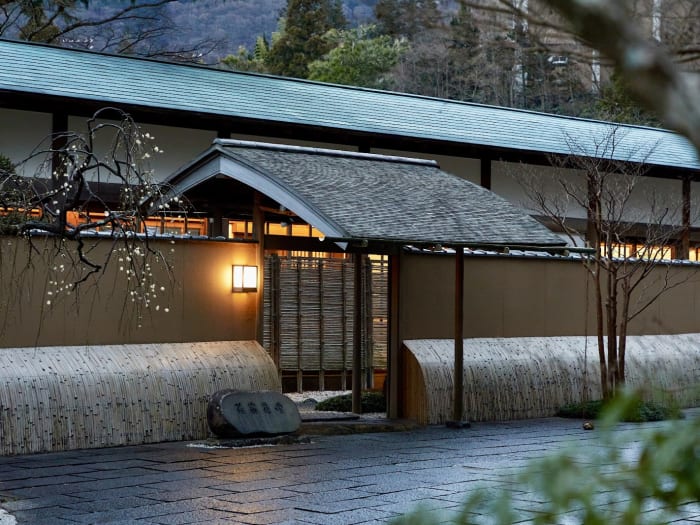
In Hakone, where mountains, forests and the steam of hot springs have long shaped a landscape of retreat, Hotel Gora Kadan belongs to a distinctly Japanese idea of hospitality: a place designed to slow time, protect privacy and connect the traveller with the surrounding environment. More than a luxury hotel, the address evokes the heritage of the ryokan, the traditional inn where the experience rests as much on gestures, materials and the seasons as on comfort itself. Here, traditional Japanese architecture is not a decorative device for the eye; it shapes the way one inhabits the spaces, moves between indoors and outdoors, observes a garden, listens to silence and senses the presence of water.
The name Gora Kadan is associated with a certain idea of Japanese refinement, one built on restraint, precision and attentiveness. In this kind of property, heritage is not read only in a façade or a few preserved details, but in a continuity of practices: measured welcome, room preparation, turndown, discreet staff, the importance of bathing rituals and the rhythm of meals. Luxury takes on a particular form here, less demonstrative than in grand urban palaces, yet often more profound. The aim is not to impress, but to create the conditions for an experience that feels entirely right.
Hakone has long held a singular place in the imagination of travel in Japan. Easily reached from Tokyo while offering a genuine sense of removal, the region is known for its onsen, varied relief, shifting views and its ability to move, within a matter of hours, from urban intensity to something almost meditative. In this context, Gora Kadan stands out as a retreat in the noblest sense. Its membership of Relais & Châteaux also places the hotel within an international collection of properties where sense of place, quality of welcome and connection to local culture matter as much as service standards.
What defines the hotel is the carefully balanced dialogue between heritage and contemporary comfort. Guests come for an immersion in Japanese culture, yet without giving up the expectations attached to a leading five-star stay: seamless service, constant attention, thoughtful facilities, and the reassurance of concierge and front desk teams available around the clock. Heritage is not frozen here; it is interpreted intelligently for modern travellers. This ability to preserve an authentic atmosphere while delivering a highly polished stay explains much of the property’s enduring reputation.
To stay at Gora Kadan is therefore to enter a story larger than that of a hotel alone: the story of Hakone as a destination for restoration, of thermal bathing as a way of life, and of a Japanese aesthetic that values emptiness, natural materials and attention to the present moment. For travellers seeking something beyond a checklist of sights, the property offers a lived form of cultural experience, understood as much through sensation as through observation.
The property
One of Hotel Gora Kadan’s greatest strengths lies in the way it is set within the landscape of Hakone. The peaceful natural surroundings, among its defining characteristics, are not merely a backdrop: they shape the entire stay. As one leaves the city behind and the road climbs, the atmosphere changes. The air grows cooler, vegetation becomes more present, and it becomes immediately clear why this region has long been associated with rest, bathing and contemplative escapes. The hotel makes full use of this geography. It offers an ideal base from which to explore Hakone, while also making it very tempting to remain within its grounds.
Traditional Japanese architecture plays a central role here. It organises a subtle relationship between built volumes and the surrounding nature, between restrained structural lines and the softness of gardens, between circulation spaces and moments of pause. In a property of this kind, luxury is measured not only by room size or the sophistication of facilities, but by the quality of transitions: from corridor to open view, from threshold to resting place, from bath to terrace, from room to garden. This fluidity, deeply Japanese in spirit, creates an immediate sense of calm.
Guests encounter a place that does not seek to overwhelm the senses. Natural materials, muted tones and carefully composed spaces encourage a slower form of perception. One notices a detail of joinery, a change in light across the floor, the discreet sound of water, the way a garden frames the eye. This aesthetic of restraint is one of the property’s great charms. It allows each guest to settle into a more inward rhythm, particularly valuable for travellers arriving from Tokyo or other major Asian cities.
The hotel’s location, close to the region’s celebrated hot springs, reinforces this sense of rightness. Hakone is one of Japan’s best-known thermal destinations, and staying at Gora Kadan means placing oneself at the heart of a territory where naturally heated water shapes habits, landscapes and local imagination. This proximity to onsen culture gives the stay a particular coherence: one does not simply come to sleep in a beautiful hotel, but to inhabit, for a few nights, a culture of restoration.
Another important asset is the property’s ability to suit both a stay devoted entirely to rest and a more active discovery of Hakone. Couples in search of a romantic retreat, travellers drawn to architecture, admirers of Japanese culture, or guests making a stop within a wider itinerary from Tokyo to other parts of the country will all find a setting that feels coherent and complete. Spring and autumn are especially appealing for the quality of the scenery, while summer tends to attract more visitors. In every season, the hotel retains that rare ability to make the place itself feel as important as the destination.
Rooms and suites
At a property such as Gora Kadan, the room is not merely a place to sleep; it is the centre of the experience. Here one finds what makes the finest Japanese addresses so distinctive: a way of conceiving space not as an accumulation of objects or effects, but as a balanced composition of emptiness, light, materials and use. Modern comfort is certainly present, yet it recedes behind a more essential impression of calm, clarity and harmony. It is precisely this restraint that gives the rooms and suites their lasting character.
The aesthetic vocabulary one expects in this context favours clean lines, natural materials and a soothing palette. Wood, understated textiles, pale surfaces and openings that frame nature all contribute to a sense of inevitability. Traditional Japanese influence appears less through ornament than through the relationship to the floor, to light and to the rhythm of everyday gestures. One enters, sets down one’s belongings, sits, observes, and very quickly the room imposes a different tempo. The stay takes on an almost ceremonial quality, without ever becoming rigid.
Part of the appeal of this kind of address lies in the privacy it preserves. Even when the hotel is in high demand, the in-room experience is generally designed to protect silence and a sense of withdrawal. This is especially important for couples, among the guests most naturally drawn to the property. Romance here is not created through artifice, but through the quality of the setting: discreet service, serene proportions, and the possibility of being together far from agitation in an environment that encourages conversation, reading, rest or simple contemplation.
Daily service strongly reinforces this impression of effortless comfort. Housekeeping, turndown, the constant availability of front desk and concierge teams, luggage handling and laundry all contribute to a stay that feels smooth and unforced, where practical needs are taken care of discreetly. In high-level Japanese hospitality, this precision of service matters as much as the facilities themselves. It allows travellers to focus on what they came to find: a pause defined by calm, beauty and restoration.
The rooms and suites at Gora Kadan therefore speak to travellers who appreciate a quieter form of luxury. One does not come here for a display of prestige, but to inhabit a space that soothes almost immediately. After a day spent exploring Hakone, enjoying the baths or moving through the wider region, returning to one’s room becomes a moment in itself. The door closes, the outside world recedes, and one rediscovers that rare feeling of being exactly where one ought to be. In a luxury market often tempted by excess, this ability to offer an inward, coherent and deeply restful experience remains one of the property’s finest achievements.
Dining
At Gora Kadan, dining forms a natural part of the wider experience of the property. In Japanese tradition, a meal is never entirely separate from architecture, the rhythm of the day, the season or the landscape; it extends a particular way of inhabiting time. This is especially true in a hotel that offers immersion in Japanese culture. Guests do not come only in search of fine cuisine, but of a certain relationship to precision, temporality and presentation. The meal becomes a discreet yet essential language of hospitality.
Without going beyond confirmed information, it is fair to say that the spirit of dining in a property of this nature generally rests on seasonality, respect for ingredients and balance of flavours. In Japan, refined cuisine is not defined by technical display alone; it also lies in the ability to convey a moment in the year, a particular freshness, a precise texture, a harmony among the elements served. For international travellers, this approach often feels revelatory: it shows that culinary luxury may be a matter of measure rather than abundance, of clarity rather than spectacle.
The setting in which meals are taken matters as much as what is on the plate. At a hotel like Gora Kadan, one expects a restrained staging in which space, light and quiet all contribute to pleasure. To dine in such surroundings, in the heart of Hakone, is also to continue the dialogue with the landscape. The mountains, vegetation, moisture in the air and proximity of hot springs all subtly influence the perception of the meal. Taste is never isolated; it belongs to an atmosphere.
For many travellers, culinary discovery is one of the principal reasons for choosing this kind of address. It offers a way into Japanese culture through one of its most sensitive registers. The gestures of service, the sequence of dishes, the attention paid to tableware and the temperature of preparations all communicate as much as flavour itself. When handled with tact, the staff can make the experience more legible for international guests without diminishing its authenticity.
Dining also takes on a particular dimension within a restorative stay. After bathing, after a day of walking or contemplation, dinner becomes a moment of re-centring. Breakfast, meanwhile, may provide a calm and structured beginning to the day. In both cases, the aim is not performance but coherence. One eats here as one stays here: attentively, in peaceful surroundings, at the pace of a place that encourages slowness. It is this continuity between hospitality, environment and culture that gives the dining experience at Gora Kadan its real depth.
Spa & wellbeing
To speak of wellbeing at Gora Kadan is first to speak of Hakone. The region is inseparable from hot spring culture, and this proximity to onsen is one of the foundations of the experience. In Japan, thermal bathing is not merely an amenity; it is a long-established practice that is at once daily, social, contemplative and restorative. It engages the body, certainly, but also attention, silence and one’s willingness to become available to a place. In a hotel such as this, wellbeing is therefore not reduced to a list of treatments. It is organised around a philosophy of release and renewal.
The first luxury here is time. To take a bath, linger in it, let the heat work, watch the steam, feel the cooler air upon leaving the water: these simple gestures regain a particular density in such peaceful surroundings. Being in Hakone, close to the region’s celebrated hot springs, gives the stay a depth that few other destinations can offer. One does not consume wellbeing as a decorative interlude; one enters a territory where naturally heated water forms part of local life and of the very identity of travel.
Traditional Japanese architecture strengthens this experience. It encourages a gentle movement between indoor and outdoor spaces, between the warmth of the baths and the freshness of the natural setting. The body becomes more aware of contrasts, textures and changes in light. This sensory attentiveness, so present in Japanese bathing culture, contributes to a deeper relaxation than a simple moment of rest. The calm of the property, the absence of visual noise and the quality of materials all play their part in this sense of re-centring.
For international travellers accustomed to Western spas, the experience can be especially striking. It serves as a reminder that wellbeing is not necessarily about multiplying protocols or pursuing excessive sophistication. It may arise from a right relationship between water, silence, space and rhythm. In this context, even the simplest moments — sitting quietly after a bath, taking a drink, returning slowly to one’s room — acquire a new value. The entire stay becomes a kind of gentle cure.
This is also what makes Gora Kadan particularly well suited to couples and to anyone seeking restoration far from urban agitation. Wellbeing is conceived here as a complete experience, beginning on arrival and extending into the room, the table, the gardens and the quality of service. Guests often leave with the feeling that they have genuinely changed pace. In a hotel world where the word ‘spa’ is sometimes used generically, Gora Kadan is a reminder that a truly memorable wellbeing stay depends first on coherence of place, culture and atmosphere.
Concierge & services
Service at Gora Kadan appears to follow a logic of discretion rather than display. This is one of the most appreciated signatures of Japanese hospitality at a high level: everything feels simple because everything has been carefully considered in advance. Guests are not constantly addressed, but accompanied with precision. This quality of attention, difficult to describe and yet immediately perceptible, often marks the difference between a very good hotel and one that leaves a lasting impression.
The known service features confirm this sense of continuity. A 24-hour front desk and round-the-clock concierge provide the flexibility expected by international travellers, whether for arrivals, departures, special requests or last-minute adjustments. Daily housekeeping and turndown contribute to the feeling of a stay that is impeccably maintained, where the room remains inviting at all times without staff presence ever feeling intrusive. Luggage storage, laundry and wake-up service complete a set of practical offerings that address the concrete needs of travellers efficiently.
In a setting such as Hakone, the concierge has a particularly interesting role. It is not simply about organising logistics; it can also help give shape and meaning to the stay. Advising on the right pace of exploration, suggesting the best moment to enjoy the region, facilitating certain transfers, or guiding guests towards experiences suited to their profile all belong to a form of service that goes beyond execution. In a destination often chosen for restoration, knowing how to balance activities and preserve time for rest is almost as important as filling an itinerary.
The multilingual staff mentioned among the known facilities is another genuine asset. In a hotel welcoming an international clientele, the ability to explain certain cultural practices and aspects of the bathing ritual or stay experience clearly contributes greatly to guest comfort. Again, the aim is not to turn the experience into a lesson, but to make hospitality more fluid and accessible without erasing its Japanese distinctiveness.
What ultimately distinguishes service at Gora Kadan is its coherence with the place itself. In surroundings this serene, service that is too visible or theatrical would feel out of place. Excellence here is expressed instead through precision, consistency and the ability to anticipate without intruding. For travellers familiar with leading houses, this form of mastery is immediately legible. It allows guests to enjoy the hotel, its baths, its atmosphere and the wider region with the reassuring sense that everything is being quietly taken care of. It is a very exact definition of luxury: a stay in which nothing feels heavy because everything has been considered with tact.
The art of living in Hakone
A stay at Hotel Gora Kadan is also a way of discovering Hakone as a mode of being rather than merely a destination. Within reasonable reach of Tokyo, the region offers one of the most appealing contrasts in contemporary Japan: the possibility of leaving behind an intense metropolis and, within a short time, entering a geography of mountains, forests, mist and hot water. This shift explains much of Hakone’s enduring appeal. People come here to breathe differently, to walk, to contemplate, to bathe, but also to reconnect with a form of slowness that has become increasingly rare.
The local art of living rests first on this distinctly Japanese relationship to the seasons. Spring and autumn, often especially prized, transform the landscape and alter the tone of the stay. Colours, light, air temperature, the density of foliage and the clarity of views give each period a distinct personality. Summer, busier and more animated, carries a different energy, with denser nature and a sense of refuge sought by many travellers. In every case, Hakone lends itself to a sensory experience of time in which the landscape is never static.
The region is of course renowned for its hot springs, but it is not defined by them alone. Hakone is also a territory of walks, viewpoints, winding roads and pauses that teach one how to look. The attentive traveller discovers a balance between activity and retreat. One may devote part of the day to exploration, then return very quickly to a more inward rhythm. It is this alternation that makes the stay so satisfying: there is no need to choose between discovery and rest.
From Gora Kadan, this philosophy becomes especially clear. The hotel acts as a gracious filter between visitor and destination. It allows guests to experience Hakone without haste, privileging quality over accumulation. A morning may begin in the calm of the room, continue with a bath, unfold into an outing in the region, and then return to the hotel for dinner and a quiet evening. This apparent simplicity is in fact deeply valuable: it restores a sense of coherence to travel.
For French or European travellers, Hakone often represents one of the most accessible and immediate expressions of a certain imagined Japan — not a fixed postcard version, but one in which aesthetics, relationship to nature and the culture of care genuinely meet. Gora Kadan embodies that meeting with particular grace. The property does not seek to folklorise the destination; it offers an inhabited, elegant and serene reading of it. That is why a stay here extends far beyond the idea of a hotel night: it becomes a sensory introduction to a way of living.
Book with MyConciergeHotel
Choosing Gora Kadan through MyConciergeHotel means approaching the stay in the right way: not as a simple transaction, but as the preparation of an experience. At a highly sought-after address where atmosphere, season and travel rhythm matter as much as room category, guidance before arrival has real value. The simplest advice is also the soundest: plan ahead. The hotel can be in strong demand, especially during the periods when Hakone is at its most compelling. Booking several months in advance not only helps secure availability, but also allows for a more coherent stay.
This anticipation matters all the more because Gora Kadan attracts varied yet discerning travellers: couples looking for a romantic retreat, admirers of Japanese architecture, guests seeking immersion in local culture, travellers moving between Tokyo and other parts of Japan, or visitors coming primarily for bathing and rest. They are all looking for the same thing in different forms: a place capable of producing calm without compromising service quality. This is precisely the kind of address for which editorial and concierge guidance makes sense.
Booking with MyConciergeHotel also helps place the hotel within a wider itinerary and encourages the right questions before departure. Which season best suits the desired experience? Should the stay be entirely contemplative, or combined with more urban stages? How should one organise time in order to enjoy the baths and natural surroundings fully? What type of traveller will benefit most from this address? These questions, often overlooked at the booking stage, are in fact central to the success of the stay.
The value of a specialist perspective also lies in clarifying what Gora Kadan truly is — and what it is not. It is not a spectacular palace in the Western sense, oriented towards display or social theatre. It is a great Japanese retreat defined by silence, precision and inward luxury, where the real richness lies in coherence of place, quality of welcome and depth of experience. It is best chosen for those reasons, rather than for expectations that do not fit. That accuracy of guidance is part of MyConciergeHotel’s role.
Finally, booking through MyConciergeHotel means favouring a qualitative reading of luxury hospitality. The aim is not merely to secure a room, but to choose the right moment, context and rhythm in order to experience the property fully. In Hakone, this approach makes particular sense. A successful stay at Gora Kadan often depends on a few simple things: arriving without haste, staying long enough to change pace, and accepting to do less in order to feel more. When a booking process helps make that possible, it already becomes part of the journey.