History & heritage
Four Seasons Hotel London at Park Lane occupies an address that expresses a very particular idea of London: a capital where grand institutions, royal parks and some of the city’s most desirable residential quarters meet almost seamlessly. Set on Park Lane, on the edge of Mayfair, the hotel belongs to an urban landscape long associated with London elegance. Its story is not that of an aristocratic palace preserved as a period piece, but of a contemporary grand hotel that engages with its surroundings rather than imitating them. That distinction matters. It gives the property a character that feels more urban than museum-like, and unmistakably London.
Park Lane, with Hyde Park on one side and the ordered streets of Mayfair on the other, is part of that London geography where heritage and present-day life coexist naturally. Classical façades, private clubs, embassies, townhouses and major shopping avenues create a setting familiar to travellers who value accuracy of place over postcard effect. Four Seasons fits this context with ease. The brand is known for attentive service and for shaping stays around very different kinds of guests, from couples to business travellers. Its luxury tends to be clear rather than theatrical: present but unobtrusive teams, spaces designed to endure, and a style of hospitality that favours ease over display.
In London, that approach carries particular relevance. The city is built on contrasts, ceremony and momentum, on deeply rooted traditions and constant reinvention. A hotel on Park Lane must therefore answer several expectations at once: provide a refuge with a sense of calm, allow swift access to business districts, and place guests within easy reach of some of the capital’s most sought-after addresses. That versatility is central to the hotel’s reputation among couples on a city break, business travellers and regular London visitors looking for a dependable base.
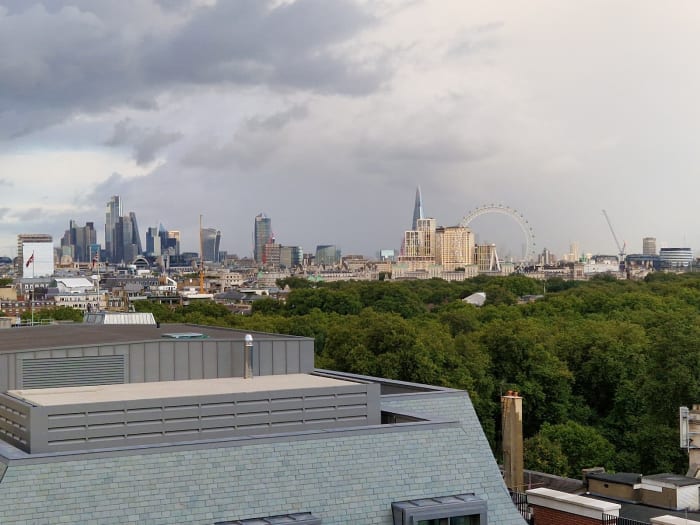
The property’s sense of heritage also lies in the way it embraces its own era. Where some addresses rely primarily on historical theatre, Four Seasons Hotel London at Park Lane favours a cleaner, quieter elegance that suits the spirit of Mayfair. Luxury here is expressed through the quality of the welcome, the consistency of the experience, the possible outlook towards Hyde Park, and that prized feeling of being at the centre of everything without being overwhelmed by it. For many travellers, that is the true heritage of a great London hotel: not only an address, but a way of inhabiting the city with ease.
The hotel
A stay at Four Seasons Hotel London at Park Lane is, above all, a choice of balance. The hotel sits in the heart of London, in an area where one can move within minutes from the open greenery of Hyde Park to the quieter streets of Mayfair, then on towards Knightsbridge or the institutions of St James’s. The location immediately defines the stay: guests come here to enjoy a capital that is dense, cultural and constantly in motion, while keeping a comfortable, highly organised retreat to return to.
The property is particularly well suited to travellers who want to experience London without losing time in transit. Major sights, shopping districts, business addresses and transport options are all within easy reach. Yet this centrality does not mean constant bustle. Park Lane is one of those avenues that allows one to feel the scale of the city, while the proximity of the park introduces a rare sense of breathing space in such an active metropolis. In the morning, the light over the trees of Hyde Park is a reminder that London can still offer calm within intensity. In the evening, returning to the hotel feels softer, more composed, almost residential.
Inside, the atmosphere sought is one of luxury without excess. Four Seasons generally favours spaces where guests immediately understand how to move, where to sit, where to work and where to meet. That clarity is invaluable in a large urban hotel. It allows business travellers to maintain an efficient rhythm, couples to shape a more reflective city break, and international visitors to settle in quickly. The personalised welcome, often cited as one of the brand’s signatures, reinforces this sense of ease. The aim is not to impress through display, but to make the stay precise, comfortable and effortless.
The address is also well suited to several different ways of using London. For a weekend, it offers immediate access to walks in Hyde Park, museums and the city’s emblematic districts. For a business stay, it places the traveller in a serious, central and well-connected setting. For a first visit to the capital, it provides an excellent base from which to understand the layout of central London. And for regular visitors, it answers a subtler need: the reassurance of a stable base with consistent standards in a city that is always changing.
Four Seasons Hotel London at Park Lane is therefore more than a backdrop. It functions as a trusted address, designed to accompany the city as it is actually lived: on foot when possible, by car when needed, between meetings, walks, shopping, museums and moments of calm. That intelligence of place, as much as the location itself, explains its lasting appeal.
Rooms and suites
In a major capital such as London, a hotel room is never merely a place to sleep. It must absorb the city’s rhythm, provide rest without detachment, and extend the character of the address through a sense of coherence. At Four Seasons Hotel London at Park Lane, that logic is fully apparent. Rooms and suites are designed to suit very different stays, from a romantic city break of a few nights to a business trip where every practical detail matters. The common thread is clear: comfort that is easy to understand, a controlled atmosphere, and service that supports the stay without weighing it down.
What guests seek here is first an impression of order and calm. In an urban hotel of this level, that depends on the quality of the bedding, the care taken with daily housekeeping, evening turndown, and the ability of the teams to adapt the experience to individual habits. These elements may seem discreet, yet they shape the quality of a stay in a profound way. After a day spent between meetings, walks, theatres, shops or museums, returning to a room that has been perfectly prepared changes one’s experience of the city itself. London feels less tiring, more fluid, more liveable.
Travellers who are sensitive to location will especially appreciate rooms that open onto the immediate surroundings of Park Lane and, depending on category, towards the calming presence of Hyde Park. In a city where the view can alter the mood of a stay, this proximity to the park brings a very particular sense of breathing space. It is a reminder that London luxury is not only a matter of decoration, but also of perspective: seeing trees, watching the light change, sensing the city without feeling enclosed by it.
The suites answer a different rhythm altogether. They suit longer stays, trips that combine work and personal time, or guests who wish to receive visitors in a more generous setting. In the Four Seasons universe, this kind of accommodation is generally accompanied by flexible service, discreet organisation and a sense of detail that makes daily life easier. For a couple, that may mean more space and privacy. For a business traveller, it may mean the ability to work in peace before heading out to dinner or a meeting.
Beyond categories, the appeal of the rooms and suites at Four Seasons Hotel London at Park Lane lies in their ability to express the spirit of the address itself: central yet never frantic, refined without stiffness, attentive to the real uses of travel. One sleeps here, certainly, but one also reads, prepares, regains one’s breath and watches the city shift with the light. In a London that can often feel intense, that quality of refuge is worth as much as the location itself.
Dining
In London, hotel dining has long ceased to be a mere supporting service. In the best addresses, it forms part of the property’s identity, whether through a precise breakfast before a demanding day, a business lunch, afternoon tea, a more composed dinner or a meal taken in the privacy of one’s room. At Four Seasons Hotel London at Park Lane, dining belongs to this culture of the grand urban hotel: it must be dependable, elegant, adaptable, and sufficiently well considered to answer very different needs throughout the day.
The first luxury here is often one of rhythm. A hotel in the heart of London welcomes travellers who do not all use the city in the same way. Some leave early for meetings, others devote the morning to galleries and shopping, while others choose to begin the day slowly, with the light over the park and the rare feeling of having time. Dining must therefore be able to follow these variations. In the Four Seasons spirit, this generally means close attention to service, consistency of execution and the ability to adjust the experience without rigidity.
Breakfast holds a particular place in this type of address. In London, it often sets the tone of the stay. When done well, it allows guests to begin the day with a sense of comfort and precision that changes everything. At a hotel of this level, one expects carefully selected produce, a menu balanced between international classics and local habits, and service capable of understanding whether one wishes to move quickly or linger. These may be details, but they are precisely what distinguish truly accomplished hotel dining.
The rest of the day calls for other uses. Lunch may provide the setting for a discreet meeting in a central location. Dinner may offer the chance to remain on site after a full London day without sacrificing a certain standard. In-room dining, in this context, is not secondary: it becomes a natural extension of the comfort of the room, particularly welcome after a flight, a performance or a long walk through the city. Here again, what matters is not display, but correctness.
What defines dining at Four Seasons Hotel London at Park Lane is therefore less a show of force than a form of consistency. The culinary experience supports the stay intelligently, respecting both the rhythms of London and the expectations of an international clientele. For couples, it adds a layer of simple, well-orchestrated pleasure. For business travellers, it provides a serious and practical option. For all guests, it contributes to an essential impression: that a hotel which truly understands hospitality also understands that good hosting often begins with feeding people well, at the right moment and in the right tone.
Spa & wellness
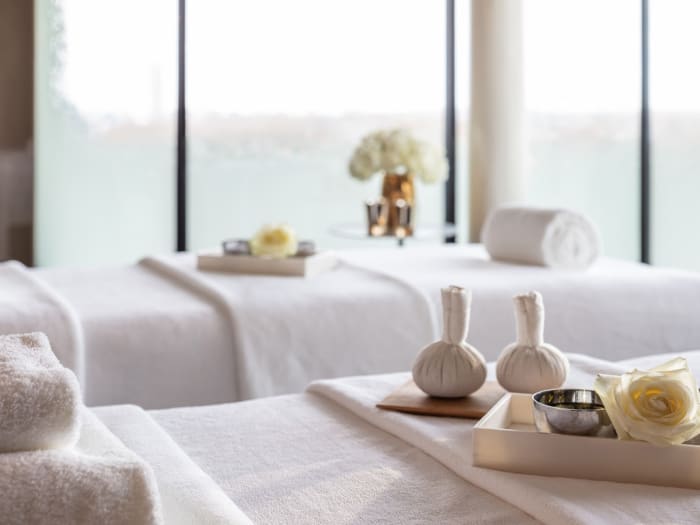
In a city such as London, wellness takes on a particular meaning. Guests do not come to the spa merely to escape daily life, but to rebalance a stay that is often dense: flights, meetings, jet lag, long walks, shopping days and late evenings. The advice to book treatments in advance is not incidental; it reflects the importance of this space within the overall hotel experience. At Four Seasons Hotel London at Park Lane, the spa belongs to the logic of the urban retreat, designed to provide a structured pause in the midst of London movement.
What travellers seek in this kind of address is less an abstract promise of relaxation than a genuine ability to lower the pace. A well-chosen treatment, a quiet moment before dinner, a recovery session after a long-haul flight or before a demanding day can alter the quality of a stay entirely. The spa then becomes functional in the noblest sense: it answers a real need through the codes of luxury hospitality, namely discretion, competence, punctuality and personalisation.
For couples, the wellness experience adds a more intimate dimension to the stay. In a capital where days can quickly become overfilled, booking a treatment creates shared time that is neither touristic nor social. For business travellers, the appeal is different but equally clear: restoring energy, easing travel-related tension, and bringing the body back into line with a demanding schedule. In both cases, the hotel fulfils its role when it can offer this kind of quiet care without turning it into a spectacle.
Wellness in London is also shaped by the seasons. In spring, when the city comes alive and the parks reclaim their place, a treatment extends that sense of renewal. In autumn or winter, it becomes almost a necessity of comfort, a way to offset the climate, fatigue and the city’s tempo. That is why the best urban spas are not decorative annexes: they are places of regulation, where one recovers a sense of measure.
At Four Seasons Hotel London at Park Lane, the spa therefore contributes to the identity of the address as much as to its practical appeal. It complements the hotel’s central location with a promise of slowing down, and its personalised service with attention paid to the body as much as to the stay. For travellers accustomed to major cities, that is often a decisive criterion. A hotel may be well located and impeccably run; if it also offers a genuine space for recovery, it becomes not merely convenient, but lastingly desirable.
Concierge & services
The quality of a great hotel is often measured by what is not immediately visible. A front desk available at all hours, a concierge capable of handling complex requests, multilingual staff, impeccable daily housekeeping, efficient luggage storage, responsive laundry, a precise wake-up service: taken separately, these elements may seem ordinary; brought together and executed well, they transform the experience of travel. At Four Seasons Hotel London at Park Lane, this service foundation is central, because it corresponds exactly to the expectations of an international clientele using London in an intense and often unpredictable way.
The 24-hour concierge plays a decisive role here. In a city as vast and in demand as London, having interlocutors who can guide, confirm, recommend and anticipate is a genuine advantage. It is not simply a matter of obtaining a reservation or a car, but of saving time, avoiding approximation and making the stay more fluid. For a couple, that may mean shaping an elegant day between the park, shopping and dinner. For a business traveller, it may mean securing faultless logistics between arrival, meetings and departure. In both cases, personalised Four Seasons service is at its most meaningful when it remains discreet while being truly useful.
The round-the-clock front desk answers another reality of contemporary travel: schedules are no longer linear. Late arrivals, early departures, changing plans and last-minute needs are part of daily life in an international hotel. Knowing that the property remains fully operational at any hour brings an essential sense of reassurance, especially in a capital where one may combine a flight, a meeting and dinner in the same day. This continuity of presence is one of the most reliable markers of well-understood luxury hospitality.
Housekeeping and support services complete this impression of control. Daily housekeeping and evening turndown ensure a constant standard of comfort. Laundry allows guests to extend a stay or maintain a polished appearance within a professional schedule. Luggage storage, often underestimated, becomes invaluable when one wants to enjoy the city before check-in or after check-out. Even the wake-up service, in the age of smartphones, retains its relevance in hotels where precision is part of the promise.
What ultimately distinguishes the service experience at Four Seasons Hotel London at Park Lane is coherence. Nothing is theatrical in itself, yet everything contributes to making the stay simpler, more flexible and more comfortable. In a demanding London, that quality of execution is worth as much as an attractive interior or a strong address. It allows the traveller to focus on what matters: meetings, discoveries, rest, or simply the pleasure of being in the city without having to think about logistics.
The London art of living
Choosing an address on Park Lane also means choosing a particular way of living London. The city cannot be reduced to a list of monuments; it is discovered through sequences, neighbourhoods and habits. Four Seasons Hotel London at Park Lane makes precisely that possible: entering the capital through use rather than through the simple accumulation of sights. Hyde Park, close at hand, sets the tone. One may begin the day with a walk, watch the light over the paths, and feel the city’s rhythm coming into place. This proximity to the park introduces a distinctly London civility, in which contact with nature remains part of daily life even in the centre of the metropolis.
From there, several Londons become accessible. Mayfair offers quiet streets, galleries, elegant houses and discreet addresses. Knightsbridge draws with its boutiques and more visible energy. St James’s, a little further on, recalls the weight of institutions, clubs and a certain British tradition. In just a few movements, one passes from one world to another without abrupt rupture. That is one of the privileges of this location: it allows the city to be understood through continuity, almost intuitively.
For couples, this art of living often takes the form of a stay built on well-balanced contrasts: a morning walk in the park, lunch in town, an afternoon of museums or shopping, a return to the hotel to prepare, then dinner or the theatre. For business travellers, it translates differently: the possibility of inserting genuine city moments into a tight schedule without difficulty. A meeting can be followed by a walk in Hyde Park, a business dinner by a swift return to the hotel, an early departure by an efficient breakfast. London then ceases to be merely a professional backdrop and becomes a lived city again.
The spring season mentioned as an especially good time to experience the address is no coincidence. It is when London regains a particular lightness. The parks recover their colour, terraces fill, and cultural events give the city a more open energy. From Park Lane, that season is felt with special intensity because Hyde Park is not an abstract reference: it forms part of the immediate landscape. That said, the hotel’s appeal is not limited to one season. London possesses, at any time of year, a cultural and social density that rewards well-placed addresses.
Four Seasons Hotel London at Park Lane thus supports a mature vision of the capital. One does not come here merely to tick off landmarks, but to inhabit London for a few days with comfort, precision and freedom. That may be the truest form of urban luxury: moving effortlessly from the calm of a park to the intensity of a great city, then returning to a hotel that knows how to extend that sense of balance.
Book with MyConciergeHotel
Booking Four Seasons Hotel London at Park Lane through MyConciergeHotel means approaching the address in the right way: as a stay prepared with precision, in a hotel where details genuinely matter. A property this central, suited both to couples and to business travellers, often requires a degree of anticipation. The choice of room category, the value of a particular view or floor, the rhythm of the stay, transport needs, the organisation of arrivals and departures, or the advance booking of a spa treatment can all have a concrete impact on the quality of the experience. The value of editorial and concierge guidance lies precisely there: turning a simple reservation into a well-constructed stay.
In a city such as London, the value of good advice often lies in its restraint. The aim is not to overload the programme, but to calibrate the stay according to the traveller’s profile. A couple arriving for a weekend will not have the same expectations as an executive on business or a regular visitor to the capital. Some will prioritise immediate proximity to Hyde Park and the elegant central districts; others will need faultless logistics around schedules, meetings and hotel services. In every case, Four Seasons Hotel London at Park Lane works best when one has clarified in advance what one truly expects from London.
Booking wisely also means thinking in terms of timing. Spring, often recommended for discovering the city, can be especially sought after. Event periods, long weekends and certain London highlights naturally affect availability. Likewise, as spa appointments are often in demand, it is best to arrange them before arrival if wellness forms part of the stay. This logic of anticipation does not diminish spontaneity; on the contrary, it helps preserve a sense of ease once on site.
MyConciergeHotel aims to place the property’s real strengths in perspective: its Park Lane location, its proximity to Hyde Park, the recognised quality of personalised Four Seasons service, and its ability to suit several styles of travel. The goal is not to promise the vague, but to help shape a stay that feels right. That may involve advice on ideal length, on the best way to balance visits with downtime, or on which services are worth prioritising according to the season.
Ultimately, booking this hotel well is already a way of experiencing London well. An address of this kind reveals its full potential when one understands how to use it: as an urban retreat, an elegant base, a starting point for the major central districts, and a place of recovery between the city’s defining moments. That is the precise and practical reading MyConciergeHotel seeks to provide, so that the stay is not only comfortable, but fully attuned to both the city and the traveller discovering it.