History & spirit of the place
In Uluwatu, a large-scale resort only makes sense if it truly engages with the landscape. That is precisely what defines Six Senses Uluwatu, Bali: not simply a hotel set on a dramatic site, but an address conceived from the cliff edge, the light and the sea horizon. The property belongs to a part of Bali with a clear and longstanding identity. The southern Bukit Peninsula is known for its limestone headlands, ocean-facing temples, beaches tucked below the cliffs and a particularly vivid relationship with the elements: wind, swell, the dry heat of the sunny season, then the tropical rains that restore the vegetation to full density. In that context, the hotel adopts a contemporary language that seeks balance rather than effect.
Being part of Six Senses offers an immediate interpretive key. The brand has built its reputation on a vision of luxury in which wellbeing is not an added service but a way of inhabiting a place. In Uluwatu, that philosophy feels especially coherent. The topography imposes calm, distance and a certain verticality of view. The Indian Ocean is never merely a backdrop; it becomes a rhythm, a constant presence, almost a form of breathing. The resort is therefore organised around a complete sensory experience: fluid circulation, open spaces, materials in natural tones and greenery that softens the architecture while preserving the connection with the setting.
Heritage here does not mean a historic palace or period residence. It is instead cultural and geographical. Uluwatu belongs to a Bali where spirituality, daily rituals and the relationship with nature remain highly visible. Without turning that reality into a cliché, the hotel draws on some of its principles: respect for the site, attention to the energy of spaces and the search for a slower pace of life. This naturally aligns with the brand’s commitments to sustainability and holistic wellbeing. The result is an address that speaks both to travellers seeking rest and to those who want a stay shaped more deliberately around health, sleep, movement or reconnection.
What ultimately sets Six Senses Uluwatu, Bali apart is its ability to hold several temporalities at once. There is the short time of the stay, with its immediate pleasures: a terrace facing the sea, late-afternoon light, a quiet moment by the water. And there is a deeper, almost insular time that invites guests to slow down. Few addresses make that sense of retreat so tangible without ever feeling cut off from the world. The prevailing impression is not of a hideaway removed from everything, but of a privileged vantage point over one of Bali’s most striking coastal landscapes.
The property
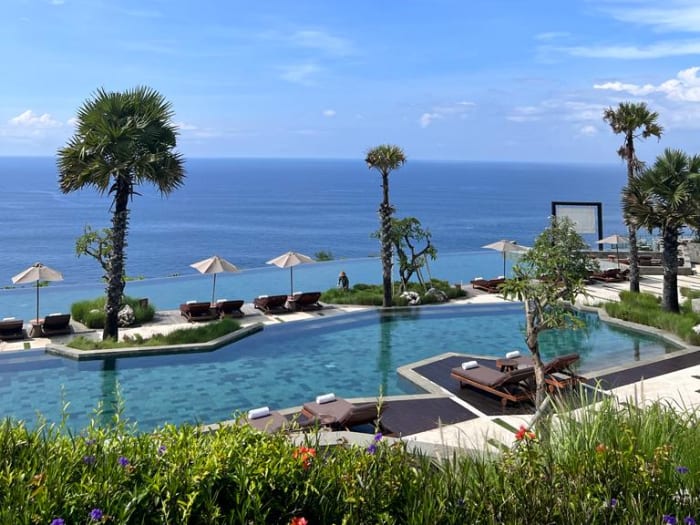
The first impression at Six Senses Uluwatu, Bali is one of site. Before the decorative details or the quality of service, what registers is the strength of its setting: a resort perched on Uluwatu’s cliffs with open views over the Indian Ocean. This elevated position gives the stay a particular tone. The eye travels far, the light is in constant movement, and it quickly becomes clear that much of the hotel experience rests on this direct relationship with the landscape. A sense of space is essential. Even when the property welcomes a varied clientele—couples, families or travellers on a wellness retreat—the architecture seeks to preserve an impression of air, calm and distance.
The shared spaces are designed in that spirit. Their contemporary aesthetic is softened by materials and colours inspired by nature. Nothing feels overly demonstrative; the elegance comes instead from overall coherence, from the way volumes open to the outdoors, from the presence of greenery and from the circulation of air and light. In a tropical climate, this intelligence of place matters as much as decoration itself. The resort seems designed to accompany the hours of the day: bright mornings, denser afternoon heat, then that particular moment when sky and sea deepen in tone. At that point, the cliff becomes a natural theatre.
The immediate surroundings contribute greatly to the property’s appeal. Uluwatu is one of the most sought-after areas in southern Bali for its coastal scenery, beaches and surf culture. Yet the resort does not feel like a purely seaside address. Its atmosphere is more contemplative than social. The surrounding greenery plays an important role in that perception. It creates transitions between spaces, provides shade, filters views and reinforces the sense of being within a preserved estate. This vegetal presence is especially valuable on a mineral site such as the Bukit Peninsula, where the balance of rock, sea and gardens gives the landscape its character.
The property speaks to travellers who expect more than a beautiful view. It offers a setting conducive to rest, but also to a form of recalibration. Choosing a Six Senses resort often reflects a specific expectation: to find a place where one can slow down without giving up comfort, and where attention to wellbeing informs the entire stay. In Uluwatu, that promise is particularly legible. Spaces are designed for relaxation, transitions are gentle and the atmosphere remains serene. Guests come here to enjoy Bali, certainly, but also to recover a quality of silence that has become rare in heavily visited destinations.
That sense of retreat does not come at the expense of practicality. With a 24-hour reception and concierge, along with smoothly run daily services, the stay unfolds with notable ease. This is one of the property’s strengths: offering a spectacular environment without making it feel intimidating. Luxury here lies as much in the quality of the setting as in that discreet, almost natural sense of effortlessness that accompanies each moment on the estate.
Rooms, suites and villas
At an address such as Six Senses Uluwatu, Bali, accommodation is more than a room category: it extends the logic of the place. At a resort set high on the cliffs, one expects a constant relationship with the outdoors, and that is precisely what shapes the experience. Rooms, suites and villas are conceived as contemporary retreats reflecting the brand’s core principles: calm lines, natural materials, a soft palette and openness to the landscape. The aim is not decorative excess, but the creation of an environment in which body and mind can relax almost immediately.
The aesthetic language remains faithful to the Six Senses identity. One expects generous volumes, abundant light, living spaces designed for flow and a marked presence of wood, stone and organic textures. This controlled restraint works particularly well in Bali, where nature already provides visual richness. Facing the Indian Ocean or set amid greenery, interiors have no need to compete. Luxury is expressed instead through proportion, quiet comfort and the sense of privacy the accommodation affords. Even when the hotel welcomes families, everything seems designed to preserve moments of calm.
One of the greatest pleasures of staying here lies in the way private spaces accompany the rhythm of the day. In the morning, light enters with clarity and reminds guests of the sea’s proximity. During the day, rooms become a refuge from the heat, suited to reading, resting or simply pausing between activities. In the evening, they regain a more enveloping quality, reinforced by turndown service and attention to practical detail. This ability to transition matters greatly in a resort centred on wellbeing. A fine room is not only pleasing to the eye; it should also help guests sleep better, slow down and recover a deeper sense of comfort.
Villas, when chosen, generally answer a different expectation: more space, greater autonomy and sometimes an even more immersive relationship with the setting. On a cliffside site such as Uluwatu, the idea of a view takes on particular importance. It is not merely a panorama; it becomes part of privacy itself. Looking out to sea from a terrace, feeling the wind at the end of the day, hearing the distant movement of the waves—all this contributes to a very contemporary form of luxury, based on experience rather than display.
This kind of accommodation suits both couples and longer stays, when guests wish to establish a personal rhythm: a slow start, a wellness session, time to read, meals taken without haste. Daily housekeeping, discreet staff and the hotel’s attentive organisation help sustain that impression of ease. Ultimately, the rooms and villas at Six Senses Uluwatu, Bali do not seek to impress through accumulation. They persuade through rightness: comfort aligned with the landscape, the climate and the very idea of a Balinese retreat.
Dining
At a resort where wellbeing is central, dining cannot be treated as a mere amenity. At Six Senses Uluwatu, Bali, it naturally forms part of a broader vision of the stay, one that seeks to reconcile pleasure, balance and attention to each guest’s personal rhythm. While the precise details of every restaurant and menu are not set out here, the overall spirit is easy to understand: high-end resort dining shaped by the tropical climate, the expectations of an international clientele and the brand’s identity, with its emphasis on health, freshness and sustainability.
The setting, of course, plays a major role. Eating above the Indian Ocean on an Uluwatu headland does not carry the same meaning as dining in a city. Time stretches, and meals become moments of contemplation as much as conviviality. Breakfast takes on particular importance in this kind of address. It accompanies the body’s awakening, the morning light and sometimes the beginning of a day devoted to yoga, the spa or an outing to the beaches of southern Bali. Guests expect an offering that is both generous and clear, able to satisfy those seeking lightness as well as those wanting a substantial meal before an active day.
At lunchtime, the resort naturally lends itself to a more flexible style of cuisine, suited to the heat and to the rhythm of moving between room, pool, relaxation spaces and outdoor activities. Leading wellness-oriented properties often favour clean plates, fresh produce and preparations that give prominence to texture, herbs, fruit and direct flavours. In Bali, this approach finds particularly fertile ground. The island has a rich culinary tradition, and even when a hotel addresses a cosmopolitan audience, it is natural for local or regional influences to appear in the offering.
Dinner shifts register. The light softens, the cliff grows quieter and the table becomes one of the stay’s great pleasures. In a resort such as this, what matters is not display but rightness: attentive service without stiffness, a setting that lets the landscape lead and a cuisine precise enough to give the meal real character. Contemporary luxury, especially in retreat destinations, no longer depends on an accumulation of formal codes. It often lies in the quality of the moment, in the possibility of dining slowly, talking at length and extending the evening without constraint.
For travellers attentive to wellbeing, the value of such dining also lies in flexibility. Being able to adapt meals to one’s energy, to sport, to a spa programme or simply to the mood of the day is part of genuine comfort. That is where food becomes service in the noblest sense: not merely to feed, but to support the stay. At Six Senses Uluwatu, Bali, dining appears to be fully integrated into the overall experience of the place, somewhere between sea horizon, tropical softness and a slower art of living.
Spa & wellbeing
If there is one deep reason to choose Six Senses Uluwatu, Bali over another resort on the peninsula, it lies in its holistic approach to wellbeing. This is not simply a marketing line; it shapes the property’s very identity. Guests who book here are not only looking for a beautiful room with a view, but for an environment capable of positively influencing energy, sleep, stress levels and the ability to slow down. In the Six Senses universe, the spa is therefore not an isolated facility within the hotel: it acts as a centre of gravity around which the other dimensions of the stay are organised.
The Uluwatu setting naturally reinforces that promise. The cliffs, the openness to the Indian Ocean, the presence of wind and the sense of space create almost ideal conditions for reconnection. There is a form of obviousness in this landscape: one breathes more deeply, looks further and more readily suspends ordinary pace. Wellbeing then takes several forms. It can be highly tangible, through treatments, massages, bodywork or recovery routines. It can also be more diffuse, embedded in the way the hotel has been conceived: spaces designed for relaxation, calm circulation, a nature-inspired aesthetic and a peaceful atmosphere amid greenery.
What often matters to experienced travellers in a property of this calibre is personalisation. A credible holistic approach assumes that the same experience is not offered to everyone. Some guests come to recover after an intense period, others to rebalance sleep, others still to maintain movement or meditation practices while away. The resort appears to answer this diversity of expectations with an offering oriented towards overall health, yet without rigidity. That nuance matters: wellbeing here is not presented as an injunction, but as a possibility. Each guest can engage at their own pace, from a simple restorative pause to a more structured programme.
In the Balinese context, this direction has particular resonance. Bali has long attracted travellers seeking retreat, gentle practices, spirituality or personal transformation. Uluwatu, with its more mineral character and broader ocean outlook than other parts of the island, gives that search a different tone: less inward in a decorative sense, more expansive, more airy. Six Senses captures that energy well. One readily imagines mornings devoted to movement, treatments during the day, extended periods of rest and quiet late afternoons facing the sea.
For many guests, it is this coherence that gives the stay its value. Spa and wellbeing are not separate moments; they permeate the entire experience, from the room to the table, from the shared spaces to the service. At a time when luxury is often being redefined around quality of life rather than display, Six Senses Uluwatu, Bali occupies a clear place: that of a resort where guests come not only to rest, but to recover a sense of alignment.
Concierge & Services
At Six Senses Uluwatu, Bali, comfort is equally about the quality of service. The reception and concierge are available 24/7. Additional offerings include daily housekeeping, turndown service, luggage storage, laundry, wake-up calls, and a multilingual staff.
The concierge plays a central role here. Uluwatu attracts a diverse range of travellers, from couples and families to surfers and visitors from southern Bali, each with their own expectations. The value of service lies in its precision; suggesting an outing, preserving a day on-site, or coordinating an activity with a treatment or meal can greatly enhance the quality of the stay.
The round-the-clock availability of the reception and concierge is invaluable in an island destination. It facilitates late arrivals, early departures, transfers, and unexpected situations. This accessibility reinforces the feeling of serenity, especially after a long journey.
Daily housekeeping and turndown service contribute to a more intimate comfort. Returning from an outing to find a tidy space enhances the sense of refuge. In the evening, the preparation of the room complements a more tranquil pace.
Laundry services, luggage storage, and wake-up calls extend this seamless experience. The multilingual staff also eases daily interactions. Together, these elements create a discreet, attentive, and well-maintained service.
The Art of Living in Uluwatu
Staying at Six Senses Uluwatu, Bali, means embracing a particular vision of Uluwatu. The region is not merely defined by cliffs and surfing; it follows a more stretched rhythm, more attuned to the elements than other parts of Bali.
The southern Bukit Peninsula is characterised by light-coloured stone, elevated roads, and sudden ocean views. It is also home to hidden beaches at the foot of the cliffs and significant spiritual sites. This geography alters one’s relationship with time. Uluwatu reveals itself in sequences, in harmony with the light and movement.
The stay can be organised in various ways. Some guests prefer contemplation and largely remain at the resort, enjoying the views, spa, and relaxation areas. Others alternate between the resort and outings to the area’s renowned beaches, celebrated for their raw beauty and surfing culture.
Even for those who do not surf, the influence of this world is palpable. A precise relaxation, an appreciation for vast horizons, an awareness of the wind and sea. Uluwatu has long attracted travellers for whom nature is a realm of experience. This energy persists.
Cultural dimensions are equally significant. The name Uluwatu evokes one of Bali’s most famous temples, perched on the edge of the cliffs. The landscape is inseparable from a spiritual depth. In Bali, ritual gestures, offerings, and daily connections to the sacred are part of ordinary life.
For an attentive visitor, this presence transforms the perception of the stay. It invites a different way of seeing. The beauty of the place is not solely natural or architectural but also cultural.
The art of living in Uluwatu lies in a balance between intensity and retreat. The sunsets are famous, the beaches alluring, and the local scene can be vibrant. Yet, it is always possible to find silence on a terrace, in a garden, or at a viewpoint overlooking the sea.
This is what a resort like Six Senses allows. To enjoy the energy of the destination without losing oneself in it. To explore and then return to slow down. This alternation often defines a successful stay in Bali.
The best time to visit is during the dry season, from May to September, particularly pleasant for enjoying the outdoors and the views. Beyond the calendar, Uluwatu can be understood as a way of being in the world for a few days, more attuned to light, the body, the wind, the sea, and the quality of time. Six Senses Uluwatu, Bali, thus offers an anchoring point, between refuge and lookout over one of the island's most striking faces.
Booking via MyConciergeHotel
Booking Six Senses Uluwatu, Bali, through MyConciergeHotel means preparing for an experience, not just a stay.
Perched on the cliffs of Uluwatu, the hotel embodies a wellness identity. It is wise to consider the stay as a whole, including the rhythm of the days, time at the spa, dining, outings, or relaxation.
It is advisable to plan wellness activities upon arrival, as slots fill up quickly. At Six Senses Uluwatu, wellness is at the heart of the experience.
Booking accurately means aligning the stay with one’s expectations. Whether it’s a very relaxing retreat, discovering Uluwatu, or a trip as a couple or family, for a few nights or more.
Choosing to go through MyConciergeHotel allows for informed decisions. Six Senses Uluwatu, Bali, will appeal to travellers sensitive to landscape, silence, the quality of spaces, and wellness.
It may be less appealing to those primarily seeking the continuous animation of a seaside resort. Choosing a destination hotel wisely means understanding what it truly promises.
The dry season, from May to September, is particularly favourable, attracting more travellers. Arrival times, services, and the organisation of the first days should be anticipated.
In a resort where views, tranquility, and wellness are the main luxuries, it is best to avoid letting improvisation encroach on the experience.
Booking via MyConciergeHotel offers a clear perspective on luxury hospitality. A spectacular site, a peaceful atmosphere, a brand renowned for its holistic approach, and a Balinese setting conducive to rejuvenation.