History & heritage
Six Senses Kanuhura belongs to a broader story than that of a simple island resort: the evolution of contemporary hospitality in the Maldives, where luxury has gradually shifted from display towards space, quiet, preserved nature and holistic wellbeing. In Lhaviyani Atoll, north of Malé, the property sits within a landscape that distils the Maldivian imagination: clear lagoon, tropical vegetation, pale sand and an uninterrupted horizon. Its identity lies precisely in this reading of place. Here, the experience is not conceived as a spectacle, but as a relationship with the island, the light, the rhythm of the Indian Ocean and a certain idea of the beach retreat.
The arrival of Six Senses in this setting gives the resort a distinct tone. The brand has established itself in high-end hospitality through an approach that combines comfort, environmental awareness and wellbeing, without separating aesthetics from use. At Kanuhura, that philosophy finds a natural setting. The Maldivian environment calls for restraint: architecture, circulation, living spaces and activities must accompany the landscape rather than compete with it. The resort follows that logic, with a simple yet demanding promise: to offer a refined island experience shaped by clarity, calm and a sense of privilege born first from space and the quality of time.
The resort also belongs to a generation of addresses responding to changing traveller expectations. A stay in the Maldives is no longer merely a postcard interlude; it often becomes a project of reconnection, whether for a couple, a family celebration or a more personal pause. This explains the emphasis on wellbeing, sustainability and the natural environment. In a destination particularly exposed to climate and ecological concerns, such commitments are not incidental rhetoric. They form part of the credibility of the experience and of the way the hotel positions itself in its time.
Kanuhura therefore retains the essentials of a major Maldivian address — private villas, direct access to the lagoon, a sense of remoteness — while placing them within a more contemporary understanding of luxury. A stay here takes the form of a chosen slowing down. Guests come for the immediate beauty of the setting, certainly, but also for the coherence of a place that values simplicity well executed: natural materials, open volumes, fluid transitions between indoors and out, and hospitality that seeks less to impress than to put one at ease. It is this restraint, more than any overt signature gesture, that constitutes its true heritage.
The setting
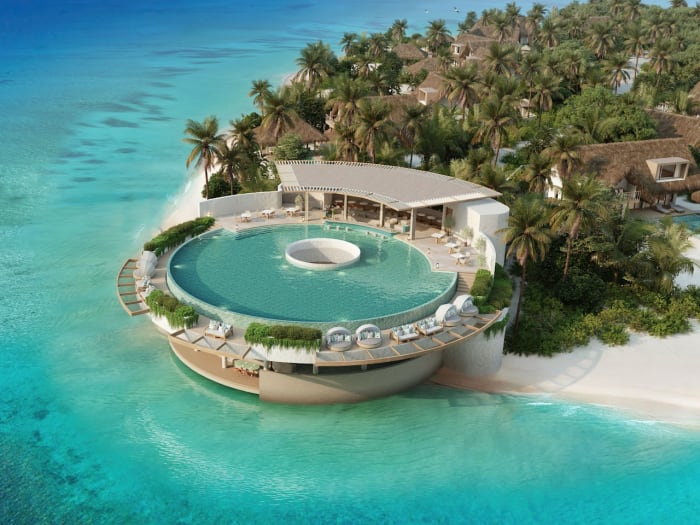
Staying at Six Senses Kanuhura means choosing an island resort where the landscape is never a secondary backdrop. In Lhaviyani Atoll, the property unfolds between white-sand beaches, coconut palms, tropical gardens and a lagoon of shifting tones. The geography itself shapes the experience: one moves from a calm shore to another more open to the horizon, from jetty to beach, from shaded path to terrace facing the sea. Everything is read at the pace of walking, cycling or buggy, with the rare sense of temporarily inhabiting an island rather than simply occupying a room in a beach complex.
One of the resort’s most perceptible qualities lies in the way space is organised. The private villas, restaurants, relaxation areas and wellness facilities appear distributed so as to preserve privacy without creating unnecessary distance. This breathing room between the different points of life gives the stay great fluidity. Guests may choose to do almost nothing, simply following the sun, walking barefoot between beach and villa, stopping for a swim, a light lunch or a moment of reading by the water. Equally, the island allows days to be structured around water activities, treatments, meals in different settings and excursions, without the whole feeling over-programmed.
The relationship with nature is central. In the Maldives, the beauty of the site is a given, but it is not enough to define an address. What distinguishes Kanuhura is the way that beauty is made habitable. Circulation leaves ample room for views, shade and sea breezes. Public spaces favour a light elegance suited to the tropical climate, with an aesthetic that seeks continuity between indoors and out. Luxury is then measured by the quality of that continuity: being able to lunch near the sand, reach the lagoon in a few steps, and feel that the day unfolds almost entirely under open sky.
Lhaviyani Atoll adds to this sense of retreat. Further north than some of the archipelago’s busiest areas, it suggests a broader, quieter version of the Maldivian stay. For travellers, this translates into a clearer relationship with the marine environment, the morning light, late afternoons on the beach and nights marked by wind and waves. The property particularly suits those seeking an island luxury free from visual excess. Honeymooners, seasoned tropical-resort guests and families wishing to combine comfort with disconnection can each find their own rhythm here.
Kanuhura is therefore more than a collection of facilities. It is a place conceived as a territory for living, with its perspectives, well-judged distances and varied uses. Guests come for the essence of a major Maldivian resort — omnipresent sea, privacy, service and gentle climate — but also for the subtler sensation of being in a coherent environment where architecture and hospitality recede enough to let the landscape take precedence.
Rooms, villas & the art of privacy
At Six Senses Kanuhura, accommodation is conceived above all in terms of privacy, space and a direct relationship with the outdoors. The resort foregrounds private villas, a format particularly suited to the Maldivian context, where the stay depends on the feeling of having one’s own fragment of island or lagoon. Whether set on the beach or over the water, these villas follow the same logic: to offer a personal refuge, open enough to admit light, sea air and views, yet protected enough to preserve tranquillity at any hour of the day.
The aesthetic expected in such a setting does not rely on display. It generally favours natural materials, pale tones, simple lines and generous volumes that visually extend the landscape. At Kanuhura, this approach sits especially well with the Six Senses philosophy. Comfort is not conceived as an accumulation of objects or signs of luxury, but as a quality of use: fluid movement between bedroom, bathroom and terrace, outdoor areas that become genuine living spaces, and that essential Maldivian sensation of passing from indoors to lagoon or sand without interruption.
For couples, the villa becomes the centre of gravity of the stay. It offers the sought-after quiet, the possibility of taking one’s time in the morning, swimming at any hour, reading in the shade or watching the sun decline from a private terrace. For families, the appeal lies in the flexibility this type of accommodation provides: more space, simplified daily life, and the ability to combine shared time with moments of retreat. This capacity to suit different uses without losing coherence is one of the resort’s principal strengths.
Service naturally contributes to this sense of residential comfort. Daily housekeeping, turndown service and a team available around the clock help maintain a level of care that is discreet yet constant. On an island stay, where guests often spend more time in their accommodation than in an urban hotel, such details matter all the more. They allow the villa to remain a true place of rest, always ready to receive one back from the beach, for an afternoon nap in the hottest hours, or for a quiet evening after dinner.
What is most appealing at Kanuhura is the idea of a luxury measured by the quality of retreat. The villas do not seek to distract from the landscape; they frame it. They offer a way of inhabiting the Maldives with more depth than a simple beach holiday: sleeping to the rhythm of the sea, living barefoot, organising one’s days around the light, and finding within a highly accomplished accommodation a form of simplicity that few destinations can deliver with such ease.
Dining
In an island resort, gastronomy plays a pivotal role. It shapes the days, organises movement around the island, and leaves a lasting impression on the stay.
At Six Senses Kanuhura, dining is an integral part of this overall experience. It alternates between different settings and moments, from meals facing the sea to more relaxed dinners.
In the morning, breakfast extends the sense of space that is characteristic of the Maldives. Tropical fruits, freshly prepared dishes, and coffee served by the lagoon set the tone.
At midday, the climate and activities often call for lighter cuisine. Seafood, salads, grilled dishes, and Mediterranean or Asian influences naturally find their place here.
In the evening, the resort takes on a more intimate atmosphere. Tables are positioned closer to the water, and dinner becomes a more ceremonial affair, while still retaining the island's relaxed vibe.
The Six Senses brand places significant emphasis on the balance between pleasure and well-being. At Kanuhura, the dining experience reflects this approach, with a focus on freshness and clarity of flavours.
This coherence is essential. It allows for a seamless transition from a spa treatment to a simple yet refined lunch, followed by a more festive dinner, all without a change in tone.
The Maldivian setting also lends itself to private dining experiences and discreet presentations. Dining on the beach, celebratory tables, or intimate moments for two take on a special significance here.
In a destination chosen for an anniversary, a honeymoon, or a significant milestone, gastronomy transcends mere culinary performance. It becomes an emotional experience.
At Six Senses Kanuhura, dining thus contributes to a continuous experience. The essence lies in the harmony between the ingredients, the service, the setting, and the ever-present sea.
Spa & Well-being
Well-being occupies a central place in the identity of Six Senses Kanuhura. It is not merely a department of the resort; it is one of the guiding threads of the stay.
In the Maldivian context, this focus takes on a particular resonance. The environment naturally invites relaxation. Soft light at dawn, constant warmth, the sound of water, and an open horizon. The spa deepens this state, already made possible by the island itself.
The Six Senses philosophy regarding well-being is based on a holistic approach. It pays attention to the body, sleep, movement, nutrition, and recovery. At Kanuhura, this is first reflected in the atmosphere. The spa is not just a place for treatments; it is a space for deceleration, where one relearns to pay attention to their own rhythm.
The island setting enhances this experience. Receiving a treatment in a tropical environment, just steps from the sea, alters the perception of time. The spa thus supports the transformation of the stay into a genuine pause. For couples, it can become a shared ritual. For solo travellers, a space for re-centering. For families, a moment of respite.
The commitment of the establishment to sustainability adds further depth to this promise of well-being. Taking care of oneself is no longer conceived independently of caring for the place. In the Maldives, this connection is essential. Respect for resources, attention to the island environment, and the desire to minimise the footprint of the stay all contribute to this coherence.
At Six Senses Kanuhura, the spa emerges as the clearest expression of the resort's promise. To slow down, to breathe, to rediscover a simpler relationship with oneself and the landscape. One comes for a massage, of course, but also for what the treatment makes possible afterwards: improved sleep quality, a more attentive presence in the moment, and a renewed availability to enjoy the sea, the light, and the silence.
Concierge & Services
In a premium island resort, the quality of service is measured by its ability to ensure a seamless stay. Six Senses Kanuhura offers a 24-hour concierge service, a continuously open reception, daily room service, a turndown service, luggage storage, laundry services, wake-up calls, and multilingual staff. Together, these services provide constant, discreet, and adaptable care, which is particularly valuable in a hotel island setting.
A stay in the Maldives comes with specific logistical considerations. Arrivals and departures depend on air, sea, or domestic connections, and schedules can vary. Needs also evolve according to the weather, water activities, or the desire for spontaneity. In this context, a concierge available at all hours greatly enhances the experience. It allows for the orchestration of practical details, booking activities, adjusting itineraries, organising special requests, or promptly addressing simple inquiries.
The 24-hour reception contributes to the same sense of tranquillity. In a place where life often follows the rhythm of the sun, it is reassuring to know that a team is available at all times. Daily room service and turndown service further enhance the feeling of accommodation that is always ready, tidied without ostentation. After a day at sea, a spa session, or a few hours on the beach, returning to a meticulously maintained villa is one of those quiet pleasures.
The laundry service and luggage storage cater to very practical needs. In a tropical destination, the ability to have personal belongings cared for simplifies daily life. Luggage storage becomes useful for early arrivals or late departures, allowing guests to enjoy the island until the very last moment without excessive constraints. The wake-up call service also remains relevant for morning transfers, excursions, or for those wishing to witness the sunrise.
Beyond the list of amenities, what truly matters at Kanuhura is the tone of the service. In the Six Senses universe, hospitality prioritises warmth, discretion, and personalisation over formalities. It is this quality of presence that transforms expected services into a genuine experience. The traveller does not feel confined but rather accompanied. In such a setting far removed from everyday life, this attentiveness makes all the difference.
The Lhaviyani Atoll way of life
To speak of a way of life in Lhaviyani Atoll is first to recognise that Maldivian luxury rests on a very particular relationship with time. Here, the essential thing is not the accumulation of addresses, monuments or urban appointments, but the quality of one’s presence to the landscape. Six Senses Kanuhura allows guests to enter precisely into that rhythm. One quickly learns that the day is structured less by obligations than by gentle intensities: morning light on the lagoon, the denser heat of midday, the return of breeze in late afternoon, then evening, often the most beautiful hour on an island.
This way of life lies in the simplicity of gestures. Walking barefoot on the sand, returning to the sea several times a day, alternating swimming, reading, a light lunch and a nap in the shade: all modest actions which, in the setting of Lhaviyani, take on a particular density. Travellers arriving from Europe or from a major city rediscover here a form of economy of movement. One does less, but inhabits more fully what one does. This sensation of slowing down has nothing idle in the negative sense; it belongs rather to a recovered quality of attention.
The relationship with the ocean obviously structures this culture of the stay. In the Maldives, the sea is never merely a panorama. It is a living, changing environment that determines the colours of the day, the activities possible and even the mood of the place. In Lhaviyani Atoll, this marine presence translates into a life oriented towards the outdoors. Meals readily take place on terraces, walks are made by the water, conversations stretch out towards the horizon. Even moments of retreat — reading, rest, treatment — remain linked to the sensation of air, light and the sound of the surf.
For many travellers, this island way of life answers a very contemporary need: to step outside a regime of permanent saturation. The stay then becomes an experience of uncluttering. One reduces one’s wardrobe choices, simplifies one’s schedule and reassesses what truly gives pleasure. A sunrise swim, an unhurried lunch, a massage and a dinner on the beach may be enough to compose a full day. This is perhaps where the strength of the Maldives lies when properly experienced: not in spectacular exceptionality, but in the happy repetition of simple gestures made precious by the setting.
Six Senses Kanuhura naturally aligns with this philosophy. Its commitment to wellbeing and sustainability, its setting amid white sand and turquoise waters, and the importance it gives to privacy make it particularly suited to those seeking more than a beautiful backdrop. Lhaviyani offers a way of being in the world, however brief, founded on breathing, light, sea and chosen simplicity. One often leaves with the memory of an island; more deeply, one leaves with the memory of a rhythm.
Book with MyConciergeHotel
Booking Six Senses Kanuhura through MyConciergeHotel means approaching a Maldivian stay with editorial and practical guidance that makes a real difference in an island destination. The Maldives require more precise preparation than a simple city break or a continental beach holiday. Beyond choosing the hotel, one must consider the right travel rhythm, the ideal length of stay, the true expectations of the trip — absolute rest, a romantic interlude, a family holiday, or a combination of wellbeing and water activities — as well as the logistical details that determine how seamless the experience will feel. This is precisely where a specialised concierge service becomes meaningful.
Six Senses Kanuhura appeals to travellers seeking both the iconic beauty of the Maldives and a deeper coherence: private villas, white-sand beaches, a Six Senses spa, and attention to wellbeing and sustainability. Yet one still needs to know how to make the most of that proposition. Certain periods will better suit those prioritising drier weather, others those seeking greater quiet or more flexible availability. Likewise, the choice of villa type, the place given to treatments, water activities or private dining can significantly alter the tone of the stay. Being well advised in advance helps avoid last-minute compromises and allows for a more finely judged trip.
MyConciergeHotel can act as a filter of quality and relevance. The aim is not merely to confirm a booking, but to help shape an experience aligned with the way you travel. For a couple, this may mean prioritising privacy, the calmest timings, a particular dinner or a stay organised around the spa. For a family, it may be more about balancing space, rest, activities and daily logistics. For a traveller already familiar with major resorts, the interest will often lie in the details: location, level of quiet, rhythm of the stay and possibilities for personalisation.
The Concierge’s advice has very concrete value here. In a resort where water activities are in demand, anticipating certain bookings can be wise, especially when the stay is short or falls during a busy period. This preparation paradoxically preserves spontaneity on site by securing in advance the moments one does not wish to miss. The rest of the time can then be left to improvisation, which is often the best way to enjoy an island.
Choosing MyConciergeHotel to arrange your stay at Six Senses Kanuhura also means benefiting from a demanding editorial eye on the property. We favour places with genuine coherence, a legible identity and a quality of experience that endures over time. Kanuhura answers that definition through its setting in Lhaviyani Atoll, its relationship with the landscape, its sense of privacy and its vision of wellbeing. What remains is to define the right way to stay there — and that is precisely where our guidance begins.