History & spirit of the place
In Uluwatu, a hotel’s story is not defined solely by an opening date or a signature architect: it is first understood through its relationship with the site. Anantara Uluwatu Bali Resort belongs to that distinctly Balinese logic in which the landscape is never mere scenery, but a structuring presence. Set on the cliffs of the Bukit Peninsula, facing the Indian Ocean, the resort is part of a generation of contemporary retreats that sought to express tropical luxury without severing ties with local identity. Here, the heritage is not that of an old palace or historic residence, but of a sacred territory, a dramatic coastline and an island way of life shaped by slowness, light and daily ritual.
Uluwatu holds a singular place in the Balinese imagination. The area is known for its steep cliffs, temple sites, surf breaks and that end-of-the-world sensation one feels when the land drops sharply into the sea. Within this setting, Anantara Uluwatu Bali Resort adopts an approach that privileges openness to the horizon. The eye is constantly drawn outward: to the deep blue of the ocean, the changing sky, the movement of the tides and the low, slanting light of late afternoon. This direct relationship with the elements gives the stay a particular tone, more contemplative than theatrical.
The spirit of the place also rests on a certain idea of Asian hospitality, attentive without being intrusive. The Anantara name, associated with high-end hotels across Asia, suggests a discreet refinement centred on experience and the quality of time spent in residence. In Uluwatu, that philosophy takes on a local character: materials inspired by the Balinese landscape, spaces designed to catch the sea breeze, a fluid dialogue between indoors and out, and an atmosphere conducive to retreat. The resort does not attempt to compete with the power of the site; it settles into it, allowing the cliff, the wind and the ocean to set their own pace.
What makes the address distinctive is precisely this balance between contemporary aesthetics and a more organic Balinese sensibility. It feels like a refuge suspended between sky and sea, conceived for travellers seeking both a resort destination and a base from which to explore southern Bali. The experience is not that of an urban hotel, but of an inhabited promontory where each hour of the day is reshaped by light. In the morning, the ocean can seem almost metallic; at midday, brilliantly bright; at dusk, denser and more saturated. This natural drama is central to the resort’s identity.
In Bali’s rich hotel landscape, Anantara Uluwatu Bali Resort stands apart through the way it inhabits the Bukit coast: neither rustic hideaway nor ostentatious enclave, but a cliffside hotel designed for contemplation, rest and the rare sensation of living close to the elements. Its history may be recent by Balinese standards, yet its sense of place is deeply connected to a territory whose visual and spiritual force leaves a lasting impression.
The property
Anantara Uluwatu Bali Resort reveals itself as an address defined by elevation and perspective. Set on the cliffs of Uluwatu, on the Bukit Peninsula, the property unfolds above the Indian Ocean with that rare quality found in certain coastal hotels: the sense that the horizon forms part of the lived space. Here, the topography is not concealed but embraced. Volumes, terraces and circulation routes appear designed to follow the slope, capture the views and create visual pauses throughout the stay.
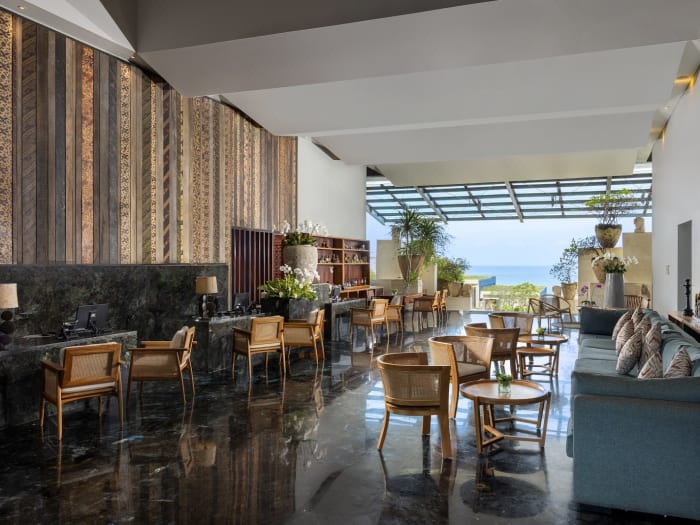
The first impression is of a place shaped by light. In Bali, the relationship between architecture and climate is essential, and the resort expresses this through an open design animated by air and by the changing hours of the day. Public spaces favour uncluttered lines, mineral textures and generous openings. The whole does not seek monumentality; it prefers a natural kind of theatre, founded on cliff, sea and depth of landscape. This visual restraint contributes to the calm that defines the resort.
The setting of Uluwatu naturally plays a central role. Wilder and more rugged than other parts of Bali, the area has long attracted travellers in search of a more dramatic coastline. People come for the panoramas, hidden beaches, surf breaks, sunsets and the proximity of Uluwatu Temple, one of the island’s most emblematic sites. To stay here is to choose a more mineral Bali, more open to the ocean, less defined by rice terraces than by the clear lines of the southern coast. Anantara Uluwatu Bali Resort is fully rooted in that particular geography.
Within the property, the atmosphere remains peaceful, almost suspended. The resort naturally suits couples, travellers in search of rest, and those wishing to alternate between restorative days and selected discoveries in southern Bali. The experience is less one of constant activity than of a chosen rhythm: breakfast facing the sea, reading on a terrace, a swim, a treatment, dinner at sunset, then a return to the quiet of night. That slow tempo is one of the address’s principal attractions.
Its integration into the Balinese landscape, one of the resort’s defining features, can be read in the way the hotel avoids imposing itself too forcefully on the site. The buildings follow the cliff rather than deny it, and the overall composition suggests a desire to preserve the primacy of the panorama. Luxury lies less in accumulation than in access to space, to the view and to a sense of relative seclusion. One is in Bali, but in a Bali of headlands, salt-laden wind and oceanic light.
For travellers already familiar with the island, the resort offers a different reading of the destination. For first-time visitors, it provides an immediate introduction to one of Bali’s most striking landscapes. In both cases, the property functions as a privileged vantage point over the Bukit coast: a place where one comes as much to inhabit the panorama as to enjoy a five-star resort.
Rooms, Suites and Villas
At Anantara Uluwatu Bali Resort, accommodation is central to the experience. The setting of Uluwatu invites guests to enjoy their room, suite, or villa with views of the Indian Ocean.
The allure of a cliffside resort lies in its relationship with the landscape. The private space becomes a vantage point, a refuge, and a place to unwind.
The spirit of the accommodations is grounded in a few clear principles: openness to the outside, contemporary comfort, a tranquil atmosphere, and a dialogue with the site. The interiors favour understated tones, in harmony with the visual strength of the location.
Here, elegance means allowing the sea, sky, and cliff to form the essence of the decor. The spaces are designed to create sightlines and extend the feeling of airiness.
For travellers, this translates into a very special experience. One wakes up facing the ocean, enjoys the light, and then returns to the terrace or the openings to the sea in the late afternoon.
This way of inhabiting one’s room is part of the Balinese stay. In the south of the island, the weather, breeze, and sunsets naturally rhythm the days.
The suites and villas cater well to this quest for intimacy and space to breathe. They are ideal for romantic getaways, celebratory trips, or for those seeking more room.
In a resort focused on relaxation, silence, relative seclusion, and the ability to settle in for the long term are just as important as the amenities. Luxury is measured by how easily one can retreat without losing sight of the landscape.
The architecture integrated into the Balinese landscape is also reflected in the accommodations. The volumes aim less to dominate the site than to frame it.
The rooms become thresholds between the temperate interior and the tropical exterior. One can feel the proximity of the sea, the quality of the light, and, depending on the time of day, the gentleness or strength of the offshore wind.
For a successful stay, the choice of accommodation category deserves careful consideration based on how much time one wishes to spend on-site. At Anantara Uluwatu Bali Resort, one also chooses a way to experience Uluwatu from a private space open to the coastline.
Dining with an Ocean View
In Uluwatu, dining rarely occurs in isolation. In a resort perched on a cliff, the meal is influenced by the setting, the light, and the rhythm of the day.
At Anantara Uluwatu Bali Resort, the dining experience accompanies the stay. It is woven into the fabric of the location, from breakfast to dinner against the backdrop of twilight.
Facing the Indian Ocean, the venue makes the panorama a constant companion. The sound of the sea, the salty air, and the light all contribute to the meal.
Even simple cuisine gains depth in this dialogue with the outdoors. This is one of the enduring charms of cliffside resorts in Bali.
In a five-star establishment, dining is based on variety and attention to the different rhythms of the stay. Some prefer structured meals, while others opt for a more relaxed approach.
In Bali, meals often align with the heat, excursions, and the most pleasant hours of the day. A good resort accommodates this flexibility.
The Balinese context adds a blend of local influences, tropical produce, and international expectations. The experience readily mixes Asian inspirations, international offerings, and a focus on freshness.
In a relaxing stay, the clarity of flavours, balance of dishes, and quality of service often matter more than technical demonstrations.
Breakfast deserves a special mention. When the heat is still mild and the ocean takes on its first hues, lingering at the table becomes a way to slow down.
It is also one of the best times to appreciate the Bukit Peninsula. One finds that sense of openness, facing the vastness, with the comfort of high-end hospitality.
In the evening, the dining experience shifts in tone. Uluwatu is one of Bali's prime sunset territories, and dinner naturally unfolds in this light.
Guests seek a more intimate atmosphere, attentive service, and a sense of calm. At Anantara Uluwatu Bali Resort, gastronomy thus extends the serenity of the stay.
Spa & wellbeing
In Uluwatu, wellbeing is not defined solely by a treatment menu; it begins with the place itself. The cliff, the openness to the Indian Ocean, the movement of air, the light and the slower rhythm of the day already create a kind of natural therapy. In that context, the spa approach at a resort such as Anantara Uluwatu Bali Resort makes complete sense. It is not simply a matter of adding a relaxation space to a comprehensive hotel offering, but of extending, in a more intimate setting, the soothing effects of the landscape.
In Bali, the culture of care belongs to a broader tradition in which the body, rest and inner balance occupy an important place. Travellers often come to the island with the desire to recentre themselves, to slow down or to recover a form of harmony tested by urban routine. On the Bukit Peninsula, that aspiration takes on a particular tone: the presence of the ocean encourages deep breathing, release and a finer awareness of sensation. A well-conceived spa knows how to absorb that energy rather than contradict it.
In a five-star resort, the wellbeing experience generally rests on several complementary dimensions: the quality of the welcome, the accuracy of the consultation, the comfort of the spaces, the skill of the therapists and the ability to adapt treatments to the rhythm of the stay. Some guests seek a single restorative pause after a long-haul flight or a day of exploring; others prefer to build a fuller routine around treatments, rest, hydration and quiet time. The appeal of staying at Anantara Uluwatu Bali Resort lies precisely in being able to align those needs with an environment that naturally encourages decompression.
Wellbeing, moreover, extends beyond the spa in the strict sense. It continues in the way one inhabits the resort: waking without pressure, walking slowly between spaces, sitting before the sea, reading, swimming, watching the sky change. This quality of attention to body and time is one of the great promises of a stay in Uluwatu. Through its peaceful atmosphere and dramatic setting, the resort creates the conditions for a deeper rest than that of a simple seaside break.
For couples, the address is particularly well suited to a shared approach to wellbeing. The setting lends itself to time together, to rituals of relaxation and to days structured around a simple balance: a treatment, a light lunch, a period of rest, then late afternoon oriented towards sunset. This sequence, very Balinese in spirit, captures what many come here to seek: not an accumulation of activities, but a sense of recentring.
From that perspective, the spa and wider wellbeing offering at Anantara Uluwatu Bali Resort contribute to a single idea of luxury: time made more available, a body less burdened, a calmer mind. In Uluwatu, the sea is not only contemplated; it also acts as a regulating, almost meditative backdrop that gives treatments and moments of rest a particular depth.
Concierge & Services
At the Anantara Uluwatu Bali Resort, the experience is also built on an organisation designed to ensure a seamless stay. The concierge and reception are available 24 hours a day. Additional services include daily housekeeping, turndown service, luggage storage, laundry, wake-up calls, and a multilingual staff.
The concierge plays a particularly significant role here. Uluwatu is not conducive to spontaneity. The distances, terrain, and local pace invite guests to anticipate their movements and activities. Organising a visit to a temple, planning a moment on a beach in the Bukit Peninsula, coordinating transfers, or booking an activity makes for a more cohesive experience. During peak season, this assistance becomes especially valuable.
The continuously open reception provides discreet security. Late arrivals, early departures, and last-minute logistical needs are managed seamlessly. In an island destination, this continuity of presence is essential.
The daily housekeeping and turndown service contribute to a quieter comfort. Rooms, suites, or villas remain ready for occupancy. Maintenance, tidying, and evening preparation enhance this sense of stability.
Laundry, luggage storage, and wake-up calls follow the same principle. These services facilitate transitions, particularly within the context of a broader itinerary in Bali, Indonesia, or Southeast Asia.
Finally, the presence of a multilingual staff underscores the attention given to an international clientele. Explaining, guiding, reassuring, or recommending with precision is an integral part of hospitality. At the Anantara Uluwatu Bali Resort, the services discreetly and flexibly support the stay.
The Uluwatu way of life
Staying at Anantara Uluwatu Bali Resort also means choosing a particular way of experiencing Bali. Uluwatu does not offer the same atmosphere as the island’s more central or urban areas. Here, the way of life is shaped by the coast, the sky, the wind and a more direct relationship with the Indian Ocean. The Bukit Peninsula has a distinct identity: drier, more mineral and at times more pared back than other Balinese landscapes. That singularity attracts travellers who seek less bustle than visual intensity, less abundance than a sense of space.
Daily life in Uluwatu is readily organised around a few major natural appointments. In the morning, the light is clear, the air still moderate, and departures towards beaches or viewpoints take place in an almost peaceful atmosphere. As the day advances, the heat encourages a slower pace, a return to the hotel, a swim or a period of rest. Then comes sunset, a true local ritual. In this part of Bali, the end of the day is not merely a transition: it is a social, aesthetic and almost ceremonial moment, when everyone seeks an ideal vantage point facing the sea.
Uluwatu is also associated with a surf culture that has greatly contributed to its international reputation. Even without taking part, one senses its presence in the general mood: a form of controlled ease, a taste for open horizons and a close attention to sea and wind conditions. This energy coexists with a more spiritual dimension, embodied notably by the nearby Uluwatu Temple, one of Bali’s best-known sanctuaries. The contrast between the force of the coastal landscape and the symbolic depth of these sacred places gives the region unusual density.
For travellers, the appeal of staying here lies in this balance between contemplation and exploration. One may choose hardly to leave the resort at all and fully enjoy its peaceful atmosphere. Or one may arrange selected outings: discovering the surroundings, spending time on the peninsula’s beaches, visiting a cultural site or dining in one of southern Bali’s coastal districts. The key is not to try to see everything. Uluwatu lends itself better to a selective approach built around a few well-chosen experiences rather than an accumulation of stops.
The dry season, from May to September, is often considered especially favourable for enjoying beaches and water-based activities. The light is clear, the days generally easier to read, and one fully understands why the Bukit coast exerts such attraction. Yet beyond the seasons, what leaves the most lasting impression is the quality of the relationship with the landscape: that feeling of always being slightly on the edge of something, between land and sea, between retreat and openness.
In this context, Anantara Uluwatu Bali Resort appears as an ideal base from which to enjoy the Uluwatu way of life without giving up the comfort of a major resort. The address allows guests to experience the region at the right distance: close enough to feel its energy, sheltered enough to savour its quiet. That is perhaps where the true luxury of the place lies: in offering privileged access to one of Bali’s most striking faces, at a chosen pace and without excess.
Book via MyConciergeHotel
Booking the Anantara Uluwatu Bali Resort through MyConciergeHotel ensures a well-prepared stay. Perched on the cliffs of Uluwatu, this destination faces the Indian Ocean. The choice of your stay depends on the season, the desired pace, the type of accommodation, and the balance between resort relaxation and exploration in southern Bali.
The first consideration is to properly position your stay within your itinerary. Uluwatu is not experienced like Seminyak, Ubud, or Sanur. It offers a more secluded atmosphere, the beauty of the coastline, stunning sunsets, tranquility, and a certain quality of silence. The Anantara Uluwatu Bali Resort can serve as a final retreat, a main stay focused on relaxation, or a beach stop within a broader journey through Indonesia. Booking with MyConciergeHotel allows for adjustments to this logic rather than selecting the hotel in isolation.
The second point concerns anticipation. Certain activities are best reserved in advance, especially during peak season. This applies to coastal experiences, specific sunset outings, wellness moments, and everything that structures a short stay. A good reservation is not merely about securing a room; it also ensures the highlights that will provide coherence to your trip. In Uluwatu, where one often seeks to optimise a few days of retreat, this preparation makes a significant difference.
Booking via MyConciergeHotel also provides a precise understanding of the suitability between the hotel and your traveller profile. This address is particularly well-suited for couples, travellers seeking relaxation, and those who favour coastal landscapes. It may be less appealing to those looking for urban immersion, continuous entertainment, or an exhaustive exploration of Bali in a very short time. This clarity in advice helps avoid mismatched expectations. It allows you to choose the establishment for what it truly offers: a peaceful, visually stunning five-star cliff resort conducive to slowing down.
The benefit of tailored support lies in practical details. Arrival and departure times, coordination with other stages of the journey, transfer organisation, and recommendations for visits or moments to prioritise according to the season are all elements that make the stay smoother. In a hotel where luxury greatly depends on the quality of time spent, everything that simplifies the before, during, and after of the stay matters.
Choosing the Anantara Uluwatu Bali Resort via MyConciergeHotel means opting for a thoughtful, contextualised, and supported reservation. In Uluwatu, where the landscape, light, and pace of the stay play an essential role, this approach allows for a full appreciation of the destination, with the peace of mind that comes from well-executed planning.