History & sense of place
In Kalutara, Anantara Kalutara Resort is defined less by grand historic pedigree than by a more nuanced dialogue with its setting. What distinguishes the property first is its unusual geography, poised between the sea and inland waterways, in a part of Sri Lanka’s coast where nature still shapes the rhythm of a stay. Here, luxury is not about display, but about a measured composition of space, light and tropical pace. That approach sits naturally with the Anantara ethos, known for resorts where local character matters as much as international comfort.
The first impression is one of balance. The site appears designed to draw the eye towards the ocean while preserving more intimate moments facing gardens, pools and inner stretches of water. In this region of Sri Lanka, where rivers and lagoons create shifting landscapes, the resort benefits from a setting that is far from incidental: it informs the entire atmosphere, calmer and more enveloping, almost island-like at times. That sense of being sheltered by the elements without feeling cut off from the world is central to the identity of the place.
The heritage one senses here is also aesthetic. The design draws on local culture without resorting to heavy-handed pastiche. Volumes, materials, decorative references and the way exterior and interior are allowed to meet suggest a contemporary reading of coastal Sri Lanka. It is less about reproducing a style than about translating a place. For the traveller, that means a stay that would lose part of its meaning if transplanted elsewhere.
The resort naturally appeals to different kinds of guests: couples seeking a seaside interlude, families wanting to combine relaxation with activity, and more contemplative travellers in search of a slower tempo. This mix works because the hotel appears to have been conceived around one essential principle of resort hospitality: the harmonious coexistence of different uses. One can fill the day with pools, beach time and water-based pursuits, or settle into a gentler, quieter rhythm.
In a country where travel is often experienced as a sequence of cultural and natural stops, Anantara Kalutara Resort occupies a particular role. It can serve as a restorative final stay after a more ambitious itinerary, or become a destination in its own right for those drawn to the coast. Its appeal lies precisely in offering more than a conventional beach hotel: a property that honours its immediate surroundings, embraces a contemporary local aesthetic, and gives the stay a calm, unforced tone. It is this coherence, more than any grand claim, that defines the spirit of the place.
The setting
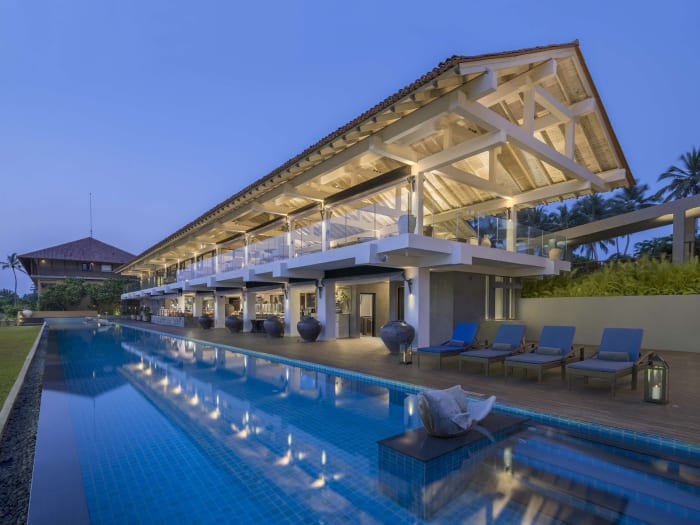
Anantara Kalutara Resort’s greatest strength lies in its geography. Set on the seafront in Kalutara and positioned between two rivers, the property enjoys a rare setting in which natural elements seem to answer one another. On one side, the ocean brings its open line, clear horizon and changing light throughout the day. On the other, calmer inland waters introduce a sense of retreat, almost of sanctuary. This dual presence of water gives the resort a distinctive character: more layered than a straightforward beach hotel, more immersive than an urban address or an isolated island retreat.
The architecture and layout appear designed to make the most of this configuration. Public spaces seem intended less to impress than to extend the landscape. Pathways, terraces, relaxation areas and outward-facing perspectives form a coherent whole, allowing guests to move easily between sociable moments and more private pauses. A stay naturally settles into a pleasing rhythm: beach in the morning, pool during the warmest hours, a garden stroll in late afternoon, dinner in a softer atmosphere once daylight fades.
The presence of pools and water-based activities reinforces the sense of the resort as a complete leisure destination. Yet the atmosphere remains notably peaceful, which matters. Not every seaside resort manages to preserve calm when the leisure offering is broad. Here, the natural setting acts as a buffer. It absorbs movement, softens transitions and allows each guest to find a personal pace. Couples tend to appreciate the restful tone, while families value the ability to vary the day without leaving the property.
Kalutara itself adds another layer of interest. The town is often seen as a gateway to Sri Lanka’s south-west coast, making it both a practical stop and a destination in its own right. Staying here allows travellers to enjoy a maritime setting without feeling entirely removed from the country’s main routes. For those wishing to combine wider exploration of Sri Lanka with a few days of rest, that relative accessibility matters as much as the resort’s intrinsic appeal.
What stands out in the end is the way the hotel turns its location into an experience. The beach is not merely scenery; it shapes the day. The rivers are not a topographical footnote; they contribute to the prevailing sense of ease. The design inspired by local culture is not simply decorative; it acts as a link between architecture, landscape and daily life. Anantara Kalutara Resort therefore offers a complete reading of its surroundings: a beachfront resort, certainly, but above all a place where nature, space and time seem unusually well aligned.
Rooms and suites
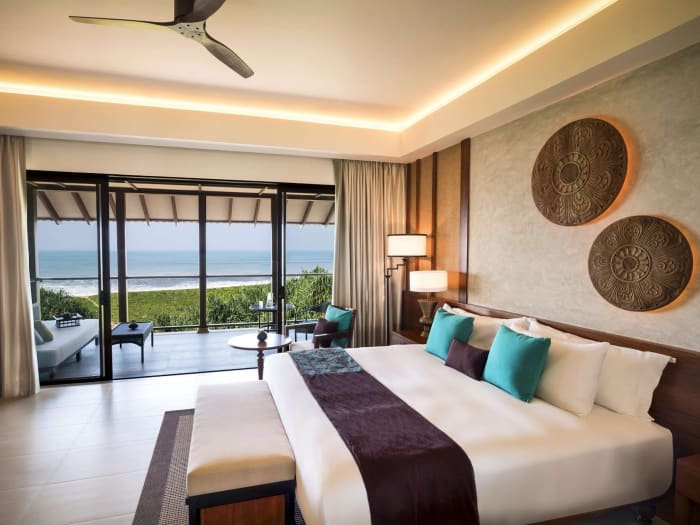
In a resort of this kind, the room is not merely a place to sleep between activities; it forms an integral part of the holiday experience. At Anantara Kalutara Resort, one expects accommodation to extend the property’s broader atmosphere: calm, light-filled and open to the outdoors without ever sacrificing privacy. The design inspired by local culture is central here. The point is not to accumulate decorative references, but to create an ambience that resonates with coastal Sri Lanka, its materials, its tones and its particular relationship with tropical light.
Accommodation appears conceived to suit different ways of travelling. For a couple, the room becomes a tempered refuge after hours in the sun, a space of retreat and comfort. For a family, it must also offer a clear and practical layout capable of absorbing the more mobile rhythm of a holiday. In both cases, the essential quality is fluidity: easy circulation, functional furnishings, and an openness towards views or outdoor spaces that continually remind guests of the nearby sea and water.
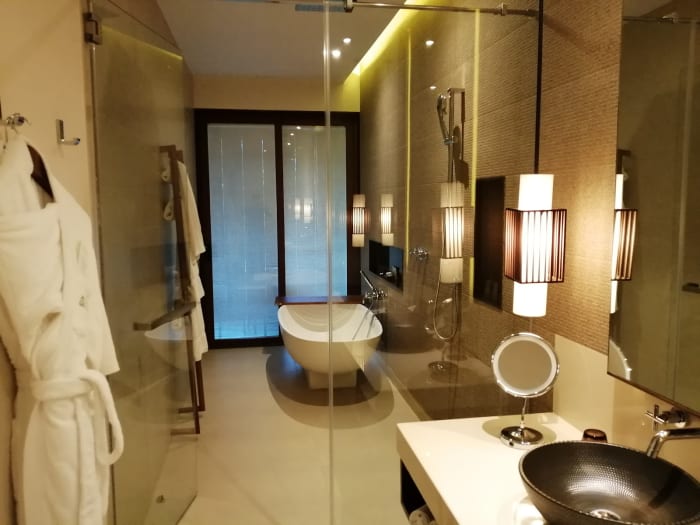
Properties of this type generally place great emphasis on bathrooms, resting areas and the transitions between indoors and out. In Kalutara, that logic makes particular sense. When the climate encourages guests to live outside for much of the day, returning to the room should bring an immediate sense of coolness and repose. One imagines airy proportions, natural palettes, textiles chosen for visual softness as much as comfort, and a discreet expression of seaside living. Nothing needs to be showy: quality is read in balanced proportions, in the way light is filtered, and in the sense of space left to the traveller.
One of the strengths of a resort like this is that it allows several ways of inhabiting a stay. Some guests will use the room simply as a cocoon between beach, pool and meals. Others will spend longer there, enjoying a balcony, a terrace or a quiet reading moment away from the heat. In either case, the accommodation should support this variety of use without imposing a single style of holiday. That is often where the success of a fine seaside address is measured: in its ability to make rest feel natural, almost instinctive.
At Anantara Kalutara Resort, the rooms and suites are likely to follow that philosophy. They do not seek to distract from the landscape, but to frame it. They offer the comfort expected of a five-star hotel while maintaining a sensitive relationship with the local context. For the traveller, that means mornings filled with light, easy returns from the beach thanks to thoughtful planning, and that valuable impression that private space remains in continuity with the spirit of the resort. In a coastal destination, it is often this sense of coherence that turns a merely comfortable stay into a genuinely restorative one.
Dining
In a seaside resort, dining is never merely functional. It shapes the day, follows the changing light and contributes to the sense of release guests seek by the water. At Anantara Kalutara Resort, the presence of several restaurants suggests an offering designed to accompany different moments of the stay: a lingering breakfast, a light lunch between swims, a more settled dinner once the heat has softened and the landscape takes on a different depth.
The Sri Lankan context naturally gives dining a particular character. Local cuisine, marked by spices, seafood, rice, curries and the island’s layered influences, lends itself well to the hotel setting when handled with care. In an international property, the challenge is often to strike the right balance between discovery and accessibility: to convey a sense of place without making the offering feel daunting to travellers from different backgrounds. When successful, that balance allows guests to move from a distinctly local meal to something more universal without any break in tone.
Setting matters as much as the plate. In a hotel positioned between sea and rivers, one expects restaurants to maintain a direct relationship with the outdoors: open views, terraces, natural ventilation where possible, or simply the feeling that the meal belongs to the landscape rather than being sealed off from it. A lunch taken after the beach does not serve the same purpose as a dinner for two; a family snack by the pool answers a different desire from a sunset drink. A well-conceived dining offering knows how to orchestrate these uses without making them feel rigid.
For families, variety is essential. It allows for changing appetites and simplifies the rhythm of the stay. For couples, atmosphere often makes the difference: the possibility of dining in a quieter setting, lingering into the evening, and connecting food with a broader sense of escape. In both cases, service plays a decisive role. In well-judged luxury hospitality, it does not intrude; it accompanies, anticipates with restraint, and allows the meal to keep its own pace.
Dining at Anantara Kalutara Resort should therefore be seen as part of the wider experience. It extends the design inspired by local culture, reflects the relationship with water and climate, and helps the traveller settle into a more fluid rhythm. One looks here less for culinary theatre than for coherence: pleasant places to spend time, food suited to the tropical setting, and options capable of working equally well for a family holiday or a couple’s escape. In a resort of this calibre, it is often this discreet intelligence in dining that leaves the most lasting impression: not a single standout meal, but a sequence of well-judged moments aligned with the place and the pace of a holiday.
Spa & wellbeing
Wellbeing at a resort such as Anantara Kalutara extends beyond the spa in the narrow sense. It begins with the site itself: the nearness of the sea, the presence of the rivers, the diffused coastal light, and the possibility of slowing down without effort. Everything contributes to a form of progressive, almost organic relaxation, which the wellness facilities then deepen. In that sense, the spa is not separate from the rest of the hotel; it is its most concentrated expression.
In a tropical setting, one’s relationship with the body changes. Guests tend to seek coolness, recovery after sun exposure, and treatments that work with the climate rather than against it. The best resort spas respond through an approach that is both sensory and practical: massages intended to release tension, rituals inspired by local or Asian traditions, and quiet spaces where one can simply pause between more active parts of the day. Without needing to list a precise menu, the expected experience here clearly belongs to that logic of gentle rebalancing.
The natural surroundings reinforce this impression. Simply being enclosed by water alters one’s sense of time and rest. After an active morning, whether spent on the beach, by the pool or in a water-based activity, the body often calls for a different pace. The spa then becomes a place of transition: from movement to stillness, from bright sun to softer light, from outdoors to indoors. This shift is essential in successful coastal stays, because it prevents the day from feeling like a sequence of obligations and turns it instead into a more harmonious composition.
Wellbeing also matters to travellers who do not necessarily use the spa intensively. For them, it lies in details: a quiet reading moment, a few lengths in the pool, an early walk on the beach, a shaded nap, or simply the ability to do nothing without guilt. Anantara Kalutara Resort seems particularly well suited to this broader definition of rest. Its peaceful atmosphere, noted as one of its distinguishing traits, creates the conditions for a form of wellbeing that is not prescriptive, but free.
For couples, this may take the form of a ritual for two, a shared treatment or an entire day shaped around relaxation. For families, it often appears differently: in the alternation between activity and recovery, and in the ease with which each person can find their own space. This is one of the most appealing qualities of a well-conceived resort: the ability to offer several levels of wellbeing, from the structured to the spontaneous. In Kalutara, that promise feels credible because it rests on a strong natural setting and on a vision of luxury that favours calm. The real refinement here may simply lie in making rest feel self-evident.
Concierge & services
In five-star hospitality, services matter not only for their number, but for the way they genuinely simplify a stay. At Anantara Kalutara Resort, that principle seems especially important, as the property appeals both to couples and to families, two guest profiles whose expectations overlap without ever being identical. The former tend to seek fluidity, calm and discreet organisation. The latter need flexibility, practical solutions and activities capable of structuring the day without making it complicated. A good resort knows how to serve both without friction; that is precisely what one expects here.
The presence of pools, restaurants and water activities already points to a service offering built around life on the property. In practical terms, much of the stay can unfold without any need to leave the resort, which is a real advantage for travellers who have come primarily to rest. In this context, concierge service takes on an orchestration role. It is not limited to arranging a transfer or handling a single request; it helps shape a coherent stay, distribute activities sensibly and anticipate busier moments, particularly in high season. The advice to reserve certain water activities in advance fits perfectly within that logic: here, service begins with a clear reading of the resort’s rhythm.
For couples, the value of service is often measured by its discretion. Being able to arrange a quiet dinner, a water-based activity, a wellness moment or simply a day free of visible effort is central to the feeling of luxury. For families, quality is expressed differently: in the ease of meals, the availability of staff, and the ability to suggest activities suited to different ages while preserving an overall peaceful atmosphere. The fact that the hotel is explicitly presented as suitable for both profiles is an important sign of operational balance.
Service in a seaside resort must also take account of climate and the habits it creates. One does not live in Sri Lanka as one does in a European capital. Days are built around heat, water, light and the need to slow down. The best properties support that rhythm through a form of flexible attentiveness: suitable timings, intuitive circulation, staff who are present without being intrusive, and the ability to recommend the right moment for an outing, a swim or an activity. This intelligence of context often makes the difference between a pleasant stay and a genuinely restorative one.
Booking through a specialist service also helps guests make the most of an address like this. A hotel such as Anantara Kalutara Resort is not chosen merely for a room category, but for a way of inhabiting the place: proximity to the beach, the balance between tranquillity and leisure, suitability for a couple or family trip, and the most favourable period to travel. The role of an expert concierge is therefore to clarify these factors, tailor the stay to the traveller’s real expectations, and ensure that everything feels effortless from arrival. In coastal luxury, the quality of service is often recognised by precisely this sensation: that no visible effort was required for the holiday to find its natural rhythm.
The Kalutara way of life
Staying in Kalutara means discovering a different tempo of Sri Lanka. The town and its coastline do not belong to the same register as the country’s major inland cultural stops, nor entirely to that of more animated beach destinations. Here, the experience is defined more by a kind of coastal gentleness, by the constant presence of water, by light that shifts throughout the day, and by the feeling that one can inhabit the landscape without disturbing it. Anantara Kalutara Resort belongs fully to that way of life.
The seafront naturally shapes the day. One begins early to enjoy softer light, slows down as the heat rises, then returns outdoors in late afternoon when the air becomes easier and the sky more nuanced. This rhythm is not a constraint; it is one of the great strengths of tropical travel when properly embraced. It encourages attention to time, adaptation of desire, and a sense that the day is something more than a sequence of activities. Kalutara is particularly well suited to this more attentive form of presence.
Its position between two rivers adds an almost meditative layer to the stay. Water is not only a maritime horizon; it surrounds, accompanies and slows. River landscapes, the gentler movement of inland waters, and the vegetation they sustain all create a counterpoint to the more open energy of the ocean. For the traveller, this duality enriches the perception of place. One does not come here only to lie on a beach, but to experience a singular geography in which several forms of calm coexist.
The Kalutara way of life also lies in the simplicity of its pleasures. A breakfast taken without hurry, a swim before lunch, a few shaded hours, a meal with local flavours, a walk at sunset: it is often these modest sequences, repeated with the right measure, that give a stay its depth. In a well-conceived resort, they become almost instinctive. One stops trying to optimise everything and allows the place to set the pace. That inner availability is one of the rarest luxuries in contemporary travel.
For couples, Kalutara offers a setting well suited to a true interlude: less demonstrative than some beach destinations, yet highly favourable to intimacy and rest. For families, the destination offers another advantage: the possibility of sharing a seaside holiday without giving up an overall peaceful atmosphere. Everyone can find a personal rhythm between water activities, pool time and quieter moments. That is perhaps where Kalutara’s elegance lies: in its ability to accommodate different uses without losing its calm character.
Choosing this destination therefore means favouring an idea of travel in which setting matters as much as programme. Anantara Kalutara Resort offers a particularly clear interpretation of that balance, combining direct beach access, design inspired by local culture and a serene atmosphere. Through it, Kalutara emerges as a destination of breathing space: a place one visits less to accumulate than to feel, less to tick off experiences than to rediscover a simpler relationship with time, water and light.
Book via MyConciergeHotel
Booking the Anantara Kalutara Resort through MyConciergeHotel means approaching this destination with precision. A seaside resort nestled between two rivers cannot simply be chosen based on photographs.
The success of your trip hinges on the timing of your departure, the desired pace during your stay, the water activities available, and the balance between relaxation and entertainment.
Editorial and concierge support allows for a tailored experience right from the outset. Whether it’s a final pause after a cultural journey, a few days of relaxation, a calm family holiday, or a romantic getaway for two.
The same destination can be experienced in different ways. MyConciergeHotel’s role is to identify these nuances to guide your booking accurately.
The best season runs from December to March, when the climate is most pleasant. This influences beach days, outdoor activities, and the use of facilities.
Booking through a specialised service also enables you to ask the right questions. Duration of stay, Kalutara's place in your itinerary, daily rhythms, and the balance between beach, pools, and wellness.
These choices are less about logistics and more about the art of travel. The aim is not merely to confirm a room but to achieve the right harmony.
In the case of the Anantara Kalutara Resort, this harmony is rooted in a strong natural setting, between the sea and rivers, a design inspired by local culture, and a tranquil atmosphere.
The resort is equally suited for a romantic escape or a family holiday. Booking with guidance ensures coherence right from the preparation of your stay.