History & heritage
Waldorf Astoria Panama City belongs to a hotel tradition that is instantly recognisable: one in which service, discretion and precision matter as much as interior design or in-room comfort. In Panama City, the property translates the Waldorf Astoria spirit into a very different urban setting from its historic North American or European references: a capital shaped by business, international exchange and constant movement, yet also a city of contrasts, where contemporary districts meet colonial heritage and tropical waterfronts. It is precisely within that balance, between metropolitan pace and the search for a composed retreat, that the hotel finds its place.
Here, heritage is not expressed through a museum-like narrative or an overworked decorative vocabulary. It is felt instead in a particular understanding of high-end hospitality: seamless arrivals at any hour, careful attention to the details of a stay, and an instinctive sense of each guest’s rhythm, whether travelling for meetings, an extended stopover or a couple’s escape. The Waldorf Astoria name suggests a codified culture of service, and the Panama City address interprets it in a more contemporary, urban register, suited to an international clientele expecting both efficiency and comfort.
Panama City itself gives the hotel’s story a distinct depth. The city is one of the great crossroads of the Americas, shaped by trade, the sea and the movement of travellers. Staying in a hotel of this category in the heart of the capital means choosing a privileged vantage point over a destination that cannot be reduced to its skyline, its canal or its historic quarter alone. Waldorf Astoria Panama City supports that more nuanced reading: it provides a stable base in a city defined by motion.
The property’s sense of heritage also lies in its ability to serve different purposes without losing coherence. Business travellers find a calm, structured setting; couples discover an atmosphere that feels refined rather than theatrical; seasoned luxury guests recognise familiar standards of quality. Nothing appears designed merely for effect; everything is intended to sustain the continuity of the experience. That is often the mark of hotels with lasting appeal: they do not seek to impress at every turn, but to maintain a consistent level of exactness.
In a city where luxury hospitality can sometimes favour visibility or spectacle, Waldorf Astoria Panama City stands out for a certain restraint. Its heritage is less that of a monument than of a signature: an art of hosting based on reliability, personalisation and understated elegance. For the traveller, this translates into something simple yet valuable: the feeling of being in an address that understands the codes of the great international hotel while remaining attuned to the particular tempo of Panama City.
The property
The first strength of Waldorf Astoria Panama City lies in its location, in the heart of Panama City, within a lively district that makes it easy to reach key attractions, business areas and places to go out. For travellers discovering the Panamanian capital, that central position is a practical advantage: it simplifies movement, shortens journey times and allows for a more flexible stay, whether focused on work, appointments, urban exploration or quieter interludes. The hotel therefore appeals to those who want to be in the middle of things without giving up a sense of retreat.
That idea of retreat is essential to understanding the property. The neighbourhood is energetic, the city animated, and the pace outside often brisk. Yet once inside, the atmosphere becomes calmer, more contained, almost suspended. It is one of the hotel’s most valuable qualities: offering a pause after the density of the day. This transition between the city’s momentum and the interior sense of quiet is not merely aesthetic; it is central to the comfort of the stay. Guests return between meetings, after dinner in town or at the end of a day of sightseeing with the feeling of re-entering a setting that is ordered, legible and restful.
The property speaks the language of contemporary urban luxury. One expects well-kept public spaces, smooth circulation, a front desk operating at any hour and an organisation capable of handling late arrivals as easily as early departures. In that context, refinement is not a static decorative statement but a quality of use. It is measured by the way the spaces support real guest needs: settling briefly before heading out again, planning the day, requesting a reservation, storing luggage or simply recovering a sense of calm in the lobby or lounge after the bustle outside.
Waldorf Astoria Panama City is particularly well suited to two types of traveller, without being limited to them: couples and business guests. The former find an elegant address, sufficiently hushed to preserve the intimacy of a stay for two while remaining connected to the city. The latter appreciate the logic of a central, efficient hotel where essential services are available and a professional rhythm can be maintained without friction. This dual appeal gives the property a balanced tone: neither exclusively corporate nor purely leisure-driven.
Choosing this address therefore means embracing a particular way of experiencing Panama City: as an active, cosmopolitan and accessible capital approached from a serene base. The hotel does not try to isolate its guests entirely from the urban environment; rather, it enables them to inhabit it with greater comfort and control. That distinction matters. The best city hotels do not sever the connection with their surroundings; they provide the right distance from them. Waldorf Astoria Panama City appears to be built precisely on that balance between immersion and shelter, between being at the centre of the city and being able to return to calm.
Rooms and suites
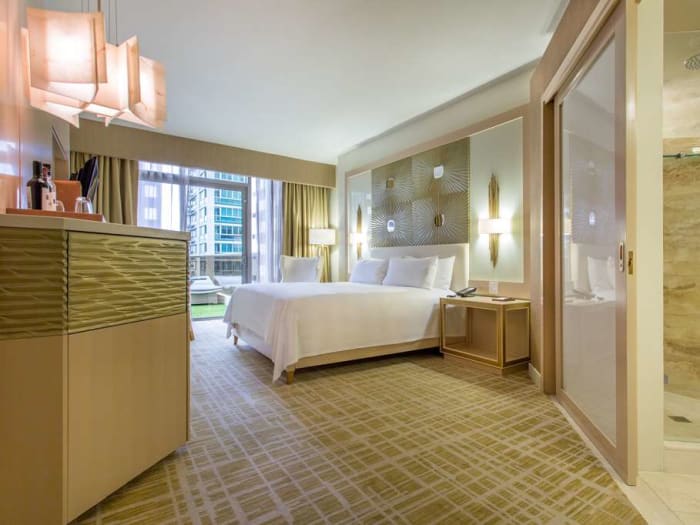
In a city hotel of this category, the room is not simply a place to sleep; it becomes a space for recovery, preparation and, at times, quiet work. At Waldorf Astoria Panama City, that multi-layered function sits at the heart of the experience. Business travellers need a stable environment conducive to concentration and rest between commitments. Couples, meanwhile, look for a more enveloping atmosphere capable of extending the sense of a shared interlude. Rooms and suites therefore need to answer different expectations without losing overall coherence: immediate comfort, understated elegance, and a feeling of order and calm.
The style one expects here belongs to a controlled contemporary luxury. One imagines layouts designed for ease of movement, materials chosen for their lasting quality, a soothing rather than ostentatious palette, and furnishings that favour clarity. In the best urban addresses, nothing is incidental: lighting should support different moments of the day, seating should work equally well for reading or a short work session, and the bed should provide a true point of return after the demands of the city outside. This kind of comfort is never theatrical, yet it defines the real quality of a stay.
The hotel’s turndown service is part of that attention to the guest’s rhythm. It suggests that beyond the room itself, the experience depends on a discreet presence that anticipates needs without intruding. Daily housekeeping follows the same logic: maintaining a space that is immaculate, orderly and ready to welcome guests back at the end of the day or into the next morning without friction. In a city as active as Panama City, that continuity is especially valuable. It turns the room into a dependable refuge: always prepared, never neglected.
Suites, when a higher category is chosen, generally extend this logic by offering greater ease, clearer separation between uses and more freedom in how the space is inhabited. For a short stay as a couple, that may mean more privacy and comfort. For a business trip, a lounge or separate area allows for a brief meeting, the review of documents or simply a clearer distinction between work and rest. Without inventing a specific layout, it is fair to say that the value of a suite in this context lies less in display than in flexibility.
What matters in the end is the impression left by the whole: that of a room designed to support the stay rather than dominate it. At Waldorf Astoria Panama City, guests come in search of a setting where they can withdraw from the noise of the city, recover a sense of quiet and regain their balance. The quality of a room is then measured by its ability to make its own mechanics disappear: the right temperature, consistent upkeep, attentive service and a peaceful atmosphere. In a well-run hotel, all of this feels simple. In reality, it is often the hardest result to achieve — and one of the most valuable for the discerning traveller.
Dining
In a capital such as Panama City, dining extends well beyond the simple question of eating within the hotel. The city moves to an international rhythm, bringing together business travellers, cosmopolitan residents and passing visitors; as a result, it encourages varied habits, from an early breakfast before meetings to a more relaxed dinner after a dense day. In this context, the dining offer at a hotel such as Waldorf Astoria Panama City must meet a double expectation: to provide a reliable, elegant and well-executed option on site, while also fitting into a destination where guests may wish to go out and explore.
Even without detailing a specific menu, one can say that a property of this level is expected to perform on several fronts. First, the quality of service, which should be just as consistent at morning coffee as during a more leisurely evening meal. Then, the clarity of the offer: a pressed traveller should be able to obtain a simple, well-handled meal without delay, while a stay for two calls for more rhythm, attention and comfort. Finally, atmosphere matters as much as the plate itself. In a high-end urban hotel, the dining room, bar or breakfast area form part of the property’s identity. They are spaces of transition, meeting points, sometimes for informal work, sometimes for relaxation.
Breakfast deserves particular mention, as it often sets the tone for the day. In a city where guests leave early for appointments or sightseeing, it must combine efficiency with pleasure. A good hotel knows how to make this moment both smooth and calming: attentive service, a controlled pace and an environment quiet enough to begin the day without haste. For couples, it is also a pause before heading out to discover the city; for business travellers, an essential sequence that should remain entirely frictionless.
In the evening, the hotel table can play another role: that of a practical and polished refuge when one would rather avoid another journey or simply extend an already full day. In that case, the value of the experience often lies in precision rather than effect. Straightforward cuisine, accurate service, a comfortable setting and a degree of discretion are enough to make dinner on site a fully satisfying option. Luxury here lies in the freedom to choose: to go out into the city if one wishes to prolong its energy, or to remain at the hotel and return to a more measured tempo.
That flexibility suits the spirit of Waldorf Astoria Panama City well. The address appears designed for guests who appreciate hotels capable of adapting to the shape of their day rather than imposing a script upon it. Dining is part of that intelligence. It is not merely one service among others; it structures moments, supports transitions and contributes to the sense of continuity that distinguishes well-run hotels. In Panama City, where meetings, urban movement and discovery often alternate within the same day, that continuity has particular value.
Concierge & Services
In the realm of luxury hospitality, services form the invisible framework of a stay. At the Waldorf Astoria Panama City, they create a clear promise.
With 24-hour concierge service, round-the-clock reception, daily room service, turndown service, luggage storage, laundry, wake-up calls, and multilingual staff, these offerings collectively convey a sense of continuity, availability, and the ability to simplify the stay at any hour.
The continuously open reception is essential in a city connected to major international flows. It accommodates late arrivals, early departures, and changes in plans.
The 24-hour concierge adds a more personal dimension. It can assist in arranging transfers, directing guests to neighbourhoods, or coordinating multiple appointments.
Daily room service and turndown service fall into a more intimate category. They contribute to tangible comfort and enhance the quality of returning to one’s room.
The laundry service addresses a very practical need, particularly appreciated during business trips or extended stays.
Luggage storage and wake-up calls reflect the same attention to guest needs. The former frees up time around arrival or departure, while the latter ensures that tightly scheduled days remain secure.
The multilingual staff is a discreet asset, facilitating communication and contributing to a smoother experience.
At the Waldorf Astoria Panama City, these services support a demanding urban stay with reliability and simplicity.
The Panama City way of life
Staying at Waldorf Astoria Panama City also means choosing a particular way of approaching the city. Panama City cannot be reduced to a single image. It is at once a business capital, a regional gateway, a waterfront city and a cultural destination in constant transformation. Its interest lies precisely in that plurality. One can move from a modern district of vertical lines to older streets, from a highly urban sequence to an opening onto the bay, from a schedule of meetings to a slower late afternoon. Thanks to its central location, the hotel allows guests to embrace that diversity without becoming scattered.
For business travellers, the local way of life is often discovered in fragments: a coffee taken more slowly than expected, an evening walk, a dinner that extends the night without weighing it down. In a city defined by movement and exchange, such moments matter. They prevent Panama City from becoming merely a functional backdrop. For couples, the city offers another reading: that of a capital where one can alternate energy and retreat, animation and calm, discovery and rest. The fact that the hotel is described as particularly well suited to both profiles is not incidental; it corresponds closely to the way Panama City invites itself to be experienced.
The dry season, mentioned in the existing description as the best time to enjoy outdoor activities, also points to a tropical reality: climate shapes the rhythm of a stay here. Walking, planning an outing, spending time outside or simply enjoying the city more fully becomes easier when conditions are more stable. This does not mean reducing the destination to a single ideal window, but rather understanding that a successful stay also depends on the alignment between the city’s tempo, the weather and one’s own intentions.
Panama City has the particular quality of being both dense and open. Dense through its activity, contrasts and regional role; open through its perspectives, light, relationship with the water and the crossroads feeling it conveys. In that context, a calm hotel acquires particular value. It does not merely serve as a place to sleep; it becomes an instrument for reading the city. One goes out better when one knows one will return to a serene place. One enjoys the external bustle more fully when it does not take over the entire stay.
This may be where the way of life associated with Waldorf Astoria Panama City truly lies: in the ability to compose a balanced stay. Begin the day in an orderly setting, cross the city for obligations or discoveries, then return to a more hushed atmosphere by late afternoon. The property does not claim to contain the whole of Panamanian identity within its walls; rather, it provides the right conditions for discovering it at one’s own pace. For a discerning traveller, that nuance matters. Luxury does not always consist in having everything on site, but in having a place that is sufficiently well judged to make the city more accessible, more legible and, ultimately, more enjoyable to inhabit.
Book with MyConciergeHotel
Booking Waldorf Astoria Panama City through MyConciergeHotel means approaching the stay through selection and guidance rather than through a simple transaction. An address such as this is rarely chosen at random. It is selected for its central location, its suitability for a stay as a couple or a business trip, its promise of attentive service and that calm atmosphere which allows guests to recover after the intensity of the city. Yet the booking itself must still reflect the reality of the stay: its length, arrival times, the need for a smooth rhythm, room-category preferences and any particular expectations regarding comfort or services.
That is precisely where an editorial and booking concierge service becomes meaningful. Rather than merely comparing rates or stacking options, it helps ask the right questions in advance. For a couple, is it worth extending the stay in order to enjoy the city without haste? For a business trip, is it preferable to arrive the evening before in order to absorb the journey and begin the following day in better conditions? If arrival is early or departure late, how should luggage and available time best be organised? These may seem like modest details, yet they often determine the real quality of the trip.
MyConciergeHotel also makes it possible to place the hotel within a wider itinerary. Panama City is sometimes a primary destination and sometimes a stop within a broader regional journey. In both cases, choosing the right property and the right pace is decisive. A central and well-structured address such as Waldorf Astoria Panama City can serve as an ideal base for a few days of urban immersion, for a dense professional sequence or for a more comfortable stopover before continuing elsewhere. Booking intelligently therefore means thinking not only about the room, but about the movement of the journey as a whole.
The value of a specialist intermediary also lies in the quality of its advice. Not all five-star hotels answer the same expectations, and not all travellers use luxury in the same way. Some prioritise absolute efficiency, others tranquillity, and others still the balance between urban life and retreat. Waldorf Astoria Panama City is particularly well suited to those seeking that synthesis: being at the heart of the city without being overwhelmed by its intensity. The role of MyConciergeHotel is to clarify that promise, ensure it genuinely matches the travel plan and make its implementation easier.
Finally, booking through MyConciergeHotel means choosing a more attentive, more legible and more serene approach to high-end travel. In an international city such as Panama City, where schedules can shift quickly and where one expects a grand hotel to simplify the stay in practical terms, that quality of support is far from incidental. It prepares the experience even before arrival. And in the case of an address such as Waldorf Astoria Panama City, it allows guests to make the most of what defines it: a central setting, polished service, a peaceful atmosphere and a genuine ability to accommodate stays with multiple purposes.