History & heritage
In Deer Valley, The St. Regis Deer Valley belongs less to the category of a historic landmark than to that of a contemporary grand mountain hotel, conceived to express an American vision of alpine luxury. Its heritage is not rooted in centuries of aristocratic life, but in a highly codified culture of hospitality carried by the St. Regis name and by a particular idea of tailored service. This lineage appears in the details of the stay: an arrival handled with ease, constant attention to the guest’s rhythm, and the ability to make effortless what is in fact the result of exacting organisation.
Within Deer Valley, a resort known for its polished approach to skiing and for an atmosphere more refined than ostentatious, the hotel feels naturally at home. It speaks to travellers who value the quality of the slopes as much as the comfort of returning to the hotel, who seek winter performance alongside the sense of being expected, recognised and looked after. This is where the St. Regis identity becomes especially relevant: not a theatrical luxury, but one built on continuity, consistency and personal attention.
The property belongs to that generation of high-end resorts that redefined the mountain experience in North America. Rather than setting tradition against modernity, it combines the two. The chalet imagination is present, yet interpreted through cleaner lines, materials chosen for both visual warmth and durability, and a staging that privileges views, light and the feeling of shelter. The result is a hotel that does not attempt to imitate the European Alps, but instead fully embraces its place in Utah’s Rocky Mountain landscape.
This sense of heritage extends to the way the hotel accompanies the seasons. In winter, it is experienced as a sophisticated refuge close to the slopes; in summer, it takes on a different tone, more open and contemplative, shaped by mountain air, dry light and outdoor pursuits. This adaptability is more than a marketing point: it forms part of the property’s identity. A great mountain hotel is never merely a backdrop; it must answer very different patterns of use without losing its coherence.
Finally, The St. Regis Deer Valley inherits the implicit promise attached to major international hotel signatures: a level of service that is legible, reassuring and immediately understood by seasoned luxury travellers. In Deer Valley, that promise acquires a distinctly local shade, warmer, more sporting and at times more family-oriented than in an urban palace. It is precisely this blend that gives the address its appeal: a disciplined service culture inherited from a leading house, applied to a mountain setting where guests come as much to breathe as to be looked after with precision.
The property
The St. Regis Deer Valley occupies a position that largely explains its appeal: a grand mountain hotel opening on to the Deer Valley landscape, with that immediate sense of space, altitude and remove sought by travellers in search of fresh air and a change of pace. The views over the surrounding mountains are not merely an added pleasure; they shape the entire experience. Depending on the time of day, the ridgelines alter in depth, the snow reflects light with almost mineral clarity, and the public rooms take on the character of inhabited lookout points.
The architecture and interiors rely on a careful balance between elegance and comfort. The expected codes of a hotel in this category are present — generous volumes, noble materials, a palette of natural tones, fireplaces and seating designed to extend the after-ski moment — yet without decorative excess. The overall atmosphere remains warm and welcoming, at times almost domestic, which suits Deer Valley particularly well, as refinement here is often expressed through quality of use rather than display.
The relationship with the mountain is central. In winter, the hotel operates as a ski-oriented base, with an organisation intended to simplify early departures and late-afternoon returns. Guests come for the slopes, certainly, but also to find, once the day is over, an environment calibrated for recovery: comfortable lounges, attentive service, smooth circulation and the feeling of being sheltered from the elements without being cut off from the landscape. In summer or the shoulder seasons, the same setting reveals another reading: that of a panoramic retreat turned towards hiking, clear air and a more deliberate slowness.
The property suits both couples and families, which is not always self-evident in high-end mountain hospitality. This versatility stems from the nature of the place itself: sophisticated enough for a stay for two, yet flexible enough to accommodate different rhythms, family ski returns, longer pauses over a meal or in the lounge. The presence of spaces suited to meetings adds another, quieter dimension, that of a resort capable of hosting business stays in a setting far removed from the rigidity of conventional corporate hotels.
What stands out, ultimately, is the overall coherence. The St. Regis Deer Valley is not simply a well-located hotel; it is an address designed to turn a privileged geography into a complete stay experience. The views, the atmosphere, the relationship with the seasons and the quality of service form a legible whole. For the traveller, this translates into a rare impression: that of inhabiting the mountain without giving up the codes of a major international luxury hotel.
Rooms and suites
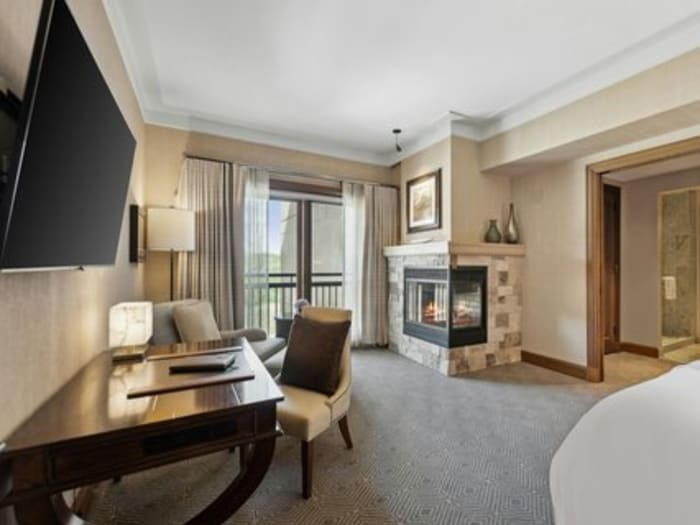
In a mountain hotel of this calibre, the room is not simply a place to sleep: it must extend the experience of the landscape, offer genuine restorative comfort and allow a seamless transition from outdoors to indoors. At The St. Regis Deer Valley, this logic can be felt in the overall atmosphere of the accommodation, conceived as elegant refuges rather than mere stopping points between activities. The sense of volume, the perceived quality of the materials and the restraint of the lines all contribute to that impression of controlled calm which often makes all the difference after a day on the slopes or on the trails.
The decorative language remains faithful to the spirit of the setting. One expects natural tones, warm materials, a discreet presence of wood and textiles, and an approach that privileges visual comfort over fashion effect. The aim is not to overplay the chalet idea, but to create an environment coherent with the mountains, refined enough for an international luxury clientele and soothing enough to feel truly inhabitable. In the best configurations, the view becomes part of the room itself, framing the Deer Valley landscape as a living backdrop that changes with weather and season.
Suites make particular sense here. In a destination where guests often stay for several days, sometimes as a family, sometimes with the wish to entertain or simply to enjoy more generous proportions, they offer an additional quality of life. The appeal lies less in display than in ease: a sitting room in which to extend the after-ski moment, a more residential rhythm, the ability to inhabit the hotel at one’s own pace. This residential dimension matters especially in mountain resorts, where time spent in the room is generally greater than in an urban hotel.
The personalised butler service, one of the property’s distinguishing features, reinforces this sense of a stay that is actively accompanied. In the St. Regis universe, such a service is not merely an outward sign of prestige; it answers a practical expectation of comfort and personalisation. Depending on the guest’s needs, it may ease arrival, streamline everyday requests and simplify the overall organisation of the stay. For the traveller, this results in a more continuous, more serene experience, in which practical details recede in favour of time genuinely enjoyed.
Ultimately, a room at The St. Regis Deer Valley should be understood as both an observation point and a cocoon. In the morning, it supports departure towards the day’s activities; by late afternoon, it becomes the setting for quiet return, reading, rest and the contemplation of mountains darkening into evening. It is this dual function — efficiency and retreat — that defines successful mountain accommodation, and that gives the stay here much of its value.
Dining
In Deer Valley, gastronomy plays a significant role in the rhythm of your stay. At The St. Regis Deer Valley, dining serves multiple purposes.
It supports early morning departures to the slopes, provides a simple lunch that fits seamlessly into an active day, and transforms into a space for unwinding in the evening.
In the mountains, dining is not quite the same as in the city. The light fades earlier in winter, and the return from skiing sharpens the appetite.
Guests often seek places where visual warmth is as important as the food itself. The balance lies in a cuisine that is clear, well-executed, and suited to its surroundings.
Breakfast sets the tone for the day. It should be smooth, comprehensive, and timely, though some may prefer to make it a more contemplative moment.
Luxury is defined as much by the quality of the offerings as by the freedom of pace. Efficiency for some, a leisurely experience for others.
As the day winds down, après-ski and dinner take on a ritualistic dimension. You settle in, share a drink, and then move to the table without interruption.
The elegant and warm atmosphere comes into its own at this time. The service remains attentive, and the ambiance is both subdued and lively, without excess.
For families as well as couples, this flexibility is important. The St. Regis Deer Valley offers a dining experience that is integrated into the overall stay.
Spa & Wellness
In a destination like Deer Valley, wellness extends beyond the spa. It begins in the mountain air and in the balance between effort and recovery.
For a five-star hotel like The St. Regis Deer Valley, the challenge is to transform this disposition into a stay experience. Wellness is understood as a holistic concept, encompassing the comfort of the accommodation, the fluidity of service, the quality of communal spaces, and the relaxation offerings.
After skiing, the body requires different attention than after an urban stay. Expectations focus on muscle recovery, warmth, and gradual relaxation. A grand mountain hotel must respond to this sequence with precision.
This involves spaces where one can truly decompress, an atmosphere that is calm without being cold, and a service that understands that luxury sometimes lies in simple things: time, silence, and seamless organisation.
This warm elegance is particularly well-suited to the wellness dimension. Relaxation is not separated from the rest of the experience; it is integrated into the hotel’s identity.
One does not transition from a sporty resort to an abstract sanctuary. Instead, one glides from one moment to the next, in a continuity of tone. This is often what distinguishes good mountain addresses; they understand that recovery is part of the pleasure of the stay.
In summer, this perspective subtly shifts. Wellness becomes less about repair and more about regeneration. Guests seek altitude, light, walking, and a sense of space. The hotel then acts as a setting that amplifies these benefits.
Rest takes on a different form—more contemplative, more diffuse, and sometimes more family-oriented. Here again, the quality of service matters. An available concierge, reliable organisation, and attentive daily maintenance contribute to the overall balance.
Thus, The St. Regis Deer Valley meets a demanding definition of hotel wellness: a place where everything works together to make the stay smoother, more restful, and more restorative. In the realm of high-end mountain experiences, it is often this coherence that makes the difference.
Concierge & Services
True luxury in a mountain resort is often measured by the quality of transitions. Skiing without delays, returning without cumbersome logistics, receiving a prompt response to a simple or complex request: it is within this continuity of service that The St. Regis Deer Valley asserts its position.
The concierge, 24-hour reception, daily housekeeping, turndown service, luggage storage, laundry, wake-up calls, and butler service all contribute to a hospitality of precision.
The concierge plays a central role here. In Deer Valley, organising a stay can quickly become technical: booking activities, adjusting schedules, coordinating departures, managing unforeseen circumstances related to weather or group dynamics. An effective concierge anticipates, prioritises, and simplifies. It transforms a fragmented itinerary into a seamless experience.
The personalised butler service adds an extra layer of comfort. It customises the welcome, facilitates certain requests, creates a more direct connection with the hotel, and contributes to a measured level of care.
The more discreet services are equally important. The turndown service shapes the perception of attention to detail. Laundry, luggage storage, and round-the-clock reception cater to very concrete needs.
Luxury is not solely found in the decor. It also resides in a hotel's ability to absorb the practical complexities of travel.
For families, couples, or business travellers, this reliability fosters a climate of trust. At The St. Regis Deer Valley, the services form the backbone of the experience.
The Deer Valley way of life
Staying at The St. Regis Deer Valley also means discovering a particular way of inhabiting the mountains in the American West. Deer Valley does not cultivate the exuberance of major resorts where everything revolves around animation; its appeal lies rather in a form of control. Guests come for the quality of the skiing, certainly, but also for a more polished, more serene atmosphere in which comfort and organisation matter as much as sporting performance. This distinctive tone shapes the local way of life and largely explains why an address such as The St. Regis feels so naturally placed here.
Winter sets the tone. Days are organised around the slopes, early departures, late-afternoon returns and that sociability particular to high-end resorts, made up of precise rendezvous, well-chosen pauses and a marked taste for warm end-of-day gatherings. Yet Deer Valley is not merely a postcard setting for experienced skiers. The destination also appeals to those who simply seek the mountains as a space to breathe: to walk, to contemplate, to enjoy a grand hotel, to alternate activity and rest. It is this refined accessibility that distinguishes it.
In the warmer months, the landscape changes register without losing its pull. The relief is read differently, trails take over from ski runs, and one finds the same idea of an active yet not frantic stay. For European travellers, Deer Valley offers an interesting interpretation of the North American mountain experience: broader, brighter, often drier in climate, with a relationship to space that deeply alters the feeling of a holiday. Luxury lies not only in service here; it also resides in this impression of openness and air.
The local way of life also depends on a certain well-kept simplicity. One may be in a highly upscale environment without everything becoming formal. This controlled informality, typical of many prestigious destinations in the United States, suits the mountains especially well. It allows for stays in which one moves from a sporting day to an elegant dinner without artificial rupture, where families coexist with couples, and where business travellers can extend a meeting into a genuinely pleasant moment. The St. Regis Deer Valley appears to align precisely with this culture: that of a serious luxury that is never rigid.
For the visitor, Deer Valley therefore represents more than a resort; it is a particular relationship to time. People come to organise their days better, to enjoy a remarkable natural environment without giving up comfort, and to recover a form of balance between intensity and softness. In this context, the hotel acts as an interpreter of the place. It does not merely accommodate; it gives access to a way of living the mountains that privileges quality of experience over display.
Booking via MyConciergeHotel
Booking The St. Regis Deer Valley through MyConciergeHotel means preparing your stay with methodical care. Anticipation, personalisation, and useful advice often make all the difference.
In a high-end mountain destination, the quality of the hotel alone is not always sufficient. Peak demand periods, activities, arrivals, departures, and room preferences all play a significant role.
Deer Valley experiences peak times, especially during the ski season. Booking early often allows for the best options that align with your travel rhythm. Reserving ski activities in advance follows the same principle.
MyConciergeHotel can help clarify priorities, plan the schedule, and prevent logistical details from disrupting the overall experience.
Not all travellers come to The St. Regis Deer Valley for the same reasons. Some prioritise access to winter activities, while others seek views, tranquility, butler service, or an elegant atmosphere without rigidity.
Others travel with family and require a flexible stay. Some combine work and leisure. MyConciergeHotel aligns these expectations with the identity of the establishment.
Booking through an editorial concierge also provides a useful filter. In the luxury realm, an abundance of information does not always yield clarity.
What matters is not just knowing that a hotel is five-star. It is also essential to understand who it is suitable for, at what time, and in what spirit of travel.
The St. Regis Deer Valley stands out for its personalised service, its mountain vocation, and its refined yet warm ambiance. However, these qualities must align with your travel style.
Booking this address with MyConciergeHotel means choosing a more supported approach to your stay. For a mountain resort where details matter, this mediation is meaningful. It allows for a well-prepared journey and a free mind upon arrival in Deer Valley.