History & heritage
In Toronto, the idea of luxury hospitality is less about inherited grandeur than about urban composure, polished efficiency and a quietly assured sense of service. The Ritz-Carlton Toronto belongs to a name long associated with a particular understanding of high-end hospitality: attentive yet discreet, formal enough to inspire confidence, and personal enough to avoid feeling generic. Its heritage is not that of an old-world palace, but of an international hotel tradition built on consistency, refinement and service culture.
In a city such as Toronto, this positioning feels especially apt. Travellers do not necessarily come in search of aristocratic décor or historical pageantry; they want a hotel that speaks to the city as it is now: cosmopolitan, fast-moving and exacting. The Ritz-Carlton Toronto answers that expectation with a contemporary identity shaped by clean lines, well-ordered spaces and a refined atmosphere that never tips into stiffness. It is not a hotel of excess. Instead, it relies on a sense of calm confidence, creating an experience in which details appear carefully considered and the stay unfolds with ease.
Its heritage is therefore cultural rather than architectural. It lies in the way guests are received. The Ritz-Carlton name carries a promise of personalised service, round-the-clock support and a level of care suited equally to business travel and urban leisure breaks. In Toronto, that promise becomes a practical reality: an address that works as a polished base in the heart of the city while preserving a sense of privacy. Luxury here is expressed through rhythm and ease: a smooth arrival, a room prepared with care, a concierge available at any hour, and a stay shaped around the guest rather than around hotel protocol.
The hotel also belongs to Toronto’s own recent story. Over the past decades, the city has established itself as a major North American capital of business, culture and international exchange. In that context, luxury hotels have had to evolve beyond simple accommodation and become interpreters of the destination. The Ritz-Carlton Toronto is part of that shift. It reflects a modern urban luxury designed for guests who may move, within a single day, from meetings to performances, from galleries to dinner, from business obligations to restorative downtime.
What remains constant is the enduring grammar of grand hospitality: availability, precision, attention to detail and continuity of care. This combination of brand heritage and contemporary metropolitan relevance gives the hotel its coherence. The Ritz-Carlton Toronto does not need to present itself as a monument to the past; it stands instead as a thoroughly modern address shaped by a service tradition that remains recognisable across time.
The Establishment
Staying at the Ritz-Carlton Toronto means choosing a truly urban address. The hotel is located in the heart of Toronto, providing easy access to the city's main points of interest.
This centrality enhances the quality of your stay. It allows for easier movement, optimises your time, and enables you to plan your days without cumbersome logistics.
The establishment offers a contemporary interpretation of the grand hotel. Its modern decor prioritises order, space, and clarity.
In a densely populated urban context, this visual coherence matters. It creates a distinct transition between the city's intensity and a more subdued interior atmosphere.
Refinement is based on a controlled composition. Carefully chosen materials, fluid circulation, and an ambiance designed to soothe without erasing the character of the place.
The address accommodates a variety of traveller profiles without losing focus. Couples find a sophisticated setting, while business travellers appreciate the proximity to economic hubs.
Transient visitors can easily organise a programme that blends culture, shopping, dining, and relaxation. The hotel acts as a balancing point between activity and retreat.
This impression is sustained by a refined atmosphere and consistent presentation. Here, everything seems oriented towards a seamless experience.
The lobby, circulation areas, reception zones, and relaxation spaces contribute to this overall sensation. It is a place that knows how to host without theatricalising the welcome.
Being in the heart of Toronto does not merely mean being well-located. It allows one to experience the city in its plurality, encompassing institutions, culture, commerce, and contrasting neighbourhoods.
For a short stay, this location allows for a concentrated experience. For a longer visit, it offers true comfort of use.
The Ritz-Carlton Toronto captivates with the accuracy of its positioning. A well-situated, contemporary, and refined downtown hotel, designed for travellers who expect comfort and clarity.
Rooms and Suites
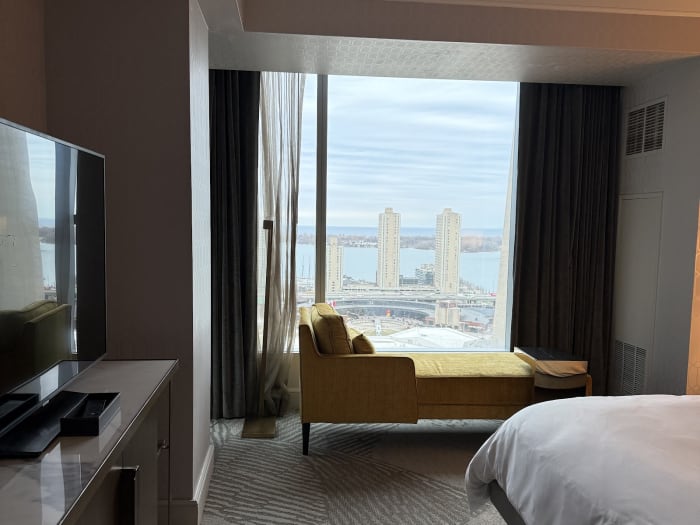
In a luxury urban hotel, the room serves more than just a place to sleep. It becomes a space for recovery, preparation, and sometimes work. At the Ritz-Carlton Toronto, this multifunctional role is at the heart of the experience. The promise of comfort is built on a contemporary aesthetic that is consistent with the rest of the establishment. The modern decor creates calm, readable, and sustainable spaces.
The rooms and suites of a grand downtown hotel must meet sometimes contradictory expectations. They should make a statement without overwhelming the senses. They must ensure privacy while incorporating the amenities expected from an international address. They also accommodate varied rhythms—early departures, late returns, romantic getaways, or business trips.
The experience is further enhanced by daily services. The daily room service and turndown service play significant roles here, reminding guests that luxury also lies in the continuity of care. Returning to a tidied room, finding an atmosphere prepared for the night, and sensing the anticipation of the stay are silent yet crucial gestures.
For business travellers, the room functions as a temporary extension of the office without losing its residential character. In Toronto, this versatility is invaluable. A five-star hotel is expected to provide an environment conducive to concentration, preparation for meetings, and relaxation. The hotel's refined setting, combined with its central location, enhances this utility.
For leisure travellers, the rooms and suites offer an elegant base from which to explore the city and then retreat. After a day spent among neighbourhoods, cultural institutions, or dining establishments, the quality of a room is measured by its ability to restore calm. A good urban hotel does not isolate guests from the destination; it offers the right distance, allowing one to feel the energy of Toronto without being overwhelmed until the early hours.
The suites extend this concept with more space and flexibility. They are ideal for longer stays, for couples seeking more comfort, or for guests wishing to entertain. The essence remains the same: a contemporary atmosphere, a high standard of decorum, and service that complements the space. At the Ritz-Carlton Toronto, the rooms and suites provide the necessary counterpoint—a controlled, discreet, and enduring comfort.
The Dining Experience
In a contemporary grand hotel, gastronomy is no longer merely an internal service. It contributes to the identity of the place and its daily rhythm.
At the Ritz-Carlton Toronto, the dining experience naturally extends the hotel’s offerings. It reflects its refinement, urban centrality, and sense of personalised service.
In a city as cosmopolitan as Toronto, this dimension is particularly significant. Travellers are attentive to the quality of the places where they dine as much as to their atmosphere.
In the morning, the dining options set the tone for the day. Some seek an efficient breakfast before their meetings, while others prefer a more leisurely moment.
Luxury here lies in the freedom to choose one’s pace. A grand hotel knows how to accommodate both the hurried guest and the one who wishes to linger.
At lunch and dinner, the dining experience can serve multiple functions. It can host a business meeting or offer a comfortable option after a busy day.
It can also become a destination in itself. In all cases, coherence with the hotel’s spirit remains essential.
Attentive service, a carefully curated atmosphere, and execution without ostentation—this is often where the accuracy of an address is determined.
Room service is also part of the expected experience in an establishment of this calibre. In a grand urban hotel, the connection between room and dining remains central.
Some meals are enjoyed in intimacy, between obligations or after a late arrival. Others become moments of sociability.
The quality of an address is measured by its ability to make these uses feel natural. Refinement primarily involves understanding the moment.
Toronto, with its cultural diversity, has shaped a discerning and curious audience. Hotels that succeed here understand that gastronomy must engage with the city.
For the traveller, this dimension fully contributes to the memory of their stay. One also remembers how they start their day, take a break, or extend an evening.
At the Ritz-Carlton Toronto, the dining experience is part of this continuity. It accompanies the hotel experience with elegance, precision, and fluidity.
Spa & wellbeing
In a metropolis such as Toronto, hotel wellbeing is not merely an added comfort; it is often a genuine necessity. Days can be dense, movement constant and schedules demanding. In that context, the presence of a spa or dedicated relaxation spaces takes on particular value. The practical advice already noted in the existing description — to book spa services in advance — says something important in itself: these moments are sought after, integrated into the stay and sometimes planned as appointments in their own right. At The Ritz-Carlton Toronto, wellbeing can therefore be understood as part of a broader logic of recovery and balance, fully in keeping with the hotel’s standing.
A spa in a five-star hotel is never just a treatment area. It acts as a counterpoint to the city. Where the outside world imposes intensity, the wellness space reintroduces slower time, quiet and another quality of attention. For business travellers, it offers release after a compressed schedule. For couples, it adds a sense of retreat to the stay. For guests in transit or on an urban break, it provides a way of punctuating the trip through something other than visits and meals. This function as a breathing space is essential to the emotional economy of a great hotel.
The luxury of wellbeing often lies in elements less visible than the facilities themselves. It is found in ease of booking, in the quality of the welcome, in punctuality and in the ability of the team to adapt a treatment to the guest’s moment and needs. A hotel known for personalised service is naturally expected to deliver on this front. Guests are not simply seeking a massage or facial; they expect a coherent experience aligned with the rest of the stay. The spa becomes one of the places where the hotel’s service promise is most clearly tested.
Wellbeing also shapes the overall perception of travel. An urban stay may be stimulating, but it can also be tiring. The body absorbs flights, time differences, long walks, meetings and shifts in climate. In that setting, the possibility of taking a treatment, enjoying a quiet moment or following a restorative routine changes the way the city is experienced. One no longer merely endures the pace; one modulates it. That is why experienced travellers often value the spa as highly as location or bedding quality.
The practical advice is straightforward: plan ahead. In luxury properties, the most desirable slots tend to fill quickly, especially in the late afternoon and at weekends. Booking in advance not only secures access to preferred treatments, but also allows wellbeing to be fully integrated into the structure of the stay. It prevents the spa from becoming an afterthought and restores it to its proper place: a chosen, considered and almost ritual part of the journey.
At The Ritz-Carlton Toronto, wellbeing should therefore be seen as a structuring element of the stay rather than a secondary indulgence. It extends the hotel’s refined atmosphere, its service culture and its ability to provide refuge in the middle of the city. In a demanding urban environment, the chance to slow down, recover and reset is far from incidental. It forms part of what guests seek in a great address: not only comfort, but a better way of moving through travel.
Concierge & Services
The true hallmark of a prestigious hotel is not always immediately visible; it reveals itself in the quality of the services that accompany the stay.
At the Ritz-Carlton Toronto, this dimension is central. The hotel offers a 24-hour concierge service, a 24-hour reception, daily room service, turndown service, luggage storage, laundry service, wake-up calls, and multilingual staff.
These services cater to real needs at all hours, with the flexibility expected by an international clientele.
The 24-hour concierge service is one of the most essential services of a grand establishment. It facilitates reservations, itineraries, logistics, and last-minute adjustments.
In Toronto, this mediation helps navigate between appointments, neighbourhoods, and outings without unnecessary friction.
The continuously open reception supports late arrivals, early departures, and changes in plans, providing discreet security and genuine flexibility.
The maintenance services play a quieter but decisive role. Daily room service ensures the upkeep of the stay.
The turndown service adds an extra layer of attention. Laundry services prove invaluable for extended stays, business trips, and multi-stop itineraries.
Luggage storage simplifies arrival and departure days, allowing guests to enjoy the city without constraints.
The wake-up call service remains a sign of seriousness, reminding guests that a luxury hotel is also a reliable infrastructure.
The presence of multilingual staff is equally important in an international address. Understanding and being understood effortlessly directly enhances the comfort of the stay.
Personalised service takes on a concrete form here, relying on a sum of gestures, availability, and tailored responses.
In a grand hotel, excellence is evident in how each need finds its solution, calmly and competently. At the Ritz-Carlton Toronto, this logic clearly structures the experience.
The Toronto way of life
Choosing The Ritz-Carlton Toronto also means choosing a particular way of inhabiting the city. Toronto does not always reveal itself at first glance. Less immediately theatrical than some major metropolises, it appeals through density of use, cultural diversity, neighbourhood life and a balance between economic energy and artistic curiosity. To understand it properly, one has to accept its rhythm, its plurality and its transitions. A hotel in the heart of the city becomes especially valuable in that context, making it easier to move from one register to another without losing time or momentum.
Toronto’s way of life rests partly on this coexistence of worlds. One can move from a morning of work to a cultural visit, an informal lunch, an urban walk and a more dressed-up evening without the sequence feeling contrived. The city encourages mixed itineraries. It suits travellers who like to plan as well as those who prefer to follow the mood of a neighbourhood or a particular address. In that setting, staying in a refined, central hotel provides a stable base while allowing guests to benefit from the city’s constant mobility.
Toronto is also a city of influences. Its identity has been built in layers, at the intersection of North American traditions, international contributions and a local culture attentive to quality of life. This can be felt in dining, in the arts and in the way public space is used. Luxury here is not necessarily ostentatious; it is often linked to convenience, time saved, quality of service and easy access to varied experiences. It is precisely on that ground that a hotel such as The Ritz-Carlton Toronto proves relevant.
For visitors, the city can be experienced in several ways. There is institutional Toronto, shaped by business, major infrastructure and professional appointments. There is cultural Toronto, made up of performance venues, museums, galleries and events. There is also a more everyday, more residential Toronto, discovered through streets, cafés, neighbourhood habits and shifts in pace. A successful stay often depends on combining these dimensions rather than reducing the city to only one of them. Through its location and concierge support, the hotel can help guests build that more nuanced reading of the destination.
What further distinguishes Toronto is its ability to remain welcoming despite its scale. The city is large, yet it can feel surprisingly manageable when one has the right anchor point. Visitors come to appreciate the transitions between indoors and outdoors, between activity and rest, between intensity and comfort. It is a city best enjoyed through those alternations. A great central hotel then plays an almost choreographic role: structuring the day, offering pauses and making it easier to set out again.
In that sense, The Ritz-Carlton Toronto is not merely a place to sleep; it is a privileged vantage point over a complex and highly liveable metropolis. It allows guests to experience Toronto’s way of life in one of its most convincing forms: sophistication without emphasis, practical cosmopolitanism and functional elegance. For French and international travellers alike, there is something distinctly contemporary about that experience. It relies not on monumentality, but on the quality of transitions and on the ease with which city and hotel respond to one another.
Book with MyConciergeHotel
Booking The Ritz-Carlton Toronto through MyConciergeHotel means approaching the stay with clarity and thoughtful support. In luxury hospitality, a reservation should never be a mere transaction. It is the first stage of the experience, the moment when the rhythm of the trip, specific expectations and practical priorities begin to take shape. For an urban address of this calibre, preparing well can make a real difference: choosing dates with likely demand in mind, planning spa appointments, organising arrival and departure times, and taking account of whether the trip is primarily business, romantic or a combination of both.
The value of editorial and concierge guidance lies precisely in its ability to turn a standard booking into a better-considered stay. Not every traveller expects the same thing from Toronto. Some want above all a central base from which to move easily around the city. Others are looking for a refined urban retreat. Others still need a hotel precisely calibrated to a business schedule. The Ritz-Carlton Toronto can answer these different uses, but the stay still needs to be positioned correctly. This is where a specialist platform becomes especially useful: it helps guests read the hotel not as a mere list of amenities, but as an address suited to a particular style of travel.
Booking ahead is particularly relevant for the most sought-after services. As already noted, spa appointments are best arranged in advance. More broadly, the same principle applies to everything that structures the experience: timings, special requests, stay preferences and the organisation of key moments. In a great hotel, details matter. The more they are anticipated, the smoother the stay becomes. This does not mean fixing every aspect of the trip in advance; on the contrary, it preserves freedom on site because the essentials have already been considered.
MyConciergeHotel works within that philosophy of intelligent preparation. The aim is not to add complexity, but to filter useful information, highlight what is genuinely distinctive and help travellers make a coherent choice. In the case of The Ritz-Carlton Toronto, that means drawing attention to the foundations of the experience: a central location, a refined atmosphere, contemporary décor, personalised service and a range of practical services designed to simplify the stay. These are the elements that matter most when deciding whether the address truly fits one’s expectations.
For couples, the booking may be shaped around a city weekend punctuated by moments of relaxation. For business travellers, it may revolve more around service responsiveness and ease of access to professional hubs. For a first stay in Toronto, the priority will often be to secure a dependable anchor point capable of making the city more legible. In every case, the principle remains the same: book well, rather than merely book quickly.
Ultimately, choosing MyConciergeHotel for this address means opting for a more considered approach to travel. One does not simply secure a room in a five-star hotel; one prepares the stay under the best practical conditions. In an active and cosmopolitan city such as Toronto, that nuance matters. It allows guests to arrive with a clear framework while still leaving room for the destination to surprise. It is perhaps the best way to approach The Ritz-Carlton Toronto: with clear expectations, a few well-planned reservations and the mental space to enjoy both the city and the hotel fully.