History & heritage
In St. Thomas, luxury is less about display than about an old relationship with the sea, the trade winds and the distinct rhythm of the Caribbean islands. In that setting, The Ritz-Carlton St. Thomas reads not merely as an upscale beach resort, but as an address designed to frame a dialogue between international hospitality and island geography. The Ritz-Carlton name suggests a certain language of service, a methodical attention to detail, and a way of making guests feel expected. Here, that promise takes on a particular tone: one shaped by horizon lines, luminous days and the gentleness of the climate, in an environment where the sea is never a distant backdrop but a daily presence.
The modern history of luxury hospitality in the Caribbean has been built around a few constants: the search for rare settings, direct access to preserved beaches, and the ability to offer high levels of comfort without severing ties with the spirit of the place. The Ritz-Carlton St. Thomas belongs to that tradition. Its identity rests on a clear combination: a privileged location on the island of St. Thomas, immediate proximity to the clear waters of the Caribbean Sea, and an atmosphere that favours serenity over ostentation. For travellers, this translates into a stay in which one moves naturally from room to gardens, from terraces to shoreline, from moments of rest to waterside pursuits.
St. Thomas itself is essential to understanding the property’s character. Part of the United States Virgin Islands, the island has long held maritime importance in the region. Its relief, bays, viewpoints and beaches make it a sought-after destination today, yet it still retains something of a territory shaped by movement, exchange and constant nearness to the sea. A hotel of this standing inevitably takes on a particular dimension here: it becomes both an observatory of the Caribbean landscape and a comfortable retreat.
The Ritz-Carlton heritage is expressed here through continuity of service. A 24-hour concierge, round-the-clock reception, daily housekeeping and turndown service may appear purely practical, yet they form part of a culture of hospitality in which a stay is meant to unfold with ease. In an island setting, that ease matters even more. It allows guests to move effortlessly from a day on the beach to an excursion, from a quiet dinner to more elaborate arrangements, from an early departure to a late arrival.
Ultimately, what remains is the idea of an address that does not attempt to compete with its surroundings, but to accompany them. The Ritz-Carlton St. Thomas is best understood through this relationship between a globally recognised hotel signature and a Caribbean site of striking visual clarity. Its heritage lies not only in the brand itself, but also in a measured way of inhabiting St. Thomas, allowing the sea, the light and the long tempo of a holiday to shape the experience.
The property
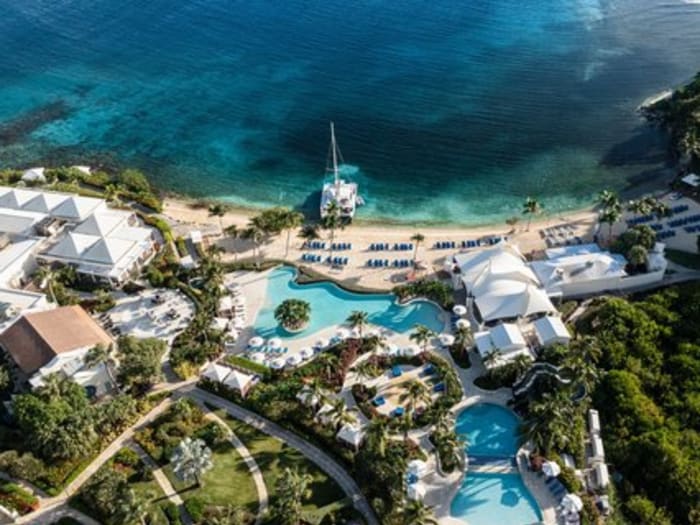
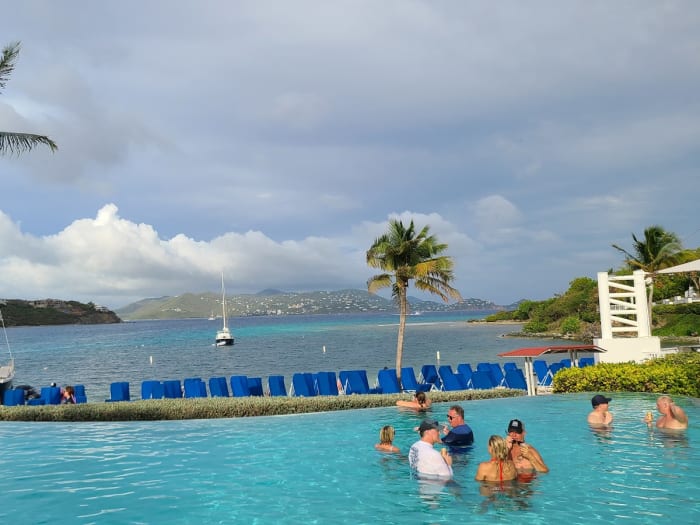
One of the first appeals of The Ritz-Carlton St. Thomas lies in its direct relationship with the landscape. Facing the Caribbean Sea, the property is set within a topography that immediately establishes the tone of the stay: clear light, tropical greenery, open lines towards the water, and that distinctly island feeling in which the outdoors becomes a living space in its own right. Here, luxury is expressed first through space and through the ease with which guests can access what they have come to this part of the world to find: the sea, the beach, the sun, and a slower rhythm.
Its setting on the island of St. Thomas is in itself a compelling argument. The island is known for its bays, pale-sand beaches and transparent waters, all of which are among the defining reasons to travel to the Caribbean. Staying at a hotel of this category means enjoying them without cumbersome logistics: one moves from the comfort of a major resort to immediate proximity with the shoreline. This continuity between architecture, outdoor spaces and the coast gives the place its coherence. Guests do not come only to sleep by the sea, but to inhabit, for a few days, a complete maritime environment.
The overall atmosphere, described as relaxed and refined, deserves emphasis. In high-end beach hospitality, the balance is delicate: too much formality can make the experience rigid, while too much informality can weaken the sense of quality. The Ritz-Carlton St. Thomas appears to seek a point of agreement between those two poles. The setting invites guests to unwind, yet the level of service and the organisation of the spaces constantly remind them of the property’s standing. This measured balance suits travellers looking for a stay that feels easy in use and polished in execution.
The relationship with the beaches is central. Access to white sand and crystal-clear waters is not a secondary amenity but one of the core reasons for staying here. For some, that will mean entire days spent between swimming and reading in the shade; for others, a starting point for water-based activities or broader exploration of the island. In both cases, the hotel acts as a stable, comfortable and well-run base to which one returns gladly after time spent outdoors.
The property also suits both couples and families, which is not always true of luxury island addresses. Couples will find a setting conducive to a romantic interlude: bright mornings, evenings facing the water, walks along the beach and dinners in a subdued atmosphere. Families will appreciate the clarity of the stay, the ease of access to activities and the presence of services that simplify day-to-day organisation. When handled well, this versatility is a sign of hospitality maturity.
In the end, The Ritz-Carlton St. Thomas stands out less through spectacle than through the obviousness of its setting. The address makes the most of what St. Thomas offers at its most desirable: the Caribbean Sea within immediate reach, a climate built for outdoor living, and the sense of disconnection that islands provide when a hotel knows how to respect their tempo. It is a place designed for travellers who wish to combine international comfort with a beach-led immersion free of unnecessary complication.
Rooms and suites
In a Caribbean resort of this category, the room is not merely a place to sleep. It is expected to extend the landscape, provide respite after the beach, and preserve the sense of calm that gives a stay its value. At The Ritz-Carlton St. Thomas, rooms and suites are therefore best understood as expressions of the property’s wider spirit: measured comfort, attentive service and a constant relationship with the maritime setting. Even without detailing specific room categories here, the essentials lie elsewhere: in ease of use, in the fluidity of daily life, and in the way accommodation supports island living.
The first criterion in such a setting is light. In St. Thomas, it shapes the day: the brightness of morning, the stronger whiteness of midday, the golden reflections of late afternoon. A successful Caribbean room must know how to receive that light without becoming harsh, create transitions between air-conditioned interiors and sunny exteriors, and offer refuge when guests return from the shore. That sense of balance matters most: a space restful enough to recover in, yet never disconnected from the place one has come to experience.
Comfort also depends on the services that accompany it. Daily housekeeping, turndown service, and the pleasure of returning to a room restored after a day outside all contribute to the overall experience. In luxury hospitality, such gestures are not incidental. They create a discreet, almost invisible continuity that allows travellers to focus on their stay rather than on logistics. At The Ritz-Carlton St. Thomas, this approach forms part of the broader brand promise built on attention and consistency.
For couples, the room often becomes the setting for a private retreat, between moments of rest, preparations for dinner or simple contemplation of the surroundings. For families, it must absorb more movement: returns from the beach, changing rhythms and practical needs. A strong resort knows how to answer both uses without losing its identity. This is where the idea of a suite becomes especially meaningful: more space, easier circulation and the possibility of living the stay with greater ease, particularly over several nights.
The value of accommodation in this kind of address also lies in what it allows guests to feel on waking and on returning. In the morning, one seeks a gentle, almost quiet beginning before heading to the sea or breakfast. In the evening, after heat, salt and the day’s activities, one expects a sense of coolness and order. This alternation between outdoors and indoors, so marked in beach destinations, gives a well-conceived room its full importance.
In short, the rooms and suites at The Ritz-Carlton St. Thomas are best seen as anchor points. They do not seek to distract from the landscape, but to provide the right frame through which to enjoy it fully. On a Caribbean stay, guests do not spend all their time in their room; yet its quality largely determines the overall impression. When it is well considered, it makes each day simpler, smoother and more restful — and that is often where true luxury resides.
Dining
In the Caribbean, hotel dining cannot be separated from the climate, the pattern of daylight and the nearness of the sea. One does not eat in quite the same way on an island as in a European capital: breakfast often takes on particular importance, lunch follows the rhythm of the beach, and dinner becomes a transition between the energy of the day and the calm of the evening. At The Ritz-Carlton St. Thomas, the dining experience is therefore best read through this island temporality, in which the quality of service matters as much as what is on the plate.
The first pleasure, in a property facing the Caribbean Sea, lies in the possibility of taking meals in an open, bright setting shaped by air and views. Even without knowing the exact configuration of the restaurants, one can expect a hotel of this standing to organise its culinary offering around guest comfort: unhurried meals, refreshing pauses after the beach, more dressed-up moments in the evening, and enough flexibility to suit the varied desires of a holiday stay. This diversity of use is essential in a resort that welcomes both couples and families.
The cuisine expected in such a context generally favours clarity, freshness and suitability to place. Travellers coming to St. Thomas are usually seeking less a conceptual performance than a table able to accompany the destination: seafood-led options, preparations suited to the climate, and dishes that work equally well for a terrace lunch or a more settled dinner. In a major international hotel, the challenge is to maintain a high level of rigour while leaving room for simplicity. It is often this well-executed simplicity that proves most memorable.
Service, once again, plays a central role. A strong hotel table is not only a matter of menu design; it depends on tempo, the accuracy of recommendations, attentiveness to travellers’ needs, and the ability to make each meal feel natural. In a beach destination, that means serving equally well an early morning coffee before an excursion and a quiet dinner after a full day in the sun. Excellence here is measured less by display than by consistency.
For couples, meals often become emotional markers of the stay: a lingering breakfast, a light lunch before returning to the water, a dinner facing the fading light. For families, dining must offer more flexibility, clarity and practical ease. A well-considered resort knows how to accommodate both registers without setting them against each other. This is one of the signs of mature hotel dining: the ability to respond to different expectations while keeping a coherent identity.
At The Ritz-Carlton St. Thomas, dining should therefore be understood as part of the wider beach-led stay. It does not necessarily seek to outshine the landscape; rather, it extends its qualities. To eat well in such a setting is to enjoy precise service, a calming environment and cuisine suited to the place. In memory, it is often these simple scenes — a drink in late afternoon, a meal taken without watching the time, the light on the sea during dinner — that remain most clearly.
Wellbeing & island rhythm
Even when a hotel does not detail all of its wellness facilities here, the question of rest remains central to the experience of staying in St. Thomas. In a destination shaped by the sea, wellbeing is not limited to a spa in the strict sense; it also depends on the way a property allows guests to slow down, recover and find a more natural rhythm. The Ritz-Carlton St. Thomas fits naturally into that logic. Its setting facing the Caribbean Sea, its relaxed yet refined atmosphere, and the fluidity of its services already amount to a discreet form of care, less demonstrative than effective.
The first benefit of such a place is sensory. The presence of water, tropical light, salty air, the sound of the shore and the ease of moving between indoors and outdoors all have an immediate effect on one’s perception of time. Guests often feel more available, less hurried, more attentive to simple gestures: walking early in the morning, sitting in the shade after a swim, taking a quiet moment before dinner. In the best beach addresses, this quality of calm is not an added extra; it forms the core of the experience.
Hotel comfort plays a full part in this state. A room restored each day, evening turndown service, reception available at any hour, and the ability to ask for advice or assistance without friction all lighten the mind. In luxury hospitality, wellbeing often arises from the removal of ordinary constraints. When organisation is smooth, travellers recover a mental availability that daily life tends to erode.
In St. Thomas, the body is also engaged differently than in a city. One swims, walks more, spends time in the sun, in the water and on the sand. This calls for a more attentive rhythm, shaped by hydration, pauses, moments out of the heat and regular returns to calm. A well-conceived hotel supports those needs without making them feel programmatic. It offers spaces where one can simply sit, read, contemplate or do nothing at all — which, on holiday, is sometimes the rarest form of luxury.
For couples, this wellbeing dimension often takes the form of a shared interlude: slow mornings, afternoons without a fixed plan, evenings experienced as a gradual unwinding. For families, it is more about finding a balance between activity and recovery, between children’s enthusiasm and adults’ need for rest. In both cases, the value of a major resort lies in its ability to absorb different rhythms without creating tension.
One might say that the truest wellbeing at The Ritz-Carlton St. Thomas lies in the harmony between place and stay. There is no need to fill every hour with activity in order to feel one is making the most of the address. Simply being there, facing the Caribbean Sea, with a high level of comfort and attentive service, already produces a rebalancing effect. It is a form of luxury that is less demonstrative than essential: one that gives space back to time, to the body and to attention.
Concierge & services
In an upscale resort, services are not merely a collection of practical options: they determine the actual quality of the stay. At The Ritz-Carlton St. Thomas, this dimension is especially important, because the island experience often requires discreet yet constant organisation. Between arrival times, departures, water-based activities, beach-related needs and guests’ specific requests, everything depends on the property’s ability to make each day feel simple. This is precisely where the Ritz-Carlton culture comes into its own.
The presence of a 24-hour concierge and round-the-clock front desk forms an essential foundation. For international travellers, this means flexibility above all: a late arrival, an early departure, a revised plan, a logistical question or a simple request for information. In an island destination, this permanent availability carries particular value. It reassures, streamlines and allows guests to live their stay without having to anticipate every detail. Luxury here lies as much in that peace of mind as in the setting itself.
Daily housekeeping and turndown service belong to the same logic. They ensure a continuity of comfort that becomes especially noticeable on a sun-led holiday, when guests move frequently between indoors and outdoors and return from the beach with sand, towels, light clothing and a pleasant fatigue. Coming back to a room that is ordered, refreshed and ready for the evening changes the perception of the stay in a meaningful way. These are quiet gestures, yet they structure the experience more surely than many visible effects.
Luggage storage, laundry, wake-up service and the likely presence of multilingual staff complete this service ecosystem. Each responds to a concrete situation: making the most of the day after checking out, having personal items cared for during a longer stay, organising an early departure, or simply communicating with ease. Considered separately, these elements may seem secondary; taken together, they outline a mature form of hospitality attentive to the real uses of travel.
The role of the concierge is particularly decisive in a place such as St. Thomas. Booking a water activity, obtaining recommendations suited to one’s pace, arranging a local outing or adjusting plans according to the weather are all requests best entrusted to a team familiar with the destination. The concierge’s advice has a very practical resonance here: it is wise to reserve the most sought-after activities early, especially in busier periods. That anticipation avoids disappointment and allows guests to make the most of the island.
For couples, good service is often measured by its discretion: everything seems to fall into place without visible effort. For families, it is also judged by its capacity to absorb the unexpected, simplify transitions and lighten the mental load. In both cases, The Ritz-Carlton St. Thomas belongs to a hotel tradition in which excellence lies not in doing too much, but in doing what is right, at the right moment.
Ultimately, services are what turn a beautiful setting into a truly luxurious stay. The sea, the beach and the light may be the first draw; the quality of the welcome shapes the lasting memory. When a hotel knows how to orchestrate that dimension with precision, the traveller is free simply to let the stay unfold — which, in a world saturated with demands, remains one of the most appreciable privileges.
The St. Thomas way of life
Staying at The Ritz-Carlton St. Thomas also means entering a particular way of living St. Thomas: not by ticking off a list of attractions, but by gradually adopting the island’s rhythm. In the Caribbean, a way of life is often made up of very simple things, provided they are experienced in the right conditions: starting early to enjoy the softer light, organising the day around the sea, allowing for pauses in the shade, accepting that time expands, and letting late afternoon become a moment in its own right. A major beach resort succeeds precisely when it enables that shift.
St. Thomas lends itself naturally to this experience. The island offers what many travellers come to the region to find: white-sand beaches, crystal-clear waters, maritime viewpoints and a sense of distance without complete isolation. It allows guests to combine rest with local curiosity. Some will choose to remain close to the shore in a sun-led retreat; others will alternate between relaxation, water activities and broader discovery of the island. In both cases, the value lies in returning to an address that is stable, comfortable and well served.
The local way of life is also understood through the relationship with the outdoors. Here, one lives more outside: on a terrace, by the water, walking along the beach, or simply watching the sea change colour. The climate encourages this availability. It alters the way one lunches, dresses, moves and even converses. People are more inclined to take their time. They accept that a successful day does not need to be filled with events. This economy of gesture and programme forms part of the deeper charm of island stays.
For couples, St. Thomas offers a naturally favourable setting for an interlude: open horizons, flattering light, walks by the sea and the impression that days lengthen without becoming heavy. For families, the island provides a broader playground, with the beach acting as a centre of gravity around which swimming, discovery and rest are organised. In a hotel such as The Ritz-Carlton St. Thomas, these two ways of inhabiting the destination can coexist without friction.
It is also worth emphasising the importance of water activities, which extend the very identity of St. Thomas. Without detailing specific programmes, their presence enriches the stay by offering another reading of the landscape: from the water, the island’s relief, bays and coastline take on a different dimension. Reserving the most sought-after experiences early remains sensible, particularly in busier periods when demand rises.
At heart, the St. Thomas way of life consists in recovering a form of clarity. The setting simplifies priorities: swim, eat well, rest, look at the sea, perhaps arrange an outing, then begin again. The Ritz-Carlton St. Thomas supports this movement with the codes of a major international hotel, without working against its spirit. It is this alliance between service standards and everyday simplicity that gives the stay its rightness. Guests often leave with less the memory of a programme than of a rhythm regained.
Book with MyConciergeHotel
Choosing The Ritz-Carlton St. Thomas through MyConciergeHotel means approaching the stay with clarity and guidance. In a sought-after island destination, where location, seasonality and the availability of activities all strongly shape the experience, booking is not simply a matter of securing a room. It is about preparing the right conditions for the trip: selecting the most suitable period, anticipating key priorities, and ensuring that the stay genuinely fits the travellers’ profile, whether as a couple, a family or for a special occasion.
The value of editorial and concierge support lies first in placing the hotel within its proper context. The Ritz-Carlton St. Thomas is not chosen for its name alone, but for what it allows guests to experience in St. Thomas: privileged access to the Caribbean Sea, proximity to white-sand beaches, a relaxed yet refined atmosphere, and a level of service consistent with the expectations attached to a five-star address. To book with full understanding is to grasp that promise as a whole, rather than through a simple list of amenities.
MyConciergeHotel can also help guests think about the stay in its real tempo. Busier periods require more anticipation, particularly for the most sought-after accommodation categories and certain water-based activities. The simplest advice is often the most useful: reserve early what matters most. In a beach resort of this category, that can make the difference between a pleasant stay and one that feels entirely seamless. It is wiser to secure the structuring elements in advance than to improvise on site once demand is already high.
This preparation is especially valuable for travellers seeking to balance rest and experiences. Some will want above all a restorative interlude, with little movement and extensive use of the beach and hotel services. Others will wish to enrich their stay with time on the water or broader discovery of the island. In both cases, a well-supported booking helps align expectations, prioritise what matters and avoid misunderstandings. Luxury often begins there: in the fit between what one imagines and what one actually lives.
Booking through MyConciergeHotel also means benefiting from an editorial perspective that values accuracy. Rather than promising the impossible, the aim is to highlight what concretely makes the address distinctive: its location in St. Thomas, its openness to the Caribbean Sea, its atmosphere, its comfort and its ability to suit both romantic stays and family holidays in the sun. This approach, more precise than promotional, helps guests make a choice that remains satisfying over time.
Finally, in a world where luxury hotel options are abundant, the true value of an accompanied booking lies in simplification. Knowing where one is going, why one is going there, when to travel and what to reserve first: these decisions, when made methodically, transform the experience. The Ritz-Carlton St. Thomas lends itself particularly well to this approach because it brings together highly desirable elements that are also in demand. With MyConciergeHotel, booking thus becomes the first step in a stay already shaped to the right rhythm.