History & heritage
On Oahu’s North Shore, The Ritz-Carlton Oahu, Turtle Bay is rooted in a landscape whose history predates hospitality itself. Here, the true heritage belongs first to the setting: a long Pacific shoreline, lush contours, shifting light and the singular rhythm of the North Shore, at once dramatic and relaxed. The contemporary resort occupies a site long recognised as a premier seaside retreat, where travellers come not for Honolulu’s urban energy but for a broader, more elemental experience of the island.
Rather than a city hotel transplanted into the tropics, the property reads as a destination in its own right. Its identity rests on a direct relationship with the coast, on spaces opening towards the horizon, and on a way of inhabiting Oahu that privileges air, light and views. This logic of placement, central to the history of great island resorts, gives the address a sense of permanence: fashions change, but the desire to stay by the ocean in a preserved setting endures. That continuity underpins Turtle Bay’s character.
Its place within the Ritz-Carlton world adds another layer of heritage, this time a hotel one: a service culture that is structured, attentive and legible, where elegance is measured by ease rather than display. In such a setting, luxury does not attempt to compete with nature; it accompanies it. Circulation areas, shared spaces, terraces and relaxation zones are conceived to let the site take precedence. The resulting impression is that of a contemporary resort that understands that, on the North Shore, the landscape remains the first signature.
This relationship with place also explains the property’s enduring appeal to travellers with very different expectations. Couples find a sense of relative seclusion, families a generous holiday base, outdoor enthusiasts a natural starting point, and business travellers a calmer environment than the island’s denser districts. This versatility does not dilute the identity of the resort; it confirms it. Turtle Bay is not merely somewhere to stay on Oahu, but a privileged vantage point from which to experience another side of the island.
To speak of heritage here is therefore less about recounting a chronology than about describing a continuity of purpose and spirit. The hotel extends a tradition of ocean-facing resort life while aligning it with the standards of a contemporary international five-star property. What remains, ultimately, is the promise of a stay in which the setting is never incidental: it shapes the experience, imposes a slower tempo and reminds guests that some places need very little embellishment to leave a lasting impression.
The property
The Ritz-Carlton Oahu, Turtle Bay reveals itself as a property defined by open horizons. Its position on Oahu’s North Shore determines everything: the sense of space, the quality of light, the constant presence of the ocean and that rare impression of being in a fully fledged resort while still in a setting that feels legible, open and almost untouched. The property draws its strength from a simple yet demanding equation: to provide the comfort expected of a five-star resort while allowing the landscape to take precedence.
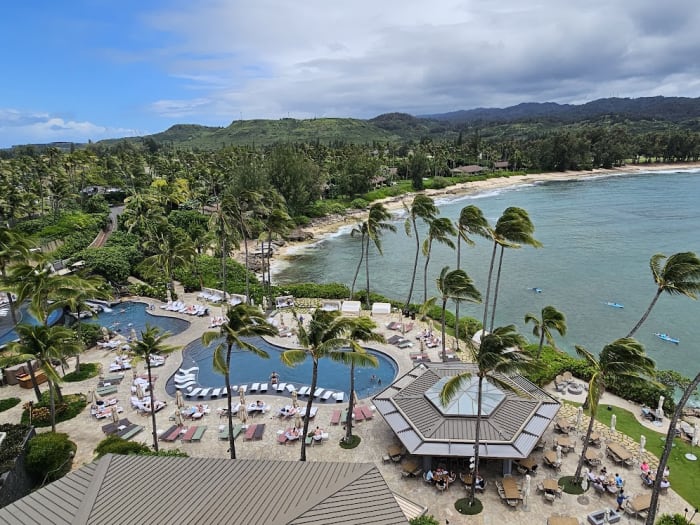
Arrival sets the tone. One moves from a more populated Oahu into a territory where vegetation, shoreline lines and the horizon regain prominence. The site is not merely tropical in a decorative sense; it is tropical in its climate, its outdoor gardens, its open perspectives and its way of organising life around the outdoors. Pools, pathways, relaxation areas and viewpoints form a whole designed to extend the stay beyond the room. Here, one does not merely look at the sea; one lives with it, from morning to evening.
Direct beach access is among the property’s defining attributes. It changes the nature of the stay by allowing an immediate relationship with the shoreline, without interruption or excessive staging. That proximity creates a valuable freedom: setting out for a walk at sunrise, returning from a swim before lunch, lingering in the late afternoon as the light softens. In a resort of this category, such ease matters more than overworked décor. Luxury here takes the form of access and availability.
Ocean views provide the other major thread. They are not simply a selling point but an organising principle of both interior and exterior design. Shared spaces gain depth as they open onto the Pacific; gardens and terraces take on another dimension when conceived as thresholds between hotel and landscape. This visual continuity contributes greatly to the calm atmosphere so often associated with Turtle Bay.
The resort therefore suits several travel rhythms. Some will see it as a pure retreat for rest, shaped by gardens, pools and a seaside mood. Others will use it as a base from which to explore the North Shore and its beaches, viewpoints and outdoor pursuits. This dual reading is one of the property’s strengths: it can be both destination and departure point, cocoon and opening onto the island.
What ultimately distinguishes the hotel is its ability to remain coherent despite the breadth of experience it offers. Service, outdoor spaces and overall organisation combine to create a sense of ease. There is no need to choose between a complete resort and a feeling of escape: The Ritz-Carlton Oahu, Turtle Bay succeeds precisely in holding those two promises together.
Rooms and suites
In a destination where the landscape is so present, rooms and suites have one essential task: to extend the sense of openness rather than compete with it. At The Ritz-Carlton Oahu, Turtle Bay, the accommodation experience is therefore best understood through a few key elements: natural light, the relationship to the views, generous comfort and that sense of private retreat that allows guests to return to calm after the beach, outdoor activities or hours spent by the pools.
The first luxury here often lies in perspective. Depending on orientation, accommodation may engage with the ocean, tropical greenery or the resort’s outdoor spaces. Even when the effect is not overtly dramatic, the presence of the outdoors remains perceptible: it enters through the windows, through lighter tones, through the way materials and lines allow the space to breathe. In an island setting, this continuity between indoors and out is essential. It avoids the pitfall of a room that feels too self-contained and constantly reminds guests where they are staying.
The decorative language expected in a property of this level generally favours contemporary elegance, restrained enough to age well. A major seaside resort is expected to create visual rest: calming palettes, comfortable textures, furniture designed for real use rather than image alone. The aim is not to overload the space with tropical references, but to compose an environment coherent with the site. In that sense, refinement is measured as much by atmosphere as by finish.
Suites answer another expectation: that of a stay with greater breadth, a more residential feel, sometimes better suited to longer stays or family travel. They allow the different moments of the day to be better articulated, between rest, reading, preparing for the day and returning from outdoor pursuits. In a resort where guests often move between active hours and quieter pauses, that generosity of space makes particular sense. It also reinforces the feeling of being settled rather than merely accommodated.
Daily comfort also rests on discreet but decisive attentions: daily housekeeping, turndown service, practical storage, inviting bedding and bathrooms conceived as spaces of transition between activity and rest. These are the elements that determine the true quality of a stay more than any stylistic gesture. In a property of this category, one expects everything to feel fluid, intuitive and free of visible effort.
Ultimately, the rooms and suites at Turtle Bay are best appreciated as anchor points. They do not seek to distract from the landscape, but to provide the right frame from which to enjoy it fully. Guests return after a beach walk, time in the sun or a day of exploration with the sense of coming back to a calm, well-composed and well-run space. That sense of rightness is what makes the difference.
Dining
In a seaside resort, dining is never only about what is on the plate: it forms part of the rhythm of a stay, a way of inhabiting the day and extending one’s relationship with the landscape. At The Ritz-Carlton Oahu, Turtle Bay, one naturally expects an offering designed to accompany this outward-looking way of life, from breakfast in the morning light to relaxed lunches after the beach and dinners in which the ocean remains, even from a distance, the mental backdrop to the meal.
What matters in such a property is above all coherence. Dining must answer several uses without losing its level of care: sustaining active days, providing a pleasant setting for restorative stays, suiting couples as well as families, and allowing for those simple but well-executed meals that often leave a stronger impression than anything too theatrical. In an island context, that sense of rightness generally comes through freshness, clarity of flavour, attention to ingredients and a service style that remains fluid.
Breakfast plays a particular role. In major beach resorts, it is often one of the most memorable moments of the stay because it condenses the essentials: light, air and the promise of the day ahead. When taken in a space open or semi-open to gardens and sea, it becomes more than a meal; it sets the tempo. Guests seek not abundance for its own sake, but a sense of controlled generosity, capable of satisfying both more substantial habits and lighter appetites suited to the tropical climate.
Lunch and daytime pauses belong to another grammar. After a morning in the sun or a waterside activity, one expects food that remains precise without feeling heavy, with the controlled informality characteristic of a well-run resort. Setting matters as much as content: an agreeable terrace, easy circulation from pool or beach, attentive but never intrusive service. These are the details that allow guests to move naturally from rest to table and back into the day.
In the evening, the experience shifts in tone. Dinner in a property such as Turtle Bay should know how to translate the atmosphere of the North Shore: less urban, more expansive and more deeply tied to the landscape. One appreciates an ambience that leaves room for conversation, slowness and the feeling of being far from noise. The quality of an address is then measured by its ability to create a moment that feels right, neither overly formal nor too casual, with service that supports the meal precisely.
In the absence of specific named venues to highlight, the essential point lies elsewhere: in the promise of dining fully integrated into the resort experience. At Turtle Bay, the table belongs to a way of staying in which one eats according to light, climate, activities and the mood of the day. That flexibility, combined with the standards of a five-star property, gives dining its true place.
Spa & wellness
Wellness at The Ritz-Carlton Oahu, Turtle Bay is not confined to a dedicated area: it begins with the setting itself. Oahu’s North Shore has a quality of air, light and openness that already acts as a corrective to ordinary pace. Simply waking up facing the ocean, walking to the beach, settling by the pools or crossing the gardens introduces a gradual form of release. In that context, spa and wellness practices make most sense when they extend that natural feeling rather than replace it.
In a major tropical resort, one expects a wellness space to offer, first and foremost, transition: between outdoors and indoors, between activity and rest, between the solar energy of the day and a quieter interval. The best spas create that shift without emphasis: hushed arrival, calming circulation, treatment rooms conceived as retreats and a slowed sense of time. At Turtle Bay, that logic sits particularly well with the spirit of the place, which already encourages guests to ease their pace.
The relationship with the elements is central here. Ocean, wind, warmth, vegetation and light create an environment that naturally calls for treatments focused on recovery, hydration, muscular release and recentring. After a day spent walking, swimming or simply enjoying the sun, a massage, body treatment or relaxation ritual takes on a very practical dimension. Wellness is not an abstract add-on; it becomes a way of fully inhabiting the stay.
The outdoor pools also form part of this experience. They offer another mode of rest, freer and more spontaneous, in which each guest composes a personal rhythm between swimming, reading, napping in the shade and contemplating the setting. In a resort of this category, the quality of time spent by the water matters as much as the existence of a formal spa. It is often there that the feeling of a successful holiday is decided: in the possibility of doing very little, but in a setting well enough conceived for that little to feel valuable.
One may also expect a property of this level to take a flexible approach to wellness, adapted to different kinds of travellers. Some will seek a single restorative moment, others a more complete routine built around treatments, gentle movement and quieter intervals. Families, couples and solo travellers do not have the same expectations; a strong resort knows how to respond to that diversity without rigidity.
Ultimately, wellness at Turtle Bay lies in the agreement between facilities and environment. The spa, pools, gardens and direct beach access form an ecosystem of relaxation rather than a mere list of amenities. That continuity is what gives the place its value.
Concierge & services
In luxury hospitality, the quality of a stay is often measured by what is not immediately visible. At The Ritz-Carlton Oahu, Turtle Bay, services form that discreet infrastructure that makes the experience fluid, legible and restful. The natural setting draws the eye first, yet it is the organisation of everyday life that allows guests to enjoy it fully: a round-the-clock front desk, 24-hour concierge, daily housekeeping, turndown service, luggage storage and all the attentions that prevent practical details from overshadowing the stay.
The concierge plays a particularly important role here. In an island destination such as Oahu, where guests may hesitate between pure relaxation and exploration, the quality of guidance makes a real difference. A strong concierge does not merely answer requests; it helps shape the stay. It can guide the rhythm of the days, suggest the right moment for an outing, facilitate a reservation or simplify logistics that might otherwise interfere with the pleasure of travel. In a North Shore resort, that mediation is especially valuable because the setting encourages guests to go out, walk, observe and organise their time according to weather and light.
A 24-hour front desk provides another form of comfort, more fundamental than it may seem. Late arrivals, early departures, unforeseen requests, the need for assistance or a simple practical question all contribute to the feeling of being expected and supported. In a property of this category, availability is not a secondary point; it is part of the promise itself.
Daily housekeeping and turndown service belong to the art of detail. They are not ostentatious, but they structure the sense of continuous care. Returning to a room restored after a day outdoors, finding in the evening an atmosphere prepared for rest, noticing that essential gestures are carried out without friction: this is often where the true perception of luxury lies. Not in accumulation, but in consistency.
Practical services such as laundry, luggage storage or wake-up calls take on particular importance during stays that combine relaxation and activity. They allow guests to travel lighter, manage timings more easily and retain flexibility, especially on early arrivals or late departures. Multilingual staff, where available, also contribute to a clear and accessible form of hospitality, essential in a property welcoming an international clientele.
Ultimately, services at Turtle Bay are best understood as the invisible framework of a successful stay. They do not seek attention for themselves, but support the experience with precision.
The Oahu way of life
Staying at The Ritz-Carlton Oahu, Turtle Bay also means discovering another idea of Oahu. The island is often associated, rightly, with Honolulu and Waikiki, with their urban energy, density and highly structured beach life. The North Shore tells a different story. More open, more horizontal and more deeply tied to the elements, it offers a different relationship to time. One comes for the ocean, certainly, but also for that sense of space that immediately changes the way the day is lived.
The local way of life in this part of the island rests first on the outdoors. Morning begins early, with clear light and already mild temperatures. The beach is not a distant backdrop but a daily presence. One walks, observes, pauses and continues. The rhythm is not that of an overfilled programme, but of a succession of simple moments: coffee facing the horizon, a swim, a pause in the shade, an unhurried lunch, a late afternoon in which the landscape fully reasserts itself. For travellers accustomed to more urban stays, that economy of gesture can be one of the great luxuries of travel.
The North Shore also has a very strong visual identity. Roads cross greener scenery, beaches feel broader and the ocean more openly displays its force. Even without planning a complex itinerary, it often takes only a little movement to understand what distinguishes this coast: a more direct relationship with nature, less filtered by urbanisation. That is precisely what makes a stay at Turtle Bay so particular. The hotel does not isolate guests from the territory; it allows them to inhabit it comfortably.
For travellers wishing to alternate rest and discovery, Oahu offers a wide variety of experiences accessible from the resort: coastal walks, beach time, landscape observation, waterside activities depending on conditions, or simply exploring the coast over the course of a day. The point is not to accumulate feats, but to compose a stay at the right scale. The beauty of the North Shore lies precisely in the way it rewards lighter programmes.
This way of living the island also has a sensory dimension. The sound of wind, the presence of salt, the warmth of the sun, brief showers, dense vegetation and evenings by the ocean create a very physical memory of the stay. One often leaves with fewer named places than with a general sensation: that of having recovered breadth, breathing space and a simpler relationship with time.
That is where Turtle Bay makes full sense. The property offers the comfort and services of a major five-star resort, but above all it gives access to an island way of life that cannot be reduced to a postcard.
Book with MyConciergeHotel
Booking The Ritz-Carlton Oahu, Turtle Bay through MyConciergeHotel means approaching this island stay through preparation rather than reservation alone. In a destination such as Oahu’s North Shore, where the experience depends as much on the setting as on the rhythm adopted once there, good advice in advance makes a tangible difference to the quality of the trip. The point is not merely to confirm a room, but to create the right conditions for the stay: ideal length, time of year, preferred view, balance between rest, beach time and activities, and the organisation of arrivals and departures.
The value of dedicated guidance appears from the first questions. Is it better to favour a few days of complete disconnection or a longer stay allowing time to explore the island? Should activities be arranged before arrival, particularly in busier periods, or should some spontaneity be preserved? Which type of accommodation best suits a couple, a family or a more contemplative break? These choices, which may seem secondary at the time of booking, often determine the success of the stay once on site.
MyConciergeHotel helps refine that reading. In a resort where direct beach access, ocean views, gardens and outdoor pools are central, the configuration of the stay deserves careful thought. A traveller coming to slow down will not have the same priorities as one wishing to alternate relaxation with discovery on the North Shore. Being guided accurately means avoiding generic decisions and recovering a more personal experience, better aligned with real expectations.
That support also matters on a practical level. Stays in Oahu may involve offset flight schedules, late arrivals, early departures or particular needs linked to the rhythm of travel. Anticipating those parameters, understanding available services and preparing certain requests in advance all contribute to a much smoother experience. In luxury hospitality, that smoothness is never incidental.
Booking through MyConciergeHotel also means benefiting from an editorial approach to travel. The property is not presented as a simple inventory of amenities, but as a place to be interpreted. For Turtle Bay, that means understanding that the true luxury lies in the relationship with the landscape, the quality of time spent outdoors, direct access to the shore and the possibility of experiencing Oahu beyond its busiest districts.
For a stay on the North Shore, our recommendation remains simple: plan ahead. Periods of high demand can affect both availability and the overall rhythm of the resort, and certain activities are best reserved in advance.