History & heritage
In Langkawi, the notion of heritage is not expressed solely through age or architecture. It is first understood through an island setting shaped by the Andaman Sea, tropical rainforest, Malay traditions and a long culture of passage. The Ritz-Carlton Langkawi belongs to that context: a contemporary luxury resort that does not attempt to imitate a European palace, but instead interprets refined hospitality through a distinctly local landscape. Its sense of luxury rests less on display than on a carefully orchestrated dialogue between nature, quiet, materials and service.
In this part of Malaysia, Langkawi has long suggested escape. The archipelago is known for its beaches, jungle-covered hills and a gentler rhythm than that of the region’s major cities. The hotel takes that promise of seclusion and frames it through the codes of the Ritz-Carlton brand: attentive welcome, detail-driven service and a composed, discreet atmosphere. It is not a heritage property in the conventional sense, but rather an address designed for travellers seeking international comfort with a clear sense of place.
Heritage here is therefore also intangible. It appears in the attention paid to local traditions, in decorative references to regional craftsmanship, and in a way of allowing the landscape to set the pace. Between sea and rainforest, the experience depends on a delicate balance: offering a high level of sophistication without losing the feeling of truly being in Langkawi. That coherence matters. Many resorts promise immersion; fewer sustain a constant conversation between architecture, vegetation, light and hospitality.
The Ritz-Carlton Langkawi also reflects a contemporary reading of Asian luxury, one in which space matters as much as décor, quiet is treated as a privilege, and privacy becomes central to the stay. The result is neither showy nor austere. It suits couples in search of a romantic interlude as well as families looking for a structured, serene and visually memorable setting.
To speak of history in relation to this hotel is therefore to refer to a broader lineage: that of tropical resorts that have learned to make their surroundings part of their language. In Langkawi, that language is shaped by the forest, the sea, unspoilt beaches and the island’s traditions. The property does not claim to tell the whole story of Langkawi; it offers a refined, legible and hospitable interpretation of it. That is precisely what gives it character: an ability to translate the spirit of the place without freezing it, and to create a stay in which the feeling of escape remains firmly connected to a real culture, climate and landscape.
The property
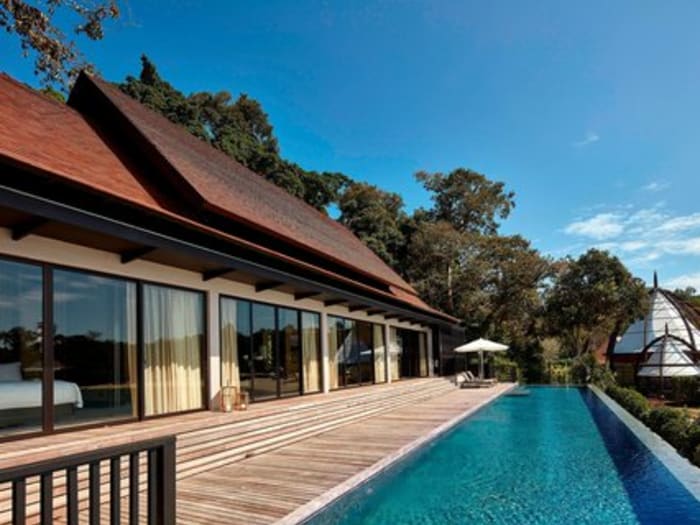
The Ritz-Carlton Langkawi reveals itself as a tropical retreat designed to make the most of its setting between shoreline and dense rainforest. The first striking element is not simply the beauty of the site, but the way the resort inhabits it. Nature is not treated as a peripheral backdrop here: it shapes the views, filters the light, accompanies movement and creates an almost immediate sense of withdrawal. The stay begins with a form of deceleration. One arrives in an environment where the air feels heavier, sounds are softer, and the presence of vegetation seems to calm everything around it.
That relationship with place explains much of the property’s appeal. Langkawi offers a geography of contrasts: pale beaches, shifting sea light, jungle-covered hills, mangroves and broad marine horizons. The hotel makes use of that richness without overworking it. Its luxury lies in well-used space, open views, fluid circulation and an architecture that appears to accompany the landscape rather than dominate it. For the traveller, this becomes a sense of continuity between indoors and outdoors, between resort comfort and tropical surroundings.
The proximity to unspoilt beaches is one of the resort’s most obvious strengths. It allows guests to experience Langkawi in its most immediate form: walking by the water early in the morning, watching the changing light at the end of the day, or simply moving between the hotel’s facilities and the sea. Easy access to a coastline still associated with a degree of calm changes the quality of the stay. This is not an entirely urbanised beach destination, but a setting in which nature retains a strong and legible presence.
The property particularly suits travellers looking for a complete resort destination without entirely giving up the idea of discovery. Couples find a setting conducive to privacy, with the sense of a world apart that well-sited luxury hotels can create. Families, meanwhile, are often drawn to the combination of comfort, service and scenery. In both cases, the place acts as a calming filter: it distances everyday pace and refocuses attention on simple pleasures, carefully orchestrated.
What ultimately distinguishes The Ritz-Carlton Langkawi is its ability to make a certain idea of contemporary escape feel tangible. Not an abstract, interchangeable resort escape, but an experience tied to Langkawi itself: its climate, vegetation, light and relationship with the sea. The hotel offers more than a high level of comfort; it proposes a way of temporarily inhabiting the island under remarkably serene conditions. For many travellers, that is where the property truly succeeds: in creating the feeling of being both protected, well looked after and genuinely immersed in a tropical landscape that retains all its power.
Rooms and suites
In a resort of this kind, the room is not merely a place to sleep between activities; it forms part of the wider experience of disconnection. At The Ritz-Carlton Langkawi, accommodation is expected to extend the sense of retreat created by the setting. That means a design in which contemporary comfort is essential, yet never detached from the tropical context. Volume, openings, materials and the relationship with the outdoors matter as much as the equipment itself. The aim is not to create an abstract luxury, but a space in which one feels immediately settled, sheltered, and still connected to Langkawi’s light and vegetation.
Judging from the property’s overall positioning, the decorative language belongs to a contemporary aesthetic enriched with local references. This approach works particularly well in an island environment: it avoids international uniformity without slipping into cliché. One can therefore expect interiors designed for calm, with a soothing palette, tactile materials and genuine attention to the balance between sophistication and warmth. In the best resort rooms, everything is about visual rhythm: nothing should distract from the landscape, yet nothing should feel anonymous. That is the line the hotel appears to pursue.
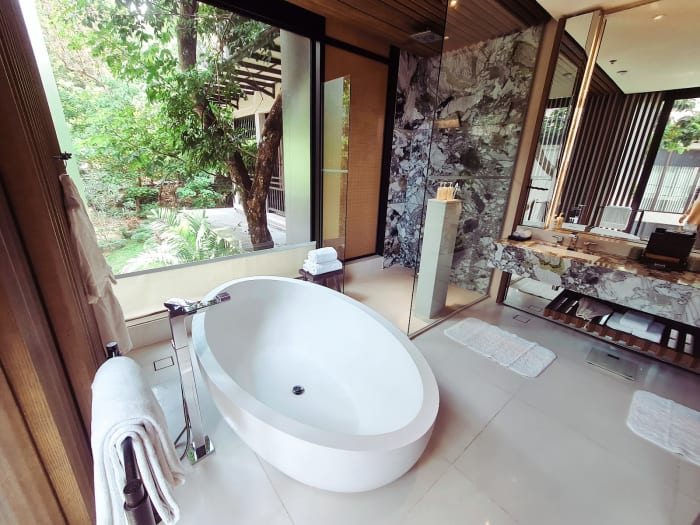
For travellers, the quality of a room in Langkawi is also measured by its ability to protect from the climate while still embracing it. In a tropical destination, one values well-tempered interiors, bathrooms conceived as true spaces of relaxation, and resting areas where one can read, contemplate or simply slow down. Daily housekeeping and turndown service contribute to that sense of discreet continuity: the room remains immaculate without the machinery of the hotel becoming intrusive. It is a small point, but in high-end hospitality, such quiet gestures often determine the perceived quality of a stay.
Suites, when chosen, generally answer a different expectation: more space, greater privacy and a more residential experience. For a romantic stay, they allow for a slower, almost domestic rhythm, in which one enjoys the hotel without feeling constantly in motion. For a family, they offer a more flexible arrangement and welcome comfort over several days. In both cases, the promise remains the same: to make the accommodation a refuge consistent with the spirit of the place.
What matters here, more than a list of technical features, is the way rooms and suites contribute to the resort’s overall atmosphere. They should provide what great hotels do best: a feeling of absolute ease. Everything seems simple, calm and well considered. One finds the signature of demanding international service, but also the intelligence of a tropical setting that calls less for display than for repose. At The Ritz-Carlton Langkawi, sleeping well is therefore not only a matter of physical comfort; it is a natural extension of the island itself, of its warmth, chosen slowness and enveloping beauty.
Dining
In Langkawi, gastronomy shapes the days, creates appointments, and contributes to the memory of travel. At The Ritz-Carlton Langkawi, it enhances the natural setting and the level of service. It is often essential to reserve a table at the main restaurant upon arrival.
In a resort of this calibre, the dining options must accompany every moment of the stay. Breakfast sets the tone. Lunch calls for a lighter touch in the tropical climate. Dinner becomes a more ceremonial affair, where atmosphere is as important as the dish itself. The balance rests on true coherence. The service remains attentive, precise, and flexible enough to adapt to the varying rhythms of the stay.
Here, the setting is almost as significant as the cuisine. Between sea and jungle, each meal takes on a unique sensory dimension. The humidity of the air, the rustling of the foliage, changing light, and proximity to water all play a part. In the finest tropical establishments, the dining experience does not compete with the landscape; it harmonises with it. Open spaces, discreet staging, and a calming tempo give the meal its rightful place.
In Langkawi, the culinary identity benefits from incorporating Malaysian or regional references. An establishment of this category finds its authenticity when it combines international readability with local roots. Travellers find familiar markers while also experiencing the destination through flavours, products, and inspirations.
For couples, dining becomes one of the highlights of the stay. Enjoying dinner against the backdrop of the evening light, having a drink in a tranquil atmosphere, extending the evening without leaving the hotel. For families, it provides a point of balance after a day at the beach, walks, or relaxation. At The Ritz-Carlton Langkawi, gastronomy thus emerges as an essential component of the journey. Thoughtfully designed spaces, reliable service, and a controlled atmosphere enhance the experience.
Spa & wellness
In Langkawi, wellbeing is not confined to a treatment menu; it begins with the climate, the vegetation, the proximity of the sea and the island’s sense of seclusion. In that context, the spa of a major resort is not merely an additional facility; it becomes one of the places where the promise of slowing down takes concrete form. The Ritz-Carlton Langkawi, set between tropical rainforest and shoreline, lends itself particularly well to this reading. Wellness here naturally takes on a sensory, almost environmental dimension before it becomes therapeutic or aesthetic.
In contemporary luxury hospitality, a successful spa is first and foremost a transitional space. It allows guests to move from social time to inward time, from a day of exploration or beach life to a sequence of deeper recovery. That transition should feel fluid and unforced. One expects calm surroundings, natural materials, controlled light and a service style able to establish trust from the outset. In a setting such as Langkawi, the experience gains even more intensity when the architecture allows the outside world to remain perceptible: humidity in the air, the sound of trees, the nearness of water, or simply the awareness of being surrounded by nature.
Treatments in a property of this kind answer varied expectations. Some travellers seek a massage after a long-haul journey or several active days; others place the spa at the centre of the stay, almost as a daily ritual. Couples find in it a moment of suspension, often essential to a romantic escape. Families may value the possibility for each person to recover their own rhythm between shared activities and individual pauses. The luxury of wellness lies in that flexibility: offering experiences structured enough to reassure, yet personal enough to remain meaningful.
A connection with local traditions can also enrich the experience, provided it is handled with restraint. In a destination such as Malaysia, travellers are often receptive to discreet cultural references, ingredients inspired by the region or gestures that do not feel entirely standardised. Once again, the key is not effect but coherence. A great spa convinces when it extends the identity of the place rather than layering on an interchangeable concept.
More broadly, wellbeing at The Ritz-Carlton Langkawi belongs to a vision of travel in which one comes less to accumulate than to recentre. The pool, time spent resting in the room, walks on the beach, unhurried meals and any treatments taken together form a kind of travel hygiene. What one takes away is less the memory of a programme than the memory of a state: having recovered a degree of inner availability. That is perhaps what the best tropical resorts offer when they are thoughtfully conceived. In Langkawi, that promise carries particular resonance, as the island itself seems to invite slowness. The spa is therefore not a side chapter, but one of its most complete expressions.
Concierge & services
In luxury hospitality, service is never merely a list of amenities. It is the invisible architecture of the stay, allowing the traveller to feel supported without being constrained, assisted without being interrupted. The Ritz-Carlton Langkawi clearly belongs to that tradition. With 24-hour concierge and front desk services, daily housekeeping, turndown service, luggage storage, laundry and multilingual staff, the property offers the essential foundations expected of a high-level international address. Yet what matters most is not simply the presence of these services, but the manner in which they are delivered.
In Langkawi, this quality of service takes on particular importance. An island destination, especially one chosen for rest, demands fluidity. Guests need to be able to organise arrival and departure without friction, ask for a recommendation, adjust a plan, delegate a logistical detail or simply obtain a prompt answer at any hour. The concierge therefore becomes a valuable point of orientation, capable of turning a pleasant stay into one that feels genuinely seamless. For travellers discovering the island, it also serves as an interface: helping them read the destination, prioritise their wishes and avoid rushed decisions.
Daily housekeeping and turndown service, often taken for granted in this category, are nonetheless worth emphasising. In a tropical climate, where one moves easily from beach to room and from open-air dinner to air-conditioned night, the quality of housekeeping directly shapes comfort. A room restored discreetly, linen perfectly maintained, attention paid to the guest’s rhythm: all of this contributes to the sense of ease that distinguishes leading hotels. True luxury is often measured by the absence of effort required from the traveller.
The presence of multilingual staff is equally important in a hotel welcoming an international clientele. It is not merely a matter of courtesy; it ensures precision in communication, understanding of expectations and calm in both simple and more delicate situations. In a resort where couples, families and travellers from different continents meet, that adaptability forms part of the standard itself.
Finally, a great hotel is judged not only by its ability to respond, but by its capacity to anticipate. That is where the difference lies. Good service executes; very good service reads the stay, understands habits, notices important moments and intervenes with restraint. At The Ritz-Carlton Langkawi, this promise of constant availability makes particular sense in a setting chosen precisely for tranquillity. The more the landscape invites surrender, the stronger the organisation behind the scenes must be. When it works, the traveller barely notices the machinery. What remains is a reassuring continuity, an elegance of operation and that rare feeling that everything has been arranged to leave the mind entirely free.
The Langkawi way of life
Staying in Langkawi is not simply about choosing a beach destination; it is about adopting, however briefly, another way of inhabiting time. The island invites attention rather than performance. One comes for the sea, naturally, for the beaches and tropical vegetation, but also for that harder-to-define feeling of being slightly removed from ordinary pace. The Ritz-Carlton Langkawi belongs fully to that way of life. It offers a setting in which one can withdraw, contemplate and organise a few discoveries without ever losing the sense of island softness.
Langkawi’s first luxury is perhaps its relationship with nature. The rainforest is omnipresent, not as a dramatic backdrop reserved for excursions, but as a continuous presence. It lines the roads, frames the views, accompanies the beaches and reminds visitors that the island is not reducible to its shoreline. That vegetal density changes the perception of the stay. One does not live only by the sea, but in a constant dialogue between forest green and the changing blue of the water. For many travellers, it is this duality that makes Langkawi so distinctive.
The local way of life also rests on a certain simplicity of pleasures. Rising early to enjoy softer light, walking on a still-quiet beach, taking time over breakfast without too fixed a programme, returning to the hotel during the hottest hours, going out again towards evening when the air becomes gentler: these are simple gestures, yet together they form a true grammar of tropical travel. A major resort such as The Ritz-Carlton Langkawi works best when it respects that natural rhythm rather than resisting it. It provides structure, comfort and service, while still leaving the traveller free to do nothing more than simply be there.
Langkawi can also be discovered in touches: coastal scenery, viewpoints, walks, time by the water or in more preserved areas. The point is not to multiply activities as though ticking off an itinerary, but to choose what suits one’s mood. That flexibility is essential. It allows each guest to shape a stay to measure, whether centred on rest, romance, family time or a balance between contemplation and light exploration.
In that context, the hotel acts as an elegant base rather than a closed world. It protects, simplifies and stages comfort, yet still allows Langkawi to exist beyond it. That is a valuable quality. The best resort addresses do not erase their destination; they offer a more fluid, more hospitable and sometimes deeper reading of it. At The Ritz-Carlton Langkawi, the way of life lies precisely there: in the possibility of moving between the intimacy of a grand hotel and the very real presence of the island, its beaches, rainforest and tempo. One leaves with more than the memory of a successful holiday: with the feeling of having approached a slower, more attentive way of being in the world, and for that very reason, a more luxurious one.
Book via MyConciergeHotel
Booking The Ritz-Carlton Langkawi through MyConciergeHotel is about preparing your stay with discernment. In Langkawi, the setting is as important as the rhythm of your journey.
Choosing the right dates, anticipating dining options, balancing relaxation with exploration, and specifying the type of stay desired all influence the overall experience.
The period from December to February generally offers a drier climate, which often attracts more travellers.
In a hotel of this calibre, it is advisable to book early. This way, the choice of accommodation is broader, especially for key moments during your stay.
Dining should also be anticipated. Reserving a table at the main restaurant upon arrival is wise, particularly for significant dinners.
In large resorts, meals often structure the stay as much as excursions do. Planning them in advance helps avoid last-minute decisions.
Booking with assistance also allows for a better calibration of the trip. Some guests prefer seclusion, the spa, the beach, and a leisurely pace.
Others wish to punctuate their stay with outings, natural discoveries, or more active experiences. Families often seek a more flexible rhythm.
MyConciergeHotel helps clarify these expectations in advance. This way, the hotel experience can be tailored more accurately to each profile.
The Ritz-Carlton Langkawi stands out for its location between the sea and jungle, its proximity to unspoiled beaches, and its immersion in the natural beauty of Langkawi.
Its contemporary luxury engages in a dialogue with local traditions. A precise recommendation aids in choosing the right duration, the best moments, and the reservations to make in advance.