History & heritage
In Beijing, the Ritz-Carlton name immediately suggests a certain idea of international hospitality: polished elegance, close attention to detail, and a style of welcome built on consistency rather than display. The Ritz-Carlton Beijing belongs to that contemporary tradition of the grand urban hotel, designed for guests who travel frequently, know the standards of major capitals, and expect a five-star address to combine efficiency, calm and poise. Its heritage is not that of a historic palace in the European sense, but of a globally recognised house set within a metropolis whose pace, scale and cultural density call for a more contemporary reading of luxury.
In a city such as Beijing, high-end hospitality has long been shaped by the capital’s economic, diplomatic and cultural transformations. International luxury hotels have found a particular role here, in a city where imperial remains, broad modern avenues, business districts, cultural institutions and a constantly evolving dining scene coexist. The Ritz-Carlton Beijing takes its place within this landscape with a clear identity: to offer a structured, refined refuge that is immediately legible to the international traveller, while remaining aware of the Beijing context around it. Its heritage is therefore twofold: that of a brand known for disciplined service, and that of a location in a capital where ceremony, spatial hierarchy and attention to custom have always mattered.
The interest of the property lies precisely in that balance. Guests do not come here for a decorative reconstruction of an imperial past, nor for a theatrical design disconnected from its surroundings. They stay here to find a sense of continuity in a city that changes quickly. The Ritz-Carlton codes—attentive welcome, carefully maintained atmosphere, public spaces designed to inspire confidence and comfort—take on particular meaning in Beijing. In a city where a day may include meetings, transfers, cultural visits and formal dinners, the quality of a hotel is often measured by its ability to absorb the city’s rhythm without letting it weigh on the stay. That role as a discreet intermediary between the intensity outside and the need for retreat is, in many ways, its true heritage.
This idea of heritage can also be seen in the way the hotel speaks to several types of traveller without losing focus. Couples find an orderly setting suited to an elegant urban interlude. Business travellers value clear organisation, continuous service and an environment that allows them to move from appointments to rest without friction. Families choosing a major international address often seek the same reliability: present teams, established routines and smooth logistics. The Ritz-Carlton Beijing answers that expectation through an assured hotel classicism that remains one of the most enduring signatures of well-judged luxury.
In the Beijing context, that sense of permanence is especially valuable. The city impresses through its scale, contrasts, historical depth and sometimes abrupt modernity. A hotel such as this is not meant to compete with Beijing itself; rather, it serves as an anchor point. Its heritage is that of an address that understands that true luxury in a great capital often consists in clarity, time saved, measured attention and consistent execution.
The hotel
The Ritz-Carlton Beijing is first defined by its setting in a lively district of the capital, an essential point in understanding the experience it offers. Beijing is not a city grasped in a single glance: it reveals itself in layers, through broad avenues, contemporary developments, historic sites, cultural venues and business zones. In that context, staying at a well-connected address in an animated environment changes the way one moves through the city. The hotel allows guests to remain in direct contact with urban energy while still offering, once inside, a welcome sense of retreat.
The property follows the clear logic of the major international hotel: public areas designed for ease of movement, volumes that support both representation and comfort, and an overall atmosphere in which elegance does not seek to impose itself ostentatiously. That legibility matters in Beijing, where days may be long and transfers frequent. One values places that simplify the experience, where arrival feels smooth, landmarks are immediate, and the organisation of the stay is understood without effort. The Ritz-Carlton Beijing cultivates precisely that impression of order and continuity.
The atmosphere described as elegant and comfortable is not merely a presentation line; it corresponds to a very concrete quality of the address. Comfort here lies as much in the materiality of the spaces as in their rhythm. A successful grand hotel knows how to create transitions: between outside and inside, movement and rest, professional use and more personal moments. In a capital as dense as Beijing, that ability to create thresholds matters greatly. The lobby, lounges, circulation areas and quieter corners all contribute to a gradual distancing from the city, without ever suggesting artificial isolation.
Its proximity to cultural attractions adds another dimension to the stay. Beijing is one of Asia’s great cultural capitals, with historical depth visible not only in major monuments but also in its districts, museums, temples, parks and contemporary art scenes. Choosing a well-situated hotel allows guests to alternate more freely between different rhythms: a morning of visits, a business lunch, a return to the hotel to reset, then an evening in the city. That flexibility is especially valuable for travellers with only a few days who still want to give their stay genuine substance.
The hotel therefore suits several uses without seeming unfocused. For a business trip, it offers the expected framework of a five-star address: seriousness, discretion and continuity of service. For a stay for two, it provides a refined urban setting conducive to slower interludes between explorations of the city. For a first discovery of Beijing, it serves as a reassuring base from which to organise a programme methodically. For travellers accustomed to major international brands, it offers the familiarity of standards that makes settling in immediate.
What ultimately stands out is a certain mastery of the urban experience. The Ritz-Carlton Beijing is not a resort detached from the world; it is a capital-city hotel, designed to engage with its surroundings. Its appeal lies in its ability to offer a refined setting without erasing the city, to support intensive stays without making them heavier, and to give the traveller a sense of stability in one of the continent’s most fascinating and complex metropolises.
Rooms and suites
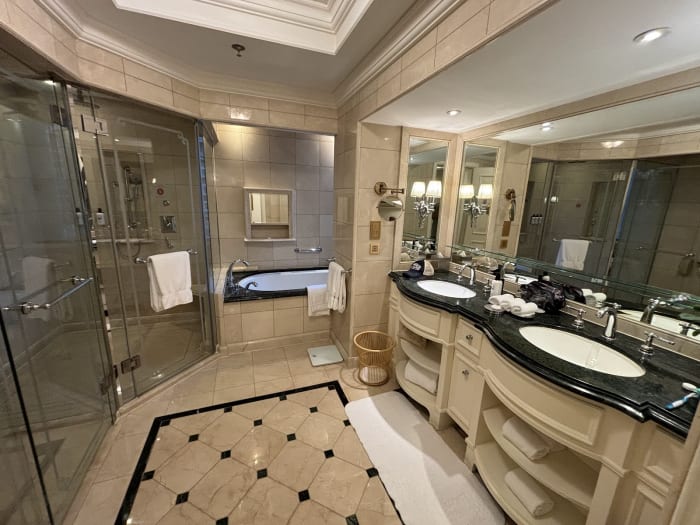
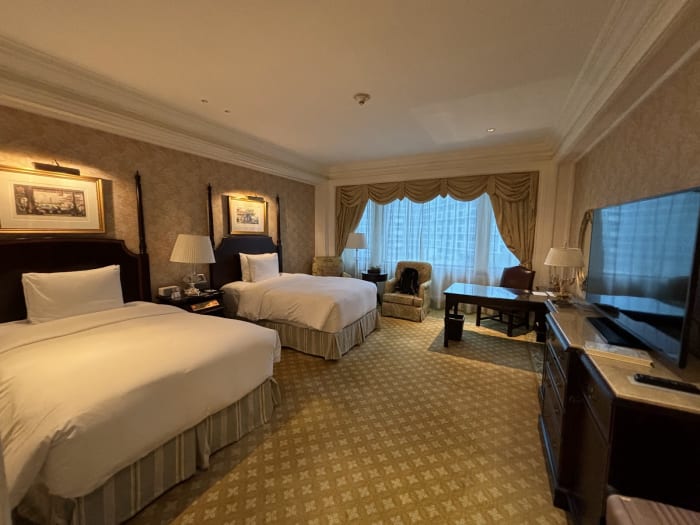
In a major urban hotel, the room is never merely a place to pass through. It becomes the true centre of gravity of the stay, especially in a city such as Beijing, where one may move quickly from a very dense programme to an immediate need for calm. At The Ritz-Carlton Beijing, the experience of rooms and suites is best understood through that essential function: to offer a space for recovery, preparation and privacy, sufficiently comfortable to absorb the contrasts of the day. The elegance promised by the hotel takes on a more personal, quieter form here, where luxury is measured less by accumulation than by quality of use.
What most travellers seek in this type of address is fairly clear: serious bedding, good visual and acoustic separation, a bathroom designed for the actual rhythm of the stay, efficient storage, impeccable upkeep, and that difficult-to-define sense of a space that is immediately inhabitable. The hotel’s known services, such as daily housekeeping and turndown, directly support that quality of living. They are a reminder that a grand hotel room is not merely well designed; it is also continuously reset to accompany the different tempos of travel, from early departures to late returns.
For business travellers, this dimension is especially important. A successful room must allow one to work for a while, perhaps take a call or prepare for a meeting, without losing its primary function as a place of rest. The balance between representation and comfort, often difficult to achieve, is part of the natural expectation of a Ritz-Carlton address. In Beijing, where professional stays can be intense, having a stable, legible and carefully maintained environment makes a tangible difference to the quality of the trip. It offers the possibility to slow down, regain one’s breath, and then set out again with the feeling of having retained some control over time.
For couples, the room—and even more so the suite—takes on another value. It becomes a refuge in the city, a place where the day can continue without leaving the hotel, where one may enjoy a quiet breakfast, a moment of reading, or simply a pause between outings. In that context, atmosphere matters as much as amenities. A successful room is not merely functional; it creates a state of mind. It should make the fatigue of travel recede, soften the agitation outside, and establish a calmer relationship with time.
Families, too, often judge a hotel by the practical quality of its rooms. Ease of settling in, team availability, luggage handling, service responsiveness and consistency of upkeep all become decisive. The concierge and front desk services available throughout the day and night reinforce that sense of constant support, particularly useful when travelling with variable schedules or more complex logistical needs.
Ultimately, the rooms and suites at The Ritz-Carlton Beijing should be understood as the most intimate extension of the hotel’s overall promise: an elegant, comfortable and reliable setting suited to different kinds of stay. In a capital that constantly demands attention, they offer what the best urban addresses still know how to preserve: the possibility of genuine retreat without severing ties with the outside world. That is often where the success of a stay in Beijing is decided: in the quality of one’s return to oneself at the end of the day.
Dining
In a great capital, hotel dining plays a more complex role than it may seem. It does not merely feed; it structures the stay, gives rhythm to the day, provides a setting for meetings and sometimes offers a valuable alternative to additional journeys. At The Ritz-Carlton Beijing, dining belongs to that logic of the major international hotel in which gastronomy forms part of the overall experience without necessarily seeking overt effect. One expects from such an address an offering capable of supporting several uses: an efficient breakfast before a full day, a business lunch, a more composed dinner, afternoon tea, or a moment of conversation in a carefully maintained setting.
In Beijing, this dimension takes on particular importance. The city has a culinary scene of considerable richness, ranging from imperial and regional Chinese traditions to the most contemporary expressions of international cuisine. In that context, a five-star hotel does not need to compete with the whole city; it must instead offer a reliable point of reference, where service quality, comfort of setting and command of tempo matter as much as the plate itself. Travellers appreciate knowing that they can begin or end their day in a coherent environment without giving up a certain sense of occasion.
Breakfast in this type of hotel deserves special attention. It is often the first real moment of the stay, the point at which one takes the measure of the day ahead. For business travellers, it is a moment of organisation. For couples, it may be slower, almost ritual. For families, it is a balancing point before visits begin. In a hotel such as The Ritz-Carlton Beijing, one expects this morning appointment to be both smooth and generously orchestrated, with attentive but never intrusive service. Luxury here often lies in that perfectly executed simplicity.
The rest of the dining offer generally follows the same philosophy. A major urban hotel should be able to host both a formal meal and a more intimate dinner, a professional exchange and a discreet pause between appointments. The quality of a dining room, its acoustics, the rhythm of service, the ability to preserve space around guests: all of this forms part of the gastronomic experience just as much as the cooking itself. In a city where one may be heavily solicited, the possibility of dining on site in a controlled setting becomes a real comfort.
It is also worth noting the social dimension of hotel dining. The lounges, bars and restaurant spaces of an international address are often transitional places: one meets there, waits there, extends a conversation there, observes the movement of the city from a distance. That function is especially relevant in Beijing, where hospitality is often articulated through precise relational codes. A hotel able to provide spaces suited to such uses fulfils far more than a catering role; it becomes a temporary way of life.
Without claiming unconfirmed details about the hotel’s restaurants or culinary signatures, it can be said that dining at The Ritz-Carlton Beijing fully supports the hotel’s promise: that of an urban luxury that is legible, comfortable and well kept. It accompanies the different moments of the stay with the same demand for coherence as the rest of the house. In a capital as vast and stimulating as Beijing, that consistency has real value.
Spa & wellness
In a city on the scale of Beijing, wellness is not a decorative extra; it is often a very practical necessity. Between jet lag, days of meetings, visits across an immense metropolis and the general intensity of travel, the body quickly registers what the mind is still trying to organise. The spa in a grand hotel therefore takes on an essential role: not merely to offer treatments, but to provide a moment of rebalancing. The Ritz-Carlton Beijing, whose existing description advises booking the spa experience in advance, suggests that this space is one of the stay’s notable points of attention.
In luxury hospitality, a successful spa cannot be reduced to a list of treatments. It depends on atmosphere, on the way silence is preserved, on the fluidity of the journey and on the teams’ ability to adapt the moment to the traveller’s rhythm. After a long flight or a dense day in the city, what one seeks is not necessarily spectacular sophistication, but a well-executed ritual, discreet care and a clear sensation of release. That is often where the difference lies between a simple facility and a genuine wellness space.
In Beijing, this interlude has particular value. The city stimulates constantly: monumental architecture, traffic, contrasts of scale, richness of visits, pace of professional exchanges. The spa then acts as a counterpoint. It allows one to slow down without leaving the hotel, to recover an inner continuity after exposure to significant external intensity. For business travellers, this function is almost strategic: a treatment placed well in the schedule can transform the quality of a trip. For couples, it becomes a shared moment that gives the stay another texture. For travellers in transit or on a short programme, it offers an efficient way to regain possession of time.
The advice to book ahead is revealing of regular use and a certain level of demand, which fits well with the profile of an international clientele accustomed to integrating wellness into the way they travel. That anticipation is all the more relevant because the best spa moments are often those that fit naturally into the programme: late afternoon after sightseeing, between professional sequences, or on the morning of a late departure. In a hotel of this category, the quality of the spa also lies in its ability to connect smoothly with the rest of the stay.
Beyond treatments themselves, the idea of wellness generally includes a broader whole: quality of sleep, comfort of the room, availability of service, the possibility of dining at an appropriate rhythm, and that impression of being looked after without having to request everything. The Ritz-Carlton Beijing, through its elegant and comfortable atmosphere, appears to answer precisely that broader definition of wellbeing. The spa would then be its most explicit expression, but not the only one.
In a capital where one often comes to do a great deal in a short time, the presence of a space dedicated to self-care changes the experience profoundly. It is a reminder that a great journey is measured not only by the number of places seen or meetings held, but also by the quality of the breathing spaces it allows. It is often in those pauses that a stay gains its depth.
Concierge & services
The true test of a five-star hotel is not found only in its décor or the comfort of its rooms, but in the quality of its everyday services. That is where the difference is measured between an address that is merely upscale and one that is genuinely mastered. According to the confirmed elements, The Ritz-Carlton Beijing offers a 24-hour concierge, a 24-hour front desk, daily housekeeping, turndown service, luggage storage, laundry, a wake-up service and multilingual staff. Considered separately, these services may seem expected; taken together, however, they form the real architecture of the stay.
The concierge in a city such as Beijing has particular value. A great capital requires orientation, anticipation and sometimes cultural or logistical mediation. Even for experienced travellers, the city’s scale, journey times, reservations, schedules and local customs can complicate organisation. A concierge available at any hour therefore offers far more than occasional assistance: it becomes a discreet coordination centre, able to help structure the stay, adjust a programme or resolve the unexpected. In luxury hospitality, that ability to simplify without becoming intrusive is one of the most concrete forms of service.
The 24-hour front desk follows the same logic of continuity. Late arrivals, early departures, changes of plan and last-minute requests are part of the normal rhythm of an international hotel. In Beijing, where long-haul flights and professional schedules often impose irregular hours, this permanence is not merely a comfort; it is a structural element of the experience. It guarantees that the traveller will always find someone to speak to, whatever the hour, and contributes to that quiet sense of security that distinguishes well-run establishments.
Housekeeping services—daily cleaning, turndown, laundry—also contribute to the deeper quality of the stay. They are not only about cleanliness or order, but about the constant resetting of private space. Returning to a perfectly prepared room after a dense day has a real effect on the perception of travel. It lightens mental load, restores a form of domestic comfort and allows one to focus on what matters. Laundry in particular becomes important during longer stays or business trips, where personal presentation forms part of the programme.
Luggage storage and wake-up service may appear more modest, yet they illustrate the philosophy of a grand hotel well: taking account of the details that make a stay smoother. An arrival before check-in time, a late departure, a connection to manage, an important meeting the following morning—these are all situations in which such services become decisive. As for multilingual staff, they are an obvious asset in an international address, easing exchanges and reducing the frictions associated with travel.
Ultimately, the services at The Ritz-Carlton Beijing express a certain idea of luxury: not the accumulation of spectacular attentions, but the creation of an environment in which almost everything feels simpler, clearer and better supported. It is this quality of execution, often discreet, that allows the traveller to devote energy to the city, to work or to loved ones rather than to logistics. In a metropolis as demanding as Beijing, that promise is worth a great deal.
The Beijing way of life
Staying at The Ritz-Carlton Beijing also means entering into a certain relationship with Beijing itself. The city does not reveal itself immediately; it asks for time, attention and a particular disposition of the eye. Political capital, major cultural centre, former imperial city and contemporary metropolis, Beijing juxtaposes worlds that do not cancel one another out but respond to each other. One may move from a historic site to an ultra-modern avenue, from a quiet park to a lively district, from a tea ritual to a business dinner. The Beijing way of life lies precisely in that coexistence of registers, in that ability to hold together solemnity, daily use and contemporary invention.
In this context, a well-located hotel becomes more than a place to stay: it serves as a mediator between visitor and city. Being close to cultural attractions makes it possible to approach Beijing not as a succession of transfers, but as a more continuous experience. One can organise days with greater flexibility, alternate exploration with returns to the hotel, create pauses and observe the city at different times of day. That breathing space matters, because Beijing is also understood through its rhythms: morning light on broad perspectives, denser afternoon activity, the particular atmosphere of evening in certain districts.
Local art de vivre is not limited to monuments. It can be read in the way space is occupied, in the importance given to meals, in the relationship between interior and exterior, in the taste for gardens, courtyards and thresholds. Even when staying in a major international hotel, that sensibility can enrich the journey. It invites one to slow down, not to reduce the city to a checklist of sites, and to pay attention to transitions. Beijing rewards travellers who accept that complexity: those who know how to devote a morning to a museum, an afternoon to wandering through a district, and then return to rest before going out again for dinner.
For couples, the city offers particularly rich ground, made of contrasts and chosen moments. For business travellers, it is a reminder that a professional trip can also become an opportunity for a subtler encounter with a singular urban culture. For families, it offers a historical and visual density that leaves lasting memories. In every case, the hotel plays a decisive role by helping transform that richness into lived experience rather than a merely overloaded programme.
What perhaps distinguishes Beijing from other great capitals is this alliance of monumentality and inwardness. The city impresses, yet it also knows how to preserve spaces of retreat, contemplation and slowness. A successful stay often consists in holding those two dimensions together: seeing the scale, then seeking the detail; understanding the long history, then observing present-day uses; accepting intensity, then recovering calm. The Ritz-Carlton Beijing, through its elegant and comfortable urban positioning, naturally belongs to that way of inhabiting the city for a few days.
The Beijing way of life is therefore not an abstract formula. It is a practice of staying well: knowing how to work with distances, choose one’s moments, alternate registers and preserve quality time in the midst of an immense capital. A grand hotel then takes on its full meaning, not as a separate décor, but as a base from which the city becomes more accessible, more legible and, ultimately, more intimate.
Book with MyConciergeHotel
Booking The Ritz-Carlton Beijing through MyConciergeHotel means approaching the stay through preparation rather than mere transaction. In a city as vast and layered as Beijing, choosing a hotel is not limited to a category or an address; it shapes a way of experiencing the destination. A well-located five-star property, suited to business trips as well as stays for two, close to cultural attractions and supported by continuous services, takes on its full meaning when integrated into a coherent travel plan. That is precisely where editorial and concierge guidance becomes useful: in aligning the hotel, the rhythm of the stay and the traveller’s actual expectations.
MyConciergeHotel makes it possible to approach this booking with greater discernment. The point is not only to confirm a room, but to understand whether the address suits the way you travel. Do you wish to prioritise access to Beijing’s cultural life? Do you need a fluid setting in which to alternate meetings and rest? Are you looking for an elegant urban atmosphere, structured enough to make the stay simple from the moment of arrival? The Ritz-Carlton Beijing answers these expectations through its clear positioning, but the quality of the experience also depends on how the stay is prepared beforehand.
That preparation concerns the tempo of the journey in particular. In Beijing, distances, traffic and the density of visits all encourage a realistic programme. Booking with a concierge approach means thinking about key moments: arrival time, luggage handling, the possible need for a spa treatment, arranging a wake-up call, or specific requests linked to a business trip or a stay for two. The hotel’s confirmed services—24-hour concierge and front desk, luggage storage, laundry, daily upkeep—then reveal their full value, because they allow the stay to be organised with flexibility.
One of the advantages of a well-supported booking is also avoiding mistakes of rhythm. Many travellers underestimate Beijing’s intensity and overload their days. Yet an address such as this one offers precisely the possibility of returning to the hotel during the day, planning recovery time, booking the spa in advance if desired, or creating a more balanced sequence between culture, business and rest. In this context, luxury lies not only in the hotel’s quality; it lies in the rightness of the whole.
Booking through MyConciergeHotel also means benefiting from an editorial reading that places the property within its real environment. The Ritz-Carlton Beijing is not presented as an abstract luxury object, but as a precise urban address, suited to certain uses and particularly relevant for those seeking an elegant and reliable base in the Chinese capital. This way of booking is more demanding, but also more accurate: it privileges fit over generic promise.
To make the most of the stay, it is wise to anticipate the elements that truly matter: flight schedules, recovery needs, visiting time, appointments, and experiences to be reserved in advance, especially at the spa. In a city that demands as much energy as Beijing, a well-considered booking is not a minor detail. It is often what turns a very good hotel into a genuinely successful stay.