The Hotel
The Middle House belongs to that generation of urban hotels that understands that a great stay is no longer defined by an accumulation of obvious luxury cues. Here, the prevailing impression is one of carefully composed calm in the heart of a metropolis that never truly slows down. In Shanghai, where contrasts play out on a grand scale between glass towers, shopping avenues, international heritage and creative energy, the hotel takes a more inward-looking approach: contemporary elegance, measured and thoughtful, attentive to materials, light and the traveller’s rhythm.
The architecture and public spaces work precisely through this balance. The language is contemporary, clean and urban, yet never cold. Traditional touches soften the whole and lend it a cultural depth that avoids the trap of interchangeable design. This dialogue between current lines and more rooted references creates an atmosphere that is immediately legible: one is in Shanghai, but in a Shanghai interpreted with restraint, without folklore or excess. It is a way of telling the city in fragments, through details, textures and a certain way of organising space and creating transitions between outside and in.
What truly sets the hotel apart is its atmosphere. Warmth is a word too often overused in luxury hospitality; here, it has a tangible meaning. The volumes do not seek to overwhelm, but to put guests at ease. Circulation is fluid, lounges invite lingering rather than mere passage, and the whole gives the feeling of an urban refuge designed for travellers who want both to inhabit the city and occasionally withdraw from it. This quality of welcome extends into a personalised service style that seems intended to support different kinds of stay: business appointments, a couple’s escape, a solo interlude, or a longer stop within an international itinerary.
The neighbourhood fully contributes to this identity. Set in a lively area of Shanghai, The Middle House benefits from surroundings that are animated, practical and alive, while still preserving a sense of retreat. It is a particularly relevant base for those who wish to alternate between days of exploration, meetings, shopping, cultural visits and moments of calm. The hotel does not merely happen to be well located; it turns that location into an experience by offering a more composed reading of the city.
Its inclusion in the Travel + Leisure World’s Best Awards 2025 fits naturally within this logic. More than a simple badge of recognition, it highlights the coherence of a property that appeals through the quality of its execution. The Middle House does not overplay its five-star status. Instead, it builds trust with its guests through comfort, precision and discreet sophistication. In a city as intense as Shanghai, that restraint is precisely what makes it distinctive.
Rooms and Suites
In a vertical city such as Shanghai, a hotel room is never simply a place to sleep. It becomes a vantage point, a place of recovery and sometimes even a temporary office. The Middle House appears to have been conceived with that reality in mind. The rooms are described as looking out over the city, and this visual relationship with the urban landscape matters greatly to the overall experience. To see Shanghai from one’s room is to register its density, energy and modernity; yet from within a carefully composed interior, it is also to regain control over the pace of one’s stay.
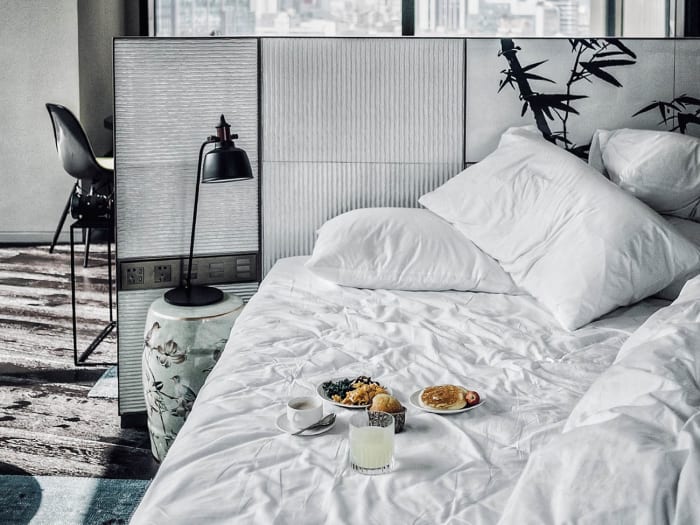
Comfort here does not rely on ostentation. It is expressed instead through the quality of the atmosphere and a clear attention to detail. The interior design, often praised, contributes to that sense of coherence. One imagines clean lines, carefully chosen materials, a palette capable of soothing without becoming bland, and a staging of space that privileges clarity. In the best contemporary hotels, luxury is recognised by the way everything seems self-evident: the flow between functions, the place given to light, the balance between privacy and openness, and the presence of decorative elements that enrich without cluttering. It is this form of quiet sophistication that is found here.
The city views play a particular role. They anchor the stay in Shanghai while giving the room an almost cinematic dimension, especially at certain times of day when light reflects off façades and the city changes texture. In the morning, that openness accompanies a more energised awakening; in the evening, it turns the return to the hotel into a gentle transition between outside intensity and interior calm. For business travellers, that visual breathing space matters as much as material comfort. For couples, it adds a living backdrop. For solo travellers, it creates a direct connection with the city without imposing its frenzy.
Daily housekeeping, evening turndown and the attention given to maintenance reinforce this sense of order and continuity. In a hotel of this level, such gestures are not incidental: they shape the true quality of the stay. A well-kept room, discreetly restored, becomes a place in which one immediately feels expected. That impression of rightness is often more memorable than any dramatic effect.
The Middle House therefore seems to speak to guests who appreciate contemporary interiors but do not want a disembodied luxury. The rooms and suites extend the hotel’s wider spirit: urban elegance, warmth and a design intended to outlast trends. They offer the right degree of retreat, comfort and connection to the city. In Shanghai, where one can quickly be absorbed by the outside rhythm, having such a refuge changes the quality of a journey in a very real way.
Dining
In a major urban hotel, dining is no longer a mere supporting service: it fully contributes to the property’s identity. The Middle House understands this well by structuring its culinary offering around two venues that answer different moments of a stay. On one side, Frasca offers a contemporary Italian interlude; on the other, Café Gray Deluxe shapes the start of the day with a selection of hot and cold breakfast options. This duality says much about the spirit of the house: a cosmopolitan, readable approach, rooted in the habits of an international clientele while keeping sight of the pleasure of the table.
Frasca belongs to that category of hotel restaurants that seek less to dazzle than to make one want to return. The idea of reimagined Italian classics suggests a cuisine that respects familiar reference points while interpreting them with a current sensibility. In a city such as Shanghai, where the dining scene is broad and constantly moving, this proposition makes sense: it offers a register that is recognisable and generous, yet sufficiently considered to stand as a destination in its own right, including for a dinner without elaborate planning. Contemporary Italian cooking in this context often implies clear textures, ingredients highlighted without excess, and a controlled conviviality suited equally to a business meal or a more relaxed evening.
Café Gray Deluxe plays another role, just as important. Breakfast is a defining moment in the experience of a hotel at this level, particularly in a city where days begin early and can easily stretch long. Offering both hot and cold options allows the venue to respond to different rhythms and habits: a quick departure for meetings, a leisurely morning, recovery after a long-haul flight, or simply the wish to take one’s time. A good hotel breakfast is judged not only by abundance, but by the clarity of the offer, freshness, ease of service and the ability to set the day on the right note. That is precisely what one expects here.
Beyond the plates themselves, dining also extends the overall aesthetic of The Middle House. One imagines spaces where design accompanies the meal without dominating it, where the atmosphere remains elegant yet relaxed, and where one may either linger or move through efficiently. That flexibility is essential in a hotel welcoming very different kinds of travellers. Some will seek a straightforward dinner after a dense day; others will make the restaurant a destination in itself. Some will want a quick breakfast, others a genuine pause before the city.
Here, dining does not attempt to multiply concepts. It prefers to offer two coherent addresses capable of structuring a stay naturally. That is often the hallmark of the most convincing hotels: those that understand gastronomy should fit the rhythm of travel, not the other way round. At The Middle House, eating becomes a logical extension of the wider experience: contemporary, polished, international and always welcoming.
Concierge and Services
The quality of a five-star hotel is often measured in what is not immediately visible. More than decorative effects, it is the continuity of service, the availability of teams and the fluency of everyday gestures that turn a good stay into one of genuine comfort. The Middle House appears to belong fully to this culture of discreet attention. The presence of a 24-hour concierge and a front desk available at any hour immediately sets the tone: that of a property which understands the constraints of contemporary travel, particularly in an international city such as Shanghai, where late arrivals, jet lag and shifting schedules are part of daily reality.
This constant availability is far from incidental. For a business traveller, it means being able to manage a change of plan, a logistical request or a transport need at unconventional hours. For a couple on a city break, it offers the freedom to improvise an evening, ask for a recommendation or organise the following day without friction. For a solo traveller, it creates a welcome sense of security and ease in a major metropolis. In this context, the concierge is not merely an information desk: it becomes an interface between hotel and city, a relay capable of adapting Shanghai to each guest’s rhythm and wishes.
Daily housekeeping and evening turndown operate within the same logic of continuous care. They establish a feeling of order, almost of breathing space, in the unfolding of a stay. Returning to a room that has been restored, finding a space discreetly reset, noticing that details have been taken care of without having to ask: these are the elements that create a lasting impression of comfort. In luxury hospitality, true sophistication does not lie in multiplying visible interventions, but in making things simpler, smoother and more natural.
Luggage storage, laundry and wake-up service usefully complete the picture. These are sometimes treated as secondary amenities, when in fact they are essential in urban and international stays. Being able to leave one’s belongings before a late flight, have a wardrobe refreshed between appointments, or organise an early departure without stress amounts to a very concrete form of luxury: saved time and reduced mental load. It is often this kind of service that distinguishes hotels genuinely designed for travellers from those content with an aesthetic promise.
Finally, the presence of multilingual staff naturally aligns with the cosmopolitan identity of the house. In a city such as Shanghai, where local and international guests intersect, this ability to welcome with precision and clarity makes all the difference. It helps avoid misunderstandings, refine recommendations and personalise exchanges.
At The Middle House, services do not appear to be conceived as a list of options, but as an invisible structure supporting the whole experience. It is this human infrastructure, available without being intrusive, that gives the hotel its real depth. Luxury here takes the form of an impeccably run organisation in the service of a freer stay.
The Art of Living in Shanghai
Staying at The Middle House also means choosing a particular way of approaching Shanghai. The city can impress through its scale, speed and visual density. It is often discovered in successive layers: shopping districts, contemporary towers, quieter streets, cafés, galleries, international addresses and traces of a cosmopolitan past that remain perceptible. In this context, the hotel plays an important role: not merely as a place to stay, but as a filter capable of making the metropolis more legible, more liveable, almost more intimate.
Its setting in a lively neighbourhood is an obvious advantage for travellers who wish to experience the city without losing time in unnecessary transfers. One can easily imagine days beginning early, with coffee and a view over the city, then unfolding through meetings, walks, culinary discoveries and occasional returns to the hotel to catch one’s breath. Shanghai is a city of practical contrasts: one can move from a highly animated environment to a hushed space within minutes. The Middle House appears to have been built precisely to accompany that movement, offering a base that is both central and calming.
The Shanghainese art of living cannot be reduced to spectacular modernity. It also lies in a certain sophistication of daily life: a taste for fine addresses, the fluidity of services, attention to design, and the coexistence of the local and the international. The hotel translates that culture well. Its contemporary architecture punctuated by traditional touches reflects a city that has never ceased negotiating between heritage and projection towards the future. This is not a fixed décor, but an ongoing conversation between different eras, influences and ways of inhabiting the urban world.
For the visitor, this means that a successful stay in Shanghai does not necessarily consist in seeing everything, but in adopting the right rhythm. Alternating intense sequences with moments of retreat, allowing oneself to be guided by a neighbourhood, choosing a few tables rather than an exhaustive list, taking time to look at the city from one’s room before heading out again. The Middle House encourages this approach because it does not seek to compete with Shanghai; instead, it offers the right distance from which to appreciate it more fully.
This position is especially valuable for contemporary travellers, often torn between efficiency and the desire for experience. One can organise a business stay here without sacrificing the pleasure of a genuine setting. One can enjoy an urban escape without succumbing to constant agitation. One can travel alone without feeling isolated. The hotel acts as a point of balance.
In many ways, The Middle House embodies a very current idea of urban luxury: not withdrawing entirely from the world, but having at one’s disposal a place capable of giving shape to the surrounding intensity. In Shanghai, that capacity is worth almost as much as the address itself. It allows a great metropolis to become a personal, nuanced and elegant experience—and one leaves with the feeling of having truly inhabited it, if only for a few days.
An Address in Contemporary Shanghai
Not every great hotel is meant to tell a heritage story in the classical sense. Some are better understood as part of a city’s ongoing reinvention, and that is likely the right way to read The Middle House. Its identity does not rest on an aristocratic past or the mythology of an old-world palace, but on a contemporary interpretation of Shanghai: a city that has established itself as one of Asia’s major urban laboratories while retaining a complex architectural and cultural memory.
In this context, the hotel takes an interesting position. Its contemporary architecture, enriched with traditional touches, does not attempt to reproduce the past; it integrates it through allusion, resonance and details capable of placing the property within a broader continuity. This is a very current approach to high-end hospitality. Rather than fixing identity within a decorative narrative, it prefers to create an environment that converses with the real city of today, shaped by international exchange, aesthetic change and the evolving expectations of travellers.
Shanghai has long fascinated through its ability to absorb diverse influences and transform them into a language of its own. That quality can be read in its urban fabric, its creative scene, its gastronomy and its orchestration of the relationship between tradition and modernity. The Middle House appears to belong to that lineage. Even its name suggests a position of balance, a form of quiet centrality, almost a mediation between several worlds: the intensity of the city and the need for retreat, international refinement and local references, contemporary efficiency and a certain softness of inhabiting space.
This way of existing within the city also corresponds to a broader evolution in luxury hospitality. Today’s travellers seek solemn décors less than coherent places capable of offering character without rigidity. They want to feel the destination without giving up the comfort of perfectly calibrated service. They expect design, but design able to endure and accompany real life. The Middle House answers that expectation by offering a form of elegance that does not depend on fashion, but on controlled composition.
Its recognition in the Travel + Leisure World’s Best Awards 2025 fits naturally into that trajectory. It signals a property that has found its place within the international landscape of notable hotels, not through excess visibility but through coherence. That is often how the hotels that truly matter are built: by developing a clear identity, remaining faithful to their setting, and offering an experience whose quality stands the test of time.
Rather than a monument, The Middle House therefore appears as a marker of contemporary Shanghai. A hotel that tells not so much of a vanished golden age as of a current way of inhabiting the city with style, calm and discernment. For the traveller, that is a valuable promise: a stay rooted in its time, yet subtle enough not to date.
Book with MyConciergeHotel
Choosing The Middle House through MyConciergeHotel means approaching the stay with a logic of precision rather than mere availability. In a destination as sought-after as Shanghai, selecting a hotel is not only a matter of category or a pin on a map. It is about finding the right balance between location, atmosphere, comfort, service style and suitability to the purpose of travel. The Middle House responds particularly well to that requirement because it brings together several qualities that are rarely combined so naturally: a relevant urban setting, a clear aesthetic identity, a warm atmosphere, rooms oriented towards the city, and a service structure designed for travellers with very different rhythms.
Booking this address makes sense for several profiles. For a business stay, the hotel offers the right setting: refined enough for meetings or private moments, fluid enough to support a dense schedule, and calm enough to preserve energy between work sequences. For a couple’s escape, it proposes a more sensitive reading of Shanghai, shaped by design, urban views and well-chosen dining moments. For a solo traveller, it brings together essential qualities: security, clarity, discreet team presence and the ability to turn a great city into a more personal experience.
The value of an accompanied booking also lies in preparation. In Shanghai, seasonality, major events and periods of high demand can affect both the rhythm of the city and the availability of the best room categories. Planning ahead not only helps secure the most suitable options, but also allows the journey to be considered as a whole: arrival times, meal arrangements, laundry needs, luggage handling, specific requests to the concierge, or simply a preference for a room that offers genuine breathing space over the city.
The Middle House lends itself particularly well to this kind of considered booking because its appeal goes beyond the overnight stay alone. It is a hotel chosen for the quality of the stay as a whole, for the way it supports the traveller even before they step out to explore Shanghai. The property’s two dining venues, the round-the-clock availability of its teams, the care given to the rooms and the overall atmosphere make it an address of continuity, where each detail contributes to making travel easier and more enjoyable.
Booking through MyConciergeHotel therefore means favouring an editorial and tailored approach to high-end hospitality. Not accumulating abstract promises, but identifying the property that truly matches an expectation, a style of travel, an idea of comfort. For Shanghai, The Middle House stands out as a particularly apt option for those seeking a contemporary, elegant address that is genuinely rooted in the city.
In a metropolis where everything moves quickly, making the right choice in advance profoundly changes the quality of a stay. That is precisely where this hotel reveals its value: in its ability to offer, from the moment of booking, the prospect of a smoother, more coherent and more fully inhabited journey.