History & heritage
In Rome, some hotels simply occupy a fine address; others genuinely extend the memory of the neighbourhood around them. Palazzo Ripetta belongs to the latter category. Its name already says much: here, the idea of a palazzo is not a stylistic flourish, but a reminder of classical Roman architecture designed to endure, adapt and host successive lives. In this part of the city, close to historic thoroughfares and walks leading towards squares, churches and the Tiber, heritage is never merely decorative. It can be read in the volumes, in the restraint of certain lines, and in the way an older building can still impose a calmer rhythm on a stay.
The hotel’s identity rests precisely on this balance between permanence and adaptation. Travellers do not find a museum-like reconstruction of Rome, but an address that embraces its classical roots while opening them to contemporary comfort. This is an important nuance. In a city where history can sometimes be staged to excess, Palazzo Ripetta favours a form of elegant continuity: references to the past shape the atmosphere without freezing the place in time. The experience therefore suits both first-time visitors discovering Rome and returning guests seeking a more inward, more lived-in version of the city.
Its membership of Relais & Châteaux also helps define the property. It is not merely a mark of prestige; it suggests a philosophy of hospitality in which the character of the house matters as much as service quality. In this kind of hotel, hospitality is measured not only by efficiency, but by the ability to give meaning to a stay: to make guests feel they are not in an interchangeable hotel, but in an address with its own personality, tied to its urban setting, architecture and a culture of discretion.
The relationship with time here feels distinctly Roman. Guests arrive after moving through a city of remarkable density, layered with history, monumental perspectives and almost secret details. Then they return to a more measured setting, where elegance is built through materials, light and proportion rather than display. That transition is part of the hotel’s appeal. It reminds one that in Rome, luxury is not necessarily about brilliance; it can also take the form of pause, shelter and continuity between the city outside and a more peaceful interior.
This is perhaps Palazzo Ripetta’s most tangible inheritance: its way of bringing Roman urban history into dialogue with the expectations of today’s traveller. The building, its name, style and positioning create a coherent story without unnecessary emphasis. It conveys the idea of a grand townhouse hotel, rooted in a central district yet preserving a certain distance from the bustle. For those wishing to stay in Rome without losing touch with its deeper rhythm, the address offers a convincing interpretation of living heritage.
The property
Staying at Palazzo Ripetta means choosing a central address without giving up a sense of retreat. In a capital where each day can quickly become a dense route through monuments, museums, squares and shopping streets, this quality matters. The hotel sits in the heart of Rome, with easy access to the city’s historic landmarks. This centrality is far from incidental: it allows guests to experience Rome on foot, leave room for spontaneity, return easily between visits and adopt a more flexible rhythm than one dictated by rigid itineraries.
The building itself cultivates a classical presence that is immediately legible, yet never static. The architecture evokes Roman urban tradition, while the interiors introduce contemporary touches that lighten the whole. This visual balance is one of the property’s strengths. It avoids two common pitfalls: heritage austerity on the one hand, and context-free modernisation on the other. Here, modernity does not try to erase the original structure, but to accompany it.
The experience of the place also depends on a certain quality of circulation. In city hotels, the impression of space often depends less on actual size than on how volumes are organised. Palazzo Ripetta appears to favour this intelligence of composition: spaces that breathe, fluid transitions between public areas and more private zones, and an atmosphere that invites both departure into the city and return from it. After hours spent in Rome’s intensity, that sense of threshold, refuge and order becomes especially valuable.
The décor contributes to this impression of a refined urban residence. Classical references add depth, while more current interventions prevent heaviness. One imagines materials chosen for longevity, tones able to catch Roman light without hardening it, and furnishings designed for genuine comfort rather than effect. This is the kind of luxury that ages well: one based not on trend, but on overall rightness.
The property suits different kinds of stays. Couples will find an ideal base from which to explore Rome at their own pace, with the possibility of pausing in a calm setting. Business travellers will appreciate the central location, service quality and the hotel’s ability to provide an orderly environment after a day of meetings. Regular visitors to Rome, meanwhile, may recognise in this address a way of staying that privileges continuity with the city rather than theatrical contrast.
Ultimately, Palazzo Ripetta is defined not only by its five-star standing, but by the way it places that standing at the service of a balanced urban experience.
Rooms and suites
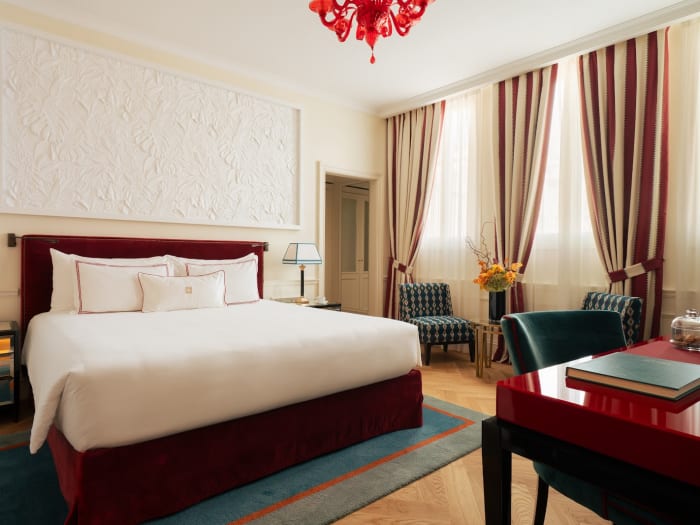
In a hotel of this category, the room is not merely a place to sleep; it becomes the second reading of the property. After the architecture and the public spaces, this is where the true coherence of an address is tested. At Palazzo Ripetta, one naturally expects rooms and suites to extend the promise made on arrival: a dialogue between Roman classicism and contemporary comfort, without decorative excess or impersonal coolness. Today’s traveller seeks not display but rightness, and this is precisely where a city-centre hotel can make the difference.
In this context, comfort is not limited to equipment. It depends first on a sense of balance. A successful room in Rome should allow guests to recover from the city without severing ties with it. That means controlled acoustics, bedding designed for genuine rest, light that can be adjusted throughout the day, and a layout that leaves room for simple gestures: unpacking, reading, working for a while, getting ready for dinner, or simply watching the outside rhythm slow from within.
The style of the rooms and suites logically follows the hotel’s wider identity. One may expect classical references handled with restraint, lines sober enough to avoid stage-set effect, and contemporary elements that bring clarity and function. This combination is especially relevant for an international clientele accustomed to fine hotels yet attentive to what truly distinguishes one address from another.
Suites, in such a setting, take on an added dimension. They are not merely larger; they offer another way of inhabiting Rome, freer and more residential, sometimes better suited to longer stays or trips that combine leisure and work. For couples, they can become a cocoon after days of sightseeing. For business travellers, they allow separate areas for work and rest.
Service naturally completes the in-room experience. Daily housekeeping, turndown service and the constant availability of reception and concierge contribute to a sense of ease. Nothing need be demonstrative here: luxury often lies in the disappearance of friction.
What ultimately gives value to Palazzo Ripetta’s rooms and suites is their likely ability to combine an urban address with genuine rest.
Dining
In high-end hospitality, dining is no longer a mere ancillary service. It fully contributes to a hotel’s identity, its daily rhythm and the way travellers inhabit the place. At Palazzo Ripetta, without resorting to grand declarations, one may expect an approach to dining aligned with the spirit of the house: elegant, attentive, rooted in the pleasure of hosting, and flexible enough to suit both leisure stays and business trips. In Rome, this dimension carries particular weight, as the city’s relationship with food is one of living culture rather than simple display.
The first challenge for a hotel in the heart of the capital is to offer a credible alternative to the abundance outside. Rome’s surroundings naturally teem with cafés, trattorias, historic restaurants and contemporary tables. For guests to choose to remain in the hotel for lunch, dinner or even a drink, more than convenience is required: atmosphere, quality of execution and a certain rightness in service.
Breakfast deserves special attention. It is often the first calm moment before the intensity of Rome. In a refined property, it should combine precision, measured generosity and an unhurried rhythm. Being able to begin the day in a carefully composed setting, with smooth service and no sense of rush, changes the tone of a stay.
The wider culinary offer, whether a restaurant, lounge or spaces for more informal pauses, ideally follows the same logic. In Rome, one particularly values places able to move from one register to another without losing poise: a light lunch between outings, a discreet business meeting, an aperitivo at day’s end, or a more settled dinner when one prefers to avoid the bustle outside.
Here, gastronomy should also be understood as an extension of Roman art de vivre. It is not limited to the plate; it includes the time given to a meal, the quality of conversation, the way light changes through the day, and that distinctly Italian sense that comfort often comes from things done well rather than theatrically.
Even without detailing a specific menu, it is fair to say that at Palazzo Ripetta dining forms an integral part of the expected experience.
Concierge and services
In a heritage city such as Rome, the quality of a stay often depends less on the planned programme than on how details are handled. This is where concierge and services become essential. At Palazzo Ripetta, several known elements already form a solid foundation: 24-hour concierge, 24-hour front desk, daily housekeeping, turndown service, luggage storage, laundry, wake-up service and multilingual staff. Taken separately, these may seem expected in a five-star hotel; brought together in a house with character, they become the tools of a fluid and reassuring experience.
The permanent availability of reception and concierge is especially valuable in Rome. Late arrivals, early departures, changes of plan, last-minute bookings and unforeseen logistical needs are all part of travel. Knowing that a team is present at any hour changes one’s relationship to the stay: guests feel less constrained, freer to improvise and calmer in the face of unpredictability.
Concierge service, particularly in a central property, is not limited to practical requests. It can become a true quality filter. Guiding guests towards a district according to the time of day, recommending a walking route, arranging a transfer, suggesting a visit suited to the traveller’s pace, or simply helping to prioritise Rome’s abundance all belong to a discreet but decisive expertise.
Multilingual staff add to this sense of ease. In an international address, the quality of exchange matters as much as the precision of the answer. Being able to express a request clearly, understand the nuances of a recommendation or settle a practical matter quickly contributes to the overall sense of control.
In-room services complete the picture with quiet efficiency. Daily housekeeping and turndown service remind us that high-level hospitality is also about rhythm. A room maintained regularly, prepared for the evening and ready to welcome one back after a day out changes the quality of rest.
Ultimately, concierge and services here are far more than a functional set of amenities. They form the invisible infrastructure of a successful stay.
The Roman art of living
Choosing a hotel in the heart of Rome is not simply selecting a point on a map; it is deciding on a particular way of living the city. Palazzo Ripetta enables precisely this measured immersion, keeping guests in touch with major historic landmarks while preserving a certain comfort of rhythm. Rome never fully reveals itself in haste. It asks for time, detours, returns and an openness to detail. A well-located and sufficiently calm hotel then becomes a true tool for reading the city.
From a central address, days can be shaped without rigidity. One sets out early to find the streets still quiet, crosses a district on foot, pauses in an almost empty church, reaches a great square as the light begins to animate it, then returns to the hotel before going out again for dinner. This freedom of movement profoundly changes the Roman experience.
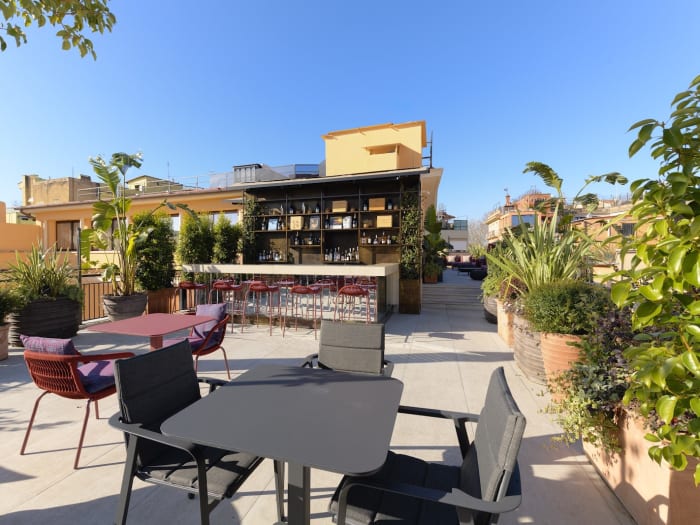
Spring and autumn, often recommended for visiting Rome, further enhance this quality. Temperatures are generally more agreeable, walking is easier, terrace pauses feel more natural, and the city seems to recover a more human scale. In this context, a hotel such as Palazzo Ripetta becomes an ideal base from which to alternate exploration and rest.
Roman art de vivre also lies in how one inhabits the intervals: an unhurried coffee, an evening stroll, a détour into a quieter street, a conversation extended over a meal. These moments matter as much as the visits themselves. They require accommodation able to support this tempo rather than disrupt it.
For couples, this way of staying encourages a more intimate Rome. For business travellers, it offers the possibility of slipping a few hours of real city life between obligations without excessive logistics. For regular visitors, it allows Rome to be rediscovered not as a backdrop but as a city one temporarily inhabits.
Palazzo Ripetta fits this idea of a balanced, cultivated Roman stay without overstatement.
Book with MyConciergeHotel
Booking Palazzo Ripetta through MyConciergeHotel means approaching the stay not as a simple transaction, but as a carefully prepared experience. For a five-star address in the heart of Rome, that difference matters. The city attracts an international clientele throughout the year, and the most sought-after periods — especially spring and autumn — often require advance planning.
The value of editorial and concierge guidance lies in its ability to turn a reservation into an informed choice. A hotel such as Palazzo Ripetta cannot be reduced to its rating or address. Its Relais & Châteaux membership, classical architecture with contemporary touches, elegant atmosphere and easy access to major historic sites create a precise profile. The question is whether that profile matches the way one wishes to experience Rome.
This approach is especially useful in a city where the luxury offer is abundant yet highly varied. Not every fine Roman address proposes the same relationship with the city. Some focus on monumentality, others on privacy, others still on gastronomy or a markedly contemporary register. Palazzo Ripetta is better suited to those seeking urban elegance, a central base and a house able to reconcile heritage, comfort and personalised service.
MyConciergeHotel also brings practical value to the organisation of a stay. For a short break, every detail matters: arrival and departure times, luggage handling, sightseeing rhythm, and specific needs linked to business travel or a couple’s trip. In a property with 24-hour concierge and reception, daily housekeeping and turndown service, it makes sense to think of the stay as a whole rather than as a mere room booking.
Booking early remains particularly wise for this address. Rome experiences regular peaks in demand, and well-located character hotels are naturally sought after. Planning ahead generally allows for a better choice of dates, room category and overall travel rhythm.
In short, booking Palazzo Ripetta through MyConciergeHotel means favouring a qualitative reading of the stay.