History & heritage
Staying at Mandarin Oriental, Macau means entering a distinctly contemporary vision of Asian hospitality, where luxury is measured less by display than by precision, ease and the quality of time spent in residence. The hotel belongs to the Mandarin Oriental world, long associated with polished urban addresses designed as sanctuaries within dynamic cities. In Macau, that philosophy takes on particular meaning. The city itself is defined by layers: Chinese and Portuguese influences, historic quarters, temples, civic squares, modern towers and major hospitality landmarks. Within that setting, Mandarin Oriental reads not as a theatrical statement but as a point of balance.
Its heritage is not that of a historic palace in the European sense, but of a leading international hotel tradition that understands how to converse with the city around it. Here, the experience is shaped by a refined interpretation of Macau: a destination of contrasts, movement, business appointments, cultural discoveries and short yet memorable leisure stays. The hotel responds to that variety with a composed, urban and quietly sophisticated language. One finds what has long defined the brand: an elegant atmosphere without stiffness, a strong sense of calm and order, and a service culture in which anticipation matters as much as availability.
For European travellers in particular, the appeal of the address also lies in its ability to provide clarity in a city whose energy can be intense. Macau is rarely still; it is best discovered in sequences, between heritage sites, broad avenues, entertainment districts and waterfront perspectives. In that context, Mandarin Oriental acts as a reassuring base. It allows guests to experience the destination fully while returning to a setting that feels measured, polished and reassuringly well run.
Its heritage is therefore best understood through continuity of style: urban luxury, international in its codes yet attentive to local context, suited to couples and families alike, and equally relevant for business travellers and guests drawn by Macau’s cultural and historic dimensions. More than a story of architecture alone, it expresses a culture of hospitality defined by consistency, restraint and a highly controlled sense of detail.
The hotel
One of the principal strengths of Mandarin Oriental, Macau lies in its central urban address, which places guests in direct contact with the city without creating a sense of disorientation. In a destination where landmarks can quickly multiply between historic quarters, contemporary complexes and busy traffic corridors, having a clear point of return changes the quality of a stay. The hotel makes it easy to shape the day with flexibility: a morning devoted to cultural sites, lunch in town, a quieter afternoon back at the hotel, then an evening out. In Macau, where one can move between very different worlds in a short time, that rhythm matters.
Its proximity to the city’s main attractions is a practical advantage. For first-time visitors, it simplifies discovery: historic sites, emblematic squares and places that reveal Macau’s layered identity are easier to reach. For returning guests, it allows for a more personal tempo, whether revisiting a neighbourhood, planning appointments or building pauses into the day. The hotel therefore answers two expectations that are not always easy to reconcile: being close to the action while preserving a genuine sense of retreat.
Aesthetically, the property favours an elegant, sophisticated atmosphere. This is expressed less through theatrical effect than through overall coherence. Public spaces are designed to create a feeling of control and calm: clean lines, subdued surroundings, smooth circulation and attentive welcome. In an address of this kind, luxury is felt in the way spaces support the guest rather than in decorative excess. After a day spent in Macau’s visual intensity, that restraint becomes a real comfort.
The hotel suits both couples and families, which is significant in an urban setting. Couples will appreciate a refined city break base, with the ability to alternate between sightseeing, downtime and dinner plans without complicated logistics. Families tend to value the clarity of service, the round-the-clock reception and concierge presence, and the ease of access to key points of interest. This versatility is central to the property’s identity: a high-end hotel, certainly, but one designed for contemporary, varied and practical use.
Rooms and suites
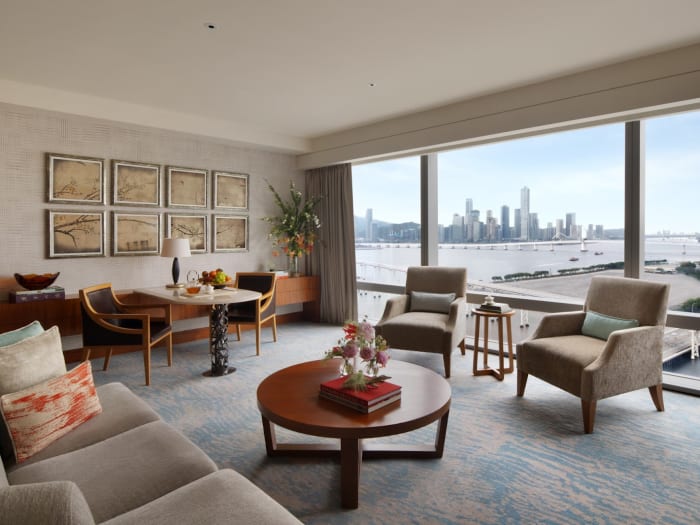
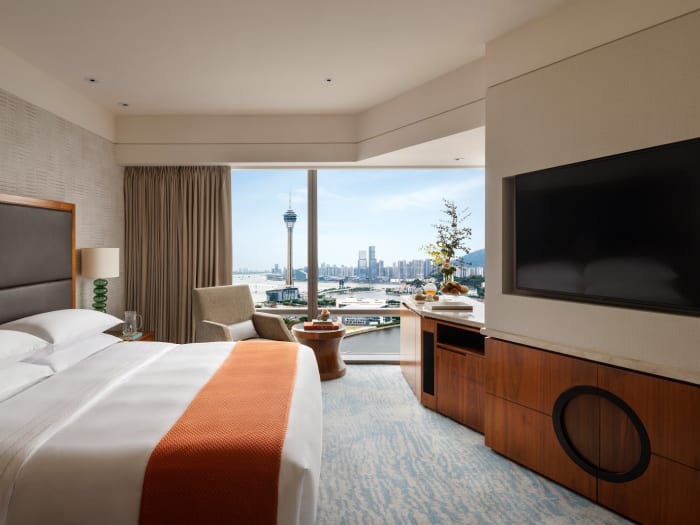
In an urban hotel of this level, the room is never merely a place to sleep; it becomes a transition space between the city and the self. At Mandarin Oriental, Macau, that role is especially important. Macau is dense, visual and energetic. Returning to one’s room should therefore create an immediate sense of release. This is often where the quality of a great hotel is truly felt: in the ability of the private space to absorb the intensity of the outside world without breaking the momentum of travel.
The spirit here is one of high-end comfort that feels both contemporary and calming. Guests are not looking for eccentricity, but for rooms remembered for their balance and ease. The best urban hotel rooms support several uses at once: resting, reading, working briefly, getting ready for dinner, enjoying a quiet breakfast or simply looking out over the city before heading out again. That discreet versatility is central to the experience. It suits travellers balancing appointments, sightseeing and downtime, as well as couples seeking privacy within an active stay.
Suites extend this logic with greater ease and flexibility. They allow the day to be divided more naturally, create a more residential rhythm and offer additional comfort for families or longer stays. In a city such as Macau, where one may move quickly between cultural plans, social engagements and business moments, extra space can meaningfully change the experience. One is no longer simply returning to a hotel room, but to a personal setting shaped by the standards of an international luxury address.
Turndown service, daily housekeeping and the constant availability of staff all contribute to this sense of continuity. In luxury hospitality, such details are not incidental. They structure the stay, especially when days are full or when travelling with children. A room that is consistently well kept and reset each evening becomes an essential part of overall wellbeing.
Dining
In Macau, dining can never be treated as an afterthought. The city has a layered culinary culture shaped by southern Chinese traditions, Portuguese influence and contemporary cosmopolitanism. In that context, staying in a major hotel inevitably raises a question of rhythm: should every meal be taken out in the city, or should some be enjoyed within the calmer setting of the hotel itself? Mandarin Oriental, Macau answers this by valuing the quality of the experience as much as convenience. Even for guests who plan to dine out in the evening, knowing that the hotel can provide a polished setting for breakfast, a measured lunch, afternoon tea or a late drink changes the way a stay unfolds.
In a hotel of this standing, dining is not simply about names or signatures; it is about coherence between place, service and moment. In the morning, a well-run hotel should allow the day to begin gently, with attentive service and a calm enough atmosphere to prepare for what lies ahead. At lunchtime, it may become a practical refuge between appointments or visits. In the evening, it offers a welcome alternative to the city’s intensity. This ability to accompany different dining needs is often more valuable to travellers than spectacle alone.
Macau naturally encourages culinary curiosity. Guests often want to explore, compare and move between local addresses and more international settings. The strength of a hotel such as Mandarin Oriental lies precisely in not confining the stay to a single dining narrative. It provides an elegant base from which to organise those discoveries, with concierge guidance that can help shape reservations according to mood, cuisine, pace or occasion.
Spa & wellness
Perhaps the most useful advice for a stay at Mandarin Oriental, Macau is to reserve a spa experience as soon as you arrive. Not because wellness should be treated as an obligatory luxury ritual, but because in Macau relaxation works best as a counterpoint to the city itself. The urban energy, the density of plans and the constant stimulation of the senses make spaces of calm especially valuable. Within the Mandarin Oriental universe, wellness has long held an important place: not simply as an added facility, but as an experience of re-centring, quiet and careful attention to the body.
In a major urban hotel, the spa is often where one truly changes pace. Guests come to recover from travel, ease jet lag, pause between visits or simply reclaim a little time for themselves. That role is particularly relevant in Macau, a destination often experienced intensely even over a short stay. A well-chosen treatment can alter the quality of the entire trip: improving sleep, restoring energy, preparing for an evening out or helping the day end more gently.
Seasoned travellers know that the quality of a spa is often determined by almost invisible elements: the welcome, the transition between spaces, the sound level, the precision of the ritual and the feeling of being cared for without intrusion. That grammar of treatment matters as much as the menu itself. One expects here a refined, personalised approach capable of responding to different needs, from post-flight recovery and relaxation massage to a couple’s pause or a decompression moment after meetings.
Concierge & services
In luxury hospitality, services matter not simply because they exist, but because of the way they make a stay easier, smoother and more pleasant. Mandarin Oriental, Macau offers the essentials that shape this promise day after day: 24-hour concierge, 24-hour front desk, daily housekeeping, turndown service, luggage storage, laundry, wake-up service and multilingual staff. Taken separately, each may seem expected in a five-star hotel. Taken together, and above all when well delivered, they create the underlying comfort guests truly remember.
A round-the-clock concierge is particularly valuable in a city such as Macau. It helps with transport, restaurant reservations, cultural suggestions, itinerary planning and last-minute requests. For first-time visitors, that guidance is invaluable; for returning guests, it becomes a tool of precision. The quality of a good concierge often lies in exactly that balance: being useful without being intrusive.
A 24-hour front desk provides another form of quiet reassurance. Late arrivals, early departures, changes of plan and occasional assistance are all common in an international destination. Knowing that support is available at any hour changes the relationship to time and reduces logistical friction, especially for long-haul travellers, families and business guests.
Daily housekeeping and turndown service belong to a more intimate register. They contribute to the sense of continuous care that distinguishes a fine hotel. A room reset with consistency and discretion becomes part of the guest’s overall wellbeing. Laundry, often underestimated, is especially practical on longer stays or mixed business and leisure trips, while luggage storage adds welcome flexibility on arrival and departure days.
The art of living in Macau
Macau is not experienced quite like any other Asian destination. Its way of life is shaped by coexistence: Iberian heritage, Chinese depth, urban modernity, swift movement and a taste for more contemplative pauses. To understand it properly, one must accept that plurality rather than search for a single image. A day may begin in a historic quarter, continue across civic squares with Mediterranean echoes, pause before an old religious façade and end in a decisively contemporary urban landscape. It is this succession of worlds, often geographically close yet atmospherically distinct, that gives the city its particular charm.
From Mandarin Oriental, Macau, that diversity becomes relatively easy to approach. The location allows guests to shape a stay according to their priorities, whether cultural discovery, shopping, business appointments or a combination of all three. First-time visitors are often wise to devote time to the cultural and historic sites that explain Macau’s identity. Returning guests may instead prefer a more intuitive reading of the city: slower walks, more attention to transitions, urban details, street rhythms and architectural contrasts.
The local art of living also lies in how one composes the day. Macau lends itself to a rhythm of short but vivid sequences: visit, pause, move on, return. It is precisely for this reason that a well-located, well-run hotel changes the experience. It allows guests to stop and reset without losing momentum. Luxury here is not about withdrawing from the city, but about moving in and out of it with ease.
Book with MyConciergeHotel
Booking Mandarin Oriental, Macau through MyConciergeHotel means approaching the property not simply as a room to confirm, but as a stay to shape thoughtfully. In a destination as dense as Macau, the quality of the experience often depends on decisions made in advance: the right length of stay, the most suitable room category, the balance between visits and rest, whether to schedule a spa treatment early, and how to navigate periods of heavier demand. Editorial and concierge guidance is especially valuable here because it turns a standard reservation into a stay that feels genuinely tailored.
The benefit of a specialist intermediary lies first in understanding the traveller’s needs. A couple on a city break will not have the same priorities as a family or a business guest extending a work trip. Some will value centrality and logistical ease; others will focus on calm, wellness or cultural access. Booking well therefore means asking the right questions before choosing.
MyConciergeHotel can also add value in the sequencing of the trip. In Macau, a few well-used hours can change the entire experience. An early arrival, a late departure, luggage storage, a spa booking, a restaurant reservation or a refined cultural itinerary may each seem minor in isolation, yet together they determine how smooth the stay feels. The aim is not to over-programme, but to create space, reduce friction and leave room for the unexpected.