History & heritage
Mandarin Oriental, Costa Navarino in Pylos belongs to a broader story than that of a simple seaside resort. Here, the stay unfolds in a part of the south-western Peloponnese where the Ionian Sea, olive-covered hills and the long memory of Messenia create an ancient, deeply rooted setting. Pylos suggests both a harbour open to the sea and an agricultural land shaped over centuries. The decision to establish a Mandarin Oriental address here is therefore meaningful: the brand brings its refined service culture to a destination whose own identity remains central.
The hotel’s heritage lies first in this meeting between an international hospitality house known for discretion and a place defined by space, light and a close relationship with the landscape. Rather than creating a sealed-off world, the property sits within a region of real cultural depth. Pylos is associated with important historical sites, stone-built villages, long-standing agricultural traditions and a tangible connection to the sea. This gives the stay a particular tone: guests come not only for a coastal escape, but for a more grounded Mediterranean experience.
The identity of Mandarin Oriental, Costa Navarino rests on balance. The brand’s hallmarks are present—attentive service, a calm atmosphere, careful detailing and a sense of ease—yet the property appears designed to let the Ionian coast speak for itself. Its architecture, inspired by the natural surroundings, follows this logic. It does not compete with the site; it works with its lines, colours and light.
In that sense, the hotel’s heritage is less about a historic building than about a contemporary way of inhabiting an ancient landscape. Luxury takes a restrained form, almost quiet, where the experience depends on the quality of the setting, the precision of service and the feeling of space. This also places the address within a more current vision of high-end travel: less demonstrative, more context-aware, and more coherent in the relationship between place, architecture and lifestyle.
To stay here is to enter several stories at once: that of a major hospitality house extending its savoir-faire without erasing the destination; that of a Greek coastline whose beauty lies as much in geography as in memory; and that of a way of travelling in which modern comfort serves something more essential—watching the sea, feeling the wind on the hills, rediscovering a slower rhythm, and realising that true privilege often lies in simplicity perfectly orchestrated.
The property
The first impression of Mandarin Oriental, Costa Navarino comes from the way it occupies the landscape without disturbing it. On the Ionian coast near Pylos, the property unfolds within a setting where topography, vegetation and light naturally take precedence. Nothing feels imposed. The architecture, inspired by the surrounding nature, expresses itself through a contemporary language of low lines, mineral tones and a constant relationship with the outdoors. The eye moves freely, the horizon remains present, and the whole creates the feeling of a place designed to breathe.
This measured integration into the site immediately changes one’s perception of luxury. Rather than relying on spectacle, the hotel offers a quieter form of sophistication. The shared spaces, conceived with wellbeing in mind, are central to that sensation. They are not simply attractive or comfortable; they shape the way the stay is lived. Circulation feels fluid, volumes are open without being cold, and each area seems designed to create gentle transitions between private retreat, social moments and contemplation.
The calm Mandarin Oriental atmosphere is expressed precisely through this control of rhythm. The hotel does not impose constant activity; instead, it provides a framework in which each guest can find their own pace. Some will see it as an elegant seaside refuge, others as a comfortable base from which to explore Pylos and Messenia, and others still as a restorative retreat centred on silence, light and service. This versatility is one of the property’s strengths.
The relationship with the Ionian Sea naturally shapes the experience. The coastline here does not have the urban or overtly fashionable character of certain Mediterranean destinations. Instead, it offers a sense of openness, clear light and a horizon that encourages slowing down. Summer is especially sought after thanks to access to beaches and water-based activities, yet the appeal of the place extends beyond swimming. Simply inhabiting such an open landscape for a few days, between sea and relief, already transforms the stay.
In practical terms, the property appears designed to meet contemporary expectations of high-end travel: modern comfort, service available around the clock, discretion, and the ability to simplify the guest experience without making it generic. This is where the Mandarin Oriental signature becomes meaningful. It is expressed not through excess, but through quality of execution. The result is a convincing synthesis of destination, architecture and hospitality: a hotel that does not seek to distract from the landscape, but to offer the best possible conditions in which to inhabit it.
Rooms and suites
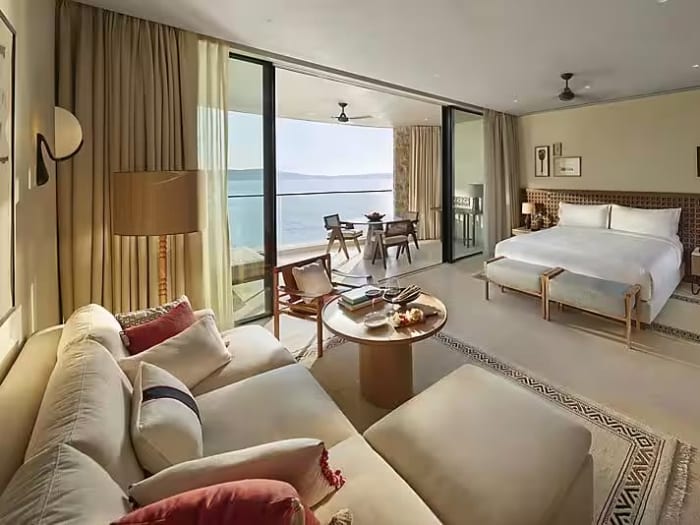
At a property such as Mandarin Oriental, Costa Navarino, the room is not merely a place to return to between activities; it is one of the true centres of gravity of the stay. In Pylos, where the light changes throughout the day and the landscape is integral to the experience, accommodation must function at once as a refuge, a viewpoint and a place of recovery. While the full typology of categories is not detailed here, the overall logic is clear: rooms and suites conceived to extend the hotel’s calm atmosphere, with particular attention paid to flow, the relationship with the outdoors and everyday comfort.
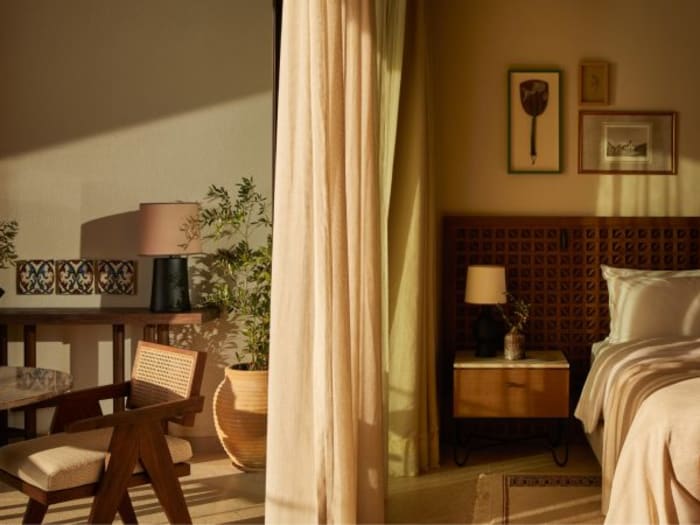
The brand’s signature is usually expressed through a very controlled sense of restraint. Interiors favour elegance without excess, where materials, tones and light matter more than decorative effect. In the context of Costa Navarino, this approach is especially apt. Architecture inspired by the natural surroundings calls for interiors that converse with the landscape rather than shut it out. One therefore expects rooms designed as extensions of the site itself: open, serene, restorative, yet sufficiently structured to meet the demands of contemporary high-end travel.
Comfort often depends on elements that may seem ordinary but become decisive when perfectly executed: high-quality bedding, effective sound insulation, well-integrated storage, bathrooms designed for real use, and intuitive movement between different parts of the room. Service is equally central. Daily housekeeping, turndown service and the constant availability of the teams all contribute to the sense of ease that distinguishes the best addresses. Nothing feels complicated; the stay unfolds naturally.
For couples, the room readily becomes a cocoon oriented towards the sea or the landscape. For families, it must also answer practical needs: organisation, flexibility, a sense of space and the ability to preserve privacy. For business travellers or guests combining work and leisure, the quality of the interior environment takes on yet another role: it must allow focus and withdrawal, then immediately support relaxation. This versatility is precisely where top-tier hotels set themselves apart.
What ultimately stands out in a property of this kind is the coherence between the room and the rest of the hotel. One does not move from carefully considered public spaces into generic accommodation. On the contrary, the room extends the general promise of the place: calm, precision and a harmonious relationship with the environment. After a day spent between the beach, regional exploration or a wellbeing interlude, one returns to a form of organised quiet. And that is often where the success of a stay is truly measured: in the ability to make the room a place where one does not simply sleep, but genuinely inhabits the journey.
Dining
In a resort of this calibre, dining is not simply a matter of adding restaurants and bars; it forms part of the way the place is understood. At Mandarin Oriental, Costa Navarino, one can reasonably expect a culinary offering conceived as an extension of the Ionian landscape and of the rhythm of the stay. Without naming unconfirmed venues, chefs or concepts, the essential point lies elsewhere: in the way meal times are staged, in the likely quality of produce, and in the ability—typical of great hospitality houses—to make breakfast, a light lunch or a more elaborate dinner feel distinct yet coherent.
The Greek context is decisive here. The Pylos region belongs to a territory where olive oil, aromatic herbs, sun-ripened vegetables, fish and seafood naturally occupy an important place in the culinary imagination. In a high-end setting, that Mediterranean foundation gains precision: accurate cooking, clean seasoning, respect for the season and close attention to freshness. In dining, luxury does not necessarily lie in complication. It often appears in the clarity of flavours, the quality of sourcing and the correctness of service.
Breakfast deserves particular mention because it sets the tone for the day. In a setting such as this, one readily imagines a gradual awakening, morning light over the Ionian coast, attentive yet unobtrusive service, and a selection allowing each guest to establish their own rhythm. This first meal is often one of the most consistent pleasures of a great hotel precisely because it combines apparent simplicity with flawless execution.
At lunchtime, the proximity of the sea calls for more flexible meals suited to a day of swimming, walking or rest. In the evening, dining regains a more ceremonial dimension without necessarily becoming formal. This is where the art of hospitality matters: creating atmosphere, setting the pace of service, offering a menu that is reassuringly clear yet sufficiently inspired to encourage lingering. At a Mandarin Oriental address, one expects that discreet precision which makes dinner feel effortless.
Dining also contributes to the wider sense of wellbeing. Eating with an open view, taking time over a coffee on a terrace, sharing a meal after a day in the sun or choosing something lighter after time at the spa: these gestures shape the experience without needing to be theatrical. At Costa Navarino, the table should accompany the destination rather than overshadow it. It should reflect the light, the season, the nearby sea and that particular Mediterranean idea in which pleasure begins with the quality of simple things, served carefully and at the right pace.
Spa & wellbeing
Wellbeing occupies a central place in the promise of Mandarin Oriental, Costa Navarino, and this is already suggested by the shared spaces designed to encourage serenity. In a destination such as Pylos, where the sea, the wind and the light already provide a form of natural restoration, the spa does not need to exist as a world apart from the rest of the hotel. It can instead extend what the site itself already offers: a slowing of pace, a better quality of attention, and a more conscious relationship with body and time. This is likely where the relevance of a Mandarin Oriental approach lies, a house long associated with a precise, discreet culture of care.
Without detailing unconfirmed facilities, one can still define the expected spirit of such a space. The spa in a hotel of this level should offer more than a treatment menu. It should create the conditions for decompression: silence, controlled light, calm circulation, attentive welcome and the feeling that each stage of the journey has been designed to reduce everyday friction. Luxury here is measured as much by atmosphere as by treatment protocols. A successful treatment often begins before the first gesture, in the way one is received, guided, settled and reassured.
The Ionian setting naturally reinforces this dimension. After a morning in the sun, a coastal walk or a more active day, returning to a wellbeing space takes on particular meaning. The body, already engaged by heat, movement or swimming, responds differently to treatments, rest and recovery rituals. In this context, travellers often seek less performance than balance: releasing tension, improving sleep, regaining energy or simply creating time for themselves within a stay that might otherwise be full of activity.
The value of a great spa also lies in its ability to adapt to different guest profiles. Some prioritise massages and facials, while others mainly seek a calm environment in which to extend the effects of a session, read, breathe or refocus. Couples find a shared moment that is quieter than social; solo travellers find a place of recentring; families, at times, find a welcome pause in the rhythm of a holiday. In every case, wellbeing is not limited to a single treatment. It becomes a way of inhabiting the hotel.
At Mandarin Oriental, Costa Navarino, this logic feels especially relevant because the property as a whole already values a calm atmosphere. The spa therefore does not correct an overly animated environment; it becomes its natural culmination. One finds what is sought in the best addresses of this kind: not a display of therapeutic luxury, but a quality of presence. A place where one immediately feels slower, more available and more attentive to oneself. In the setting of a stay on the Ionian coast, that return to essentials takes on particular depth.
Concierge & Services
In high-end hospitality, services find their meaning in the way they simplify the stay. At the Mandarin Oriental, Costa Navarino, this principle appears to be central. With a 24-hour concierge, 24-hour reception, daily housekeeping, turn-down service, luggage storage, laundry, wake-up calls, and multilingual staff, the establishment is designed where the continuity of attention is as important as comfort. True luxury often lies in making each step more seamless.
The concierge plays an essential role here. In Pylos, where the stay can blend beach relaxation, local exploration, and pre-booked activities, having a contact who can organise and adjust plans transforms the quality of the journey. Booking certain activities in advance, especially during peak season, allows for a more serene enjoyment of the destination. For international travellers, the presence of multilingual staff enhances this immediate ease.
The continuously open reception meets another demand of contemporary luxury: flexibility. Late arrivals, early departures, changes in plans, or last-minute requests do not become sources of friction. A high-end hotel is recognised by its ability to absorb these variations without creating a sense of effort.
Daily housekeeping and turn-down service deserve mention. They contribute to the feeling of being anticipated and cared for. Returning to a tidied room, finding an atmosphere prepared for relaxation in the evening, and noticing that practical details have been attended to: these elements profoundly influence the perceived quality of the stay. Laundry services, luggage storage, and wake-up calls follow the same logic.
In a hotel like this, services should never be intrusive. Their success lies in their discretion. They are available and precise without taking centre stage. This restraint aligns with the soothing atmosphere of the establishment, allowing travellers to feel both cared for and free.
At Costa Navarino, this service infrastructure forms the invisible framework of the stay. It supports the comfort of the rooms, the serenity of the common areas, and the possibility of enjoying either very active or almost still days. What is often remembered is the impression that everything has been thoughtfully arranged for the journey to unfold with a rare sense of ease.
The Pylos art of living
Staying at Mandarin Oriental, Costa Navarino also means discovering a particular idea of Pylos and, more broadly, of the south-western Peloponnese. The local art of living cannot be reduced to a postcard of turquoise sea and summer sun, even if those elements obviously matter. It is better understood as a balanced relationship between landscape, time and daily habits. Here, the Ionian coast offers space before spectacle. Days are organised around light, heat, measured movement, unhurried meals and the feeling that the sea is never far away, even when one moves inland towards hills or villages.
Pylos holds a distinctive place in the Greek imagination. It is a place of passage, memory and maritime openness, but also a small town and a wider territory that retain a human scale. For travellers, that changes everything. One is not in a seaside resort saturated with tourist signs; one enters a region with its own life. Olive groves, winding roads, stone houses, harbours, shaded squares and sea views create a daily environment that does not try too hard to charm. That is precisely what makes it compelling.
The art of living in Pylos also passes through the region’s produce. Even without listing everything, one naturally thinks of olive oil, seafood, herbs, fruit and that Mediterranean cooking which values accurate simplicity. During a hotel stay, this local culture is felt as much on the plate as in the rhythm of meals, in the importance of terraces, and in the pleasure of lingering at the end of the day when the heat softens and the light becomes gentler. Luxury here often lies in tuning oneself to that cadence rather than trying to alter it.
The region also invites gentle exploration. A day may alternate between swimming, rest, the discovery of a historical site or village, and a return to the hotel to recover comfort and serenity. This alternation is one of the great strengths of a stay at Costa Navarino: one can experience the destination without giving up refuge. The journey is not divided between outside and inside; it moves between the two. The landscape nourishes the hotel, and the hotel allows the landscape to be appreciated more fully.
For couples, Pylos provides a setting suited to contemplative stays made of walks, late dinners and long mornings open to the sea. For families, the destination combines nature, space and summer activities. For travellers more interested in culture, it offers an entry point into a Greece that feels less obvious, less urban and more grounded. In every case, the experience depends on a quality of presence.
That is perhaps what a stay at Mandarin Oriental, Costa Navarino reveals best: the possibility of inhabiting Greece differently, in a version that is calmer, broader and more nuanced. Pylos imposes nothing. It is approached through morning light, the blue of the Ionian Sea, the slowness of lunch and the scent of sun-warmed hills. When the hotel succeeds in translating that gentleness into hospitality, the journey acquires a lasting dimension, well beyond the simple memory of a holiday.