Overview
Here, a rare hotel operation is chosen in Tokyo: 909 keys, yet a straightforward approach to the stay. The Main Building houses 560 rooms, while the Tower Building contains 349. This volume might dilute the experience; however, it does quite the opposite when well-organised. Check-in is at 2:00 PM, check-out at 12:00 PM, with 24-hour room service and a reliable concierge. This is what a seasoned traveller expects for a seamless Tokyo experience, rather than an overly narrative decor. On the dining front, the establishment offers a useful cultural hint. THE IMPERIAL VIKING SAL claims to be Japan's first 'viking' buffet. This term holds significant weight in the Japanese hotel scene, almost serving as a marker of an era in dining practices. If you prefer more straightforward references, PARKSIDE DINER lists three classics in black and white: Imperial Pancake, American Clubhouse Sandwich, and Vegetable Curry. And when a hotel of this size also documents four wellness areas, featuring an indoor pool, fitness centre, thermal baths, and treatment rooms, I pay less attention to the rhetoric and more to the rhythm.
History & Heritage
In Tokyo, the Imperial Hotel holds a unique place in Japan's modern history. Opened in 1890, it was established under the vision of Eiichi Shibusawa.
From the outset, the hotel was conceived as the country's first state guesthouse in Western style. This purpose grants it both a ceremonial and cultural role.
Thus, the hotel accompanies a decisive moment in Japan's opening to the world. Its location becomes a meeting point between national traditions and international hospitality standards.
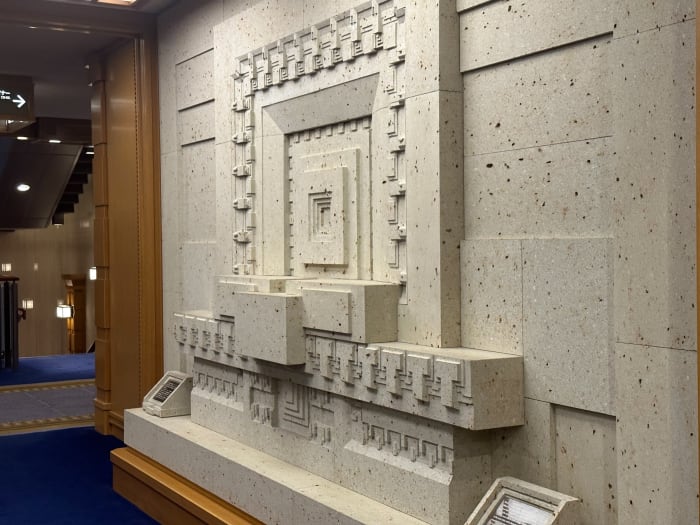
In 1923, the Imperial Hotel was rebuilt according to a design by Frank Lloyd Wright. This new architecture then affirmed its status as a symbol of modern Japan.
Wright's influence remains central in the memory of the place. This year marks the centenary of his building, a significant milestone in the hotel's history as well as that of Tokyo.
The legacy of the Imperial Hotel lies in this rare continuity. Born as a state institution and later reinvented by one of architecture's great names, it embodies a certain vision of Japanese modernity.
Architecture & Design
Upon its opening in 1890, the Imperial Hotel Tokyo occupied a unique position in the capital. It became the first state guesthouse in Western style in Japan.
This origin informs its architectural language. The neo-Renaissance style places the building within a readable compositional grammar, inherited from the grand European codes. The ensemble asserts an idea of representation, measure, and display, without breaking from the solemnity expected of an official address.
In 1923, the reconstruction entrusted to Frank Lloyd Wright marked a decisive turning point. His intervention was not merely a facelift; it redefined the hotel's image and anchored it in a modernity that was then fully asserting itself.
This dialogue between Western heritage and Japanese ambition gives the Imperial Hotel a significance that transcends mere hospitality. The architecture becomes a public sign, accompanying the country's entry into a new way of presenting itself to the world.
Thus, the Imperial Hotel Tokyo is not only to be read as a grand historic hotel. It also stands as an architectural landmark, where the 1923 reconstruction has permanently established its status as a symbol of modern Japan.
The In-House Experience
The in-house experience is primarily reflected in the scale of the inventory. The official site announces 909 keys. The Main Building comprises 560, while the Tower Building adds another 349.
The details of the accommodations remain understated. No surface area is provided. There is no distinction between rooms and suites beyond the total of 909 units. No signature category names are confirmed.
Check-in is at 2:00 PM, and check-out is at 12:00 PM.
Dining
The dining options are better documented than the history or architecture. The Imperial Lounge Aqua serves as a bar and lounge space. It is the hotel's buffet restaurant, touted as Japan's first viking buffet. PARKSIDE DINER offers American cuisine, with three classics highlighted: the Imperial Pancake, American Clubhouse Sandwich, and Vegetable Curry. For Japanese cuisine, SAN APPLAUSE is presented as a Japanese restaurant operated by Nadaman. Lastly, NAKATA showcases a balance between carefully selected sushi toppings and a Tokyo-style twist.
Wellness & Spa
The wellness floor is organised into four distinct areas.
It includes an indoor pool, a fitness area, thermal baths, and spa treatment rooms.
Service & Team
Services include parking, concierge, 24-hour room service, and airport transfers at an additional charge.
Arrival is at 2:00 PM, and departure is at 12:00 PM.
Practical Information
- **Address**: Tokyo, JP - **Rating**: 5 stars; Palace - **Capacity**: 909 keys in total - **Distribution**: 560 rooms in the Main Building; 349 in the Tower Building - **Wellness**: indoor pool; fitness; thermal baths; spa treatment rooms - **Confirmed Services**: concierge; parking; 24-hour room service; airport transfer at an additional cost - **Timings**: check-in 2:00 PM; check-out 12:00 PM
Our Verdict
The establishment features 909 keys, a concierge, 24-hour room service, airport transfers for an additional fee, and wellness facilities across four zones. However, the history, architecture, and immediate surroundings still require further consideration before a more comprehensive recommendation can be made.