History & heritage in the heart of the Alpilles
In Saint-Rémy-de-Provence, some addresses seem less imposed upon the landscape than naturally absorbed by it. Hôtel Château des Alpilles belongs to that rare category of properties whose presence feels almost organic, in dialogue with trees, light and the unhurried rhythm of the Alpilles. Beneath centuries-old plane trees, arrival carries a distinctly Provençal sense of transition, from the outside world into an estate where time appears to move differently.
The very name, Château des Alpilles, anchors the hotel in a powerful local geography. Here, the word ‘château’ suggests more than architecture alone; it evokes a way of inhabiting Provence, shaped by shade, stone, gardens and long views over a cultivated yet living landscape. In Saint-Rémy-de-Provence, where local history is read as much in lanes and townhouses as in mas and country estates, the property belongs to a broader regional continuity: an elegant, cultivated Provence deeply attached to both landscape and hospitality.
This relationship to place matters greatly for travellers wondering what might be the most beautiful hotel in the Alpilles. The answer is always subjective. Some value views, others architecture, others still the restaurant or the sense of calm. Château des Alpilles stands apart less through display than through coherence: a clear rootedness in Saint-Rémy, the atmosphere of a Provençal house of character, and a way of expressing the Alpilles without reducing them to cliché. That is often what lingers after a stay: not a staged setting, but a feeling of rightness.
The immediate surroundings reinforce this sense of heritage. Saint-Rémy-de-Provence is one of the most desirable gateways to the Alpilles, not only for its charm but for its proximity to a countryside shaped by olive groves, cypresses, pale paths and limestone ridges. To stay here is to settle into a Provence that needs no embellishment. The estate acts as a calm threshold, sheltering guests from the pace of the village while remaining closely connected to its cultural life.
The Palace distinction awarded by Atout France adds an important institutional dimension. In French hospitality, it reflects more than comfort alone; it recognises personality, quality of experience and a property’s ability to embody a destination. At Château des Alpilles, that recognition feels especially apt because the hotel’s appeal rests precisely on the alliance of character, discretion and rootedness.
The result is an address for travellers seeking more than a base in Saint-Rémy-de-Provence. It offers a way into the Alpilles through a property that belongs to its setting, balancing vegetal heritage, southern softness and measured refinement.
The setting: a château in Saint-Rémy-de-Provence, between village and nature
Some hotels shape an entire stay simply through their address. Château des Alpilles is one of them, because it allows guests to experience Saint-Rémy-de-Provence according to a particularly desirable balance: close enough to reach the village, its squares, galleries and terraces, yet sufficiently set back to restore a sense of quiet and space the moment one passes through the gates. For travellers seeking a château in Saint-Rémy-de-Provence without giving up the ease of a contemporary stay, this setting is one of the property’s defining strengths.
The estate sits within the natural landscape of the Alpilles with a restraint that makes it all the more persuasive. Nothing feels contrived. The centuries-old plane trees establish the scale of the place and immediately create a relationship with season, shade and the light breeze moving through the leaves. Provence is expressed here less through decorative signals than through tangible sensations: filtered light, abundant greenery, the breathing space of a park, and the nearness of countryside that seems to begin at the hotel’s threshold.
This location will appeal equally to guests in search of rest and to those wishing to explore the region. Saint-Rémy-de-Provence remains one of the most attractive bases for discovering the Alpilles, from villages and olive-lined roads to markets, studios and landscapes long associated with artists’ eyes. The question of the prettiest village in the Alpilles often arises when planning a route through the area. It invites many answers, as each village has its own tone. What Château des Alpilles offers is precisely the freedom not to decide too quickly: guests can roam, compare, return, and then come back in the evening to a setting that is neither urban nor remote, but delicately poised between the two.
The hotel is also well placed for the Valetudo Art Centre, whose contemporary art-therapy focus adds an unusual cultural layer to a stay. Its presence is a reminder that Saint-Rémy is not limited to postcard imagery. The town and its surroundings can also host more discreet, thoughtful and creative encounters.
For those curious about the most beautiful châteaux in Saint-Rémy-de-Provence, the appeal of Château des Alpilles lies precisely in its lived quality. It is not approached as a detached monument, but understood through use: along a drive, in a garden, on a terrace, through discreet service, or when returning at the end of the day after time spent in the Alpilles. It is a château best discovered by staying in it.
Rooms and suites: calm as the truest luxury
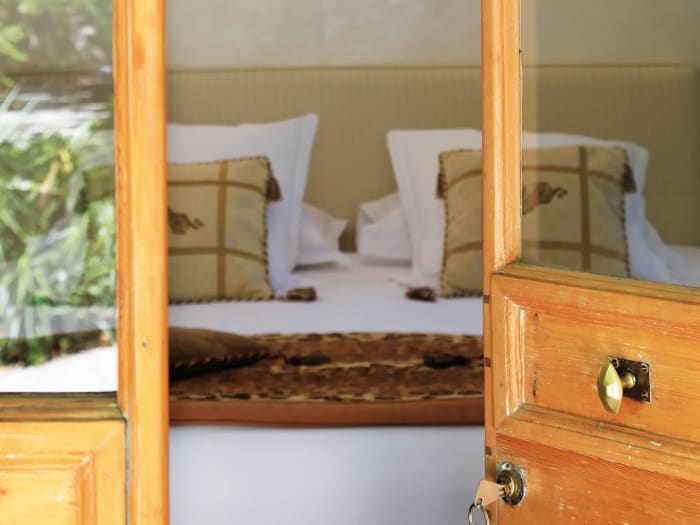
In a characterful house in Saint-Rémy-de-Provence, a room is never merely functional. It must extend the spirit of the estate, provide genuine retreat, and admit just enough of the surrounding landscape. At Château des Alpilles, the expectation is of a stay where privacy matters as much as setting. Luxury here is measured first by the quality of quiet, by the sense of being sheltered from agitation, and by that particular ability some places have to dissolve tension within the first few hours.
The overall setting suggests rooms and suites conceived as Provençal refuges rather than showpieces. In an environment shaped by plane trees, gardens and the nearby Alpilles, the experience of the room becomes almost sensory: softer light at day’s end, the coolness of shade, slower mornings, and a feeling of space that accompanies waking. In Saint-Rémy-de-Provence, where many travellers come in search of a form of breathing room, this coherence between outside and inside is essential.
Guests familiar with leading French hotels increasingly expect more than standardised comfort. They look for balanced proportions, a clear atmosphere, materials that converse with the place, and service capable of anticipating needs without intruding. Daily housekeeping and turndown service contribute to that quality of use which turns a fine address into a true house of stay. Nothing spectacular on the surface, but a series of attentions that make it possible to return from the village or from a day in the Alpilles to a room restored and ready for evening.
Time itself matters here. In a hotel such as Château des Alpilles, the room is not simply where one sleeps; it becomes a discreet vantage point over Provence. One reads there, lets the morning in, pauses after lunch, and prepares for dinner shaped by Fanny Rey and Jonathan Wahid. This alternation between outdoors and indoors, between exploring Saint-Rémy and returning to the estate’s calm, gives the stay its rhythm.
For a long weekend or a longer retreat, the rooms and suites belong to a clear promise: to experience Saint-Rémy from a place of withdrawal, where the evening brings back the softness of the estate and the morning begins without haste.
Dining: Fanny Rey, Jonathan Wahid and a sought-after gastronomic address in Saint-Rémy
At Château des Alpilles, dining is not an incidental pleasure; it is one of the principal reasons to travel here. In a region sought as much for light as for flavour, the presence of chef Fanny Rey, awarded two Michelin stars, gives the address particular weight. Alongside her, Jonathan Wahid shapes the pastry offering with a sensibility that extends the experience well beyond dessert. For travellers searching for the Château des Alpilles restaurant, its menu, or the spirit of its table before booking, this pairing is what immediately draws attention.
What matters here is not prestige alone, but the way a restaurant belongs to a place. In Saint-Rémy-de-Provence, cuisine naturally draws on an imagination of produce, seasonality and landscape. One expects a serious table to engage with Provence without reducing it to a set of clichés. Fanny Rey’s presence suggests precisely that degree of rigour: a personal, contemporary and structured reading capable of expressing the region on the plate with precision rather than folklore.
Jonathan Wahid’s role adds further depth. In leading houses, pastry is no longer a mere conclusion; it forms part of the culinary identity itself. A successful sweet creation can leave as lasting an impression as any signature savoury course, because it often condenses the memory of the meal into one final gesture. Within the setting of Château des Alpilles, such attention to pastry strengthens the sense of a complete experience, considered in both sequence and rhythm.
The estate’s surroundings naturally shape the perception of the table. Dining in a château in Saint-Rémy-de-Provence, under the influence of gardens and the softness of evening, is not simply about indulgence. It is a way of reading Provence through texture, fragrance and tempo. The meal becomes a central moment of the stay, as important as a walk in the Alpilles or time spent wandering Saint-Rémy itself.
For lunch, destination dining or a stay built around the table, Château des Alpilles presents a clear gastronomic identity: one that speaks to serious diners and to travellers wishing to anchor their discovery of Saint-Rémy in a memorable culinary experience.
Concierge & services: the discretion of a grand house
In high-end hospitality, the most decisive services are often those noticed least. At Château des Alpilles, the presence of a 24-hour concierge and round-the-clock reception places the stay within a logic of calm availability rather than display. This continuity matters especially in a destination such as Saint-Rémy-de-Provence, where travel rhythms may be flexible, improvised, extended by dinner, a late arrival or an early departure into the Alpilles.
True luxury in service lies in the ability to accompany without rigidity. A grand house knows how to welcome a guest after a long drive, handle practical details smoothly, store luggage, arrange an early wake-up call, or respond precisely to a last-minute request. Luggage storage, wake-up service, laundry, daily housekeeping and turndown are not incidental features; they form the invisible framework of a successful stay.
In a Palace hotel, this mechanism must remain light. Guests do not come to observe the efficiency of a system, but to experience seamless continuity. That is particularly true in a place such as Château des Alpilles, where the overall atmosphere depends on calm and softness. Overly demonstrative service would contradict the spirit of the estate. By contrast, a team able to appear at the right moment and then withdraw naturally extends the experience of the place.
For travellers comparing rates, photographs and reviews, service is often the deciding factor. Two hotels may share an appealing setting; what distinguishes them over time is the quality of accompaniment. Château des Alpilles appears to uphold a classical and still very relevant idea of French hospitality: elegance without effect, professionalism without weight, and constant availability that allows guests to experience Saint-Rémy with real freedom.
The Saint-Rémy art of living: culture, landscapes and the rhythm of the Alpilles
To stay at Château des Alpilles is also to choose a particular idea of Saint-Rémy-de-Provence. The town is not merely a charming destination; it is one of the most subtle points of balance in inland Provence, where local life, culture, landscape and hospitality meet without cancelling one another out. From the estate, this art of living is accessed in successive touches: an early departure for the village, a return beneath the trees in the hottest hours, an afternoon given over to reading, walking or a dinner that becomes the evening’s central event.
The Alpilles exert a singular pull on travellers. Their modest relief, sharply defined light, olive groves, villages and cultural density create a territory discovered less through performance than through repeated looking. One returns for a road, a market, a terrace, a view glimpsed at the turn of a path. Château des Alpilles makes precisely this slower acquaintance with the region possible. It does not urge guests to see everything; it invites them to see better.
The question of the prettiest village in the Alpilles often arises in travel conversations. It says something essential about the region: beauty is not concentrated in a single point. It moves between villages, squares, pale façades, cypresses, chapels, hills and orchards. Saint-Rémy-de-Provence has the advantage of combining that beauty with the reality of a lived destination. One can wander, lunch, discover cultural addresses, and then return within minutes to the calm of a green estate.
The nearby Valetudo Art Centre adds a more contemporary note. In a region sometimes reduced to its expected images, a place devoted to contemporary art therapy is a reminder that Provence can also host more reflective forms of creation. For attentive travellers, that diversity matters. It gives the stay depth beyond a succession of pretty views.
Booking Château des Alpilles: an address for a stay shaped with precision
Booking Château des Alpilles is not simply a matter of choosing a five-star hotel in Saint-Rémy-de-Provence; it means setting the tone for an entire stay in the Alpilles. Some addresses serve as a base. Others define an experience. Here, the setting beneath centuries-old plane trees, the Palace distinction, the dining led by Fanny Rey and Jonathan Wahid, and the proximity to both the village and the Valetudo Art Centre create a sufficiently coherent whole for the hotel to become a destination in its own right.
When booking, travellers often look at several entry points: rates, photographs, reviews, and sometimes the possibility of a private event or wedding. These searches reflect less a simple price comparison than a desire to understand the nature of the experience on offer. In the case of Château des Alpilles, the appeal lies in the combination of several dimensions: a strong anchoring in the Provençal landscape, the atmosphere of a house of character, a clearly defined gastronomic ambition, and a level of service aligned with the expectations of guests familiar with leading French addresses.
The property particularly suits those wishing to experience the Alpilles without scattering their time. Rather than multiplying stops, one can settle in Saint-Rémy-de-Provence and allow the region to unfold from a stable, calm and well-positioned base. This approach appeals equally to couples seeking a refined weekend, international travellers discovering Provence in comfort, and guests for whom the restaurant is a decisive criterion.
For travellers considering reviews of Château des Alpilles, the best way to approach the property is perhaps to understand what it truly promises: not theatrical luxury, but depth of experience — old trees, a well-judged setting, a recognised table, continuous service and a calmer relationship to time.