The Hotel
Domus Balthasar belongs to that rare category of addresses chosen for their sense of obviousness. In Prague, some hotels seduce through grandeur, others through discretion; this one clearly belongs to the latter. Its appeal lies in a balance not often achieved between historic character, contemporary comfort and a genuinely human scale. In a city where architecture frequently commands silent admiration, the hotel offers a more intimate reading of the destination: not a frozen backdrop, but a lived-in place shaped around the real rhythm of a stay.
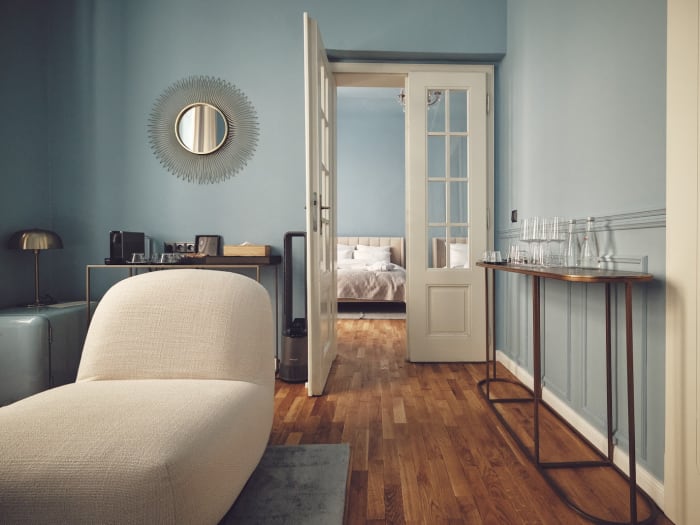
From the moment of arrival, the prevailing impression is of a house rooted in the old fabric of the city without ever becoming trapped in a purely heritage-driven aesthetic. The interiors blend historic touches with modern comfort, and do so with a restraint that avoids theatricality. One does not come here for a display, but for an atmosphere. That distinction matters. It gives the stay a particular quality: that of an urban refuge where, after the crowds around major landmarks and monuments, one returns to a quieter, more hushed environment.
Its five-star positioning is expressed less through ostentation than through the precision of the welcome and the attention paid to how guests actually live in the space. Personalised service, so often used elsewhere as a slogan, becomes something more tangible when delivered in a house of modest scale, attentive to preferences, timings and the practical needs of a stay in Prague. The sense of continuity between front desk, concierge and daily assistance contributes to the fluidity sought by travellers accustomed to fine hotels.
The hotel is particularly well suited to those who want to experience Prague on foot, taking time to move from one quarter to another, lingering in a courtyard, following a cobbled lane to a viewpoint, then returning to a more intimate setting. Couples will naturally appreciate the romantic urban atmosphere, yet the address also speaks to business travellers who value calm, centrality and thoughtful execution over a large-scale hotel machine.
What ultimately distinguishes Domus Balthasar is the way it allows city life and retreat to coexist. Prague is felt all around, in the materiality of the neighbourhood, in the proximity of historic buildings, in the immediate cultural density. And yet, once inside, the experience becomes more personal, almost domestic in its warmth. That is often the mark of hotels that age well: they do not seek to impress at every turn, but to accompany a stay with accuracy and ease. In a capital as visited as Prague, that sense of rightness often matters more than spectacle.
History & Heritage
To stay at Domus Balthasar is also to accept that Prague sets its own historical tempo. Few European cities offer such visual continuity across the centuries: façades, cobbled streets, church silhouettes, narrow passages, perspectives suddenly opening onto a square or a bridge. In such a setting, a hotel cannot merely be well located; it must enter into dialogue with its surroundings. Domus Balthasar does so in subtle ways, rooted in a quarter where historic buildings and stone lanes create a setting that feels entirely authentic.
The value of such an address lies precisely in this proximity to Prague’s historical fabric. Here, heritage is not treated as something museum-like. It is sensed in the scale of the spaces, in the presence of architectural details, in the way one moves from outside to inside. The historic touches woven into the interiors do not attempt to recreate a fixed period; rather, they extend the spirit of the place, reminding guests that they are staying in a city whose identity has been built in successive layers. This approach avoids the trap of overdone historicism and leaves room for a more elegant, more contemporary reading of heritage.
Prague has the singular quality of being both monumental and secretive. The city’s iconic images are known to everyone, yet its true charm often reveals itself in the interstices: a discreet staircase, a silent courtyard, the shadow of a steeple across a pale façade, the irregular line of old streets. A hotel such as Domus Balthasar makes particular sense within this sensitive geography. It does not attempt to compete with the monuments; instead, it allows them to be approached from a more measured, more personal setting that extends the experience of the city rather than competing with it.
This relationship to heritage is also expressed through a certain idea of Central European hospitality: elegance without emphasis, genuine attention to comfort, a preference for calm atmospheres. Where some historic addresses rely on decorative display, Domus Balthasar appears to favour continuity. The past is present, yet it never overwhelms use. That is an important quality for contemporary travellers who wish to feel the place without giving up the ease of everyday comfort.
Ultimately, the hotel’s heritage is not reduced to a date or an anecdote, but to a way of inhabiting Prague. It offers an experience of an old city lived from within, in a setting where history remains tangible without becoming heavy-handed. For those who come to Prague seeking more than a sequence of visits, that nuance changes everything: the stay gains depth, coherence and, above all, lasting memory.
Rooms & Suites
In a city as visually dense as Prague, the hotel room plays an essential role: it must serve both as an anchor and as a counterpoint. Domus Balthasar appears to understand this well by favouring interiors where modern comfort meets historic touches, without excess or pastiche. The result is an atmosphere particularly well suited to refined city stays, when one wishes to return, after a day of walking and visiting, to a space that feels calm, coherent and in keeping with the spirit of the destination.
The appeal of these rooms lies first in their tone. One imagines an aesthetic that does not seek to distract, but to settle the guest in. Contemporary elements answer very practical expectations of comfort, while historical references discreetly evoke the Prague setting. That restraint is valuable. It allows the room to remain a true place of rest rather than a theatrical set. In high-end hospitality, this ability to calibrate character is often what separates enduring addresses from passing trends.
For couples, the experience naturally takes on a more intimate dimension. Prague lends itself to romantic stays, and a hotel such as this supports that promise through a warm atmosphere and a scale that encourages the feeling of being expected rather than simply accommodated. For business travellers, the room becomes an efficient transition space between appointments, movement and recovery. Calm, centrality and the quality of daily service matter just as much as aesthetics.
Turndown service and daily housekeeping reinforce this impression of continuous care. These are details, yet fine hotel experiences often rest on precisely such invisible gestures: a room refreshed at the right moment, a renewed sense of order at the end of the day, discreet attention that never interrupts the rhythm of the stay. Added to this is the reassurance of a front desk and concierge available around the clock, which greatly simplifies the organisation of a city programme, especially for late arrivals or early departures.
More broadly, the rooms at Domus Balthasar seem to express a certain idea of urban luxury: a luxury of proportion, comfort, relative quiet and continuity between the history of the place and contemporary expectations. One does not necessarily come here for the grand scale of an international palace, but for a subtler quality of inhabitation. For many travellers, that is precisely what makes a stay memorable. A successful room is not merely attractive; it accompanies the slow hours of the morning, the return from a walk, evening reading, preparations for dinner or departure. In Prague, that function takes on particular value, as the city invites a constant alternation between immersion and retreat. Domus Balthasar appears to offer that rhythm with ease.
Concierge & Services
True luxury in a cultural capital such as Prague is not defined solely by décor or location. It is also measured by the way a hotel simplifies the city. Domus Balthasar appears particularly persuasive on this point thanks to a range of services designed to make a stay smoother, more flexible and more personal. The presence of both a concierge and a front desk available around the clock immediately changes the nature of the experience: one travels with greater freedom, without having to shape every movement around fixed opening hours.
That continuous availability is especially valuable in a destination where days can quickly become full. Between visits, concerts, dinners, business meetings or simply extended walks, itineraries rarely remain perfectly linear. Being able to rely at any hour on a team capable of advising, confirming, recommending or assisting is less an optional comfort than a genuine intelligence of travel. In the best houses, concierge service does not merely respond; it anticipates, refines and accompanies. It is this kind of attention that turns a good location into a truly well-managed experience.
Personalised service, highlighted as one of the hotel’s defining traits, takes on particular importance here. In a human-scale address, personalisation is not a script but a relationship. It may be expressed through a better understanding of a guest’s habits, a more intuitive handling of requests and a presence that remains discreet while being highly effective. For a couple on a city break, this means a simpler, more harmonious stay; for a business traveller, lighter logistics; for a family, greater day-to-day flexibility.
Practical services usefully complete that promise. Luggage storage allows guests to make full use of their first and last hours in the city without being constrained by arrival and departure times. Laundry service answers the needs of longer stays as well as the small contingencies of urban travel. Wake-up service, daily housekeeping and turndown all contribute to a steady, almost silent comfort that gives the stay its polished feel. Multilingual staff add another essential dimension in an international city: communication that is easy, clear and reassuring.
What emerges overall is a mature conception of hospitality. Nothing is showy, yet everything appears designed to support the traveller’s experience with consistency. In five-star hospitality, this quality of execution often matters more than the multiplication of facilities. A well-served hotel is one that leaves space for the city while never leaving the guest alone with its complexity. In Prague, where one may wish to improvise as much as to plan, Domus Balthasar seems to offer exactly what is needed: a refined base, a reliable presence and support flexible enough to adapt to very different kinds of stay.
The Art of Living in Prague
One of the great privileges of staying at Domus Balthasar lies in its location in the heart of Prague, within walking distance of the city’s major historic and cultural sights. This centrality is not merely convenient; it shapes a particular way of experiencing the city. Prague is a destination best understood on foot, through the continuity of old streets, bridges, squares and perspectives that naturally connect one quarter to another. To stay in a hotel embedded in this urban fabric is to adopt a more organic rhythm, made up of gradual discoveries rather than fragmented transfers.
The neighbourhood, with its cobbled lanes and historic buildings, plays a full part in that experience. It offers that distinctly Prague combination of monumentality and intimacy: a remarkable façade may stand beside an almost silent alley; a busy route may suddenly open onto a quieter corner; the city constantly alternates between urban theatre and retreat. From the hotel, this richness becomes immediately accessible. Often, only a few minutes outside are enough to recover that particular sensation of being immersed in a cultural capital whose beauty never reveals itself all at once.
For travellers drawn to history, the location allows for multiple approaches: religious architecture, traces of the imperial past, museums, concert halls, walks along the river and viewpoints over roofs and spires. For others, Prague is better experienced through cafés, bookshops, inner courtyards, discreet boutiques and unplanned pauses. The advantage of a central address is precisely that it does not impose a single reading of the city. It accommodates both the full day of visits and the aimless stroll that leaves room for detours and surprises.
This flexibility is especially welcome across the seasons. Summer naturally draws more visitors, yet spring and autumn often offer light and weather well suited to long walks. At those times, Prague reveals a softer, more nuanced side, perhaps less spectacular but often more profound. Returning in the late afternoon to a calm, warm address after several hours outdoors then becomes part of the pleasure of the stay itself.
The Prague art of living, as one may approach it from Domus Balthasar, ultimately rests on a simple idea: taking one’s time. Time to observe the details of a façade, to cross a district without a fixed purpose, to prolong an evening, to change course at the last minute. A well-located, well-served hotel does not dictate the journey; it gives it elasticity. That is perhaps the true value of this address. It allows Prague to be lived not as a checklist of monuments, but as a city to inhabit, even briefly, with curiosity, comfort and continuity.
Book with MyConciergeHotel
Choosing Domus Balthasar through MyConciergeHotel means favouring a particular way of travelling: more guided, more legible and more attentive to the actual quality of the stay. In Prague, where the hotel offer may appear abundant yet uneven in its promises, the value of an editorial selection lies precisely in its ability to distinguish addresses with genuine coherence. Here, that coherence rests on a few clear elements: a central location, a historic setting of considerable charm, interiors combining modern comfort with heritage touches, and personalised service that gives the stay its depth.
For the traveller, booking through a specialist concierge is not merely a matter of convenience. It is also a way of preparing the stay with greater precision. An address such as Domus Balthasar is best appreciated when chosen for the right reasons: the desire to discover Prague on foot, a preference for human-scale hotels, the search for a refined yet unostentatious setting, or the need for a calm and central base for business travel. This perspective matters, because the best stays often arise from a good fit between the spirit of a place and the expectations of the guest.
MyConciergeHotel also makes it possible to place the reservation within a broader experience. In Prague, this may mean shaping a stay around major cultural sights, a romantic weekend, a longer urban interlude or a business trip enriched by leisure time. The added value does not lie in artificially multiplying options, but in the relevance of recommendations and the ability to guide travellers towards the right rhythm. In a city that lends itself equally well to improvisation and planning, that expert mediation brings genuine comfort.
Booking well in advance remains wise, particularly during periods of high tourist demand. Prague attracts visitors throughout the year, with particular intensity in the warmer months, while spring and autumn appeal through their balance of pleasant weather and a calmer atmosphere. Planning ahead not only secures the stay, but also allows for a better-shaped programme, especially when one wishes to make the most of a central location and a hotel where attention to service forms part of the experience.
Ultimately, booking Domus Balthasar in this way means choosing the address for what it truly offers: an elegant, intimate reading of Prague. Neither a mere stopping point nor a showpiece setting, the hotel accompanies the city intelligently. It is exactly the sort of house one recommends to travellers who want to move with style without losing sight of place. And that, too, is what a good reservation should make possible: not merely securing a room, but preparing a stay that already carries meaning from the moment of arrival.