History & heritage
In Audrieu, the experience begins with a quality that has become rare in contemporary hospitality: the feeling of entering a place that was not created as a backdrop, but as a residence. Château d’Audrieu belongs to the French tradition of country houses turned characterful hotels, where guests come as much for the depth of the setting as for the comfort of the stay. Here, the architecture, the garden views and the slower rhythm imposed by the estate create a discreet narrative, free from excessive staging. The château suggests the classical elegance of a grand Norman property, with the restraint that distinguishes genuinely historic addresses from overly theatrical recreations.
Its membership of Relais & Châteaux says much about the nature of the property. This is not simply a five-star hotel with high-end amenities, but a house that embraces a particular art of hospitality, rooted in place, cuisine and a more personal approach to travel. In this kind of address, history is not decorative rhetoric: it can be read in the proportions, in the way rooms connect, in the woodwork, in the openings onto the park, and in the lounges that invite guests to linger rather than merely pass through. Luxury here takes on a quieter, more distinctly French form, shaped by continuity and balance.
Staying at Château d’Audrieu also means choosing a particular idea of Normandy. One does not come here for the bustle of a resort or the anonymity of a large-scale hotel, but for the sense of a cultivated retreat, where built heritage and surrounding nature remain in dialogue. Encircled by gardens, the château retains the ability to make time felt without ever slipping into museum-like stiffness. The appeal of the place lies precisely in this successful tension between memory and use: one inhabits a historic building, yet does so with the codes of a contemporary luxury hotel and with comfort designed for modern expectations.
This heritage dimension gives the stay its particular tone. In the morning, light across the façades and pathways of the estate recalls a landscape shaped over generations; in the evening, the lounges and shared spaces recover something of domestic life, more intimate than ostentatious. For travellers drawn to places with genuine soul, Château d’Audrieu offers a form of hospitality that has become uncommon: that of a French château which does not seek to impress at all costs, but to establish an atmosphere that lingers. It is this sense of rightness, more than any spectacular gesture, that defines its living heritage.
The property
The first strength of Château d’Audrieu lies in its setting. In Audrieu, within naturally peaceful surroundings, the hotel offers that sense of retreat which immediately changes the tone of a stay. Encircled by gardens, the estate acts as a threshold between the pace of travel and the much slower rhythm of a country escape. One arrives here to settle in, to recover a sense of space, to reconnect with long perspectives, pathways, lawns and trees that allow the eye to breathe. This relationship with the landscape is not incidental: it shapes the entire experience of the property.
The château itself has presence without severity. Its character as a French residence, its historic and refined setting, the composition of its façades and the way the building sits within the park create an impression of harmony rather than monumentality. This is a hotel that preserves a human scale. One senses the nobility of the setting, but also a warmth that avoids distance. The shared spaces play a full part in this balance. They invite guests to unwind, read, linger in conversation or enjoy a drink without hurry. At a time when many luxury hotels favour immediate visual impact, Château d’Audrieu reminds one of the value of inhabitable luxury, designed to endure over the course of a stay.
Its peaceful atmosphere in a natural setting is among its most persuasive qualities. The estate lends itself to unhurried walks, to late-afternoon returns from excursions, and to those in-between moments that often become the best memories of a journey: strolling through the gardens, settling into a lounge, watching the light shift, and realising that there is nothing to do except be present. This quality of silence and spaciousness explains why the address is particularly well suited to couples and restorative breaks.
Yet the property is not limited to a single style of travel. Its level of service, composed environment and suitable hotel facilities also make it possible to consider more structured stays, including professional ones, provided one is seeking calm rather than an urban setting. Summer is naturally especially pleasant, when the gardens become an obvious extension of the interiors, but the château’s appeal is not dependent on one season alone. On the contrary, this kind of house often reveals different nuances throughout the year: broader light in the warmer months, a more enveloping atmosphere when the lounges and the intimacy of the building come into their own.
Ultimately, Château d’Audrieu stands out for a quality that has become increasingly precious: coherence. The place, the landscape, the style of service and the spirit of the house all tell the same story. Nothing feels imposed. For the traveller, that coherence translates into an immediate sense of rightness: the feeling of having chosen not only a beautiful hotel, but a setting that gives shape and rhythm to the entire stay.
Rooms and suites
In a château hotel, the question of the room is always central. Travellers are not simply looking for a high level of comfort; they also expect continuity between the spirit of the place and the intimate experience of the night. At Château d’Audrieu, this is precisely part of the appeal: finding in the rooms and suites the natural extension of a historic residence, without giving up the expectations attached to a five-star property. The value of such an address lies in this delicate balance between heritage character and contemporary comfort, between decorative individuality and ease of use.
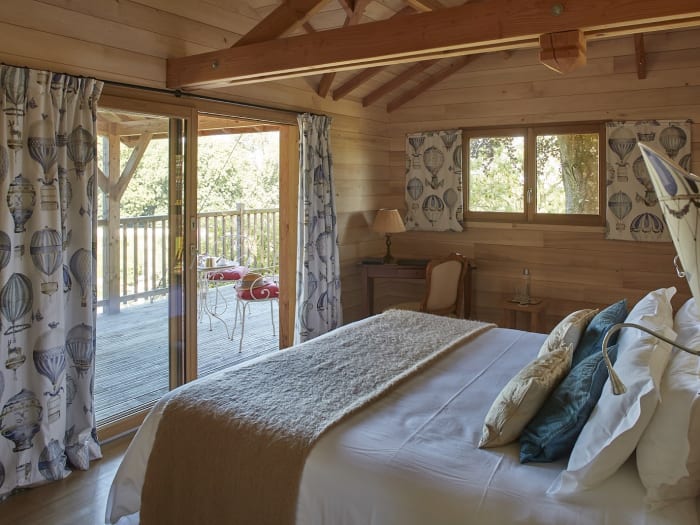
Without becoming trapped in a fixed aesthetic, accommodation in a château of this category generally favours generous proportions, light, views over the estate or gardens, and an atmosphere that feels more residential than purely hotel-like. That is what one expects here: spaces designed for rest, where the calm of the park continues indoors, and where materials, furnishings and decorative details contribute to a coherent whole. In this kind of house, elegance does not come from accumulation, but from composition. A fine ceiling height, a window opening onto greenery, a restful palette, a properly arranged bed, an armchair in which one can genuinely sit and read: these are the elements that alter the quality of a stay.
The rooms and suites are especially well suited to travellers who appreciate discreet luxury. This is not a place of display, but of carefully calibrated comfort. Daily housekeeping and turndown service, among the known amenities, reinforce that sense of continuous care which marks out the best houses. Nothing ostentatious, but real attention to the guest’s rhythm, to the ease of returning from a walk or dinner, and to the way the room regains its character as a refuge each evening.
For a stay as a couple, the setting naturally lends itself to a more enveloping experience. Silence, the presence of the gardens and the distance from ordinary distractions encourage a form of retreat that is particularly welcome over a weekend or a few days away. For business travellers, the quality of such an environment can also be an advantage, provided one is seeking a place conducive to concentration and rest rather than an urban base. In both cases, the room is not merely a stopover: it fully contributes to the identity of the stay.
What makes accommodation in a château such as Audrieu successful is, finally, the feeling of inhabiting a place rather than merely occupying it. One opens the curtains onto a park, hears less of a town than of the countryside, and returns in the evening to an atmosphere of domestic life softened by the codes of a grand hotel. This quality of inhabitation, rare and difficult to reproduce, explains why well-run heritage hotels often leave a more lasting impression than more overtly spectacular properties. At Château d’Audrieu, the room belongs to that promise: to offer not only comfort, but a particular way of dwelling in Normandy.
Dining
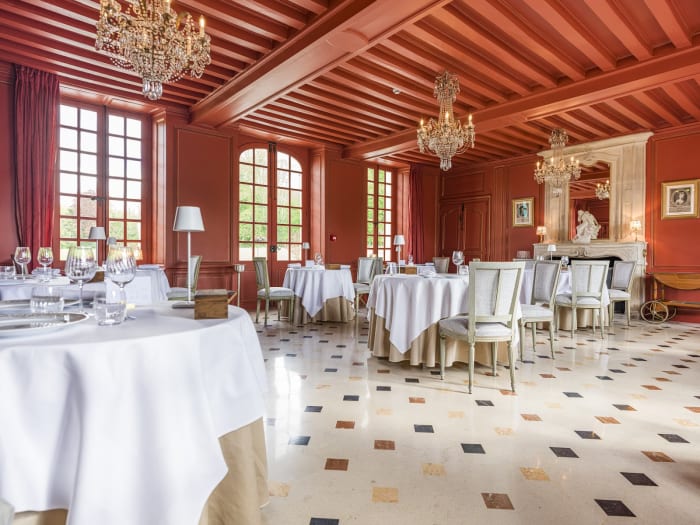
In a Relais & Châteaux property, gastronomy is never a mere ancillary service. It forms an integral part of the identity of the stay, just as much as the architecture or the landscape. At Château d’Audrieu, that dimension takes on particular importance, as the setting naturally calls for a certain idea of the French table: attentive to the seasons, to the quality of ingredients, to the rhythm of the meal, and to coherence between cuisine, service and décor. The advice to reserve a table as soon as one arrives says enough about the importance of dining within the overall experience of the house.
Dining in a château surrounded by gardens is not simply a matter of consuming a meal; it is an exercise in availability. One sits down with more time, more attention, often after a walk on the estate or a day spent exploring the region. The meal then becomes an anchor point of the stay, a moment in which the spirit of the place is encountered in another form. In this kind of address, one expects French cooking of a high standard: clear, precise and capable of expressing refinement without excess. Membership of Relais & Châteaux implies that underlying level of expectation: a table that matters, not because of grand claims, but because of the quality of execution and service.
The historic and refined setting naturally heightens the pleasure of dinner. Evening light, views over the park, the more hushed atmosphere of the dining rooms, and staff who are attentive without being intrusive all contribute to making the meal feel distinct. For couples, it is often among the most memorable moments of the stay, precisely because it combines several pleasures at once — taste, setting, conversation and the sensation of being elsewhere. For travellers familiar with great houses, what is sought here is not necessarily technical display, but rightness: a cuisine in keeping with the château, with Normandy and with the very idea of an elegant country retreat.
Breakfast, often underestimated, also plays its part in this experience. In an estate such as this, it takes on a different tone depending on the season: more open to the gardens and light in fine weather, more intimate when the interiors come to the fore. It is a moment in which the quality of a house reveals itself through details, through the pace of service, and through the way the day begins without haste. Here again, true luxury is read less in abundance than in care.
For guests choosing Château d’Audrieu, dining therefore represents far more than a convenience. It extends the spirit of the residence and gives the stay some of its most sensorial moments. One often leaves a hotel of this kind remembering a room, a garden, late-day light — and a dinner that brought all of these into resonance. It is this continuity between place and plate that defines the value of great French houses, and that makes meals here worth treating as occasions in their own right.
Concierge & services
Luxury hospitality is often judged less by what is visible than by what works quietly in the background. At Château d’Audrieu, service appears to belong to that tradition of great French houses in which attention is neither demonstrative nor distant, but constant. The known amenities — 24-hour concierge, 24-hour front desk, daily housekeeping, turndown service, luggage storage, laundry, wake-up service and multilingual staff — sketch the outline of an operation designed to support the stay with ease, at any hour, and without burdening the experience.
In a setting such as a château surrounded by gardens, this quality of service takes on particular meaning. The place invites guests to slow down; service should make that slowing down possible. The aim is to anticipate without interrupting, to respond without imposing, and to make simple what might elsewhere become logistical. A late arrival, an early departure, laundry needs, planning an itinerary in the region, reserving a table or storing luggage before setting off again: all these attentions form the invisible framework of a successful stay. When they are handled well, they free the traveller from practical management and allow full attention to be given to the place itself.
The concierge plays an essential role here. In a destination such as Audrieu, the function is not limited to executing standard requests; it can shape the stay, suggest a rhythm, and help compose a day between heritage, countryside and time back at the château. This is especially valuable for travellers wishing to explore Normandy without multiplying constraints. A good concierge also recognises differing expectations according to profile: a romantic stay, a restorative escape, a more structured break, or a trip combining work and rest. Service then becomes a form of interpretation of the place, almost a discreet mediation between the house and its guests.
Multilingual staff are another important element in an address of this category. They ensure smoother communication with an international clientele and contribute to that sense of ease which distinguishes genuinely well-run establishments. The continuously staffed reception, meanwhile, offers welcome flexibility, particularly for off-schedule arrivals or requests made outside usual hours. In a five-star hotel, these services are not merely standards; they take on their full meaning when integrated into the culture of the house.
Ultimately, what one expects from a place such as Château d’Audrieu is service capable of protecting the atmosphere. The great paradox of the best hotels lies here: the more precise the service, the less it is felt as a mechanism. It becomes a quality of ambience. One feels expected, accompanied and understood, without the stay losing its freedom. It is this controlled discretion that marks the difference between a very comfortable establishment and a true house of hospitality. In Audrieu, that is the essential challenge: to make service not a performance, but an obvious presence.
The art of living in Audrieu
Choosing Château d’Audrieu also means choosing a particular way of inhabiting Normandy, far from purely functional itineraries. Audrieu is not a destination to be consumed at speed; it is a base from which to experience a landscape, a quality of light and a culture of slower time. The village and its surroundings invite a more nuanced kind of travel, where heritage, countryside, good food and returns to the calm of the estate naturally alternate. This geography of the stay matters greatly: it allows guests to experience the region without giving up the sense of retreat offered by the château.
The local art of living begins with the relationship between nature and history. In Normandy, landscapes are never entirely wild nor wholly domesticated; they bear the traces of long-standing uses, estates, cultivation, roads and villages that form a deeply inhabited territory. Château d’Audrieu belongs to that continuity. From the estate, one senses this ordered, generous countryside, well suited to detours and unhurried discovery. A day may begin with a leisurely breakfast, continue with an excursion in the region, and end in the gardens or at table, without ever feeling like a race through a checklist.
For couples, this gentler rhythm is undoubtedly one of the property’s greatest strengths. Luxury here often consists in being able to do less. Taking time for a walk, lingering in the shared spaces, returning early to the château rather than extending the day unnecessarily, accepting that a successful stay is measured not by the number of sites ticked off but by the quality of the hours lived — this is what the place encourages. The peaceful natural setting fosters such availability. It makes possible a more sensorial form of travel, attentive to details: shifting weather, the colours of the park, evening quiet, the discreet conviviality of the lounges.
This way of staying also suits travellers who already know France well and seek less the accumulation of sights than the rightness of an atmosphere. Audrieu then becomes an appealing base from which to explore while returning each evening to a place with genuine identity. That is a considerable advantage over more standardised accommodation: returning to the hotel is not merely a logistical necessity, but one of the pleasures of the journey. One comes back to the château as one returns to a chosen house.
The art of living in Audrieu ultimately lies in this alliance between apparent simplicity and real refinement. Nothing feels forced. The countryside, the gardens, the château, the table and the service form a whole in which luxury almost becomes secondary because it is so fully integrated into the daily life of the stay. That is precisely what makes the experience convincing. This is not an artificial interlude, but a form of cultivated comfort that allows the region to be appreciated in depth. For those seeking an elegant, peaceful and inhabited Normandy, Château d’Audrieu offers a particularly well-judged perspective.
Book via MyConciergeHotel
Booking the Château d’Audrieu through MyConciergeHotel means preparing for a stay with precision. The appeal of this location lies as much in its atmosphere as in its offerings.
Some travellers seek a romantic getaway in a historic and refined setting, while others favour the tranquillity of the gardens. Still others use it as an elegant base to explore Normandy.
This approach is particularly beneficial when it comes to a château-hotel. The choice of season, the pace of the itinerary, the anticipation of meals, and the organisation of arrivals and departures all play a significant role.
The summer season is particularly suited to enjoying the gardens. It is wise to book a table promptly in a house where the gastronomic aspect is paramount.
The Château d’Audrieu is well-suited for couples and relaxing stays. It can also meet the expectations of business travellers seeking a calm and well-maintained environment.
Beyond the availability of a room, it is essential to understand what will make the stay successful. Taking the time to revisit the estate and incorporating dining into the itinerary are key.
For a five-star hotel that is a member of Relais & Châteaux, this coherence is vital. In the case of the Château d’Audrieu, it hinges on the right timing, appropriate expectations, and a stay designed around tranquillity, nature, and quality service.