History & heritage
Canal House belongs to one of Amsterdam’s most enduring images: the canal houses lining the historic waterways that have shaped the cityscape since the Dutch Golden Age. Staying here is not simply a matter of choosing a central address; it means inhabiting, for a few nights, a distinctly Amsterdam form of refinement, defined by narrow façades, deep floor plans, steep staircases, tall windows and a constant dialogue between interior spaces and the city outside. The hotel draws its personality from this classical architecture without turning it into a museum piece. What it retains is proportion, verticality and that very local way of bringing light into spaces that favour intimacy over display.
In a city where the finest hotels are often those that work intelligently with existing buildings, Canal House embraces an elegance of continuity. The carefully curated interiors, one of its defining characteristics, do not erase the spirit of the place; they accompany it. There is a subtle conversation between heritage and contemporary hospitality: period proportions, historic detailing, views over water or quieter inner spaces, and, in counterpoint, comfort designed for the modern traveller. The balance is all the more persuasive because it remains understated. Nothing here feels overtly demonstrative. Materials, lighting and measured contrasts take precedence over theatrical excess.
Its membership of Small Luxury Hotels of the World also helps define its position. The affiliation suggests not standardised luxury but a particular idea of independent hospitality: properties on a more human scale, with a clear identity, attention to detail and a more personal relationship to the guest experience. Canal House fits squarely within that tradition. Its heritage is not merely architectural; it also lies in a way of receiving guests. In a city that attracts visitors year-round, where one can sometimes feel as though one is moving through a setting admired by everyone, the hotel offers a calmer, more inward-looking relationship with Amsterdam.
It is also worth understanding the property within the broader context of the Dutch capital. Amsterdam has long cultivated a form of restrained sophistication, less dependent on grandeur than on quality of life, balanced proportions and an appreciation for beautiful, useful things. Canal House expresses that spirit well. Its story is not that of a monumental palace, but of an urban house transformed into a characterful retreat. That is precisely what makes it feel relevant today: it offers an intimate reading of luxury, rooted in the city’s historic fabric and in an aesthetic that values depth over spectacle.
The Establishment
One of the main attractions of Canal House lies in its location along the canals of Amsterdam, nestled in a central yet relatively tranquil environment. This dual quality is significant in a city where the experience of one’s stay heavily depends on the chosen neighbourhood. The address allows for easy access to museums, shopping streets, cafés, galleries, and key points of interest, all while maintaining a peaceful atmosphere once the door is crossed. The hotel is not only well-placed but also offers a sense of respite. There is a pleasure in returning to a slightly secluded space after a busy day.
The classical architecture contributes fully to this sensation. As is often the case with canal houses, the façade suggests a contained elegance, while the interior spaces reveal an unexpected depth. Visitors discover a universe where the city remains close without overwhelming. The carefully composed common areas reinforce this impression of an urban sanctuary. They invite guests to settle in, read, plan an itinerary, or observe the changing light on the windows and the water. In a hotel of this nature, luxury is often measured by the quality of the rhythm it allows.
Canal House particularly appeals to those seeking a characterful address rather than a large, impersonal complex. Its intimate atmosphere is part of its identity. This translates into a more human scale, a quieter flow, and a more direct relationship between the staff and the guests. The feeling of being awaited, recognised, and supported without being constantly solicited is at the heart of the experience. This restraint is invaluable in a destination as popular as Amsterdam.
The establishment is well-suited for couples on a getaway, business travellers, or regular visitors to the city seeking an elegant and discreet base. It does not aim to compete with grand monumental addresses. Instead, it offers a more domestic relationship with luxury, set within a historical framework, with the canal as a daily horizon. This proximity to the water, the bridges, the passing bicycles, and the façades reflected in the calm surfaces gives the stay a distinctly local tone. One is not merely in Amsterdam; one is in a certain idea of Amsterdam, quieter and more nuanced.
Rooms and Suites
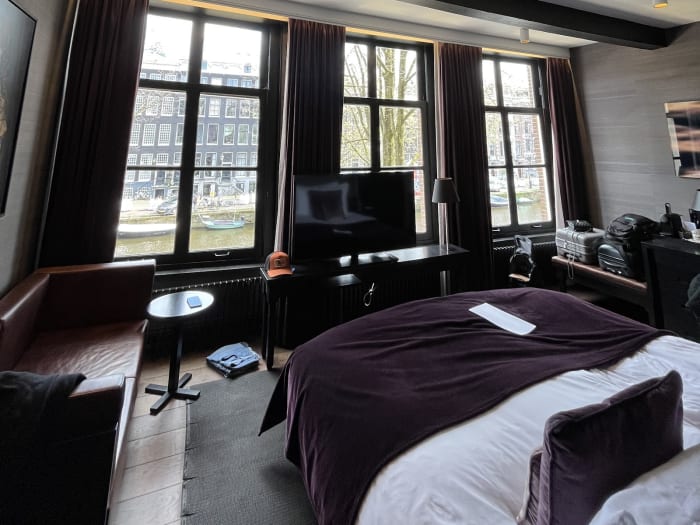
At Canal House, the room extends the architectural and emotional experience of the address. It is integrated into the historical fabric with a true uniqueness.
The volumes vary according to the configuration of the house. This diversity adds to the charm of a stay in a canal residence. Each room interacts with the ancient structure, the light, and the views.
The decoration plays a decisive role. It does not clutter the space; rather, it guides it. Materials, tones, and furnishings create an enveloping atmosphere designed for retreat.
In a city in motion, the rooms offer a counterpoint. Relative silence, visual comfort, soft lighting, and clean lines create a soothing environment. Luxury is expressed here in the details.
For couples, this intimate dimension is particularly appreciated. Canal House is ideal for getaways where one enjoys both the city and the address.
For business travellers, the same setting fosters concentration and recovery. In both cases, attentive hospitality prevails, never intrusive.
The turn-down service, daily maintenance, and attention to detail enhance the quality of the stay. The essence lies in the overall coherence.
A successful room in a characterful hotel makes one forget its technical complexity. It reveals a comfortable, harmonious space that fits its environment. Canal House prioritises intimacy, personality, and a sensitive relationship with Amsterdam's architecture.
Dining
At Canal House, the culinary experience aligns with the spirit of the house. It favours a discreet form that is coherent with the stay.
This may include a well-served breakfast, a coffee, an evening drink, or a few moments of dining. In an intimate hotel, quality also depends on the tempo of service, the tranquillity of the spaces, and the attention given to the overall experience.
In Amsterdam, this approach finds its natural place. The city invites guests to alternate between outdoor discoveries and returns to the hotel.
One might spend the morning in a museum, have lunch in a nearby neighbourhood, return to rest, and then head out for dinner by the water. In this logic, the hotel plays a role of anchorage.
It does not need to concentrate everything to be successful. It must primarily offer the right moments.
A breakfast in an elegant and calm setting can matter more than an overly ambitious promise. Similarly, settling into a lounge or common area extends the evening pleasantly.
Canal House stands out for the coherence between its intimate atmosphere and its approach to dining. Hospitality here emphasises personalisation, advice, and well-executed simplicity.
Personalised service takes on its full meaning. This could involve recommending a local address, arranging a reservation in the city, suggesting a quieter time for breakfast, or preparing a special attention for an early departure.
For the French traveller, the dining experience at Canal House is seen as part of a broader stay. The address suits those who enjoy exploring Amsterdam in successive touches, without sacrificing the comfort of an elegant base.
The pleasure lies less in an on-site gastronomic scene than in an attentive house. It accompanies the rhythms of the city and offers, around meals, silence, light, and care.
Concierge & Services
Canal House focuses on attentive and personalised service. In a characterful address, this aspect often matters more than an abundance of facilities.
The hotel offers 24-hour concierge service, 24-hour reception, daily maintenance, turn-down service, luggage storage, laundry service, wake-up calls, and multilingual staff. In a human-scale house, this ensemble supports a smooth and serene stay.
In Amsterdam, the concierge service holds a special place. It allows for adjusting the stay to the traveller's rhythm. Itineraries along the canals, table reservations, transfers, or visit recommendations—these attentions give the stay its true quality.
The continuously open reception provides useful flexibility for late arrivals, early departures, and changes in plans. The luggage storage allows for more freedom to enjoy the city on the day of arrival or departure.
Daily maintenance and turn-down service enhance the feeling of a room always ready. Laundry service and wake-up calls extend this logic of discreet assistance.
Canal House prioritises precise and flexible hospitality, tailored to individual rhythms. In this intimate setting, this relational quality gives the stay a more personal tone, right in the heart of Amsterdam.
The Amsterdam art of living
Staying at Canal House offers access to a particularly balanced version of Amsterdam. The city fascinates through its urban design, its relationship with water, its cultural density and its ability to combine local daily life with international appeal. Yet it is best understood when approached at the right pace. From an address set along the canals, the experience immediately takes on a different texture. Amsterdam reveals itself not as a sequence of sights to tick off, but as a city of routes, light and atmosphere. In the morning, the quays have an almost residential softness; during the day, the streets animate around shops, museums and markets; by evening, reflections on the water lend the historic centre an almost cinematic depth.
Canal House seems particularly well suited to this more sensitive reading of the destination. Its peaceful atmosphere allows guests to step away from touristic intensity without giving up centrality. It is an ideal base for exploring on foot, by bicycle or along the canals, depending on mood. Amsterdam rewards non-linear itineraries: crossing a bridge at random, entering a discreet courtyard, moving from a lively district into a suddenly quiet street, stopping in a café, then setting off again towards a museum or gallery. In this context, the luxury of a good hotel lies in making such openness possible. You leave without an overly rigid plan, knowing that you will later return to somewhere calm, elegant and familiar.
For culture lovers, the city offers a remarkable concentration of institutions, collections and independent addresses. For those seeking atmosphere above all, Amsterdam reveals itself in details: slightly leaning façades, half-drawn curtains, houseboats, bicycles resting against railings, flowers on tables, bookshops, flower markets and terraces whenever the season permits. Spring and summer, mentioned in the short description, are indeed especially pleasant for enjoying the canals and gardens, though autumn and winter have their own devotees, as the city becomes more introspective when the light fades and interiors regain their appeal.
Seen in this way, Canal House is not merely accommodation; it is a filter. It proposes a way of experiencing Amsterdam with greater softness, precision and continuity. It embodies a form of urban travel that favours quality of presence over accumulation. Looking, walking, returning, setting out again, dining elsewhere, coming back late, opening the window onto the relative quiet of the canal—these simple gestures take on particular value in the right setting. That is perhaps where the art of living enabled by this address truly lies: in a city intensely visited, yet lived from a place that restores its most serene and elegant side.
Book with MyConciergeHotel
Booking Canal House through MyConciergeHotel makes sense for travellers expecting more than a simple room confirmation. A property of this kind—intimate, sought-after and well located—deserves to be chosen carefully, because the quality of the stay often depends on details that standard booking platforms do not capture: timing, room profile, travel rhythm, movement habits, expectations regarding quietness or quick access to key districts. In a city as popular as Amsterdam, and in a hotel that may be fully booked during peak periods, anticipation remains essential. The recommendation to reserve several months in advance, already present in the short description, is especially relevant here.
The value of concierge-led booking lies first in clarifying the actual need. No two Amsterdam stays are the same. Some travellers are looking for a romantic break centred on canals, walks and dinners; others prioritise museums, business appointments or a more residential discovery of the city. Canal House, with its peaceful atmosphere in the heart of Amsterdam and its personalised service, can suit several types of stay, provided the trip is prepared thoughtfully. Booking through MyConciergeHotel makes it possible to place the hotel within a coherent travel plan rather than treating it as just another room option.
That support is equally valuable when organising the surrounding details that genuinely shape the experience: arrival and departure times, neighbourhood recommendations, restaurant reservations, seasonal visiting advice, luggage handling or adapting an itinerary to a short stay. In a destination where the offer is abundant, true value lies not only in access but in selection. A good concierge helps sort through options, avoid overly obvious routes, preserve breathing space and make the most of the hotel’s canal-side setting. The result is a stay that feels both smoother and richer.
Choosing MyConciergeHotel to book Canal House also means favouring a certain idea of high-end travel: more editorial, more accompanied and more attentive to nuance. The aim is not to overpromise but to match a property to a genuine expectation. Canal House will appeal above all to travellers sensitive to classical architecture, relative calm, intimacy and quality of service. If that is precisely what you are seeking in Amsterdam, this house is a particularly apt choice. Booking early, clarifying your priorities and thinking of the stay as a whole are the best ways to draw out its full substance. That is where MyConciergeHotel adds value: turning a good reservation into a genuinely well-constructed stay.