Discussing mountain hotels in Rome requires some clarification. We are neither in the Dolomites nor the Alps. In Rome, the mountain pertains to urban relief, hills, promontories, elevated gardens, and views that overlook the city. This is precisely what makes this ranking intriguing. The Italian capital can also be understood through its relative altitudes. Some establishments are situated on a hill, while others retreat above the bustling crowds. Still others borrow from mountain vernacular the concepts of refuge, calm, distance, and panorama. For a discerning traveller, this perspective changes everything. It allows one to choose not just a hotel in Rome, but a position within the city. Often, it offers a more breathable way to inhabit the metropolis.
At MyConciergeHotel, we have therefore adopted a clear methodology. We do not assess proximity to ski slopes or resorts here. Instead, we examine the relationship between the hotel and the Roman landscape. We observe the elevation, the quality of the views, the sense of retreat, access to gardens or terraces, and the ability of the establishment to provide a rare breath of fresh air in a dense metropolis. We also incorporate constant criteria from our selection process. The international reputation of the establishment matters. The level of service is also significant. Architectural identity, coherence of decor, and the relevance of the experience within its neighbourhood remain crucial. It is important to note that a mountain hotel in Rome is primarily one that takes height, both literally and sensibly.
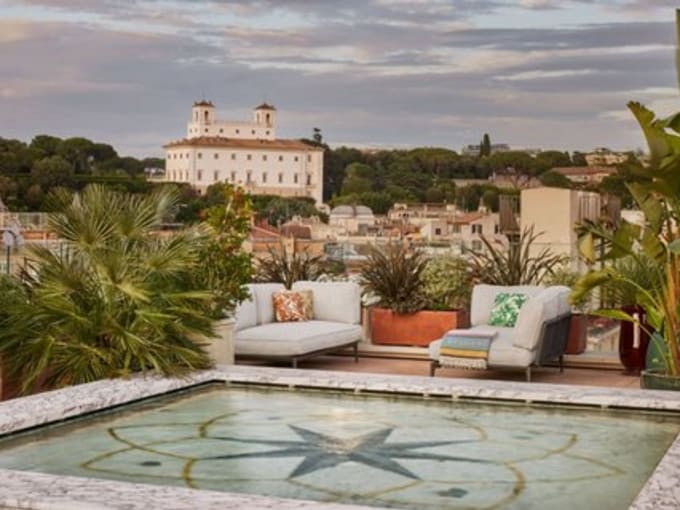
The panorama of the selected addresses actually showcases several interpretations of this idea. Rome Cavalieri naturally stands out in this context. Its location on the heights of Monte Mario structures the entire experience. Hotel Eden offers another version. This address is not experienced as a perched resort, but as an elegant observation point over the Roman rooftops. Villa Medici brings a unique nuance. Its position on the Pincio and its relationship to the gardens provide an almost monastic sense of retreat. Bulgari Hotel Rome leans more towards a tranquil urban fortress. Here, the mountain becomes a language of refuge, minerality, and controlled distance. Casa Monti, finally, introduces a more intimate interpretation. Here, the relief is less topographical and more mental. The very name suggests an escape, and the neighbourhood offers a more textured, less frontal Rome.
For 2025 and 2026, our advisors are observing an increasingly clear expectation. Travellers want Rome, but not the saturation. They seek the city without renouncing the pause. This demand favours hotels capable of offering a sense of elevation. The view remains a strong criterion, but it is no longer the only one. Relative silence, the presence of a garden, light, and the possibility of having breakfast or an aperitif on a terrace carry more weight. Long-stay clients are particularly attentive to this. They wish to alternate cultural intensity with recuperation. In this logic, addresses that are elevated or set back gain relevance. My advice: in Rome, the notion of mountain should be interpreted as a luxury of breathing space. This is often what makes the difference between a pleasant stay and one that is truly well-paced.
This perspective also aligns with a certain idea of luxury à la française, which we advocate at Le Concierge. Luxury is not about accumulating effects. It is about orchestrating the experience. In Rome, this means choosing an address that places you just right. Just in relation to the city. Just in relation to your tempo. Just in relation to the season. A terrace with a view does not hold the same value in the height of summer as it does in November. A large garden serves a different purpose for a couple on a short getaway than for a family. A Roman hill is not merely a backdrop. It is a filter. It alters noise, light, approach, and sometimes even the perception of distances. What our advisors often observe is that clients remember less a spectacular effect than a feeling of balance.
Thus, this ranking should be read without expecting an absolute truth. Each hotel has its audience, its rhythm, and its definition of height. Rome Cavalieri will naturally suit those seeking grandeur, panorama, and a true dissociation from the centre. Hotel Eden will appeal more to travellers who wish to remain in a classic Rome, with a view that accompanies the day. Villa Medici will attract lovers of culture, gardens, and relative silence. Bulgari Hotel Rome caters to those looking for a highly structured address, with a strong identity and a sense of protection. Casa Monti may resonate with travellers who prefer a more creative and sensitive interpretation of the neighbourhood. None of these hotels alone encapsulates the mountain in Rome. Together, they outline several credible usages.
This is precisely the spirit of this Top 5. It does not seek to force a category. It offers a useful framework for choosing Rome by its heights, retreats, and views.