L’établissement
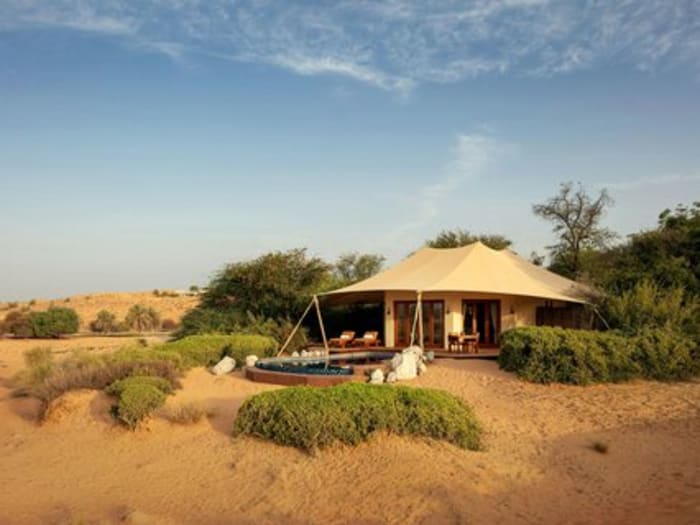
Il existe à Dubaï une autre manière d’habiter le paysage que celle des tours, des marinas et des adresses urbaines spectaculaires. Al Maha s’inscrit dans cette lecture plus silencieuse de l’émirat, au cœur du désert, dans un décor de dunes, de lumière rasante et d’horizons ouverts. Ici, l’expérience ne repose pas sur l’agitation de la ville mais sur la sensation rare d’un retrait véritable, où le luxe prend la forme de l’espace, du calme et d’une relation directe avec la nature. L’arrivée elle-même marque une transition nette : on quitte progressivement les grands axes pour entrer dans un territoire où les lignes se simplifient, où les couleurs se réduisent à l’ocre, au sable, au brun et au bleu du ciel.
L’architecture et les partis pris décoratifs prolongent cette immersion. L’ensemble puise dans un imaginaire inspiré de la culture bédouine, sans folklore appuyé, avec une préférence pour les matières chaudes, les silhouettes basses et une intégration visuelle qui cherche moins à dominer le désert qu’à s’y fondre. Cette retenue est essentielle à l’identité du lieu. Elle permet à l’hôtel de conserver une présence discrète malgré le niveau de confort attendu d’une adresse 5 étoiles. Le paysage reste le premier protagoniste, et l’établissement agit comme un observatoire privilégié plutôt que comme une enclave coupée de son environnement.
Ce positionnement explique aussi le type de séjour que l’on vient y chercher. Al Maha parle d’abord aux voyageurs qui souhaitent ralentir, retrouver un rythme plus organique, mesurer la journée à la course du soleil plutôt qu’au programme d’une ville. Les couples y trouvent un cadre naturellement propice à l’intimité, mais l’adresse convient tout autant à ceux qui veulent approcher le désert dans des conditions de grand confort. L’impression générale tient à cet équilibre précis entre isolement et attention constante, entre nature brute et hospitalité très maîtrisée.
Le désert de Dubaï n’est pas ici un simple décor photographique. Il devient une présence continue, perceptible depuis les espaces de vie, les terrasses et les suites, et souvent animé par l’observation de la faune locale. Le regard s’habitue à lire les nuances du terrain, les mouvements du vent sur les dunes, la manière dont la lumière transforme la scène d’une heure à l’autre. Le matin apporte une clarté nette, presque minérale ; le soir étire les ombres et installe une douceur qui redéfinit entièrement les volumes.
Membre des Leading Hotels of the World, l’établissement revendique ainsi une forme de luxe de destination, fondée moins sur l’ostentation que sur la singularité du site et la qualité de l’expérience. C’est une adresse pensée pour ceux qui considèrent qu’un grand hôtel ne se résume pas à ses prestations, mais qu’il doit aussi offrir un rapport particulier au lieu. À Al Maha, ce rapport est immédiat, presque instinctif : on vient pour le désert, pour la sensation d’éloignement, pour la beauté d’un environnement préservé, et pour cette manière très rare qu’a l’hôtel de laisser le silence devenir un véritable privilège.
Chambres et suites
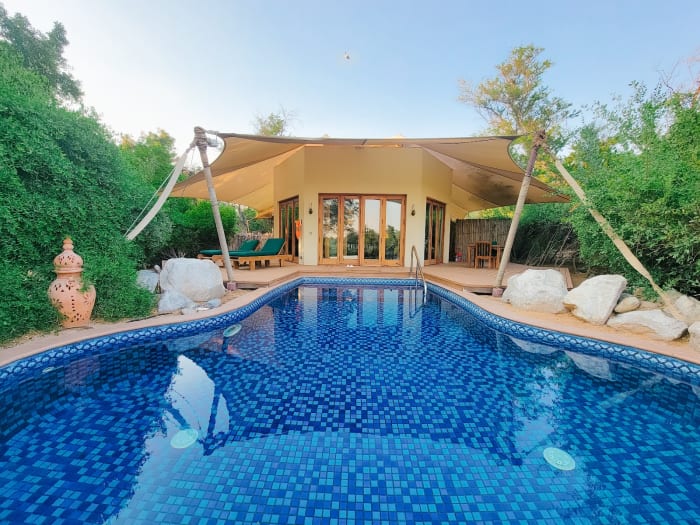
À Al Maha, l’hébergement participe pleinement à l’expérience du désert. Les suites ont été pensées comme des refuges ouverts sur le paysage, où le regard reste constamment attiré vers les dunes. Cette relation visuelle est essentielle : elle donne à chaque séjour une dimension contemplative, presque cinématographique, qui distingue immédiatement l’adresse d’un resort classique. On ne vient pas seulement dormir dans un hôtel de grand confort ; on habite temporairement un territoire, avec la sensation d’en observer les variations depuis un poste privilégié.
Le vocabulaire décoratif prolonge l’identité générale de la maison. L’inspiration bédouine se lit dans l’atmosphère, dans le choix de tonalités chaudes, dans une certaine idée du campement réinterprété avec raffinement, plutôt que dans une démonstration thématique. Le résultat privilégie la cohérence et la douceur visuelle. Les espaces cherchent à envelopper sans enfermer, à rappeler le désert sans le caricaturer. Cette approche confère aux suites une personnalité nette, éloignée des intérieurs interchangeables que l’on rencontre parfois dans l’hôtellerie internationale.
L’un des grands atouts réside dans la manière dont intérieur et extérieur dialoguent. Les ouvertures cadrent le paysage, la lumière naturelle devient un élément de décor à part entière, et les moments passés en chambre changent de tonalité selon l’heure du jour. Tôt le matin, tout semble plus vif, plus précis ; à la tombée du soir, les couleurs se densifient et l’ambiance gagne en intimité. Cette qualité de lumière, propre au désert, transforme l’expérience la plus simple — lire, prendre un café, s’attarder quelques minutes en silence — en véritable luxe de séjour.
Le confort, lui, reste celui d’une adresse haut de gamme attentive aux détails. Service de couverture, entretien quotidien, attention portée au rythme des hôtes : tout concourt à créer une sensation de fluidité. Rien ne doit interrompre cette impression de retrait paisible. Les voyageurs en quête de déconnexion apprécient particulièrement cette continuité entre l’environnement extérieur et la sérénité intérieure. Les suites deviennent alors moins un simple point de chute qu’un lieu où l’on choisit de rester, de ralentir, de regarder.
Pour les couples, cette configuration a une évidence particulière. La vue sur les dunes, l’isolement relatif, le silence et la présence discrète du service composent un cadre naturellement propice à l’intimité. Mais l’expérience ne se réduit pas au romantisme. Elle convient aussi à ceux qui cherchent une forme de concentration, de repos profond, ou simplement le plaisir rare d’un hébergement qui ne détourne jamais l’attention de son environnement. À Al Maha, la suite n’est pas conçue comme un univers fermé sur lui-même ; elle agit comme une extension confortable du désert.
C’est sans doute là que réside la singularité de l’adresse. Beaucoup d’hôtels promettent une belle vue ; ici, la vue structure le séjour. Beaucoup évoquent l’esprit du lieu ; ici, celui-ci s’inscrit concrètement dans la manière d’occuper l’espace, de ressentir le temps, de percevoir la lumière et le silence. Les suites ne cherchent pas à rivaliser avec le paysage par l’effet ou l’accumulation. Elles lui laissent la première place, tout en offrant le niveau de confort et de soin attendu d’un grand hôtel. Cette retenue, dans un contexte aussi spectaculaire, est précisément ce qui leur donne leur justesse.
La table
Dans un environnement aussi singulier, la restauration ne peut pas se contenter d’être un simple service annexe. À Al Maha, elle prolonge le rythme du séjour et participe à cette sensation d’éloignement confortable qui fait toute la valeur de l’adresse. Les repas s’inscrivent dans une temporalité plus lente, accordée au désert, à la lumière et à l’envie de prendre place sans précipitation. On dîne moins pour cocher une table que pour prolonger une atmosphère.
Al Diwaan incarne cette dimension avec une proposition internationale et une allure sophistiquée qui convient particulièrement bien au cadre. Le registre n’est pas celui de la démonstration tapageuse, mais d’une élégance mesurée, adaptée à un hôtel où le décor naturel reste central. Après une journée passée à observer les dunes, à profiter du calme ou à explorer les environs, le dîner prend ici une tonalité presque rituelle. Le contraste entre l’immensité extérieure et le confort feutré de la table crée un moment de transition très réussi entre le désert et l’intimité du soir.
Le Hajar Terrace Bar offre une autre lecture de la convivialité, plus légère mais tout aussi cohérente avec l’esprit de la maison. On y vient pour un verre dans une ambiance calme, pour un cocktail artisanal ou une sélection de boissons pensée dans un registre international. Ce type d’espace prend une importance particulière dans un resort de destination : il devient un lieu de pause, de conversation et d’observation, où l’on s’attarde naturellement au retour d’une activité ou avant le dîner. Dans un cadre désertique, la terrasse acquiert une valeur presque scénographique, tant la lumière et la température modifient l’expérience au fil des heures.
Ce qui distingue la table à Al Maha, c’est moins la multiplication des concepts que la cohérence d’ensemble. Deux adresses suffisent à dessiner un art de recevoir clair : un restaurant signature pour structurer les repas, un bar-terrasse pour les moments plus informels. Cette sobriété est en accord avec le lieu. Elle évite la dispersion et permet à chaque espace de trouver sa juste fonction dans le séjour. L’expérience gastronomique reste ainsi lisible, fluide, sans surcharge, ce qui convient particulièrement à une clientèle venue chercher le calme et la continuité plutôt qu’une succession d’animations.
Le plaisir de manger dans le désert tient aussi au contexte sensoriel. Les saveurs, la conversation, le service et le paysage se répondent différemment lorsque l’on se trouve loin du bruit urbain. Le silence alentour, l’air du soir, la profondeur du ciel et la lenteur naturelle du lieu donnent aux repas une qualité presque suspendue. Même les instants les plus simples — un apéritif en terrasse, un dîner pris sans hâte — gagnent ici une densité particulière.
Pour les voyageurs qui choisissent Al Maha, la table fait donc partie intégrante de l’expérience de destination. Elle n’a pas besoin d’effets spectaculaires pour convaincre. Sa force réside dans l’accord entre le cadre, le tempo et le niveau de service. Dans un hôtel où tout invite à ralentir, la restauration adopte le même langage : celui d’un luxe discret, attentif, capable de transformer un repas en prolongement naturel du désert.
Spa & bien-être
Le bien-être trouve à Al Maha un terrain d’expression particulièrement évident. Dans le désert, la notion de ressourcement cesse d’être un argument convenu pour devenir une expérience presque physique. Le silence, l’espace, l’absence de sollicitations permanentes et la présence continue du paysage créent des conditions rares pour ralentir réellement. Le spa s’inscrit dans cette logique : il ne vient pas corriger le rythme du séjour, il en est l’extension naturelle.
Dans une adresse de cette nature, on attend moins une accumulation d’installations qu’une qualité d’atmosphère. Le soin commence avant même le premier geste technique, dans la manière dont le lieu prépare le corps et l’esprit à relâcher la tension. Le désert joue ici un rôle essentiel. Sa lumière, sa chaleur, son dépouillement visuel et sa profondeur de champ invitent à une forme de recentrage que peu d’environnements offrent avec autant d’évidence. Le spa prend alors tout son sens comme espace de transition entre l’expérience extérieure et un apaisement plus intérieur.
Les voyageurs qui viennent à Al Maha recherchent souvent cette combinaison précise : vivre un décor spectaculaire sans renoncer au confort, et trouver dans ce cadre une possibilité de repos profond. Les soins répondent à cette attente en apportant une dimension plus intime au séjour. Après une sortie dans les dunes, une journée passée à contempler le paysage ou simplement quelques heures à se laisser porter par le calme du resort, le passage au spa permet de prolonger la sensation de déconnexion. Il ne s’agit pas seulement de se faire plaisir, mais de donner une forme plus consciente au ralentissement.
Le bien-être, ici, ne se limite pas à une cabine de soin. Il se lit dans l’ensemble de l’expérience : la vue depuis les suites, la qualité du silence, la douceur du service, la possibilité de prendre son temps sans justification. C’est cette cohérence globale qui distingue les grandes adresses de destination. Le spa devient un point d’ancrage dans un art de vivre plus large, où l’on accepte de faire moins pour ressentir davantage. Dans un monde saturé d’images et de vitesse, cette simplicité maîtrisée a une vraie valeur.
Pour les couples, le contexte se prête naturellement à des parenthèses à deux, mais l’expérience convient tout autant aux voyageurs solitaires venus chercher une forme de retrait. Le désert a cette capacité singulière à élargir le regard tout en ramenant à l’essentiel. Le soin, dans ce cadre, n’est pas un luxe accessoire ; il devient une manière de s’accorder au lieu. On ressort moins stimulé que rééquilibré, moins impressionné qu’apaisé.
C’est sans doute ce qui fait la justesse du bien-être à Al Maha. Rien n’y semble forcé, rien n’essaie de surjouer l’idée de sérénité. Le cadre suffit déjà à installer une disposition intérieure favorable au repos. Le spa vient simplement approfondir cette promesse, avec la discrétion qui convient à un hôtel où l’essentiel se joue dans la qualité de présence au paysage. Ici, prendre soin de soi revient d’abord à se rendre disponible au désert, à sa lenteur, à son silence et à la sensation rare d’être, pour un temps, réellement ailleurs.
Conciergerie & services
Dans un resort de désert, la qualité du service ne se mesure pas seulement à l’efficacité, mais à la manière dont elle reste presque invisible. Al Maha cultive précisément cette forme de présence discrète qui permet au séjour de demeurer fluide sans jamais rompre l’impression de calme. Réception ouverte en continu, conciergerie disponible à toute heure, entretien quotidien, service de couverture, consigne à bagages, blanchisserie, service de réveil et personnel multilingue composent une base solide, attendue dans l’hôtellerie haut de gamme, mais qui prend ici une importance particulière en raison de l’isolement choisi du lieu.
Lorsque l’on séjourne au cœur du désert, on apprécie d’autant plus une organisation capable d’anticiper les besoins sans alourdir l’expérience. Le vrai luxe réside souvent dans cette sensation que tout a été pensé en amont : les horaires s’ajustent, les demandes se traitent avec simplicité, les transitions entre repos, repas et activités se font naturellement. Le service ne doit ni sursolliciter ni disparaître ; il doit accompagner. C’est une nuance essentielle, surtout dans une adresse où les hôtes viennent chercher une forme de déconnexion et non une animation permanente.
La conciergerie joue à ce titre un rôle central. Elle permet d’orchestrer le séjour avec souplesse, qu’il s’agisse de réserver une activité, d’organiser le rythme des journées ou de répondre à des demandes pratiques. Dans un environnement où l’on ne sort pas improviser une soirée comme en centre-ville, cette capacité d’accompagnement devient structurante. Elle rassure sans rigidifier, et permet à chacun de vivre le désert selon son propre tempo. Certains voudront ponctuer leur séjour d’expériences organisées ; d’autres préféreront préserver de longues plages de silence et de contemplation. Un bon service sait respecter ces deux approches avec la même justesse.
L’entretien quotidien et le service de couverture contribuent également à cette impression de confort sans effort. Dans un cadre où la lumière, la chaleur et le sable font partie intégrante de l’expérience, le soin apporté aux espaces privés devient particulièrement appréciable. Revenir dans une suite parfaitement tenue après une sortie ou après quelques heures passées dehors participe à la qualité générale du séjour. Là encore, il ne s’agit pas d’effet, mais de continuité : tout doit soutenir la sensation de refuge.
Le personnel multilingue et la disponibilité permanente de la réception rappellent que l’hôtel s’adresse à une clientèle internationale habituée à un haut niveau d’attention. Pourtant, l’identité du service ne semble pas reposer sur la formalité pour elle-même. Dans un lieu comme Al Maha, l’excellence se lit plutôt dans le tact, dans la précision des gestes, dans la capacité à être là au bon moment. Le désert impose une certaine retenue ; le service l’épouse intelligemment.
Au fond, les prestations de l’hôtel prennent toute leur valeur parce qu’elles servent un projet plus large : rendre possible une expérience de retrait sans jamais faire sentir la contrainte de l’éloignement. C’est là une réussite subtile. On bénéficie de l’isolement, du silence et de la beauté du site, tout en conservant le confort opérationnel d’une grande maison. Cette alliance entre nature, intimité et service bien calibré constitue l’un des ressorts les plus convaincants du séjour à Al Maha.
L’art de vivre à Dubaï, version désert
Séjourner à Al Maha, c’est aussi découvrir une autre idée de Dubaï. L’image la plus répandue de l’émirat reste celle d’une métropole verticale, tournée vers l’innovation, le commerce, les grandes signatures architecturales et une forme d’énergie continue. Cette lecture est réelle, mais incomplète. Le désert rappelle une profondeur géographique et culturelle plus ancienne, plus lente, qui permet de replacer la ville dans un territoire plus vaste. En choisissant une adresse comme Al Maha, on ne tourne pas le dos à Dubaï ; on en explore une autre vérité.
Cette vérité tient d’abord au paysage. Les dunes imposent une échelle différente, presque corrective après l’intensité urbaine. Elles réintroduisent le vide, la distance, la répétition des formes simples. Dans cet environnement, le regard se repose et l’attention se déplace. On observe davantage, on parle parfois moins, on accepte plus facilement de ne rien faire pendant un moment. C’est une expérience précieuse dans une destination souvent associée à la performance du voyage, à l’accumulation d’adresses et à la recherche du spectaculaire.
Le désert permet aussi d’approcher, par touches, un imaginaire lié aux traditions nomades et à l’hospitalité de la région. Le design inspiré de la culture bédouine donne à l’hôtel une tonalité particulière, non comme reconstitution, mais comme fil conducteur esthétique et sensible. Cette présence discrète d’un héritage local enrichit le séjour en lui donnant une profondeur que le seul luxe matériel ne saurait offrir. Elle rappelle que le raffinement, dans cette partie du monde, peut aussi passer par l’art de recevoir, la protection contre les éléments, le sens de l’ombre, du repos et du partage.
L’observation de la faune locale participe à cette immersion. Dans un séjour désertique, le paysage n’est jamais totalement immobile. Il se révèle à travers des signes parfois ténus : un mouvement au loin, une présence furtive, une vie qui s’adapte à des conditions extrêmes. Cette dimension donne au désert une complexité que l’on ne soupçonne pas toujours depuis la ville. Elle transforme la contemplation en attention, et l’attention en expérience.
Pour beaucoup de voyageurs, l’intérêt d’un tel séjour réside précisément dans cette complémentarité avec Dubaï. On peut imaginer quelques jours entre ville et désert, entre architecture contemporaine et immensité naturelle, entre rythme soutenu et retrait. Al Maha représente alors le contrepoint idéal : un lieu où l’on rééquilibre le voyage, où l’on retrouve de la respiration, où l’on comprend que l’émirat ne se résume pas à ses icônes urbaines.
Cet art de vivre version désert ne cherche ni l’ascèse ni l’aventure brute. Il propose une forme de sophistication calme, fondée sur le temps retrouvé, la beauté du site et le confort d’une grande maison. On y apprend à apprécier des plaisirs devenus rares : un lever de jour sur les dunes, un verre pris lentement en terrasse, le silence entre deux conversations, la sensation de ne pas être attendu ailleurs. Dans une destination souvent pensée en termes d’intensité, Al Maha défend une autre élégance : celle de la retenue, de l’espace et d’une relation plus essentielle au lieu.
Réserver via MyConciergeHotel
Certaines adresses demandent plus qu’une simple réservation : elles appellent une mise en scène précise du séjour. Al Maha appartient à cette catégorie. Parce qu’il se situe au cœur du désert, parce qu’il se prête autant au repos qu’aux expériences de destination, et parce que son attrait repose largement sur le bon rythme du voyage, il gagne à être préparé avec soin. Réserver via MyConciergeHotel permet d’aborder cette parenthèse avec une logique de composition plutôt que de simple disponibilité.
Le premier enjeu consiste à penser le séjour dans sa bonne durée. Une nuit peut suffire à saisir la singularité du lieu, mais c’est souvent à partir de deux nuits que l’on profite réellement de son tempo. Le désert demande un temps d’adaptation : il faut arriver, laisser retomber la ville, s’habituer au silence, regarder la lumière changer, accepter de ralentir. Une réservation bien pensée tient compte de cette respiration. Elle permet aussi de mieux articuler les activités éventuelles, les moments de repos, les repas et les temps simplement consacrés à la contemplation.
La saison joue également un rôle important. Les mois les plus cléments, d’octobre à avril, correspondent naturellement à la période la plus recherchée pour profiter du désert dans de bonnes conditions. Anticiper devient alors essentiel, non seulement pour sécuriser la suite souhaitée, mais aussi pour organiser les expériences qui donnent au séjour sa texture particulière. Dans une adresse de destination, ce sont souvent les détails de planning qui font la différence entre un beau passage et une expérience pleinement aboutie.
Réserver avec accompagnement, c’est aussi mieux calibrer le voyage selon son intention. Certains hôtes viennent pour une retraite romantique, d’autres pour une coupure après quelques jours en ville, d’autres encore pour une immersion plus contemplative dans le désert. Le même hôtel ne se vit pas de la même manière selon que l’on privilégie les activités, le bien-être, la gastronomie ou le simple plaisir de rester dans sa suite face aux dunes. Une approche sur mesure permet de hiérarchiser ces attentes et d’éviter de surcharger un séjour dont la réussite dépend précisément de son équilibre.
Il faut également tenir compte de la nature du lieu. Al Maha n’est pas une adresse où l’on improvise tout au dernier moment. Son isolement fait partie de son charme, mais il implique une certaine préparation : transferts, horaires d’arrivée, réservations de table, organisation des activités et gestion du rythme quotidien. Lorsqu’ils sont pensés en amont, ces éléments deviennent invisibles une fois sur place. C’est exactement ce que l’on attend d’un grand séjour : que la logistique s’efface au profit de l’expérience.
Choisir MyConciergeHotel pour réserver Al Maha, c’est enfin privilégier une lecture éditoriale du voyage. On ne sélectionne pas seulement une chambre ; on compose un moment, un décor, une cadence. Dans le désert de Dubaï, cette nuance compte plus qu’ailleurs. Le vrai luxe n’est pas seulement de séjourner dans une belle adresse, mais d’y arriver au bon moment, avec le bon tempo, et la liberté de n’avoir plus qu’à regarder les dunes, écouter le silence et laisser le lieu faire son œuvre.