History & heritage
In Wingen-sur-Moder, Villa René Lalique belongs to a distinctive cultural landscape where the history of the decorative arts meets that of a wooded, discreet Alsace deeply rooted in craftsmanship. The property’s name naturally refers to René Lalique, a major figure in French decorative arts whose work shaped jewellery, glassmaking and the art of living at the turn of the 20th century. In this part of the Northern Vosges, the Lalique presence is no anecdote: it is part of the area’s identity. Staying here therefore means entering a place that offers more than high-end accommodation; it engages with a precise aesthetic heritage, immediately perceptible in the property’s overall atmosphere.
The villa itself suggests this continuity between memory and contemporary use. Without seeking a museum-like effect, the address cultivates a restrained elegance: balanced proportions, carefully chosen materials, crafted light and a constant dialogue between interiors and landscape. It feels more like a residence than a conventional hotel, with all the intimacy, calm and attention to detail that implies. This residential dimension matters greatly to the experience. It sets Villa René Lalique apart from more demonstrative properties by favouring a quiet sophistication, visible in the quality of the finishes as much as in the rhythm of the stay.
Heritage here is not merely decorative. It is also expressed through a certain idea of French hospitality, where precision of service, a culture of the table and respect for the place form a coherent whole. The five-star status and Relais & Châteaux affiliation extend that logic: that of a characterful house, rooted in its surroundings, making singularity a principle rather than a marketing line. At Villa René Lalique, luxury does not rely on accumulation, but on the harmony between heritage, gastronomy, comfort and discretion.
This historical depth gives the stay a particular tone. Guests do not come only to sleep in a beautiful address or dine in a sought-after restaurant; they also come to understand, through one house, what Alsace can produce at its most refined when craftsmanship, nature and culture are brought together. In a region often associated with villages, vineyards or culinary traditions, Wingen-sur-Moder offers another reading: more confidential, more artistic, almost contemplative. Villa René Lalique is one of its most accomplished expressions, with that rare ability to make heritage felt without ever freezing it. The past remains alive here, not as scenery, but as a living material of the present.
The property
The first impression at Villa René Lalique is one of retreat. Not an austere isolation, but a welcome distance from noise, movement and the automatisms of contemporary travel. The leafy setting, in the heart of Alsace, immediately creates a sense of breathing space. In Wingen-sur-Moder, the wooded surroundings and the village’s peaceful character form a backdrop that invites not so much touristic performance as attentive presence. The property is clearly suited to those seeking this quality of silence, this sense of mental space that well-situated houses can provide.
The estate is deliberately intimate in scale. This matters: the stay does not dissolve into the anonymity of a large resort. One’s relationship with the place remains legible, almost immediate. Guests quickly notice the garden views, the way light enters the lounges, and the balance between architecture, greenery and decorative elements. This spatial clarity contributes to comfort. You understand where you are, how the house works, and that understanding reinforces the feeling of being received rather than merely accommodated.
The decorative language combines Alsatian references with contemporary touches, without leaning into folklore. The aim is not to reproduce a postcard version of the region, but to retain its warmth, materiality and certain codes of conviviality, then translate them into a more current idiom. The result is measured and coherent, appealing to travellers who appreciate places with identity but have little taste for ostentation. The shared spaces contribute to the same impression: they support the stay with elegance, never overshadowing it.
The address is particularly well suited to romantic escapes, gastronomic breaks and restorative stays. The natural rhythm of the place encourages guests to slow down: linger over coffee, extend a reading moment, walk in the garden, return to the room before dinner, and let the day unfold. This more supple temporality is part of the contemporary luxury the house embodies. It is not about inactivity, but about recovering a quality of attention.
Its location in Wingen-sur-Moder also offers another way into Alsace. Away from the busiest routes, one discovers an inward-looking region, more forest than vineyard, more secret than spectacular. This geography gives Villa René Lalique a particular personality: that of a destination in its own right rather than a mere stopover. Guests come for the house, the table and the atmosphere, while also discovering a less expected territory. It is this alliance between a destination of character and a refined refuge that gives the place its strength. Nothing feels forced. Everything seems designed so that, from the moment of arrival, the guest encounters a calm sense of obviousness.
Rooms and Suites
In a house of this nature, the room extends the narrative of the place. At Villa René Lalique, it combines hotel comfort, residential intimacy, and aesthetic coherence. In this human-scale establishment, it is not a standardised module. It is fully integrated into the experience. Here, one finds a discreet refinement and a controlled warmth.
The décor engages in a dialogue between Alsatian inspiration and contemporary lines. The overall effect remains subtle. Enveloping materials, soothing tones, and carefully chosen details create a balance between elegance and comfort. The result invites relaxation. It also evokes the rarer sensation of truly inhabiting one’s space, even for a night. The rooms encourage a slower pace and a return to a form of inner silence.
Perceived quality often rests on what is not immediately visible. The fluidity of circulation, the care taken with the bedding, the appropriateness of the lighting, the turn-down service, and the discretion of daily housekeeping all contribute significantly. A great stay does not solely depend on the beauty of a décor. It also relies on how that décor supports the simplest of uses. A good night’s sleep, returning to an immaculate room after dinner, sensing that everything has been prepared without ostentation: this is where the difference lies.
The rooms and suites cater to a clientele in search of tranquility. Couples, gastronomes, travellers celebrating a special occasion, or those wishing to indulge in a demanding interlude find a fitting setting. The intimacy of the place encourages short yet intense stays. One alternates between moments of rest, reading, a leisurely preparation before dinner, and unhurried awakenings. In the morning, the light and the verdant surroundings extend this feeling of chosen retreat.
What captivates here is less the spectacular effect than a sense of accuracy. The rooms do not accumulate signs of luxury. They establish a deep, legible, and lasting comfort. This restraint suits the spirit of the place. It allows for what is essential: the quality of sleep, the feeling of being protected from the outside, and the continuity between the room, the table, and the landscape. In a destination where one also comes to experience gastronomy, this quality of refuge takes on its full significance. The room then becomes the counterpoint to the restaurant: a space of calm, recovery, and a sensitive extension of the stay.
The Dining Experience
Gastronomy lies at the heart of Villa René Lalique. More than just a service among others, it structures the stay and sets its rhythm.
In a property of this calibre, dining is not merely an adjunct to accommodation; it is one of the primary reasons for being here. Often, it is around dinner that the promise of the journey is built.
The experience begins long before the plate is served. It encompasses the anticipation, the preparation for the evening, and the transition to the restaurant. In this intimate establishment, this progression remains particularly fluid.
Everything seems designed to guide the guest towards a moment of focus and pleasure. This continuity between hospitality and gastronomy is one of the hallmarks of great French houses.
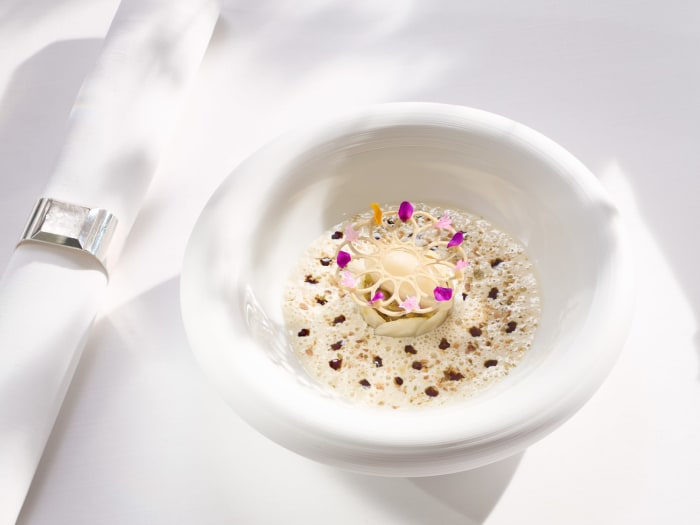
The gastronomic cuisine here invites careful consideration. Luxury resides in the overall precision: the accuracy of cooking, the clarity of flavours, the rhythm of service, the intelligence of pairings, and the quality of attentiveness in the dining room.
The establishment is rooted in the French tradition of fine dining as a complete, sensory, cultural, and relational experience. The meal becomes a highlight of the stay.
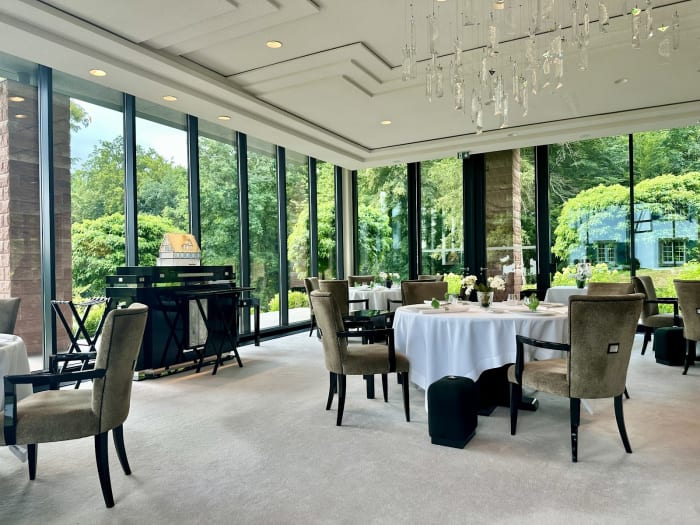
The setting naturally plays a major role. Dining in a house associated with the Lalique universe adds a unique aesthetic dimension to the experience. The attention given to light, materials, presentation, and atmosphere enhances this impression.
For travellers choosing Villa René Lalique, reserving dinner is an integral part of the stay. It is wise to consider the room and the dining experience as a cohesive whole. Here, gastronomy is neither decorative nor ancillary; it is the primary language of the place.
Wellness & a Moment of Calm
Villa René Lalique embodies a philosophy of tranquility and attentiveness. Here, well-being flourishes in the peaceful surroundings and the intimate scale of the establishment. Whether for a night or a weekend, the stay allows guests to distance themselves from everyday distractions.
The garden and lush landscape play a crucial role, providing a natural counterpoint to the intensity of a gourmet dinner. Taking a walk outside, observing the light filtering through the leaves, or extending a quiet coffee break: these simple gestures acquire a special significance here. Luxury, in this context, lies in the ability to slow down and breathe.
Comfort is also defined by the quality of the room and the seamlessness of the service. Thoughtfully curated bedding, turn-down service, discreet room tidying, wake-up calls upon request, and attentive concierge services all contribute to a simplified stay. This almost invisible comfort allows both body and mind to relax naturally.
For many travellers, Villa René Lalique will serve as a gastronomic and emotional refuge. It is a place to reconnect, celebrate, unwind, share a meal, sleep deeply, and enjoy a preserved environment. Well-being here is as much about relationships as it is about physical comfort. In the context of a romantic getaway, this aspect takes on a particular significance.
This approach appeals to guests who appreciate a moment of calm. Villa René Lalique offers a luxury of deceleration, founded on the harmony between the house, the landscape, and the table. Here, rest does not adhere to a schedule; it emerges naturally from a thoughtfully curated set of conditions.
Concierge & Services
In a high-end establishment on an intimate scale, the service must never appear mechanical. At Villa René Lalique, it is based on a discreet, continuous, and precise presence. 24-hour concierge service, 24-hour reception, daily room service, turn-down service, luggage storage, laundry, wake-up calls, and multilingual staff create a seamless stay.
The reception available at all hours provides tangible serenity. Late arrivals, early departures, last-minute requests, or the need for assistance always find a point of contact. In a place designed for calm, this continuity matters. Luxury also consists of not having to think about logistical details.
The concierge plays a central role. It accompanies, guides, and simplifies the stay. Dinner timings, local walks, luggage management, or the rhythm of the stay, it helps organise the experience coherently. When it is just right, the service becomes less visible and more relevant.
Daily housekeeping and turn-down service contribute to this sensation of a perfectly maintained home. They accompany the various moments of the stay, from returning to the room to preparing for the night. Nothing spectacular, but a series of precise gestures. The laundry service and luggage storage add practical comfort, particularly for travellers on the move.
The presence of multilingual staff serves as a reminder that high-end hospitality also relies on immediate understanding. Simply expressing a preference, request, or constraint changes the quality of the welcome. Villa René Lalique thus champions a service that is neither distant nor intrusive, but tailored.
The art of living in Wingen-sur-Moder
Choosing Villa René Lalique also means choosing a certain idea of Alsace, less obvious than that offered by the region’s busiest routes. Wingen-sur-Moder does not belong to the immediately recognisable tourist scenery; that is precisely what makes it interesting. Here, the art of living is discovered through a more intimate relationship with the territory: forests, calm, changing light, and the presence of an artisanal and artistic heritage that gives depth to the landscape. The stay then acquires a different tone: more inward, more attentive, almost slower.
This part of Alsace invites guests to move beyond clichés without denying regional identity. One still finds a sense of welcome, the importance of the table, a taste for well-kept houses and a concrete relationship to materials, seasons and know-how. Yet everything is expressed in a more confidential register. For the traveller, this is an opportunity: to discover a region not as scenery to consume, but as an environment to feel. Villa René Lalique acts here as a privileged point of entry. Through its name, atmosphere and table, it immediately offers a sensitive way of reading the place.
The local art of living also lies in this ability to let culture and nature coexist. In the surrounding area, one may imagine walks, moments of observation, stops in villages or discoveries linked to glassmaking and decorative heritage, without needing to saturate the stay with activity. It is a destination that accommodates restraint very well. A quiet morning, a light lunch, an outing nearby, a return to the hotel to prepare for dinner: this chosen simplicity fits the spirit of the house perfectly.
For couples, the destination has a particular obviousness. The calm of the village, the intimacy of the hotel, the centrality of the gastronomic experience and the leafy setting all combine to create a stay suited to conversation, discreet celebration and shared time. Guests come here less to collect visits than to give quality to a few carefully chosen moments. It is a more mature approach to travel, and often a more memorable one.
Wingen-sur-Moder finally reminds us that a great stay does not always depend on an urban address or a spectacular panorama. It may arise from a subtler concordance between a place, a house and a way of inhabiting time within it. Villa René Lalique illustrates that idea perfectly. It allows guests to experience Alsace at its most hushed: a taste for detail, fidelity to craftsmanship, the gentleness of a preserved environment, and that very French ability to make hospitality a form of art de vivre. For travellers seeking a destination of character, refined without excess, Wingen-sur-Moder becomes a discreetly compelling choice.
Booking via MyConciergeHotel
Booking Villa René Lalique through MyConciergeHotel means approaching this address with precision. Here, the preparation of the stay is almost as important as the stay itself.
The right tempo involves collaboratively considering the date, the room, the dinner, and the desired pace for the getaway. A well-supported reservation allows for these elements to be arranged simply.
One of the key points concerns the dining experience. It is advisable to book the main restaurant upon arrival, or in advance when possible. Spaces are limited. In a destination where the restaurant is of such significance, this moment should not be treated as a detail. MyConciergeHotel helps articulate accommodation and dining coherently.
The platform can also assist in positioning the stay according to the appropriate use of the place. Romantic getaway, discreet celebration, gastronomic weekend, or a stop along an Alsatian itinerary. Depending on the intention, expectations vary. Calm, timings, flexibility upon arrival or departure, specific requests in the room. In a human-scale establishment, these nuances matter. They can adjust the stay with precision.
Villa René Lalique is not merely a list of amenities, even if they meet the standards of a five-star establishment. Its value lies in a more subtle ensemble. Its roots in Wingen-sur-Moder. Its hushed atmosphere. Its affiliation with Relais & Châteaux. Its verdant setting. Its gastronomic vocation.
A well-informed reservation takes this personality into account. It allows one to know who the address will suit best, at what time of year, and in what spirit to experience it.
Choosing MyConciergeHotel prioritises relevance over mere availability. For a house like Villa René Lalique, this difference matters. One does not simply choose a category of hotel. One chooses an ambiance, a scale, a promise of stay. When this promise is understood in advance, everything becomes more fluid. The arrival, the dinner, the night, the awakening, and then the memory one carries away.