History & heritage
In Bangkok, few addresses create a genuine sense of retreat without disconnecting from the city. The Sukhothai Bangkok belongs to that category of hotels whose identity rests less on spectacle than on coherence. Its name recalls the ancient kingdom of Sukhothai, often associated in the Thai imagination with balance, refinement and classicism. The reference is telling: rather than imitating a historic palace, the hotel translates certain principles of Thai aesthetics into a contemporary language — symmetry, water, stone, calm sightlines and a measured relationship between architecture and gardens.
Over time, the hotel has established itself as a Bangkok address valued for an atmosphere that is more composed than theatrical. In a capital defined by intensity, traffic and constant movement, it offers another reading of luxury: one built on relative quiet, fluid circulation, breathing space and attentive service. This way of inhabiting the city has shaped its reputation among international travellers seeking either an elegant base for business or a refuge for a few days of discovery.
Its membership in Small Luxury Hotels of the World also clarifies its positioning. It suggests something essential: the experience here is not conceived as a standardised product, but as a sum of details, rhythms and sensations. Guests generally find what major cities make hardest to preserve: continuity. Continuity between arrival and settling in, between public spaces and the privacy of the room, between the energy outside and the calm within.
The heritage of The Sukhothai Bangkok is therefore not simply a matter of dates or dramatic milestones. It lies more in a certain idea of high-end Asian hospitality, interpreted with restraint. Landscaped gardens, reflecting water, mineral materials, ordered volumes and discreet transitions create a setting designed to outlast passing trends. That is precisely what gives the hotel its timeless character.
For travellers, this notion of heritage matters. It means one does not come here merely to sleep in a fine Bangkok hotel, but to enter an address that has preserved a recognisable signature — one shaped by calm, precision and the right degree of distance from urban bustle. In a city where everything changes quickly, such fidelity to an art of hospitality becomes a form of living heritage in itself.
The Establishment
The Sukhothai Bangkok stands out for its unique approach to space. While many urban hotels lean towards verticality, this one favours a more horizontal and breathable composition. Contemporary architecture harmonises with carefully arranged landscaping: gardens, water features, courtyards, and visual pathways. This staging of calm forms the heart of the experience.
Upon arrival, the prevailing impression is one of slowing down. Not a complete break from Bangkok, but a suspension. The noise seems to fade away, perspectives open up, and the communal spaces exude a subtle elegance. The lounges, corridors, and waiting areas contribute fully to the sense of being at home.
The hotel appeals to those who appreciate places where luxury is reflected in the quality of the atmosphere. The landscaped gardens in the heart of Bangkok play a crucial role here. They organise the view, create breathing spaces, and remind us that in the midst of a dense capital, some places are designed around balance. This greenery makes it a fitting choice for both business travellers and leisure stays.
The neighbourhood allows for a flexible exploration of Bangkok. One can set off early for business meetings, return in the afternoon for a quieter pause, and then head out again for dinner or to explore the city. The Sukhothai Bangkok caters to this reality with a fluid organisation and an ambience that does not tire.
Finally, what strikes one is the coherence between the hotel’s name, its contemporary architecture, and its soothing atmosphere. Nothing feels forced here. The place does not seek to overplay exoticism nor erase its urban roots. It offers a refined version of the urban refuge: a Bangkok hotel that embraces the city while interpreting it through calm, geometry, and discretion.
Rooms and Suites
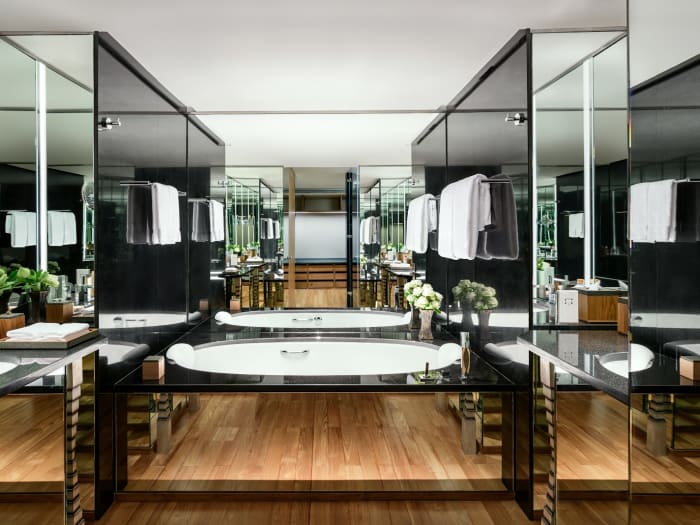
In a hotel like The Sukhothai Bangkok, the room extends the general logic of the establishment. Here, one finds a pursuit of tranquillity, an attention to lines, and a sense of order. Luxury is conveyed through the clarity of space and the quality of daily experience. For the traveller, this translates into an environment designed for rest, occasional work, and the simple pleasure of inhabiting the room for a few hours.
In Bangkok, this quality is far from superficial. Days can be long, intense, and very hot. Thus, returning to an interior free from unnecessary stimulation is greatly appreciated. In an establishment of this calibre, one expects serious bedding, a comfortable bathroom, meticulous maintenance, turn-down service, and daily housekeeping. Often, it is these details, more than decorative effects, that determine the true quality of a stay.
The suites appeal to travellers seeking more space. They offer a clearer separation between rest and moments of reception or work. In an international capital like Bangkok, this configuration suits both extended stays and demanding business trips. A well-designed urban hotel knows how to cater to different needs without losing its cohesive tone.
The relationship between the interior and the exterior also matters. In a property renowned for its landscaped gardens and serene atmosphere, the room becomes a retreat. One returns here after visiting temples, markets, meetings, or dinners. It offers a controlled temperature, a slower pace, and a sense of protection. This refuge function is central to luxury hospitality in Asia, and The Sukhothai Bangkok embraces it with precision.
When choosing between a room and a suite, it all depends on the type of stay. A brief visit to the city can be very well enjoyed in an elegant and well-organised room. A longer stay, an urban honeymoon, or a trip combining business and leisure justifies opting for a suite. The appeal of this address lies in its simple promise: to provide, in the heart of Bangkok, a space where one can truly unwind.
Dining
In Bangkok, dining is never merely a hotel service. The city ranks among Asia's great culinary capitals. The Sukhothai Bangkok is part of this comprehensive hospitality ethos, where the culinary experience contributes to the identity of the stay.
The first pleasure often lies in breakfast. In Bangkok, days begin early, and the heat encourages one to enjoy the cooler hours. Set against a backdrop of gardens and elegant spaces, breakfast takes on an almost ceremonial dimension. Tropical fruits, pastries, international options, coffee savoured at leisure. For many travellers, this is where the tone of the stay is set.
The rest of the dining offerings cater to various needs. There are business meals, which require calm, punctuality, and impeccable service. More personal dinners, where one seeks a certain atmosphere. And the in-between moments, tea, snacks, or drinks at the end of the day. The elegant communal spaces allow for lingering between meetings or extending the evening without leaving the hotel.
What makes dining here interesting is its ability to engage with the city without merely replicating it. Bangkok offers an unparalleled culinary intensity outside. Inside the hotel, one expects a form of mastery. The pleasure lies not in excess, but in balance. A clear cuisine, attentive service, and an ambience that allows for conversation, relaxation, or celebration without effort. In an urban stay, this consistency becomes invaluable.
It would be a shame to stay at The Sukhothai Bangkok without embracing both dimensions of the journey. Enjoy the hotel's dining for moments of comfort, then explore the markets, local eateries, and the city's finest restaurants. It is this alternation that enriches a stay in Bangkok. The hotel thus plays its role: providing a fitting backdrop to better return to the city. A good hotel restaurant is not a retreat; it is an anchor point.
Spa & Well-being
At The Sukhothai Bangkok, well-being is an integral part of the overall experience. Bangkok is an exhilarating city, yet it can be demanding on the senses. The heat, traffic, visual density, and jet lag create a genuine need for recovery.
The spa addresses this necessity as a place of transition. It is a sanctuary to retreat to after a long-haul flight, between two days of meetings, or upon returning from a more intense exploration of the city. Booking a treatment upon arrival often allows for a more serene entry into the stay.
In a venue renowned for its calming atmosphere, the spa extends this quality of silence and control. The treatment transcends a mere pleasant moment; it aids in recalibrating the body to the rhythm of travel.
Well-being also permeates the entire establishment. The landscaped gardens, elegant communal spaces, and the sensation of tranquility at the heart of Bangkok all contribute to this experience. One sleeps better in a hotel where transitions are gentle. Recovery is enhanced in a place that absorbs some of the city's intensity.
Thus, The Sukhothai Bangkok is well-suited for travellers who are attentive to deep comfort. Well-being emerges from a coherent whole, where service, time saved, preserved calm, and discreet attentiveness compose this unique experience.
Concierge & Services
Hotel luxury is often measured by the quality of its most discreet services. At The Sukhothai Bangkok, several fundamentals shape a seamless experience: 24-hour concierge, 24-hour reception, daily room service, turn-down service, luggage storage, laundry, wake-up service, and multilingual staff.
For the business traveller, this flexibility is essential. Bangkok is a city of meetings, connections, and time zone shifts. Being able to rely on an active reception at any hour, a reliable wake-up call, efficient luggage handling, or well-organised laundry significantly enhances the quality of the stay. These services help maintain professional continuity in a foreign city.
For leisure travellers, the same services take on a different significance. The concierge becomes a support point for organising travel, refining an itinerary, booking a car, obtaining a visit recommendation, or articulating a day between temples, markets, shopping, and relaxation. In a metropolis as rich as Bangkok, the value of a good concierge lies in its ability to simplify without standardising.
The turn-down service and daily maintenance also contribute to this sense of precision. The room is ready at the right moment, personal belongings are respected, and special requests are met. This discretion is among the most refined forms of hospitality.
Finally, the multilingual staff deserves special mention. In an international establishment, the quality of interaction relies as much on courtesy as on understanding expectations. At The Sukhothai Bangkok, these services are delivered in a calm and elegant atmosphere. This combination of constant availability and restraint distinguishes a well-managed urban address.
The Art of Living in Bangkok
Staying at The Sukhothai Bangkok means embracing a particular way of experiencing the city. Bangkok never reveals itself all at once; it unfolds in layers and contrasts. An establishment like this serves as a foundation for an urban lifestyle: setting out early, returning to recharge, and then venturing out again in a different direction. This flexibility enhances the appreciation of a captivating and demanding capital.
Bangkok is understood as much through its grand religious sites as through its street scenes, business districts, shopping centres, canals, and culinary aromas. The discerning traveller discovers a complex city where the sacred and the everyday coexist without artifice. Starting the day at a temple, enjoying a simple lunch, traversing a contemporary neighbourhood, and then returning to the hotel before heading out for dinner often creates the best rhythm.
Between November and February, the more temperate season is ideal for exploring on foot. However, regardless of the time of year, Bangkok requires a true understanding of tempo. One must accept that not everything can be seen. It is wiser to allow for moments of rest and to focus on a few carefully chosen experiences. A serene hotel thus becomes invaluable, enabling one to experience the city without being overwhelmed by it.
The Bangkokian art of living also hinges on this coexistence of registers. One can seamlessly transition from an ancient sanctuary to a contemporary avenue, from a bustling market to a plush lounge, from street food to a more formal dining experience. The Sukhothai Bangkok accommodates this plurality well, providing a stable backdrop from which each guest can craft their own version of Bangkok.
To fully enjoy your stay, the best advice is straightforward: use the hotel as a place of respite, not as a closed bubble. Take your time over breakfast. Ask the concierge to arrange your journeys. Schedule a treatment if the jet lag sets in. Then go out and see the city as it is: dense, vibrant, sometimes bewildering, always alive. Returning to the tranquil gardens and spaces of the hotel adds depth to the experience. In Bangkok, luxury lies in choosing the right distance.
Book with MyConciergeHotel
Booking The Sukhothai Bangkok through MyConciergeHotel means approaching the hotel not simply as a room to secure, but as an experience to prepare intelligently. In a destination as layered as Bangkok, the difference is often made before arrival: choosing the right room or suite category, shaping the rhythm of the stay, organising transfers, reserving a spa treatment, and balancing leisure with professional commitments. The better a trip is considered in advance, the more fully the hotel can deliver once one is on site.
This address lends itself particularly well to tailored preparation. The traveller profiles it attracts are varied: couples on an urban escape, business travellers, guests who favour calm hotels in major capitals, and mixed stays combining work with discovery. Not everyone expects the same thing from a five-star hotel in Bangkok. Some will prioritise rest and wellbeing, others logistical fluidity, and others still easy access to the city’s principal points of interest. The role of MyConciergeHotel is precisely to help clarify those priorities so that the booking can be guided in a meaningful way.
In practical terms, that may mean recommending a suite rather than a room for a longer stay, suggesting that spa treatments be arranged as soon as the booking is confirmed, or advising on the most pleasant travel period, notably between November and February when the climate is generally milder. It may also mean drawing attention to the value of a hotel that is a member of Small Luxury Hotels of the World for travellers seeking something more individual than a standardised large-scale property.
Booking through an editorial and concierge-led intermediary offers another advantage as well: it places the hotel in context. The Sukhothai Bangkok is not chosen solely for its facilities, but for its atmosphere, landscaped gardens, calming contemporary architecture and ability to provide a genuine counterpoint to the city’s energy. That qualitative reading often helps determine whether the address truly matches one’s way of travelling.
Finally, MyConciergeHotel can help turn a good booking into a seamless stay. A hotel of this category reveals its full value when details are aligned: a smooth arrival, a suitable room, special requests communicated and the first hours on site simplified. In Bangkok, where urban intensity can quickly take over, that preparation has real value. Booking The Sukhothai Bangkok with discernment is already a way of beginning to enjoy what it offers most meaningfully: a form of organised calm in the heart of one of Asia’s most vibrant cities.