The hotel
On Boston’s waterfront, InterContinental Boston offers an address that suits both travellers intent on reading the city closely and those who simply want to move through it with ease. Its contemporary architecture, set beside the harbour, belongs to a district where historic Boston meets the energy of a reinvented waterfront. The experience begins with a distinctly local sensation: being poised between water and city grid, between the glass silhouettes of downtown and the founding landmarks of one of America’s oldest cities.
Much of the hotel’s character comes from this direct relationship with the harbour. Views over Boston Harbor bring a rare sense of openness to a dense metropolis and quietly remind guests how deeply the city’s identity is tied to maritime trade, crossings and an enduring Atlantic imagination. From the public spaces, as from some rooms, the changing light on the water becomes a living backdrop: light mist in the morning, metallic reflections by day, softer tones as evening settles over the quays.
Inside, the register is that of a clear-lined urban luxury, free of excess. Volumes, materials and circulation favour legibility and comfort. The hotel embraces a modern aesthetic, with elegant interiors that avoid theatricality. It is a fitting approach for Boston, a city of contrasts where one can move within a few streets from an eighteenth-century brick façade to a more contemporary ensemble. InterContinental Boston belongs to that continuity: it does not attempt to imitate history, but offers a present-day base from which to discover it.
Location is one of its most obvious strengths. Being in the heart of Boston, close to the Freedom Trail and near the Boston Tea Party Ships and Museum, changes the rhythm of a stay. Guests can set out on foot towards major landmarks, reach the financial district with ease, continue along the waterfront, or shape a day without constantly relying on a car. That logistical simplicity matters, whether for a business trip structured around meetings or a city break alternating museums, architecture, shopping and pauses by the water.
The overall atmosphere remains sophisticated yet approachable. Couples, families and business travellers can all use the hotel differently without the place losing coherence. It feels like an address designed to accompany the city rather than insulate itself from it. After a day in Beacon Hill, on the trail of American history, or among Boston’s cultural institutions, returning here has a calming quality: the presence of the harbour, the restraint of the interiors and the steadiness of the service restore a gentler pace to the evening.
Its inclusion in Condé Nast Traveler’s 2025–2026 Gold List confirms this distinctive position within the local hotel landscape. More than a mere place to stay, InterContinental Boston emerges as an elegant hinge between the scholarly city and the maritime city, between the intensity of an active centre and the breathing space offered by the water. For travellers who want to understand Boston without giving up the comfort of a major international hotel, the balance feels particularly well judged.
Rooms and suites
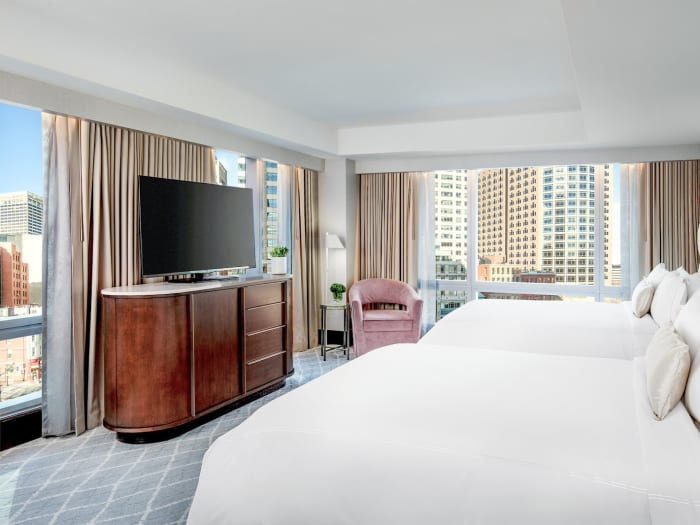
In a city where days are often spent outdoors, walking from one neighbourhood to another, the quality of a room is frequently measured by its ability to slow the pace without severing the connection to what lies outside. At InterContinental Boston, rooms and suites follow that logic. They extend the hotel’s contemporary aesthetic through a restrained language, designed for lasting comfort rather than instant effect. There is nothing ostentatious here: elegance comes from clean lines, balanced proportions and an overall sense of order that suits an urban stay particularly well.
In this setting, the first luxury is often light. Depending on orientation, some rooms look towards the city while others open onto the harbour, bringing in the presence of water that subtly transforms the stay. In Boston, where the seasons shape the landscape so distinctly, a view is never merely decorative. It speaks of climate, movement along the quays, the New England sky and the way the city unfolds between historical inheritance and modernity. Waking to the harbour, or returning in the evening to the reflections of the waterfront, gives the experience an added depth.
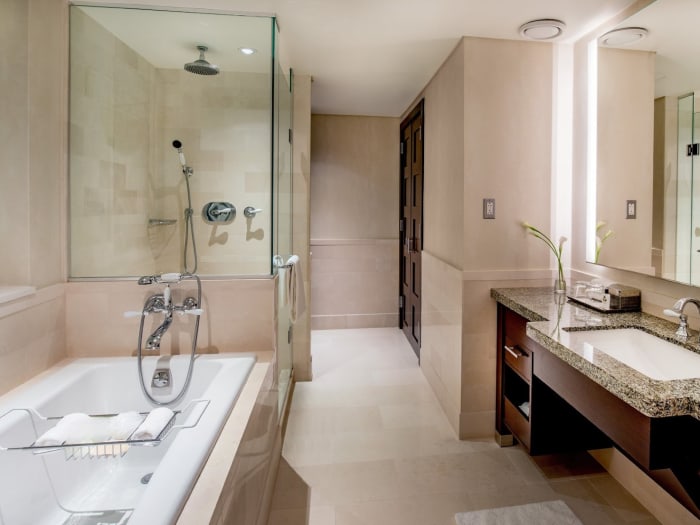
The layout favours clarity. Sleeping spaces are conceived to suit the business traveller working between meetings just as well as the couple on a city break or the family exploring Boston together. From a major international hotel one expects a certain discreet efficiency: intuitive circulation, thoughtful storage, enveloping bedding and a bathroom able to support the rhythm of a full day. It is precisely in this absence of friction that a room succeeds. Everything should feel simple, not because the place is minimal, but because it has been designed so that a stay unfolds without unnecessary effort.
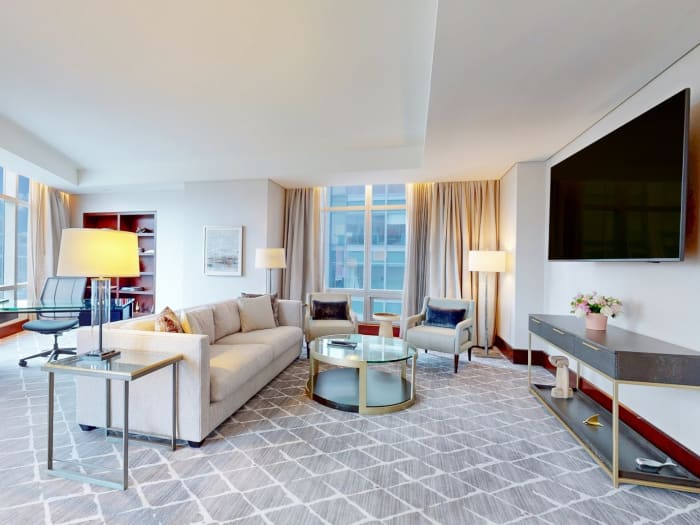
The suites introduce a more residential dimension, especially valuable for longer stays or for guests who wish to host, work or simply enjoy more space. In a city such as Boston, where many visitors combine professional obligations with time for discovery, that flexibility matters. A separate sitting room, a broader perspective over the city or harbour, a stronger sense of retreat: all these elements allow the stay to be shaped according to need without losing the hotel’s aesthetic unity.
Turndown service and daily housekeeping reinforce this impression of continuity. They are reminders that beyond design, hotel comfort rests on regular, almost invisible gestures that keep the room at its most welcoming from morning to night. In a property of this level, true refinement lies not only in materials or views, but in the consistency with which the space remains ready to receive.
These rooms and suites do not try to distract from Boston; rather, they provide a calm frame from which to move through it more fully. After the animated streets of downtown, the cultural institutions, the waterfront or the city’s historic routes, one returns here to a form of visual quiet and measured comfort. It is a kind of hospitality that understands the city it serves: active, cultivated, maritime, occasionally intense, and all the more enjoyable when, at day’s end, it can be contemplated from a perfectly kept interior.
Dining
In an urban hotel of this calibre, dining is never merely functional. It structures the hours of a stay, provides meeting points, creates pauses between visits and can even become a reason to remain in-house when the city begins to slow. At InterContinental Boston, that dimension is shaped through a distinctly Italian identity, expressed between restaurant and bar in a spirit that favours controlled conviviality over display.
Matria sets the tone on the restaurant side. Its inspiration draws from Piedmont and the Italian Riviera, two culinary imaginaries that differ greatly yet are joined by a shared idea of precise generosity. The former suggests a cuisine of terroir, structured and deeply comforting; the latter brings a more maritime, supple and sunlit note. On the plate, that line translates into housemade pastas, quality steaks and a selection of old-world wines chosen to accompany rather than dominate. The intended result is not a folkloric version of Italy, but a table capable of offering, in the heart of Boston, a dinner with character where technique remains in service of the pleasure of eating.
This direction feels particularly apt in the local context. Boston has a rich dining scene, but also a culture of full days, divided between business appointments, cultural outings and long walks. Returning to the hotel for a dinner that is at once substantial, legible and elegant has a certain rightness. Matria answers that need with a proposition suited equally to a business meal and to a more intimate evening. The aim is not to dramatise the occasion, but to give it shape and substance.
To extend the evening, or simply mark a pause at the end of the afternoon, Bar Fellini introduces another register. Its décor, with rich textures and sculpted arches, creates a more enveloping atmosphere, at moments almost cinematic, without losing the restraint expected of a grand hotel. The cocktail programme revisits Italian classics with close attention to balance. Martini, Negroni and other established references find a natural home here, in a spirit that speaks as much to seasoned hotel-bar regulars as to travellers seeking a place where the day can gently change key.
Together, restaurant and bar create a genuine internal geography. One may begin the evening there, continue it, or simply claim a self-contained moment without any larger plan. That is one of the privileges of a strong urban address: to offer spaces that do not merely serve the rooms, but exist as places in their own right. At InterContinental Boston, that autonomy is felt in the way dining contributes to the hotel’s overall atmosphere.
For the traveller, this means a welcome form of freedom. One can choose to go out and explore Boston and its neighbourhoods, or decide that after a full day, the best itinerary is simply to come downstairs for dinner and drift afterwards towards the bar for a final drink. In either case, the hotel fulfils its role: not to compete with the city, but to offer within it a coherent, elegant and well-paced version of contemporary hospitality.
Concierge and services
The true luxury of a major urban hotel often reveals itself less in appearance than in the quality of transitions. Arriving early, leaving late, storing luggage, receiving a useful recommendation, returning to a room restored after a full day: these gestures form the invisible fabric of a successful stay. At InterContinental Boston, that continuity rests on a service structure designed to accompany varied rhythms, whether the trip is a tightly scheduled business visit, a weekend for two or a more mobile family stay.
The presence of a 24-hour front desk and round-the-clock concierge immediately sets the tone. In a city such as Boston, where flight times, early meetings, evening performances or impromptu excursions can alter the day’s plan, such availability is more than a comfort: it allows the stay to remain flexible. In this context, the concierge is not merely a practical intermediary. The role becomes that of an interpreter of the city, able to shape a day according to shifting priorities, assist with transport, suggest a walkable route or smooth the details that might otherwise fragment the experience.
Daily housekeeping and turndown service contribute to the same idea of continuous hospitality. The effect of a perfectly kept room on the perception of a stay is often underestimated. In an active destination, where impressions and miles accumulate quickly, returning in the evening to a space restored to order creates a welcome sense of reset. Comfort is not only material; it is mental as well. Everything that reduces the traveller’s logistical burden increases their availability to the city.
Luggage storage, laundry and wake-up service belong to that discreet efficiency that distinguishes well-run properties. The first can win back a precious half-day, on arrival as much as departure, especially for guests wanting one last walk along the waterfront, a museum visit or lunch in town. The second answers the realities of longer stays, business travel or wider itineraries along the East Coast. As for wake-up calls, they may seem to belong to another era; they remain one of those reassuring details that matter when a train, flight or important meeting is at stake.
The presence of multilingual staff adds another layer of ease. In an international address, the ability to welcome travellers from different backgrounds without creating unnecessary distance has real value. It belongs to a mature form of hospitality, one that understands service not as a multiplication of effects, but as the art of making every interaction simpler, clearer and more precise.
Ultimately, the services at InterContinental Boston express a particular idea of the contemporary grand hotel: a place where one is looked after without being constrained, accompanied without being watched, helped without the help becoming conspicuous. This quietly effective discretion is especially well suited to Boston, an exacting, intellectual and mobile city that lends itself to full itineraries. Everything here seems designed so that guests can devote their energy to the city itself, knowing that the hotel’s operational backdrop will hold its place perfectly.
The Boston way of life
To stay at InterContinental Boston is also to adopt a particular way of experiencing the city: on foot, in sequences, allowing history, water and neighbourhoods to speak to one another. Boston is not a metropolis that reveals itself in a single gesture. It is understood in layers, through adjoining districts and routes that connect foundational sites with more contemporary zones. The hotel’s location, in the heart of the city and close to the waterfront, makes precisely that gradual reading possible. One may begin the day in harbour light, move on through the landmarks of American history, then drift towards a Boston that is more commercial, more cultural or more residential according to mood.
The nearby Freedom Trail offers an almost natural structure for discovery. This historical thread provides an entry into the city through its founding narrative, without reducing the experience to a purely heritage-based itinerary. In Boston, history is never entirely museum-bound; it remains woven into daily life, in squares, façades, institutions and patterns of movement. The proximity of the Boston Tea Party Ships and Museum likewise reminds visitors how deeply the relationship to water and to the very idea of political liberty belongs to the local DNA. From the hotel, these dimensions are not abstract: they become accessible almost at once.
Yet the Boston way of life extends beyond its symbols. It also lies in a relatively legible urban scale, a culture of walking and the coexistence of highly distinct neighbourhoods, each with its own texture. A morning may be devoted to architecture and institutions, an afternoon to the waterfront and museums, and the day may end in another register altogether, among shops, bookshops, cafés or restaurants. This variety, concentrated within a fairly manageable perimeter, makes Boston especially rewarding for stays of a few days: dense without being overwhelming, cultivated without being remote, active without losing all softness.
The seasons also play an essential role in the experience. Spring and autumn are often the most harmonious moments to explore the city, when temperatures favour long walks and the light sharpens the contrasts between brick, stone, glass and water. From a hotel oriented towards the harbour, these seasonal variations become even more expressive. They invite a flexible rhythm: setting out early, returning for a pause, going back out in the late afternoon, or choosing instead to contemplate the city from indoors when the weather calls for greater retreat.
Boston finally appeals through its balance of seriousness and pleasure. It is a city of universities, political memory, culture and business, but also a city of walks, maritime views and simple moments very well lived. InterContinental Boston fits naturally within that spirit. It allows guests to experience the city without overstatement, with the right degree of comfort and perspective. One returns in the evening with the sense of having crossed several cities in a single day: historic Boston, harbour Boston, contemporary Boston. Few addresses make that plurality so immediately legible.
History and heritage
InterContinental Boston is not a heritage hotel in the classical sense. Its identity does not rest on an old façade or on an aristocratic narrative carried into the present. Its interest lies elsewhere: in the way a contemporary address enters into dialogue with a city whose historical consciousness is unusually strong. In Boston, almost every district seems to carry a precise memory, whether political, maritime, intellectual or architectural. To place a major modern hotel on the waterfront is therefore to take a position within that conversation between past and present.
The building embraces that contemporaneity. Its modern architecture and elegant interiors do not attempt to reproduce the colonial or federal codes that shape so many images of Boston. On the contrary, the hotel suggests that a city’s heritage may also be read through its capacity for transformation. Boston’s waterfront, long tied to port and commercial activity, has over time become a space of movement, promenade and hospitality. InterContinental belongs to that evolution: it forms part of a new urban geography in which water is no longer only an economic tool, but a lived landscape.
This position is especially compelling in a city where American history is omnipresent. Nearby, the Boston Tea Party Ships and Museum recalls a foundational episode of the pre-revolutionary era; a little further on, the Freedom Trail links essential sites in the national story. From the hotel, these landmarks are not relegated to the status of distant excursions. They form part of the immediate neighbourhood, as though the contemporary stay were constantly bordered by traces of a decisive past. That is one of Boston’s particular charms: history is close at hand, yet never entirely fixed.
InterContinental Boston also inherits, in a more diffuse way, the tradition of major international hotels established in cultural or economic capitals. Such addresses often play a discreet but genuine role in city life: welcoming business travellers, visitors in transit, families on discovery trips, and at times events or encounters that contribute to the life of the centre. In a metropolis such as Boston, where universities, finance, medicine, innovation and cultural tourism intersect, that role as an interface takes on full meaning. The hotel becomes a structuring place of passage, a point of convergence rather than a mere backdrop.
Its recent inclusion in Condé Nast Traveler’s 2025–2026 Gold List belongs to this logic of maturity. It signals less a passing fashion than a durable place within the city’s landscape of leading addresses. The true heritage of a contemporary hotel is often built in precisely this way: through consistency of service, the accuracy of its location, the quality of its urban integration and the manner in which it accompanies the uses of its guests year after year.
In that sense, InterContinental Boston tells a very current story of hospitality: one in which luxury does not seek legitimacy through the past, but finds depth in the context it inhabits. In Boston, that depth is considerable. Between revolutionary memory, maritime culture and urban renewal, the hotel occupies a position that allows the city to be grasped in full continuity, from its origins to its most contemporary expressions.
Book with MyConciergeHotel
Choosing InterContinental Boston through MyConciergeHotel means approaching the property in the right way: not as a room to be confirmed, but as a stay to be composed. In a city so shaped by neighbourhoods, walkable distances, visiting rhythms and seasonal variations, the relevance of a booking depends as much on the choice of hotel as on the way it is placed within a coherent programme. An address on the harbour, in the heart of Boston and close to major landmarks such as the Freedom Trail, is not experienced in quite the same way whether one is coming for forty-eight hours, for a week combining business and leisure, or for a first discovery of New England.
The value of dedicated guidance lies first in this fine reading of the stay. Some travellers will prioritise immediate proximity to historic sites; others will care more about harbour views, the fluidity of business appointments or the ability to move easily between districts. Others still will seek a balance between time in the city and moments of retreat, with the option of dining in-house, having a drink at the bar and setting out the next day on a very different itinerary. Booking intelligently here means aligning location, rhythm and the traveller’s real expectations.
This approach is all the more relevant because Boston rewards well-prepared stays. The city is wonderfully walkable, yet it benefits from being thought of in sequences: historical mornings, cultural afternoons, waterfront walks, evenings that are either more gastronomic or more intimate. A hotel such as InterContinental Boston then becomes a strategic base, able to support these shifts in register without ever complicating the logistics. It still matters, however, to choose the right tempo, the right length of stay and sometimes the right room or suite category according to the nature of the trip.
MyConciergeHotel makes it possible to place the booking within precisely that wider logic. For a couple, the priority may be a more contemplative experience, with the harbour as a guiding thread. For a business trip, the essential point may be the fluidity of services, the quality of rest and ease of access to the main activity centres. For a family, one may seek above all simplicity of movement, flexibility of timing and the ability to alternate cultural discovery with moments of pause. In each case, the same hotel can answer very different expectations, provided it is booked with discernment.
There is also, in this way of proceeding, a certain idea of contemporary luxury: saving time, avoiding approximate choices and entering a city with a base that already feels right. Boston is a destination that reveals itself most fully when one does not have to improvise the fundamentals. InterContinental Boston offers a strong, elegant and central setting; the guidance of MyConciergeHotel helps draw from it the most fitting interpretation for the stay in question.
Booking then becomes more than a formality. It is the first gesture of a successful journey, the one that shapes the quality of the days ahead, the ease of movement, the pleasure of returning in the evening and the rare sense that everything is in its place. In a city as nuanced as Boston, that initial accuracy often makes all the difference.