History & heritage
Château de la Treyne belongs to that rare category of addresses where hospitality is not merely a matter of comfort, but of continuity. In Lacave, within the preserved countryside of the Lot, the property reflects a distinctly French tradition: that of the château turned hotel without losing its residential soul. Here, heritage is not a decorative concept. It is expressed through the relationship between architecture, landscape and the rhythm of a stay. Guests do not enter a standardised hotel, but a characterful house whose identity rests on permanence.
Its Relais & Châteaux affiliation helps define this position. It implies a certain idea of travel, rooted in place, individuality, fine dining and attention to detail. At Château de la Treyne, that ethos feels entirely coherent in a setting that encourages the eye to slow down. The château overlooks a wooded, mineral landscape typical of the Quercy region, with that sense of elegant retreat associated with the great French country houses. One finds here not ostentation, but poise: historic volumes, a hushed atmosphere, open views over nature, and that very French idea of luxury that favours balance over effect.
Heritage also takes on a more intimate meaning. It refers as much to the building’s memory as to the customs that have settled into it over time: the importance of a carefully considered table, the quality of service, the discretion of the staff, the attention paid to guests’ privacy. In a château hotel, the finest experience often lies in this delicate balance between preservation and adaptation. The property must remain legible as a historic residence while meeting contemporary expectations. Château de la Treyne appears to cultivate precisely that line: preserving the spirit of an old house without freezing it, offering the comfort expected of a five-star hotel without diluting the site’s character.
This continuity is especially apparent in the way the château relates to its surroundings. In many heritage properties, the landscape serves as a backdrop. Here, it seems integral to the experience. The sense of relative seclusion, the presence of greenery, the impression of being welcomed into a peaceful enclave all contribute directly to the identity of the address. That is what gives a stay its depth: one comes not simply to sleep in a beautiful building, but to inhabit, for a few days, a particular relationship with time and space.
In that sense, Château de la Treyne belongs to a French art of living centred on duration, restraint and harmony. Heritage is not treated as spectacle, but as a living material. For the traveller, that distinction matters. It turns an overnight stay into an experience of place, and a stay into a lasting memory.
The property
Staying at Château de la Treyne means choosing a form of luxury defined first and foremost by its setting. The property stands out for its position in the heart of an unspoilt natural landscape, far from urban agitation and overly composed resort destinations. This immediate relationship with nature sets the tone from the moment of arrival. The château appears as a point of balance between built elegance and surrounding countryside, with a presence that does not dominate the landscape but belongs to it. For travellers seeking silence, space and a legible sense of place, this quality of setting matters as much as the amenities themselves.
Lacave offers a particularly compelling base from which to discover an inland France that is rural, cultured and rooted, without tipping into folklore. The Lot has that beauty of gentle reliefs, valleys, pale stone and dense vegetation that creates depth rather than instant effect. The château benefits fully from this geography. One feels agreeably removed, yet never cut off. It is an address suited equally to retreat and to more active exploration of the region, depending on whether one wishes to focus on contemplation, gastronomy or cultural discovery.
The overall atmosphere of the house rests on a form of controlled calm. The word peaceful, often overused in hospitality, has real substance here. It refers not only to a quiet environment, but to an entire composition: fluid circulation, spaces that invite one to linger, views that open the horizon, and a pace of service that accompanies rather than rushes. Elegance, too, is expressed less through accumulation than through coherence. In a successful château hotel, every element should feel rightly placed, and it is precisely this sense of ease that shapes the quality of a stay.
The property’s character also lies in its ability to combine the intimacy of a country house with the codes of a five-star hotel. One comes here not for constant animation, but for a feeling of refuge. That makes it especially well suited to couples, solo travellers wishing to reconnect with themselves, or anyone who associates travel with a certain inner availability. In season, the outdoor spaces naturally extend this experience. Gardens, terraces and viewpoints become places to inhabit in their own right, not merely transitional areas.
What is most striking, perhaps, is the way the château seems to invite another reading of time. One rediscovers the pleasure of an unhurried coffee, a walk through the grounds, a return to one’s room before dinner, a meal that unfolds into the evening rather than fitting into a schedule. This slower temporality is one of contemporary luxury’s rarest offerings, and Château de la Treyne appears to embrace it fully. For many travellers, that is where the property’s true singularity lies: in its ability to provide, with restraint and grace, a setting in which one can genuinely switch off.
Rooms and suites
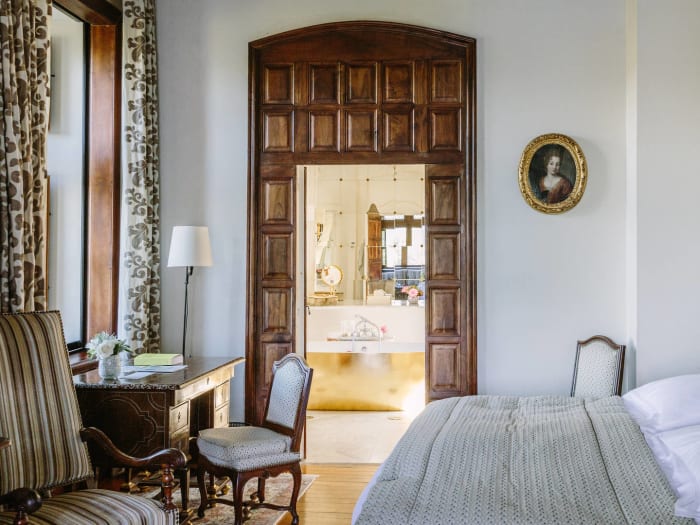
In a château hotel, a room should never be merely a place to sleep. It extends the spirit of the house and gives the stay its most intimate dimension. At Château de la Treyne, one may reasonably expect rooms and suites to follow the logic of a characterful residence: distinctive proportions, a hushed atmosphere, a dialogue between heritage features and contemporary comfort, and a strong emphasis on quiet. What matters here is not uniformity, but personality, with that sought-after feeling of staying in an inhabited place rather than an interchangeable hotel product.
The charm of a château bedroom often lies in details one notices before analysing them: the thickness of a wall, the height of a window, the way light enters at certain hours, the visual relationship with the grounds or the countryside. In an address such as this, the room experience rests on that quality of presence. One seeks both rest and a sense of belonging to the site. Opening the curtains onto greenery, feeling the silence of the morning, returning after dinner to a room prepared with care: these simple gestures gain particular depth when set within a heritage property.
The known level of service reinforces this impression of discreet comfort. Daily housekeeping, turndown service, and a front desk and concierge available around the clock create an environment that feels smooth, reassuring and understated. In the best houses, luxury in the room is measured not only by equipment, but by the absence of friction. Everything should feel natural: a room maintained with precision, an evening return that prepares one for rest, and a team able to respond efficiently to a simple request as well as a more specific need.
For couples, the setting naturally lends itself to a romantic experience, not in a theatrical sense, but in a more accurate one: intimacy, silence, beautiful views and a slower pace. For solo travellers, the room becomes a true place of retreat and observation, somewhere to read, write, rest or simply look out over the landscape. That versatility matters. It suggests that comfort has been conceived not merely to impress, but to support different ways of inhabiting a stay.
In this kind of property, suites often play a particular role by offering greater scale and an even more residential feel. Without detailing what has not been confirmed, it is fair to say that the overall spirit of the house encourages that sense of private residence within a grand estate. More than an accumulation of material features, it is the overall harmony that defines the success of the accommodation: the quality of sleep, the serenity of the setting, the feeling of being sheltered from the outside world without losing contact with the beauty of the landscape. At Château de la Treyne, it is likely this alliance of character, calm and service that gives the rooms their true value.
The Dining Experience
Gastronomy is an integral part of the identity of Château de la Treyne. On-site, a refined dining experience places the meal at the heart of your stay. In a Relais & Châteaux establishment, dining fully contributes to the overall experience of the location. It reflects a territory, a rhythm, and a particular notion of hospitality. At the château, dinner is part of a whole where the setting, lighting, service, and the time dedicated to the meal are as important as the dish itself.
The context of Lacave and the Lot region naturally lends itself to this culinary experience. The area evokes a gourmet France, deeply connected to its products and seasons. In an establishment of this calibre, one expects a cuisine of precision, elegantly showcasing local produce. Sophistication often lies in the balance between local roots and contemporary expression.
Booking in advance underscores the significance of dinner during your stay. In a château, the transition from the outside to the dining room, or to the terrace in season, marks the evening. It provides structure to the experience and embeds the journey within a distinctly French art of living.
Service plays a decisive role. A refined table reaches its full potential with a team capable of sensing the rhythm of the diners and offering accurate recommendations. This quality of service fosters an atmosphere of trust, allowing ample space for taste, conversation, and the enjoyment of the setting. For couples, dinner often becomes the highlight of the day. For solo travellers, it can provide a particularly precious moment of calm.
Here, gastronomy is part of a coherent whole. At Château de la Treyne, the dining experience extends what the place already expresses through its architecture and landscape: a measured refinement, linked to the pleasure of being present.
Concierge and services
In characterful hospitality, the quality of services is measured not by their mere presence, but by the way they support the experience without weighing it down. According to the known information, Château de la Treyne offers a 24-hour front desk, 24-hour concierge, daily housekeeping, turndown service, luggage storage, laundry, wake-up service and multilingual staff. Taken individually, these are the standards expected of a five-star property. Taken together, they suggest something more important: a promise of fluidity, of a stay in which practical organisation recedes so that the pleasure of place can come forward.
The concierge plays a central role here. In a destination such as Lacave, where travel often follows a gentler, more intentional rhythm, a good concierge does more than answer requests. It helps give shape to the time spent on site. That may mean reserving a table, organising an early departure, suggesting an itinerary in the surrounding area, adapting plans to the weather, or simply smoothing out the unexpected. In the best houses, this function rests on an intelligence of the stay rather than an accumulation of services. The aim is not to multiply interventions, but to make each day simpler, clearer and more enjoyable.
Turndown service and daily room care belong to the same philosophy. They remind us that great comfort is also built through repeated details: returning to a room kept impeccably, finding it prepared for the night, sensing that someone is looking after things without ever becoming intrusive. This discretion is essential in a château hotel. It preserves the happy illusion of a house that functions naturally, even though it relies on precise organisation.
The permanent availability of the front desk and concierge also brings a welcome sense of ease. It is especially valuable for travellers arriving late, leaving early, or wishing to retain complete freedom in the way their stay unfolds. In a peaceful and relatively secluded environment, knowing that a team remains accessible at any hour reinforces comfort. Luggage storage, laundry and wake-up service, sometimes considered secondary, then reveal their full usefulness: they allow one to travel light, improvise an extra stop, or maintain one’s own rhythm without unnecessary constraint.
The multilingual team is also an important sign of openness. In a house of this standing, the welcome must be both precise and warm, able to address French and international guests alike without losing its natural tone. It is often in this quality of communication that the overall perception of service is shaped. A well-chosen word, a clear explanation, an attention offered at the right moment can transform the relationship to the hotel.
At Château de la Treyne, services therefore seem designed not to perform luxury, but to establish continuity of comfort. That distinction matters. It suits a house where guests come for calm, landscape, dining and the feeling of being looked after with tact. In a place such as this, true service consists precisely in making the stay feel freer.
The Art of Living in Lacave
The Château de la Treyne is fully integrated into its surroundings. Staying here means discovering a particular vision of rural France.
In Lacave and its surroundings, the landscape, stone, gastronomy, and heritage create a discreet art of living. This restraint is part of the place.
The local way of life is based on simple sensations. The light on the pale stone, the freshness of a summer morning, the presence of the woods, the evening silence.
In the Lot, one does not merely traverse a backdrop. One inhabits a rhythm. The château embodies this rhythm with precision.
It offers an elegant anchor for this broader sense of time. Walks, meals, moments of tranquillity, and discoveries unfold here without haste.
The French art of living takes on a tangible form here. Welcoming guests, taking care of the table, respecting mealtime, and valuing the setting.
Added to this are intimacy and a measured attentiveness. At the Château de la Treyne, these codes reflect a way of being.
The surrounding territory invites deep exploration. This part of the inland south-west lends itself to cultural escapes, country roads, and stone villages.
The château serves as both a refuge and a base. One ventures out during the day, then returns to its calm, its table, and its comfort.
This alternation between the outdoors and indoors is part of the pleasures of the stay. Exploration and retreat find a natural balance here.
For couples, Lacave offers a setting conducive to a journey for two. Conversation, walking, contemplation, and dining find their natural place here.
For solo travellers, the destination allows for a rare form of re-centering. One finds the necessary space to read, think, observe, and rest.
Here, luxury is not about constant events. It is about the quality of presence.
The promise of the Château de la Treyne perhaps lies here. To provide access, without pretension, to a tangible version of the French art of living.
An experience made of attentiveness, landscape, taste, and moderation. In a hospitality world dominated by spectacle and speed, this proposition retains its strength.
Book with MyConciergeHotel
Booking Château de la Treyne through MyConciergeHotel means approaching the stay through guidance rather than mere transaction. An address of this nature calls for finer preparation than a standard reservation. One is not simply choosing a hotel category or comfort level; one is shaping an interlude, with expectations around calm, dining, rhythm and setting. In that context, the value of an editorial concierge service lies in turning available information into useful recommendations adapted to the traveller’s profile and the season of the stay.
The château is particularly well suited to advance booking, especially for those wishing to make the most of dining on site. The existing advice to reserve the restaurant ahead of time is especially relevant here. In houses where gastronomy forms part of the core experience, dinner arrangements should not be left to chance, particularly during busier periods. Planning ahead not only secures a table, but also gives the stay greater structure and ease. It is often this sort of detail that makes the difference between a pleasant stop and a truly accomplished experience.
Booking through MyConciergeHotel also helps position the stay according to intention. A couple may wish to prioritise a romantic escape centred on the room, dinner and time spent on the property. A solo traveller may be looking more for retreat, with particular attention to quiet, flexibility and nearby discoveries. Others may want to integrate the château into a broader itinerary through the Lot or south-west France. In every case, the added value lies in the ability to read the property accurately and orient the booking accordingly.
This approach is all the more relevant for a heritage address, where expectations are often more nuanced. Some guests are drawn primarily by historic character, others by the dining, and others still by the feeling of elegant seclusion. Well-managed guidance helps clarify these priorities before departure. It also helps think through useful services: arrival time, specific needs, luggage arrangements, meal rhythm, and particular requests linked to comfort or the flow of the stay. Nothing extraordinary on the surface, yet everything that contributes to a smoother experience.
MyConciergeHotel fits precisely within this logic of accuracy. The aim is not to overpromise, but to book with discernment, taking into account what the property genuinely offers: a Relais & Châteaux château, a peaceful and elegant atmosphere, an unspoilt natural setting, refined dining and a clearly expressed French art of living. For the traveller, that clarity is valuable. It allows one to arrive with well-calibrated expectations and, often, to appreciate more fully what makes the house distinctive.
In the case of Château de la Treyne, booking intelligently means protecting what matters most: time, calm and the coherence of the stay. That is exactly what attentive concierge guidance should provide.