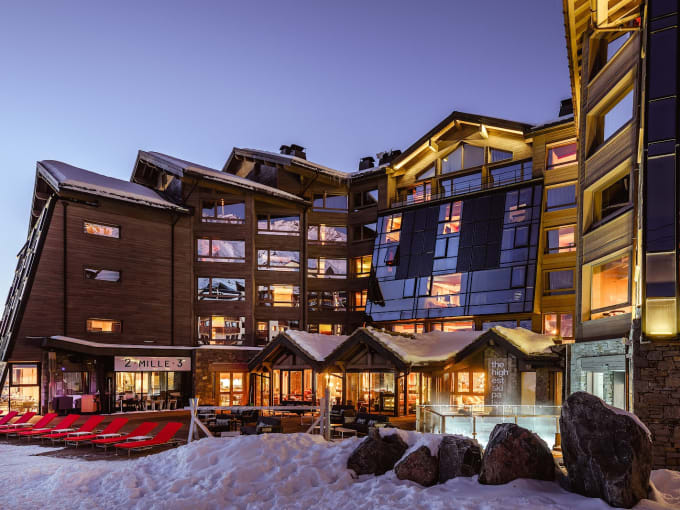
In Val Thorens, high-end hospitality meets a rare equation. It requires a blend of altitude, direct ski access, thermal comfort, smooth circulation, and genuine quality of stay. The resort holds a unique position in the French Alps, attracting expert skiers, well-organised families, and an international clientele accustomed to high standards. In this context, choosing the right hotel transforms the entire experience. It is not merely about booking a room; it is about selecting a rhythm, a view, a relationship with the snow, and a way of inhabiting the mountain. Between Altapura, Fitz Roy, Le Koh-I-Nor, and Pashmina, Val Thorens offers several interpretations of alpine luxury. It is precisely this diversity that this ranking aims to clarify, without unnecessary embellishments.
Our methodology is based on concrete, comparable, and observable criteria. We first consider the address within its immediate environment. In Val Thorens, location is as important as the displayed category. Access to the slopes, the management of ski-in/ski-out departures, and the relationship to the resort centre weigh heavily. We then assess the coherence of the hotel product. Architecture, the size of the establishment, the quality of common areas, the presence of a spa, the interpretation of rooms, and the level of service must form a credible whole. We also take into account the brand reputation when it exists. Finally, we favour hotels capable of providing a stable experience, both during peak season and quieter periods. It is worth noting that a great mountain hotel is often judged by logistical details.
The local panorama is more nuanced than it appears. On paper, several establishments share the same high category and the same resort. In reality, they do not tell the same mountain story. Altapura, Hôtel Altapura, and L’Altapura refer to the same well-known signature in Val Thorens. This presence highlights the importance of the address in the resort's imagination. Fitz Roy embodies another interpretation, more central and historical in the local landscape. Le Koh-I-Nor showcases a dominant location and an immediately recognisable identity. Finally, Pashmina appeals to those seeking a more subdued atmosphere. What our advisors observe is that travellers hesitate less between good hotels than between various styles of stay. The ranking must therefore illuminate these real differences.
For 2025 and 2026, several trends are confirmed in high-altitude resorts. The first concerns space. Travellers want better-designed rooms, functional family suites, and places where après-ski is not limited to the bar. The second relates to well-being. A spa is no longer just a brochure selling point; it has become a recovery criterion, especially after active days at altitude. The third evolution is the fluidity of the stay. Guests value hotels that simplify equipment, slope departures, and daily life. Finally, high-end mountain experiences are moving away from ostentatious luxury. They favour sustainable materials, a protective atmosphere, and a calmer relationship with service. In Val Thorens, these expectations find a natural ground, provided the hotel truly delivers on its promise.
There is also, in these alpine houses, a certain idea of French luxury. It does not necessarily manifest through demonstration; it is reflected in the precision of the welcome, the quality of a lounge after skiing, a well-orchestrated dining experience, and the feeling of being awaited. In the mountains, this philosophy takes on a particular hue. Luxury becomes an art of protection against the elements. One seeks just the right warmth, intimacy without isolation, views without excessive exposure, and service without rigidity. Val Thorens, despite its sporting energy, knows how to offer this form of balance. My advice for interpreting this ranking is to think of use before image. A hotel may be perfect for a three-day sporting stay but less suitable for a family week.
This is why we reject simplistic hierarchies. An editorial ranking does not aim to distribute absolutes; it serves to organise preferences according to defined criteria. All the hotels selected here belong to a high level of expectation. None are interchangeable. Some attract primarily through their access to the ski area, others through their atmosphere, their position in the resort, or their balance between activity and retreat. Our advisors often observe this. The best hotel does not exist in the abstract; it exists for a specific trip, with a season, a budget, and precise expectations. The interest of this top 6 is therefore to assist in making the right choice, not to crown a universal winner. In Val Thorens, the right address is one that aligns with your way of experiencing the mountain.
Here is our interpretation of the best hotels in Val Thorens. It distinguishes clear hotel personalities in a resort where the premium offer remains concentrated yet structured.