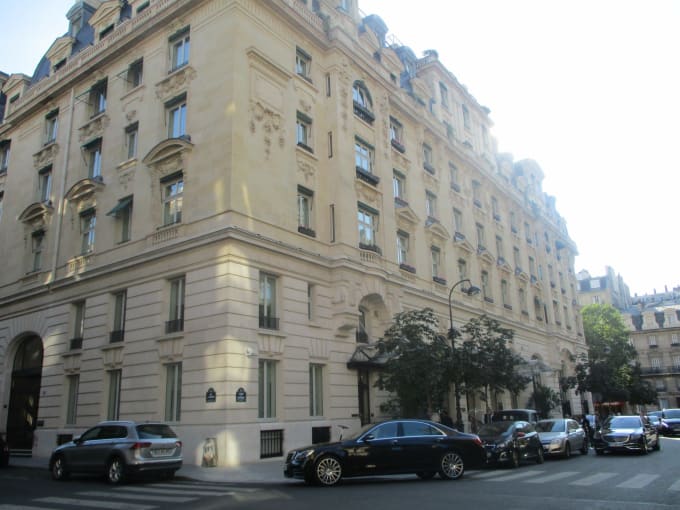
The 16th arrondissement holds a unique position in the Parisian hotel landscape. It lacks the hustle and bustle of the historic centre, as well as the worldly front of certain addresses on the Left Bank. Instead, it offers a different perspective. A more residential idea of Paris, quieter yet never subdued. Between Avenue Kléber, Place du Trocadéro, Passy, La Muette, Auteuil, and the outskirts of Bois de Boulogne, the area combines embassies, Haussmannian buildings, private mansions, and grand urban vistas. For a traveller seeking an urban hotel, the 16th meets a specific expectation. It allows one to experience Paris with space, relative calm, and striking views. It is also a district where high-end hospitality takes on various forms, from institutional palaces to more design-oriented addresses.
At MyConciergeHotel, we assess this segment with simple yet demanding criteria. Firstly, genuine urban anchoring. A grand Parisian hotel is not judged solely by its official rating. It is evaluated based on its relationship with the city. Location, neighbourhood, accessibility, quality of views, ease of movement, and the ability to evoke Paris from the very threshold are all significant factors. Next, we observe the coherence between promise and experience. A palace like Hôtel The Peninsula Paris, Saint James Paris, or Shangri-La Paris is not assessed with the same expectations as a five-star hotel like Brach or Hôtel Molitor Paris - MGallery. Lastly, we consider longevity. Architecture, identity, quality of common spaces, perceived service level, and relevance for various uses weigh more heavily than the novelty effect.
The panorama of the 16th is richer than one might imagine. It brings together highly codified establishments and more liberated offerings. Hôtel The Peninsula Paris embodies an international interpretation of the Parisian palace, in close proximity to major thoroughfares and institutions. Shangri-La Paris offers a rare heritage dimension, with a location that directly engages with the Seine and the Eiffel Tower. Saint James Paris, situated in a more unique register, stands almost as a residential exception in the arrondissement. Brach introduces a more contemporary, lifestyle energy without departing from the realm of high-end service. Hôtel Molitor Paris - MGallery attracts an audience sensitive to architecture, sports, and the western part of Paris. Finally, Hôtel Raphaël, Hôtel Square Paris, and Sofitel Paris Baltimore Tour Eiffel remind us that the 16th also excels in traditional hotels that are well-located and easily identifiable.
For 2025 and 2026, several trends are reshaping demand in this Parisian sector. The first concerns space. Travellers increasingly value hotels that offer breathing room, light, and smooth circulation. In this regard, the 16th has a structural advantage. The second trend relates to the blending of uses. Guests are no longer simply choosing a room, but rather a rhythm of stay. Some desire a hotel that allows for a mix of meetings, shopping, and cultural outings. Others seek a more residential base, close to parks, museums, or quiet neighbourhoods. The third trend pertains to integrated well-being. Spas, pools, fitness centres, and terraces are no longer secondary attributes; they have become decision-making criteria. What our advisors also observe is a return to addresses with strong personalities. Standardisation is less reassuring than before. Identity matters more.
French luxury in the 16th is not merely about decor or protocol. It is characterised by a sense of measure. There is less visible ostentation than in other capitals. However, the quality of the address, the discretion of the staff, the integrity of materials, the mastery of volumes, and the attention to silence take on particular value. It is an arrondissement suited to travellers for whom Paris should remain livable. The relationship with the city is more domestic, almost more quotidian. One might stroll along Avenue Foch, head to the Trocadéro, cross over to Chaillot, or dash towards Roland-Garros or the Louis Vuitton Foundation depending on the day's agenda. My advice is simple. If you love Paris but dread the tourist saturation, the 16th often strikes the right balance between intensity and retreat.
This ranking should therefore be read without automatic reflexes. It does not designate a perfect hotel for everyone. It ranks addresses according to an editorial logic, based on observable facts and concrete uses. A palace distinguished by Atout France does not have the same purpose as a creative five-star hotel. An address with a monumental view does not meet the same expectations as a well-maintained local hotel. Here, we highlight the best urban hotels in the 16th, not the most ostentatious. This involves considering the relevance of the location, the quality of the setting, the consistency of service, and the ability to embody a specific Paris. Some travellers will seek representation. Others will prefer intimacy. Still others will want a hotel that functions as a destination in its own right. All three approaches have their legitimacy.
Our top 6 fits within this nuanced perspective. It brings together addresses that truly matter in the hotel landscape of the 16th. Some are established references. Others resonate more with today's Paris. All have a reason for being in this neighbourhood. A point to remember before discovering the ranking: the best urban hotel is not just the one that impresses upon arrival. It is the one that perfectly complements your way of experiencing Paris.