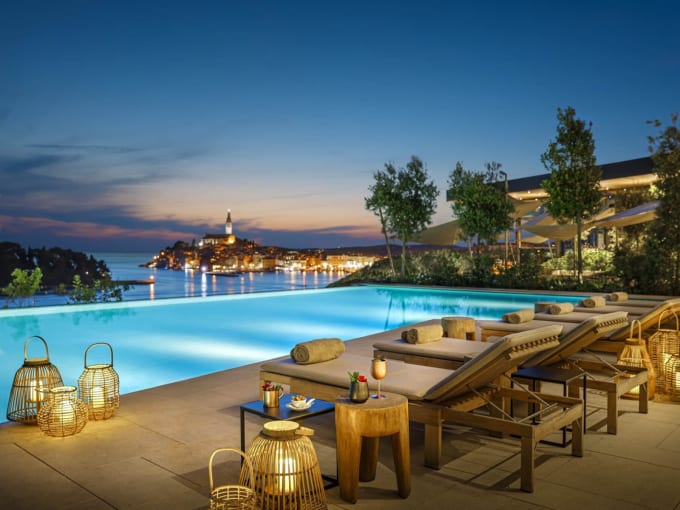
Over the past two decades, Croatia has established itself as a premier hotel destination in the Mediterranean. Its appeal is not solely scenic; it is structural. The country boasts legible historic cities, a rugged coastline, inhabited islands, and a vibrant agricultural hinterland. For discerning travellers, this density offers a more nuanced experience than the mere notion of a beach holiday. One can transition from an urban palace in Split to an island retreat on Lošinj, before heading to Istria for a wine-centric stay. It is precisely this variety that makes a ranking useful. From Boutique Hotel Alhambra to Grand Park Hotel Rovinj, Maslina Resort, or Meneghetti Wine Hotel & Winery, Croatia presents multiple interpretations of luxury, each telling a different story.
At MyConciergeHotel, we do not rank a hotel based on an abstract promise. We first observe verifiable elements. The displayed category, exact location, brand reputation, integration within the landscape, and the coherence between the place and the experience are all significant factors. We also consider a hotel's ability to embody its destination. A good hotel in Croatia must not only offer a high level of comfort; it should also facilitate an understanding of the territory. What our advisors assess is the overall accuracy. An urban palace is not judged in the same way as a vineyard estate. An island refuge is not compared to a large seaside resort on the same criteria. The ranking establishes hierarchy, but more importantly, it provides context.
The Croatian panorama is more diverse than one might imagine from abroad. In Split, Hotel Vestibul Palace offers a heritage and urban perspective. In Korčula, Hotel Lešić Dimitri Palace presents hospitality within a fortified town, with a more intimate scale. On the island of Lošinj, Boutique Hotel Alhambra leans towards classic resort living and a connection to the sea. In Istria, Grand Park Hotel Rovinj, San Canzian Hotel, Kempinski Hotel Adriatic Istria Croatia, and Meneghetti Wine Hotel & Winery outline four distinct approaches. One is urban, facing a port. Another is rooted in the countryside. A third embodies international resort characteristics. The last intertwines hospitality and vineyard. Further south, Orebić adds yet another tone with Hotel Katarina and Hotel Villa Korta Katarina & Winery.
For 2025 and 2026, several trends are solidifying in the high-end Croatian hospitality sector. The first is the pursuit of the right scale. Travellers still desire space but less anonymity. The most successful hotels often articulate intimacy alongside comprehensive services. The second trend concerns local anchoring. Wine, olive oil, regional materials, and cultivated landscapes are becoming criteria for choice, rather than mere decorative elements. The third is the rise of combined stays. Our advisors frequently craft itineraries that span Istria, Dalmatia, and the islands. Finally, the relationship with well-being is evolving. It is no longer solely about spas. Calm, light, walking, access to the sea, and sleep quality now weigh equally in the final decision.
This evolution aligns with a notion of luxury that we readily advocate. French luxury is not an accumulation; it is a reading. It requires distinguishing between what pertains to decor, service, location, and time saved. In Croatia, this framework is particularly useful. A hotel may be remarkable for its location in an old town. Another may stand out for its relationship with the agricultural landscape. A third may excel in providing a genuine maritime respite. My advice is simple. One should choose a Croatian hotel as one would select an address in Venice or Provence. It is not merely about booking a room; it is about choosing a rhythm, a horizon, and a way of inhabiting the place for a few days. This is where a good ranking becomes a travel tool.
Therefore, this top 10 should be read without seeking a universal verdict. The number one is not automatically the best for everyone. Some travellers will favour the fluidity of a large contemporary hotel. Others may prefer a more intimate format or a characterful address in a historic centre. We reject hollow superlatives, as they obscure useful differences. What we aim to do here is to organise high-level experiences according to their overall relevance, consistency, and evocative power. It is also worth noting that Croatia rewards well-crafted stays. A night too long in one city, or an island poorly placed in the itinerary, can alter the perception of a trip. Thus, a good hotel is also one that intelligently fits into the journey.
The following top list brings together ten strong addresses, each with its own logic. Some excel due to their location. Others through their coherence. Still others by their ability to endear an entire region. This is how they should be read.