History & sense of place
In Stari Grad, history is never merely a backdrop: it shapes the landscape, local habits and even the quality of the light. A stay at Maslina Resort therefore unfolds within an ancient Mediterranean setting on the island of Hvar, where ports, olive groves, dry-stone walls and coves have long defined a particular way of inhabiting the coast. The property does not present itself as a historic residence in the traditional sense; rather, its identity lies in its ability to engage with this island context without overwhelming it. That distinction matters. In this part of the Adriatic, the most convincing luxury does not rely on theatrical heritage, but on allowing the place itself to speak with restraint: vegetation, sea views, a slower rhythm, proximity to Stari Grad and the culture of hospitality associated with the Dalmatian shoreline.
Its membership of Relais & Châteaux helps to clarify that philosophy. The affiliation suggests less a standardised style than a certain idea of hospitality: attention to experience, care for detail, local rootedness and the desire to make a stay feel coherent rather than simply well equipped. At Maslina Resort, that coherence appears to rest on a few clearly legible principles: serenity, a close relationship with nature, easy access to the sea and an atmosphere shaped around wellbeing. There is nothing ostentatious in that promise; it depends instead on a form of controlled calm, particularly appealing on an island whose summer reputation can also bring a livelier tempo.
Stari Grad lends the whole experience a distinctive depth. One of Croatia’s oldest towns, it retains a precious human scale, very different from seaside destinations designed purely for instant consumption. Here, walks feel meaningful, views open gently and one quickly understands why so many travellers choose this part of Hvar to withdraw slightly from the bustle without giving up the beauty of the coast. The resort fits that logic of balance: sufficiently secluded to preserve tranquillity, yet close enough to allow guests to discover the character of the town and its surroundings.
The spirit of the place also lies in a certain Mediterranean modernity. Not a spectacular one, but a contemporary way of interpreting the island: restrained lines, a fluid relationship between indoors and outdoors, an emphasis on natural light and a sense of space conceived for rest. In a property of this kind, heritage is not measured only by the age of the walls; it is also expressed in the way a hotel understands its territory and offers a current reading of it. Maslina Resort seems to work precisely within that continuity between landscape, hospitality and the art of slowing down.
For the traveller, this creates a rare impression: arriving somewhere that does not try to impose an artificial narrative, but instead reveals the qualities already present in the site. The sea is not an added selling point; it is a constant presence. Calm is not a marketing phrase, but a genuine condition of the stay. And refinement is not reduced to display; it is conveyed through the rightness of proportions, the discretion of service and the feeling of being welcomed into an environment designed to endure. That is perhaps where Maslina Resort’s real personality lies: in its alliance of island life, measured elegance and fidelity to the spirit of Stari Grad.
The property
Maslina Resort’s first appeal lies in its setting: in Stari Grad, on the island of Hvar, within a peaceful natural environment and with easy access to the sea. Simple as that may sound, it in fact shapes the entire experience. Here, a stay is organised around a tangible closeness to the coastline without sacrificing the shelter of a calm setting. One does not come merely to look at the sea, but to live by its rhythm: changing light throughout the day, salt in the air, Mediterranean vegetation and that particular sensation of being both secluded and connected.
The property appears to have been conceived to make the most of this relationship with the landscape. In a contemporary resort of this kind, the quality of a stay often depends on the way architecture allows views, silence and light to circulate. When it works, the shared spaces are not simply transitional areas; they become places in which to breathe. One imagines open perspectives, gentle transitions between indoors and outdoors, terraces where lingering feels natural and a constant dialogue with the surrounding environment. This is not merely an aesthetic matter; it is a way of making rest feel tangible.
The choice of Stari Grad is equally meaningful. On Hvar, some addresses favour animation, summer social life and visibility. Maslina Resort seems to embrace a different proposition: a more inward form of luxury, founded on tranquillity and the quality of the setting. That does not mean isolation. On the contrary, the location allows guests to enjoy a town of real character, with its harbour, lanes, walks and local rhythm, giving the stay genuine depth. The resort then becomes an anchor point: somewhere to return to after a swim, an excursion or dinner, with the feeling of re-entering an ordered and peaceful environment.
This impression is reinforced by the overall atmosphere, explicitly oriented towards wellbeing. Here too, the term deserves to be taken seriously. In the best properties, wellbeing is not confined to the spa; it begins in the way a place receives body and mind. The temperature of spaces, intuitive circulation, pleasing materials, attentive yet unforced service, the possibility of retreat or shared moments: all of this contributes to a deeper sense of comfort. Maslina Resort seems to cultivate precisely that kind of low-tension hospitality, in which elegance does not create distance but encourages release.
For different kinds of traveller, this configuration is particularly relevant. Couples will find a setting suited to discretion and contemplation. Families may appreciate a natural environment that feels legible and less frenetic than other island destinations in high season. Business travellers, meanwhile, encounter what high-end work trips often require: a place calm enough to focus, yet inspiring enough to turn a professional stay into a pleasant interlude. That versatility is not insignificant; it suggests a property capable of maintaining a clear identity while remaining welcoming to varied uses.
Ultimately, the hotel distinguishes itself less through an accumulation of effects than through a sense of balance. Balance between sea and vegetation, between retreat and accessibility, between refinement and ease of use. In a luxury market where many addresses seek to impress instantly, Maslina Resort appears to favour a more lasting form of seduction: that of a place one understands gradually, over the course of the day, because it leaves room for landscape, silence and the quality of time spent there.
Rooms and Suites
In a resort where the natural setting plays a central role, the rooms and suites extend the experience of the location. They offer rest, intimacy, and a seamless connection with the outdoors.
At Maslina Resort, they embody the core principles of the establishment: tranquility, understated elegance, contemporary comfort, and a sensitive link to the island of Hvar.
The foremost quality expected is the impression of space. This is due as much to the size as to the layout. Smooth circulation, well-proportioned furniture, natural light, discreet storage, and distinct areas structure the whole.
A successful room invites one to slow down. It offers a pleasant temperature, silence or the muted sounds of the coastline, and an immediate sense of relaxation.
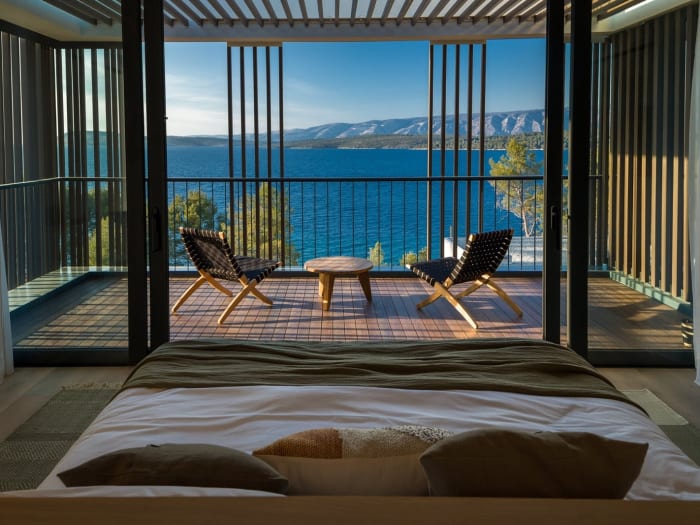
In Stari Grad, the connection to the outdoors is particularly significant. Terraces, balconies, or large bay windows maintain a constant link with the Adriatic light and the surrounding vegetation.
In the morning, this relationship with the outside world transforms the waking experience. In the evening, it extends the day at a more leisurely pace. The room does not disconnect from the landscape; it echoes it.
Comfort is measured in the details. Quality bedding, bathrooms designed for daily use, rigorous maintenance, nightly turndown service, and daily housekeeping create a seamless stay.
Discreet luxury often consists of never having to think about it. Everything seems simple, available, and obvious. This apparent ease rests on the precise work of the teams.
The suites cater to different needs. Extended stays, family trips, the necessity for a separate lounge, or a desire for increased intimacy.
The challenge remains the same: to preserve an atmosphere consistent with the spirit of the resort. A successful suite is not merely larger; it offers a more expansive way to inhabit the space.
At Maslina Resort, rooms and suites embody this idea of deceleration. They do not attempt to compete with the landscape; they accompany it.
For couples, they encourage discretion. For families, they provide a stable base between outdoor moments. For business travellers, they restore order and calm after a busy day.
Dining
In an island address of this calibre, dining occupies a particular place. It is not simply an expected service in a five-star hotel; it becomes one of the principal ways of entering into relationship with the destination. At Maslina Resort, even without detailed information here on restaurants or culinary signatures, one can still discern a clear orientation: hospitality aligned with landscape, season and the wellbeing atmosphere claimed by the property. In the Mediterranean, that coherence often takes the form of cuisine based on freshness, precision and controlled simplicity, where produce, cooking and setting matter as much as technical sophistication.
The first luxury in such a context is rhythm. Having breakfast in a resort oriented towards the sea is never insignificant. It is often the moment when the stay truly begins: the light still soft, service attentive yet discreet, fruit, breads, savoury and sweet preparations, hot drinks and the feeling of having time. In the best houses, breakfast is not rushed; it becomes a daily ritual, almost a way of tuning oneself to the place. In Stari Grad, where the surroundings invite contemplation more than haste, that tempo makes particular sense.
Lunch generally calls for another register: lighter, more sunlit, designed to accompany a day of swimming, reading or exploring. In a resort with easy access to the sea, one especially appreciates menus capable of offering clear, digestible and well-executed dishes that extend the holiday mood without weighing down the body. Composed salads, fish, vegetables, olive oils, herbs, citrus and desserts that are understated rather than showy: this Mediterranean vocabulary, when well interpreted, is often enough to create a genuine taste memory.
Dinner, finally, marks a shift. The light fades, conversations lengthen and service takes on a different density. In a Relais & Châteaux member property, one naturally expects particular attention to the dining experience, whether gastronomic in the strict sense or simply very well conducted. That implies a readable menu, relevant pairings, service able to guide without intruding and, above all, measured staging. The setting matters here almost as much as the plate: terrace, view, materials, lighting, acoustics. In the most successful places, one dines with the evening air as much as with the food.
Part of the appeal of a resort such as Maslina also lies in the possibility of alternation. Some meals call for ceremony; others are better left spontaneous. A drink at the end of the afternoon, a light bite after the beach, a longer dinner, a family meal or a more intimate table for two: the quality of a dining offer is measured by its flexibility as much as by its level. Today’s traveller seeks less systematic display than a rightness of tone capable of adapting to hours and moods.
Ultimately, dining at Maslina Resort should be understood as an extension of its overall identity. It contributes to the idea of a calm form of luxury, attached to the taste of place, seasonality and the quality of time spent together. More than a performance, one expects a harmonious experience: meals that accompany the day on Hvar, underline the beauty of the setting and leave, upon return, the memory of a Mediterranean lived with precision rather than emphasis.
Spa & Wellness
Wellness is an integral part of the Maslina Resort's identity. This emphasis changes the perception of the stay. In many hotels, the spa remains secondary. Here, the promise is broader. It aims to place the traveller in a state of relaxation, self-care, and reconciliation with the long passage of time. The spa becomes an essential centre of gravity.
The natural setting of Stari Grad reinforces this approach. The proximity to the sea, Mediterranean vegetation, the light of Hvar, and the tranquillity of the site encourage a less artificial approach to care. The body does not abruptly transition from one world to another; it extends a state already initiated by the surroundings. After a walk, a swim, or a few hours outdoors, entering a wellness space that harmonises with the environment feels natural. It is often in this continuity that the quality of a great hotel spa is determined.
Discerning travellers expect an atmosphere, a method, and discretion from such a venue. A good spa is not merely defined by its treatment menu or facilities. It relies on a quality of silence, light, materials, and hospitality. The best establishments offer clear pathways, relevant recommendations, and treatments tailored to the rhythm of the stay. High-end wellness does not need to be ostentatious; it should be felt.
In a resort like Maslina, this approach can take many forms. For some, wellness might be a massage or a facial after the journey. For others, it may involve a more holistic routine. Restorative sleep, balanced meals, time outdoors, reading, gentle movements, sea baths, and moments of retreat. The value of a place oriented towards this dimension is its ability to accommodate these various uses without hierarchy. The spa does not impose performance; it supports different needs, depending on age, purpose of the stay, and individual fatigue levels.
Couples often find a common language of rest here, away from packed schedules. Families can carve out recovery time between activities. Business travellers find a concrete way to decompress, especially after busy days. In all cases, the success of a wellness offering is measured by its ability to transform the overall atmosphere of the stay. One leaves less tense, sleeps better, and pays more attention to simple sensations. The evening air, the taste of breakfast, the quality of silence.
Maslina Resort finds a very contemporary uniqueness here. More than a demonstrative luxury, it offers a form of regenerative luxury, in tune with contemporary expectations. The traveller no longer seeks merely to be served; they wish to be rebalanced, even if just for a few days. In a soothing natural environment, with easy access to the sea and hospitality designed for serenity, wellness ceases to be an isolated moment. It becomes the fabric of the stay.
Concierge & Services
In the luxury hotel sector, services are valued for their presence as much as for their integration into the experience. At Maslina Resort, they create a seamless stay.
Maslina Resort offers a 24-hour concierge service, a continuously open reception, daily room service, and turndown service. Additionally, there is luggage storage, laundry services, wake-up calls, and multilingual staff.
On an island like Hvar, the reception and concierge available at all hours play a central role. Late arrivals, early departures, and changes in plans require flexibility. This availability brings genuine peace of mind, especially during multi-stop itineraries.
The concierge acts as a link between the visitor and the territory. Booking a transfer, suggesting a departure time, recommending a walk, or organising a special moment enhances the quality of the stay. Luxury here lies in a correct orientation, tailored to desires, pace, and season.
Room services reflect a more discreet comfort. Daily housekeeping ensures continuity of the stay. The turndown service accompanies the transition to night. Laundry services prove useful during extended stays, family trips, or summer visits.
The presence of multilingual staff is also significant. In an international destination, it enhances relationships, clarifies exchanges, and adapts to individual expectations.
For couples, these services preserve the spontaneity of the stay. For families, they simplify logistics. For business travellers, they provide a reliable framework when time is of the essence.
At Maslina Resort, this ensemble suggests structured, attentive hospitality tailored to a high-level island stay.
The art of living in Stari Grad
Choosing Maslina Resort is not simply booking a hotel on Hvar; it is also choosing Stari Grad and, with it, a particular way of inhabiting the island. The town has a distinctive tone within the Adriatic: older, more restrained and often more contemplative than the coast’s most exposed destinations. One comes for the sea, certainly, but also for a human scale, a slower relationship with time and a form of authenticity that does not perform itself. For many travellers, it is precisely this quality that turns a seaside stay into a genuine destination experience.
The local art of living begins with walking. In Stari Grad, the most enjoyable movements are often made on foot, along the waterfront, through lanes, around the harbour or towards more discreet viewpoints. This slowness is not a lack; it is a richness. It allows one to notice details, feel changes in the light, hear the sounds of the shore, stop for a coffee or prolong a walk without purpose. In an era dominated by optimisation, this availability to place becomes a true luxury.
The relationship with the sea naturally structures the day. Depending on the season, it may take the form of an early swim, a boat departure, time spent reading by the water or simply looking towards the horizon. The fact that the resort offers easy access to the sea strengthens this continuity between hotel and local life. One does not live on one side in the property and on the other in the town; the two experiences answer each other. The sea becomes a guiding thread, at once landscape, activity and breathing space.
Stari Grad also invites guests to rediscover a less theatrical Mediterranean. Here, interest often lies in restrained pleasures: an unhurried lunch, the shade of a garden, the scent of pines or herbs warmed by the sun, the return of calm in late afternoon, the softness of an evening by the water. This economy of the senses corresponds closely to the spirit of a resort oriented towards wellbeing. It reminds us that travel is not only about ticking off places, but about recovering a quality of presence.
For couples, Stari Grad offers a setting well suited to time away together, far from overly demonstrative bustle. For families, the town and its surroundings may provide an accessible introduction to the island, with gentler rhythms and simple activities. For business travellers, meanwhile, this quieter atmosphere makes it possible to extend a work trip with a few genuinely restorative hours. In every case, the destination acts as a salutary corrective to contemporary saturation.
This is where Maslina Resort finds its full meaning. The hotel does not seek to replace Stari Grad; it offers a hospitable, refined and sheltered version of it. It allows guests to enter the island without abruptness, to enjoy the beauty of the coastline without excess and to inhabit, for a few days, a different relationship with time. The art of living in Stari Grad may lie precisely there: effortless elegance, attention to simple things and the conviction that a successful stay leaves as much room for contemplation as for action. For the contemporary traveller, that promise has rare value.
Book via MyConciergeHotel
Booking the Maslina Resort through MyConciergeHotel means approaching your stay in Stari Grad with a consultative mindset. For a five-star address that is a member of Relais & Châteaux, located on an island and renowned for its tranquil atmosphere, this nuance is significant. Not all stays are the same, even within the same hotel. The chosen period, the profile of the travellers, the need for absolute calm or immediate access to activities, the duration of the stay, and the organisation of transfers all strongly influence the final experience. The benefit of dedicated support is to adjust these elements in advance.
The first advantage lies in understanding the location. Maslina Resort caters to couples, families, and business travellers, but each will seek something different. Some will prioritise proximity to the sea, while others may value the wellness atmosphere, logistical ease, or the opportunity to explore Stari Grad under favourable conditions. Booking with a representative who can qualify these expectations allows for a more precise orientation of the stay. In luxury hospitality, this quality of framing often makes a significant difference.
Seasonality is another essential point. Summer attracts numerous visitors, while spring and autumn also offer pleasant weather for exploring the region. The high season will suit those who wish to fully enjoy island life and long days by the sea, provided they plan ahead. The shoulder seasons may appeal to travellers seeking milder temperatures, tempered light, and a more serene pace. Support during the booking process helps to select the window most suited to one’s travel plans.
Practical organisation is equally important on an island. Arrival times, connections, luggage, special requests, and departure constraints quickly become structuring factors. Thanks to the 24-hour concierge service and continuous reception at the hotel, the stay already benefits from a solid foundation on-site. In advance, MyConciergeHotel can help ensure this fluidity by clarifying needs and preparing for sensitive points. This discreet work is particularly valuable for short stays, family trips, or business travel.
Booking through an editorial concierge also allows for a more qualitative perspective on the address. It is not merely about confirming a room, but about understanding whether the hotel truly meets the expectations of the moment. Whether it’s a restful retreat, a romantic interlude, an elegant base for discovering Hvar, or a stay where wellness takes precedence over the agenda, this perspective helps avoid miscasting.
Finally, the most sought-after establishments in season are booked early. Anticipating allows for securing your stay while also preserving choice and coherence in your travel plans. For the Maslina Resort, this means maximising the chances of experiencing a calm stay focused on wellness on the island of Hvar.