The hotel
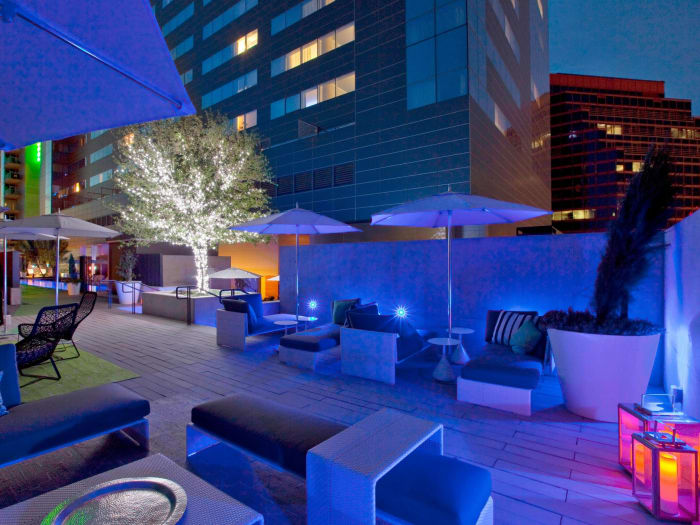
W Austin belongs to a generation of urban hotels that treat the property not merely as a place to stay, but as a stage in its own right. In the heart of Austin, it sits within a city long defined by contrast: creative spirit and American efficiency, music culture and economic momentum, Texan ease and cosmopolitan polish. It is precisely within that tension that the hotel feels most convincing. Its identity rests on a confident contemporary aesthetic, bold lines, immediate visual energy and a way of pairing high-end comfort with the city’s constant movement.
From arrival, the impression is of a place that understands its moment. The public spaces favour a lively, almost theatrical atmosphere at times, without losing the clarity expected of a five-star hotel. Guests come to stay, certainly, but also to feel Austin in a direct way: a city in motion, shaped by business, music, late nights and an urban lifestyle that never becomes overly self-important. W Austin captures that tempo and translates it into a precise hotel language built around bold design, carefully considered spaces and service designed to support very different styles of stay.
The address appeals equally to business travellers and couples looking for an elegant base from which to explore the city. That dual purpose is central to understanding the hotel. On one hand, it offers the ease expected of a central property: round-the-clock reception, concierge support, smooth organisation and straightforward circulation between spaces. On the other, it retains a hedonistic, almost social dimension that sets it apart from a purely corporate hotel. The result is neither cold nor showy. It is a form of contemporary urban luxury that favours immediacy over ceremony.
Its inclusion in Condé Nast Traveler’s 2025–2026 Gold List underlines that clarity of vision: this is a hotel that does not attempt to imitate the heritage codes of grand traditional houses, but instead proposes a current reading of five-star hospitality. Here, elegance is expressed through rhythm, location, service quality and an intelligent relationship with the city. For the traveller, that means an experience especially well suited to Austin itself: energetic, connected, mobile and open to what is happening beyond the lobby. W Austin does not cut guests off from the destination; it becomes one of the most coherent gateways to its pulse, with comfort, style and efficiency.
The Austin way of life
Staying at W Austin means choosing an address that allows the city to be read without excessive filtering. Austin is not a capital fixed in a single image. It is at once an economic centre, a university city, a major music hub and a weekend destination for American travellers seeking energy, restaurants, concerts and nightlife. That plurality is part of its singularity, and the hotel makes full use of it thanks to its central setting. For visitors, that changes everything: days can be arranged with real freedom, moving between meetings, walks, food stops and late evenings without ever feeling removed from the city’s core.
The immediate area opens onto a dense, active Austin shaped by the flows of the contemporary city. There is a valuable sense of proximity to local attractions, nightlife addresses and the places where the current image of the Texan metropolis is being made. By evening, that centrality takes on a particular importance. Austin is known for its lively nightlife, and W Austin allows guests to enjoy it with unusual ease. One can go out, return, extend the evening or retreat quickly to the calm of the room. That ease is a luxury in itself in a city where the cultural and social calendar can quickly define an entire stay.
The value of such an address lies not only in geography, but in the way it supports the city’s real patterns of use. Austin is often discovered in fragments: an early coffee, daytime meetings, a detour to a gallery or shop, dinner, then live music or a bar late into the night. W Austin responds well to that logic of movement. It provides a stable, comfortable and stylish base from which to improvise. That flexibility is especially valuable during peak periods, when festivals and major events turn the city into an open-air stage and make location even more decisive.
For couples, the experience becomes a rhythmic city break, with the blend of elegance and energy that suits Austin well. For business travellers, the hotel keeps them close to the action while preserving the markers of high-end service. In both cases, the city remains the true partner of the stay. W Austin does not attempt to compete with it through a self-contained universe; instead, it acts as a refined link between exterior intensity and interior comfort. That is perhaps where its relevance lies: in its ability to offer an urban luxury that accompanies the destination as it is—alive, shifting and deeply contemporary.
Rooms and suites
In a hotel whose identity rests largely on the energy of its public spaces and a strongly urban setting, the room plays an essential role: it reintroduces measure, comfort and a degree of retreat. At W Austin, that balance appears central to the experience. The overall aesthetic remains faithful to the spirit of the house—contemporary, structured and visually clear—but here it is placed in the service of a more intimate use. After the movement of the lobby, evenings out or a day of meetings, the room becomes a place of recomposure, designed to slow the pace without breaking with the hotel’s identity.
The carefully considered design noted among the hotel’s defining traits is generally expressed through attention to volume, materials and visual coherence. In an address of this kind, nothing is entirely accidental in the way space is organised: the bed takes a central role, lighting contributes to atmosphere, lines remain legible and the whole seeks elegant efficiency rather than ornament. This approach suits an international clientele accustomed to major urban hotels and sensitive to a form of contemporary luxury that privileges genuine comfort, functionality and a clear aesthetic signature.
Rooms and suites also respond to different patterns of use. For a short stay, they provide an immediately comfortable base, with the expected markers of a five-star hotel: daily housekeeping, evening turndown, attentive service and a sense of constant order. For a business trip, they preserve breathing space between the day’s different moments, with the important feeling of being able to reset without leaving the city centre. For a stay as a couple, they extend the idea of an urban refuge, both stylish and calming, where one can reconnect before heading back out into Austin.
What distinguishes a good grand-hotel room is not only its appearance, but its ability to support the traveller’s rhythm. Here, that quality lies in the combination of central location and interior control. The city remains immediately accessible, with its attractions, restaurants, nightlife and events, yet there is also a setting capable of absorbing that intensity. It is a very contemporary form of luxury: not isolation, but the ability to regulate one’s exposure to the outside world.
In the suites, that logic naturally expands. The additional space allows guests to inhabit the hotel differently, with greater latitude, comfort and a stronger sense of temporary residence. For some travellers, that is the best way to experience Austin: remain at the centre, retain direct access to what matters, while enjoying a more generous setting in which to work, receive guests or simply prolong the quieter hours. W Austin thus succeeds in making the room not just a backdrop, but a precise and fluid instrument of the stay, in tune with the city around it.
Concierge and services
The luxury of a major urban hotel is often measured less by display than by the quality of its invisible services. At W Austin, that dimension appears especially important, because the hotel addresses a clientele that expects responsiveness, flexibility and a nuanced understanding of the constraints of contemporary travel. In a lively city, with peak periods shaped by festivals and major events, a property’s ability to simplify the logistics of a stay becomes a decisive part of the experience. This is where the service machinery matters most.
The presence of a 24-hour concierge and round-the-clock front desk immediately creates a reassuring framework. For the international traveller arriving late, for the couple returning after an evening out, for the professional whose schedule extends beyond conventional hours, that continuity of service is more than a comfort: it is a condition of ease. It allows the stay to unfold without rigidity, with the certainty that a request, question or practical need can be handled at any time.
To this are added those attentions which, in a five-star hotel, make the difference when well executed: daily housekeeping, turndown service, luggage storage, laundry and wake-up service. Considered separately, each may seem expected. Taken together, however, they shape a coherent experience in which everything works to lighten the domestic burden of travel. Time is not lost to practical organisation; guests can devote themselves to the city, their meetings, their evenings out or their rest. That sense of ease is one of the most persuasive forms of contemporary luxury.
A multilingual team also contributes to this impression of comfort. In a destination such as Austin, which attracts both international and American travellers, the quality of human exchange remains essential. A great hotel does not merely respond; it knows how to guide, prioritise, anticipate moments of pressure and propose solutions suited to the profile of the stay. For some, that may mean optimising a business schedule. For others, arranging outings, securing a table, easing an early arrival or a late departure. Service does not need to be theatrical to be memorable; it needs above all to be accurate, available and consistent.
It is precisely that consistency that gives W Austin its hospitality credibility. Its visual universe may be dynamic and its atmosphere more animated than that of a classic address, but the foundation of the stay remains that of a structured grand hotel. Behind the energy, there is service discipline. Behind the style, organisation. For the guest, this means that the experience rests not only on image or location, but on a genuine ability to support the journey in all its practical dimensions. In a city often visited in order to live intensely, that discreet but constant support is not a detail: it is what makes it possible to enjoy Austin fully without ever feeling overwhelmed by it.
Dining and social moments
In an address such as W Austin, dining is not merely a service function; it forms part of the overall staging of the stay. Even when a traveller spends much of the day outside, the way a hotel organises its dining moments, its transitions between day and night, and its spaces for meeting and unwinding deeply shapes the perception of the place. Here, the contemporary atmosphere and bold design suggest an approach to conviviality that is more urban than ceremonial, more rhythmic than formal, in keeping with the spirit of Austin.
In the morning, a well-located grand hotel often acts as a threshold between the privacy of the room and the energy of the city. Breakfast, whether taken quickly before a working day or more slowly during a leisure stay, becomes a strategic moment. In a property of this level, one expects less display than accuracy: attentive service, a pleasant setting, smooth execution and the ability to begin the day without friction. That practical quality matters especially in a destination where schedules can be dense and days long.
As the hours pass, the hotel returns to its role as a meeting point. In a city known for nightlife and sociability, dining and bar spaces take on particular importance. They allow guests to extend the atmosphere of Austin without leaving the property, to arrange an aperitif before going out, a dinner without further movement, or a final drink on returning. W Austin seems well suited to these sequences: moments when one is not necessarily seeking the ceremony of a classic grand restaurant, but the right atmosphere, well-considered food and drinks, a setting that supports conversation and an energy that remains controlled.
That social dimension is central to its identity. Some hotels offer silence, others display; this one appears to offer tempo. One can easily imagine travellers crossing paths between meetings, couples beginning the evening on site, and city regulars using the hotel as much as a meeting point as a place to stay. It is a very current way of thinking about hotel dining: not as a separate sanctuary, but as a natural extension of urban life.
For the visitor, this approach offers a simple but valuable advantage: it preserves choice. One may use W Austin as a practical and discreet base, or instead integrate it fully into the programme of the stay. In both cases, dining and social spaces contribute to the coherence of the whole. They extend the idea of a hotel rooted in its city, attentive to the real habits of its guests and capable of offering, beyond comfort, a certain quality of presence. In Austin, where days often stretch late into the evening, that ability to accompany movement without exhausting it gives the address genuine relevance.
A hotel of its time
W Austin does not belong to the tradition of historic palaces or heritage grand hotels in the European sense. Its interest lies elsewhere, in another idea of luxury—more recent, more urban and more directly linked to the transformation of major American cities at the turn of the twenty-first century. To understand the hotel, it helps to place it within that contemporary history: that of addresses which accompanied the rise of new cultural and economic centres by proposing a hotel language capable of speaking to a mobile, international clientele attentive to design as much as to service.
Austin provides a particularly revealing setting for this evolution. Long perceived as a city apart within Texas, it gradually asserted itself as a creative, technological and cultural metropolis. That rise created demand for hotels able to welcome travellers arriving for business, festivals, music, events or simply for the city’s singular atmosphere. W Austin belongs to that moment. It speaks less of an old past than of an assumed modernity: that of a destination built as a crossroads of uses, scenes and influences.
From this perspective, its bold design is not merely a decorative choice. It expresses a way of positioning itself within the city and within the hotel market. Where some houses seek continuity with classic codes, W Austin claims a more immediate, more graphic identity, more connected to the expectations of a generation accustomed to moving between capitals, economic hubs and cultural destinations. Its contemporary atmosphere, lively public spaces and centrality all serve the same idea: to make the hotel a place to stay, certainly, but also a place of presence, sociability and immersion in the local tempo.
The recognition brought by Condé Nast Traveler’s 2025–2026 Gold List reinforces that reading. It does not turn the property into a monument; rather, it highlights its ability to embody coherently a certain form of current hotel excellence. An excellence grounded not necessarily in age, but in execution, relevance of positioning and the fit between the place, the city and the expectations of its guests.
That is why W Austin can be seen as a hotel of its time. It reflects a precise moment in high-end hospitality, one in which the hotel becomes at once refuge, meeting point and urban observatory. Its heritage is not that of centuries, but that of a recent travel culture shaped by speed, events, local scenes and the desire to experience a destination from within. In Austin, that promise takes on particular force. The hotel does not merely tell the story of a city in motion; it participates in the way the city is lived today.
Booking through MyConciergeHotel
Choosing W Austin through MyConciergeHotel means favouring a more fluid and more targeted way of preparing a stay in a city where the calendar can quickly become decisive. Austin experiences periods of very high demand, notably during festivals, major cultural gatherings and business events that attract a large international crowd. In that context, booking early is not merely a prudent suggestion; it is often the condition for securing the best stay options, preserving the coherence of one’s programme and ensuring that logistics do not overshadow the pleasure of travel.
The value of tailored support lies first in understanding the right tempo. No two stays in Austin are quite the same. Some travellers come for a few intense nights, intending to enjoy nightlife, restaurants and the energy of the city centre. Others seek an efficient base for a business trip, with precise expectations regarding location, schedule flexibility and comfort. Others still want to combine the two, alternating obligations with time to explore. W Austin responds well to that diversity, but it is in the quality of preparation that the experience gains its full value.
Booking through MyConciergeHotel allows the hotel to be approached not as a simple room to confirm, but as an anchor point to be aligned with one’s style of travel. The central location, proximity to local attractions, easy access to nightlife and contemporary atmosphere may be especially relevant for certain traveller profiles; the stay still needs to be organised coherently around those strengths. A late arrival, an early departure, the need for a calmer rhythm despite the external energy, the wish for a stay as a couple with a genuine urban-escape feeling: these nuances matter when choosing an address of this kind.
There is also, in this way of booking, an attention to detail that corresponds to the very spirit of luxury hospitality. The right hotel is not simply the one that looks appealing in photographs or appears on a reference list; it is the one that fits the precise moment of travel. W Austin, with its energy, assertive design and strategic position, is particularly well suited to those who want to experience Austin up close without giving up the comfort of a structured five-star hotel. It still needs to be booked at the right moment, in the right logic, with a clear sense of what one is seeking.
Booking through MyConciergeHotel ultimately means treating reservation as the beginning of the experience rather than an administrative formality. In a destination as dynamic as Austin, that difference is real. It makes it possible to turn a good address into the right stay: one in which the hotel, the city and the guest’s personal rhythm align naturally. It is often in that discreet adjustment that the most successful stays are made.