The Hotel
In Denver, The Art Hotel Denver, Curio Collection by Hilton, speaks first to travellers who move through a city with their eyes open. Here, hospitality is not simply about providing a polished base between meetings or museum visits; it shapes an urban experience in which aesthetics, spatial flow and immediate proximity to cultural institutions define the stay. The positioning is clear and self-assured. This five-star hotel builds its identity around an ongoing conversation with the city, its creative energy and its taste for contemporary forms.
The address stands out for that distinctly American ability to combine efficiency, comfort and staging without tipping into theatricality. Design plays a structural role. The artworks displayed throughout the property are not mere decoration; they contribute to the atmosphere, creating a dialogue between interior architecture, light and materials. For the guest, this changes the nature of the experience: one does not simply enter a hotel, but a place conceived as an extension of the cultural district around it.
That coherence is one of its strongest qualities. Where some properties use art as a marketing device, The Art Hotel Denver folds it into everyday experience. Moving through the public spaces, pausing in the lobby, returning at the end of the day after an exhibition or dinner all take on a different texture. The stay gains rhythm, depth and almost a sense of narrative. It is a hotel that speaks particularly well to design-minded travellers, to guests who respond to atmosphere, and to those who prefer addresses with a clear point of view over standardised luxury.
Its place within the Curio by Hilton collection adds another layer: the feel of an individual hotel supported by a major hospitality group for service quality, operational ease and the level of comfort expected by international guests. That balance between character and reliability suits both leisure stays and business trips. Couples on a city break, museum-goers and professionals seeking a more inspiring setting than a conventional hotel can all find common ground here.
Its inclusion in Condé Nast Traveler’s 2025–2026 Gold List says less about fashion than about relevance. It points to the hotel’s ability to embody a certain contemporary way of travelling: seeking somewhere rooted, cultured, comfortable and coherent. In Denver, a city defined by contrasts between mountain horizons, civic culture and Western modernity, The Art Hotel Denver emerges as an address that does not rely on excess, but on precision.
A Hotel Shaped by Denver’s Cultural Scene
The Art Hotel Denver is not a historic grand hotel in the European sense, with listed façades, society legends and aristocratic memory. Its interest lies elsewhere, and that is precisely what makes it relevant within the contemporary hospitality landscape. It belongs to a generation of hotels conceived to engage with their immediate surroundings rather than withdraw from them. In Denver, that approach makes particular sense. Over recent decades, the city has established itself as a significant cultural destination in the American West, with museums, performance venues and civic institutions reshaping both its centre and its image.
Within that context, The Art Hotel Denver reads as a hotel of its time: a property designed not as an isolated retreat, but as a base in a district where people come to look, listen, learn and move between institutions. Its purpose is closely tied to its proximity to Denver’s leading cultural attractions. That shapes the experience far beyond geography. Guests are not merely well located; they are staying in a place that mirrors the rhythm, audiences and imagination of the neighbourhood.
Placing art at the centre of the hotel’s identity is therefore as much an urban decision as an aesthetic one. In a city where culture has a visible place in public life, the hotel extends that movement indoors. The artworks on display become a way of introducing visitors to the spirit of the destination before they even step into a museum or gallery. That continuity between outside and inside gives the address real narrative coherence.
This orientation also belongs to a broader shift in high-end American hospitality in the early twenty-first century. Many hotels sought distinction through identities that felt more editorial, more rooted and more responsive to local cultural life. The Art Hotel Denver is part of that evolution, but with particular clarity: here, art is not an afterthought or theme layered on later, but the framework of the project itself. Design, the visible collection in the public spaces, the location and the atmosphere all move towards the same idea.
This way of telling a hotel’s story through context rather than inherited prestige suits Denver well. The city does not trade on a fixed monumental past; it advances through alliances between institutions, contemporary creation and urban liveability. The hotel captures that energy. It offers visitors an immediate reading of the destination: a Western metropolis that is not defined solely by mountains or business, but also by genuine cultural depth.
In that sense, The Art Hotel Denver has a form of heritage that is less patrimonial than civic. Its story is tied to a city that has made culture part of its identity and appeal. For travellers, that is an important distinction. One does not come here to sleep in a timeless fantasy, but to inhabit, for the length of a stay, an address that reflects present-day Denver with intelligence.
Rooms and Suites
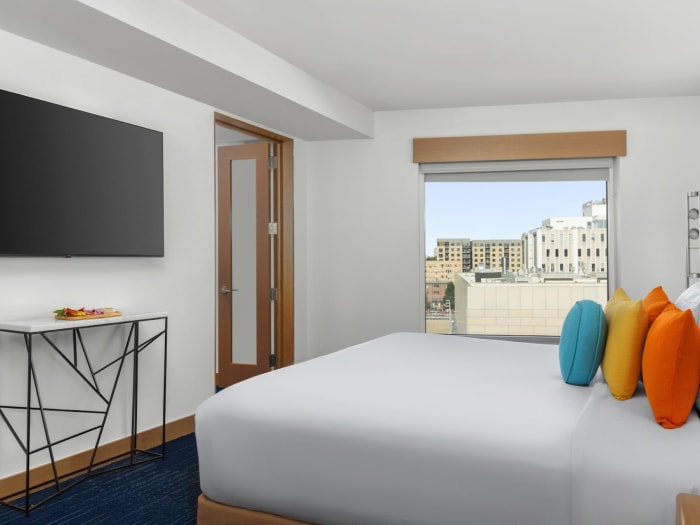
In a hotel whose identity rests as much on perception as on comfort, the question of the rooms is essential. They must extend the aesthetic experience without sacrificing clarity, offer calm without becoming impersonal, and meet the expectations of an international clientele accustomed to a high standard of service. The Art Hotel Denver appears to approach that balance with restraint: modern comfort is central, yet always placed within a wider composition in which design and atmosphere matter as much as equipment.
One can readily imagine the rooms as well-composed urban retreats, designed to lower the tempo after a day spent between museums, meetings and walks through central Denver. In an address of this kind, luxury lies not in accumulation but in flow. A good room is one in which one immediately understands how to inhabit the space, where the light feels right, where materials create coherence, and where every detail seems chosen to support the stay rather than draw attention to itself.
The hotel’s artistic identity naturally extends into the accommodation. Without turning every room into a manifesto, that sensibility is likely expressed through visual discipline: clean lines, a contemporary mood, carefully judged decorative elements and an overall sense of balance. For design-minded travellers, that continuity between public and private spaces matters. It avoids the disconnect often found in hotels where the lobby tells one story and the rooms abandon it entirely.
Underlying comfort rests on the services that genuinely matter in daily use. Daily housekeeping preserves the feeling of a place always ready to receive you, while turndown service adds that extra degree of attention that turns returning to the room into a transition rather than a routine. On a business trip, such details support a seamless schedule. On a cultural weekend or a stay for two, they contribute to a discreet softness more valuable than overt display.
The rooms also lend themselves to different styles of stay. Some guests will want an elegant, functional base close to the city’s cultural institutions. Others will appreciate the chance to slow down, read, work or simply extend the aesthetic experience in a calmer setting. This is where The Art Hotel Denver finds its balance: it does not impose a single way of staying, but offers an environment coherent enough to adapt to several rhythms.
Suites, when chosen, generally answer a desire for additional space, a more residential sense of comfort and a broader feeling of ease in the heart of the city. In a hotel of this category, they appeal equally to couples who want their room to become a destination in itself and to business travellers needing a more generous setting in which to work or receive. Whatever the configuration, the principal appeal remains the same: the impression of inhabiting a contemporary, cultured and carefully considered place where the room is not merely somewhere to sleep, but an extension of the hotel’s overall intelligence.
Dining
In a city such as Denver, where the culinary scene has grown in confidence and maturity, hotel dining can no longer be merely a supporting service. It must offer a credible social setting, capable of attracting both residents and local regulars. With FIRE restaurant and lounge, The Art Hotel Denver appears to have chosen that route: a contemporary table that privileges atmosphere, conviviality and a certain idea of American hospitality—playful, yet sincere.
The very name FIRE suggests energy, warmth and movement. One imagines a space designed as much for dinner as for extending the evening over a drink, in surroundings that remain faithful to the hotel’s aesthetic identity. In a property of this kind, the restaurant plays a pivotal role. It connects travellers to the city, gives shape to the end of the day and offers a natural meeting point between guests and the local scene. When well judged, it avoids the pitfall of the overly neutral hotel restaurant created only for convenience.
The promise here lies in that expression of contemporary American hospitality: welcoming without excess, relaxed yet polished, expressive without losing sight of service. For European visitors, this is often one of the pleasures of the best urban dining rooms in the United States: an ability to create a lively atmosphere without sacrificing professionalism. One dines seriously, but without stiffness. The meal can therefore take different forms depending on the rhythm of the stay: dinner after a performance, a business meeting in a less formal setting, a moment for two before returning upstairs, or simply the desire to remain in-house rather than go back out.
The fact that FIRE is described as contemporary places it in a modern register rather than a heritage one. Guests come for cuisine and service aligned with the pace of Denver today. The lounge adds another layer: a more flexible space suited to an aperitif, conversation or an easy end to the evening. In a hotel centred on the overall experience, that continuity between dining, sociability and design is valuable.
For hotel guests, the restaurant also offers an obvious practical advantage: the ability to structure a full day without compromising on the quality of the dining moment. After a morning of cultural visits or a day of meetings, it is reassuring to find on site a setting that does not feel like a fallback option. This is often where the true quality of an urban hotel is measured: in its ability to make its dining spaces destinations in their own right.
FIRE therefore contributes very naturally to the identity of The Art Hotel Denver. More than a restaurant, it completes the hotel’s narrative. It reminds guests that a well-conceived property is not limited to its rooms or lobby, but also unfolds around the table, where one quite literally tastes the tone of a place.
Concierge and Services
True urban luxury is often measured less by display than by the quality of attention paid to practical details. From that perspective, The Art Hotel Denver offers a set of services aligned with what one expects from a contemporary five-star hotel: availability, discretion, continuity and the ability to simplify a stay without making it feel over-managed. The presence of a 24-hour concierge and round-the-clock front desk immediately sets the tone. Whether for a late arrival, an early departure, an unexpected logistical need or a last-minute recommendation, the hotel remains accessible at all times—essential in a major city and particularly valuable for international travellers.
In a property located steps from Denver’s cultural attractions, the concierge takes on a particular role. It is not limited to handling requests; it can become the interface between guest and city. Securing a table, pointing the way to an exhibition, suggesting a walkable itinerary, helping to shape a day balanced between visits and downtime—these are the gestures that turn a well-organised stay into a genuinely fluid experience. In a hotel whose identity is linked to culture, that mediation matters all the more.
Housekeeping services also contribute to this sense of continuity. Daily housekeeping maintains a consistent level of comfort, especially appreciated over several nights. Turndown service is subtler, almost ritualistic. It signals the shift from the public rhythm of the day to a calmer, more private tempo. Such gestures may seem simple, but they deeply shape the perception of a high-end hotel.
Luggage storage adds valuable flexibility, particularly for travellers whose schedules do not align neatly with check-in or departure times. Being able to enjoy the city unencumbered, or to arrive early and begin exploring immediately, has a tangible effect on the quality of the stay. Laundry service, meanwhile, answers the needs of longer stays as well as business travel, where presentation and practicality remain important. Wake-up service, often underestimated, still has clear relevance for early departures, important meetings or excursion days.
The presence of multilingual staff usefully completes the picture. In a destination welcoming guests from a range of backgrounds, the ability to communicate with ease contributes directly to comfort. It reduces friction, facilitates specific requests and reinforces the feeling of being understood quickly, without unnecessary effort. Once again, luxury lies in the simplicity of the exchange.
Ultimately, the services at The Art Hotel Denver appear designed to support a precise idea of the stay: time in the city that should remain inspiring, but never complicated. The hotel accompanies without imposing, anticipates without theatricality, and provides the solid operational framework that allows guests to focus on what matters most—discovery, work, rest or conversation. It is often in this quiet command that the best urban addresses reveal themselves.
The Denver Way of Life
Staying at The Art Hotel Denver means choosing a particular reading of Denver. Not the expected one of a simple gateway to the Rockies, but that of a city that has built an urban way of life around culture, walkability in its central districts and a relatively direct relationship with civic institutions. By virtue of its location close to major cultural attractions, the hotel encourages precisely that rhythm: stepping out on foot, shaping the day around an exhibition, a building, a lunch, then returning briefly before going out again in the evening.
This way of inhabiting the city is especially appealing in Denver, whose cultural centre offers unusual density within a setting that remains legible. One can move from museum to civic building, from public space to restaurant, with that sense of openness characteristic of many cities in the American West. For European travellers, that spaciousness is often part of the appeal: broader horizons, clearer light and a relationship between culture and everyday life that feels less ceremonious than elsewhere.
The Art Hotel Denver fits naturally into this dynamic. Its atmosphere, designed for lovers of art and design, acts almost as a preparation of the eye. Before even exploring the neighbouring institutions, guests are already placed in a state of attention. The artworks visible throughout the hotel, the contemporary tone of the interiors and the studied restraint of the whole create continuity with what one seeks in the city: an aesthetic experience, certainly, but also a more conscious way of moving and observing.
Denver lends itself well to this kind of composed stay. One can alternate between intensity and pause, formal culture and more spontaneous pleasures. A morning may begin with a visit, continue with a walk through the district, then give way to a return to the hotel for rest or a drink before dinner. That flexibility is one of the destination’s real luxuries. It allows guests not to consume the city at speed, but to experience it in sequences.
For couples, the hotel offers a setting well suited to a cultivated city break, far from the clichés of a stay that is either purely contemplative or purely festive. For business travellers, it allows a professional trip to become something richer, using free time to connect with the local cultural scene. For families too, the proximity of museums and galleries can help structure a stimulating and accessible programme, provided it is approached with flexibility.
Ultimately, the way of life suggested by this address rests on a simple idea: city travel can be comfortable, inspiring and intelligently located all at once. Denver emerges here as a destination of substance as much as scenery, and The Art Hotel Denver as a privileged vantage point from which to grasp its nuances. One comes to sleep well, certainly, but also to sharpen one’s view of an American city that has made culture one of its most convincing languages.
Book with MyConciergeHotel
Choosing The Art Hotel Denver through MyConciergeHotel means treating the reservation as the beginning of the stay rather than a mere transaction. For a property whose appeal rests as much on atmosphere as on location, that distinction matters. A hotel like this cannot be reduced to a room category or a list of amenities; it works through the fit between the traveller’s profile, the rhythm of the visit and the way one wishes to experience Denver. Booking intelligently therefore already means refining the experience.
The value of dedicated guidance appears first in choosing the right pace. A cultural weekend for two does not call for the same priorities as a business trip, a longer stay or a family stopover. Some travellers will want to maximise access to nearby institutions and structure very full days. Others will prefer a balance between visits, downtime and time spent in the hotel itself. In every case, the value of a booking concierge lies in the ability to guide guests towards the most suitable arrangement without relying on formula.
This approach is particularly relevant for The Art Hotel Denver, whose strength lies in its overall coherence. Guests come for the proximity to cultural attractions, for the atmosphere shaped around art and design, for the comfort of a five-star urban hotel, and for the possibility of experiencing Denver without wasted time or unnecessary detours. A well-prepared reservation helps unlock that logic. It allows one to think through arrival, timings, meals, the pace of visits and even how best to use the hotel’s services to create a smoother stay.
Booking with care also means giving proper weight to the details that tangibly change a trip. A late arrival feels different when one knows the front desk and concierge remain available at all hours. A final day in the city becomes lighter when luggage storage has been anticipated. An ambitious cultural programme gains comfort when pauses and an on-site dinner are built in. The most successful hotel experiences are often those that feel simple once on site precisely because they were thoughtfully arranged in advance.
For travellers drawn to design, culture and addresses with a clear identity, The Art Hotel Denver deserves to be approached as a destination within the journey. It is not simply a matter of sleeping near the museums, but of choosing a place that extends the city’s creative impulse into its interiors. That continuity is what should be preserved at the moment of booking: selecting not only a room, but a way of inhabiting Denver.
MyConciergeHotel follows that philosophy of the well-judged stay. The aim is not to do more, but to do better: choose better, anticipate better, and connect hotel and destination more intelligently. For a property such as The Art Hotel Denver, that precision makes all the difference. It allows guests to enter the city through the right door—that of a hotel that immediately sets the tone for a cultivated, contemporary and exceptionally well-located stay.