History & sense of place
In Menlo Park, Rosewood Sand Hill feels less like a conventional city hotel than a Californian retreat designed for a slower rhythm. Its identity begins with its setting: gentle hills, carefully tended gardens and clear West Coast light, on the edge of Silicon Valley. That location gives it a distinctive tone. Guests find the efficiency expected by an international clientele used to high standards, but also a residential calm that is rare in a region so often associated with speed, innovation and tightly packed schedules. The hotel’s character lies precisely in that balance between the intensity of the nearby business world and the need for breathing space.
The Rosewood approach is central here. The brand is known for a style of hospitality that privileges personalisation, discretion and the feeling of inhabiting a place rather than merely passing through it. At Rosewood Sand Hill, that philosophy is especially legible: low-rise architecture, a fluid dialogue between indoors and outdoors, shared spaces designed never to feel showy, and service that is attentive without theatricality. Luxury here does not rely on effect. It is expressed through the quality of materials, the care given to the gardens, the way a terrace opens onto the landscape, and the calm tempo the hotel manages to establish from the moment of arrival.
The address appeals equally to business travellers and to guests seeking a more restorative interlude. That is one of its most interesting qualities: it accommodates very different purposes without losing coherence. In the morning, some leave for company headquarters and campuses across the Valley; others linger over coffee, walk through the gardens or simply rest with views of the hills. This coexistence creates no visible friction because the hotel has been conceived as a structured refuge, able to absorb different rhythms without sacrificing the sense of space.
Within the Californian luxury-hotel landscape, Rosewood Sand Hill occupies a particular position. It does not rely on beach imagery, urban energy or overt heritage drama. Its strength lies in a form of accuracy: that of a hotel which understands its territory, its clientele and the increasingly rare value of quiet. Menlo Park, with its residential profile, intellectual and entrepreneurial surroundings, and proximity to some of the West Coast’s most influential hubs, provides the context. The hotel turns that context into a place one can genuinely inhabit.
For European travellers, the property often reveals another side of California: less postcard-driven than the coast, yet more subtle in its relationship to nature, space and quality of life. Rosewood Sand Hill does not need to overstate its appeal. Its legacy is above all that of contemporary hospitality well executed, rooted in a specific place and faithful to a certain idea of high-end American comfort: generous, serene and exceptionally practical.
The property
One of Rosewood Sand Hill’s greatest strengths is that it immediately conveys a sense of place. In Menlo Park, between the momentum of Silicon Valley and a calmer landscape of hills and Californian greenery, the hotel creates the atmosphere of a retreat without true remoteness. Arrival sets the tone: nothing ostentatious, but a feeling of air, openness and continuity between the built environment and its surroundings. The lush gardens, highlighted among the property’s known strengths, are not mere decoration. They shape the way the hotel is experienced, introducing greenery throughout and naturally softening both the architecture and the pace.
The architecture and layout appear designed to capture light and frame views. The outlook over the surrounding hills is especially important. It serves as a reminder that, even within easy reach of one of the world’s most influential economic territories, the landscape remains a central part of the stay. That relationship with the outdoors is particularly valuable in a region where visits are often driven by business obligations. Rosewood Sand Hill offers more than a convenient base: it provides a setting in which to reset, hold a conversation in peace, work with greater perspective or simply recover a sense of ease.
The shared spaces extend that impression. They favour relaxation and fluid movement rather than monumentality. One imagines lounges open to daylight, terraces where guests linger, and transitional areas between indoors and outdoors that make the Californian climate fully tangible. This way of organising space is characteristic of the best West Coast addresses: instead of creating a hard divide between interior refuge and surrounding nature, they turn permeability itself into a form of luxury.
The location is, of course, strategically strong. Being close to Silicon Valley means easy access to meetings, campuses, headquarters and regional points of interest, while still returning in the evening to a more serene environment. For an international clientele, that balance is particularly valuable. It combines logistical efficiency with quality of stay, without forcing a choice between a purely functional hotel and a remote resort. Menlo Park offers an especially convincing base in that respect: connected enough, yet less exposed to intensity than denser hubs.
What truly distinguishes the property, however, is its ability to turn location into identity. Many hotels benefit from a good address; fewer know how to build a coherent experience around it. Here, proximity to the technology world never overwhelms the place. It remains a context rather than a decorative theme. Rosewood Sand Hill does not attempt to imitate or comment on the business environment around it. Instead, it offers a counterpoint: a space of calm, measured comfort and attention to detail, where one can prepare for a demanding day or withdraw from it.
For couples, families and business travellers alike, that versatility matters. The hotel seems designed to host varied stays without losing its unity. It works for a few nights of meetings, a longer regional stay, or a restorative pause while exploring the Peninsula and greater San Francisco area. In every case, it maintains the same promise: discreet luxury rooted in the landscape, and a slightly slowed relationship to time — which, in this part of California, already feels like a rare privilege.
Rooms and Suites
At the Rosewood Sand Hill, the rooms and suites embody the overarching ethos of the establishment. Here, one expects a refined comfort and a sense of tranquillity that harmonises with the surroundings. In Menlo Park, where many stays intertwine professional obligations, time zone adjustments, and the need for recuperation, the quality of a room is measured as much by its aesthetics as by its ability to restore focus. The essence lies in discretion, space, and the fluidity of use.
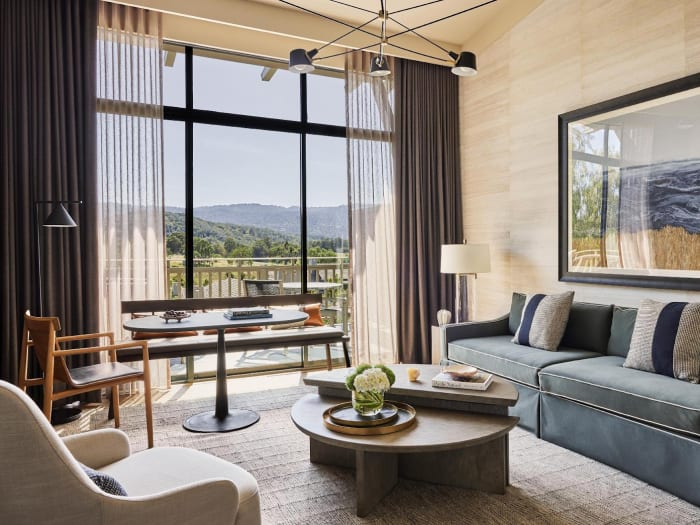
The design language reflects contemporary residential luxury. Warm materials, a palette inspired by the Californian landscape, sustainable furnishings, and lighting tailored to various moments of the day create a cohesive experience. Views of the surrounding hills enhance this sense of openness. Even indoors, the outside remains perceptible. This is an essential quality in a hotel where one might prepare a presentation, rest between meetings, or read in the late afternoon.
The promise of personalised service that defines Rosewood is fully realised here. In the room, it manifests as a seamless welcome, thoughtful preparation, nightly turndown service, meticulous daily housekeeping, and practical needs addressed with discretion. Daily room service, laundry, concierge, and 24-hour reception outline a frictionless stay.
The suites cater to more specific expectations: extended stays, the need to host, family travel, or simply a desire for space. At Rosewood Sand Hill, they enhance the feeling of a private residence. The appeal lies not only in the size but also in the layout. Clear functional separation, intuitive circulation, and the ability to work or relax without confusion of purpose are paramount.
For business travellers, the ideal room must be stable, quiet, and efficient. For couples, it should offer a soothing intimacy. For families, it must simplify logistics without sacrificing elegance. Rosewood Sand Hill addresses this diversity through a design that prioritises enduring comfort. This is often what distinguishes hotels that leave a lasting impression: the feeling that everything is perfectly in place.
In the Californian context, this quality resonates particularly well. Visitors often arrive in the region with a packed agenda, journeys to organise, and meetings to attend. Returning in the evening to a room that seeks to soothe rather than impress becomes a true luxury. The rooms and suites at Rosewood Sand Hill embody this tradition of well-executed American comfort: generous without heaviness, elegant without coldness, and sufficiently flexible to accommodate both a brief overnight stay and a more extended visit.
Dining
At a property such as Rosewood Sand Hill, dining is not defined solely by what appears on the plate; it shapes the rhythm of the day. In Menlo Park, where one may move from a working breakfast to an informal lunch and then to a dinner intended to extend conversation rather than rush it, food and beverage must be precise, flexible and aligned with the spirit of the place. One therefore expects an approach in tune with contemporary California: clear, seasonally minded, attentive to freshness, and elegant enough to suit both local patrons and travellers passing through.
The setting matters greatly. In a hotel known for lush gardens, relaxing shared spaces and views over the hills, dining is not simply a practical function. It is also a way of engaging with climate and light. A well-placed terrace in the morning, lunch in an open and airy atmosphere, a drink at day’s end as the landscape softens: these moments often matter as much as the menu itself. Rosewood Sand Hill seems especially well suited to this kind of dining integrated with its environment, where pleasure comes as much from context as from cuisine.
For business travellers, the requirement is clear: an offer capable of accommodating different kinds of meetings without stiffness. Guests need to be able to settle in for an early coffee, hold a discreet conversation, arrange a meal without excessive formality, or choose the ease of in-room dining after a demanding day. The hotel’s known services — 24-hour concierge, round-the-clock reception and daily housekeeping — suggest a well-run operation conducive to such stays. In that context, dining becomes as much a matter of comfort as of pleasure.
For leisure guests, it takes on another dimension. In a peaceful hotel setting, food and drink help create a resort-like feeling even on a short stay. In the morning, they can set the tone for a slower day; in the evening, they make staying in more appealing than heading elsewhere. That is one of the advantages of the best mixed-purpose luxury properties: they make remaining on site desirable, not through lack of alternatives, but because the hotel itself offers an environment pleasant enough to hold one’s attention.
Without claiming a specific culinary signature, one can say that Rosewood Sand Hill calls for a cuisine of balance rather than theatrics. In this part of California, the strongest hotel tables tend to succeed when they avoid heaviness and favour clarity of flavour, quality produce and execution without showmanship. International guests appreciate that, as do local regulars, who are often exacting about freshness, service rhythm and the overall comfort of the experience.
Ultimately, the true success of hotel dining, especially at this level, lies in its ability to adapt to different uses without losing character. Breakfast in the sun, a light pause between appointments, a more settled dinner, a convivial drink: each sequence should feel natural. At Rosewood Sand Hill, everything suggests that dining follows this logic of functional elegance. It does not seek to distract from the place itself; it becomes one of its most enjoyable expressions, serving a stay in which the quality of the setting matters just as much as the quality of the moments shared around the table.
Spa & wellness
Wellness at Rosewood Sand Hill appears first and foremost to be a matter of atmosphere. Even before considering treatments or specific facilities, the peaceful setting, lush gardens, relaxing shared spaces and views over the surrounding hills already create a sense of restoration. In a region where performance and constant availability can quickly saturate attention, that ability to offer calm is far from incidental. It is, on the contrary, an essential part of the experience. Luxury here begins with the possibility of slowing down without effort.
At a five-star hotel of this level, the wellness dimension usually has to answer several expectations at once. It should allow physical recovery after a long flight or a demanding day, provide more immersive moments of care for leisure travellers, and remain flexible enough to adapt to changing schedules. By its very nature, Rosewood Sand Hill seems particularly well placed to meet that range of needs. Its environment encourages simple rituals: an early walk in the gardens, a quiet pause before breakfast, a moment of stillness in the late afternoon as light softens over the hills.
The concierge’s existing advice — to enjoy the gardens for a morning stroll — says a great deal about the spirit of the place. It suggests an idea of wellness that does not depend solely on technical facilities, but on a way of inhabiting the hotel. Walking early, feeling the cool air, noticing the carefully maintained planting, and rediscovering a more organic rhythm before the day accelerates: these are simple gestures, yet often more memorable than an over-programmed schedule. The best properties understand this. They do not confine wellbeing to a dedicated room; they weave it through the entire stay.
Add to that the promise of personalised service, and the difference becomes clearer. In the spa and wellness sphere, personalisation does not need to be theatrical to be valuable. It may consist in guiding a guest towards the best time of day, suggesting a rhythm more suited to the stay, facilitating the organisation of a treatment, or simply preserving a seamless sense of comfort between room, relaxation areas and hotel services. That coherence is often exactly what seasoned international travellers seek.
The Californian context reinforces this reading. Here, wellness is rarely conceived as a complete break from everyday life; it is more often part of a culture of balance, bodily awareness, natural light, outdoor living and a certain sophisticated simplicity. Rosewood Sand Hill appears to belong to that tradition. Its luxury is not one of radical disconnection, but of subtle recalibration: sleeping better, breathing more deeply, recovering more fully, regaining mental space.
For a business stay, that dimension can transform the entire experience. A hotel that genuinely allows one to rest becomes a strategic ally. For a couple’s weekend, it gives depth to the stay and prevents it from becoming a mere succession of services. For families, it creates a more harmonious setting in which everyone can find their own rhythm. That is perhaps the true wellness quality of Rosewood Sand Hill: its ability to make calm itself feel like a service, without ever making it seem contrived.
Concierge & Services
Service often elevates a very good hotel into a truly memorable category. At Rosewood Sand Hill, this aspect supports a seamless, personalised stay without visible overload.
The property offers 24-hour concierge services, a 24-hour reception, daily room service, turn-down service, luggage storage, laundry, wake-up calls, and multilingual staff. Together, these amenities reflect an organisation designed to anticipate needs before they become burdens.
Located near Silicon Valley, the concierge plays a particularly vital role. It helps to navigate often complex days. Whether it’s arranging a transfer, adjusting a schedule, providing a suitable recommendation for limited free time, or offering logistical support between meetings, it is in these details that the true quality of a great hotel is measured. Continuous availability reassures, especially for an international clientele. Knowing that a competent contact is accessible at any hour significantly enhances the comfort of the stay.
The turn-down service and daily maintenance contribute to another form of luxury: that of continuity. The hotel discreetly reorganises itself around the guest. This requires precision, coordination, and a sense of timing. When too visible, service can become intrusive; when insufficient, it reveals the seams of the operation. Rosewood Sand Hill remains faithful to this principle.
Laundry services, luggage handling, wake-up calls, and the presence of multilingual staff often determine the quality of an extended stay or a business trip. The ability to quickly retrieve a garment, leave luggage with peace of mind, be assisted in one’s language, or rely on a dependable wake-up call fosters a sense of control and confidence. Contemporary luxury often hinges on this: reducing mental load rather than adding external signs of prestige.
For families, these services make the hotel more livable. For couples, they preserve the lightness of the stay. For business travellers, they constitute an invisible infrastructure. Rosewood Sand Hill succeeds precisely because it does not turn service into a spectacle. It integrates service into the overall experience, alongside gardens, views, and the tranquil atmosphere.
In a region where everything moves quickly, a hotel capable of offering stability is worth more than an impressive decor. Rosewood Sand Hill understands this expectation with finesse. Its service does not seek to capture attention; rather, it aims to make the stay simpler, sweeter, and more coherent.
The Menlo Park way of life
Staying at Rosewood Sand Hill also means discovering a particular side of Northern California. Menlo Park has neither the overt energy of San Francisco, nor the coastal imagery of the shoreline, nor the theatrical quality of certain resort destinations. Its appeal is subtler. It lies in a quality of life shaped by space, light, well-kept residential surroundings and immediate proximity to Silicon Valley without necessarily adopting its constant tension. For travellers, that nuance matters. It allows the region to be approached differently: not as a mere sequence of meetings or sites to tick off, but as a territory where one can still make time, observe the landscape and appreciate a certain ease of movement.
Rosewood Sand Hill fits naturally into this way of life. Its peaceful setting amid Californian landscapes, lush gardens and views over the surrounding hills extend what is most attractive about Menlo Park: a fairly direct relationship between daily life and cultivated nature. Luxury here does not come from a radical break with the real world; it emerges instead from a particularly well-calibrated version of it. One moves easily from a highly demanding working environment to a more residential, at times almost contemplative atmosphere. That swift transition is one of the Peninsula’s privileges when properly experienced.
For international visitors, Menlo Park often serves as an entry point into the contemporary culture of the South Bay: innovation, nearby universities, major companies, but also cafés, walks, tree-lined neighbourhoods and a rhythm less confrontational than in denser urban centres. Its interest is not solely professional. It is also sociological and aesthetic. One senses here a California of sought-after balance, informal comfort, attention to the immediate environment and care for the quality of everyday experience. Through its positioning, Rosewood Sand Hill offers a particularly good vantage point from which to observe that way of living.
The relatively mild climate throughout the year reinforces this impression. It encourages the use of terraces, pleasant movement and time spent outdoors without any need for staging. In many destinations, the outdoors is seasonal or exceptional. Here, it belongs to the everyday. That is why the hotel’s gardens and relaxation spaces matter so much: they are not an added extra, but a faithful translation of local life. They embody a very Californian idea that comfort also depends on air, light and the ability to remain in contact with the landscape.
For couples, Menlo Park can be the choice of a quieter stay away from obvious circuits. For families, it offers a practical and serene base. For business travellers, it is a chance to discover that Silicon Valley is not reducible to offices alone. In every case, the town and its surroundings invite a form of calm curiosity. One seeks here less an accumulation of dramatic images than an understanding of a certain style of life: efficient yet not outwardly hurried, sophisticated yet rarely demonstrative.
That is precisely what the hotel seems to capture. Rosewood Sand Hill does not overplay California; it offers a mature, grounded and liveable reading of it. In that sense, it is an excellent base from which to grasp what is most interesting about Menlo Park: a luxury of context, balance and breathing space, harder to describe than a monument or a beach, yet often far more lasting in the memory.
Book with MyConciergeHotel
Booking Rosewood Sand Hill through MyConciergeHotel means approaching the property with the right level of guidance. A hotel such as this is not chosen solely for its five-star status or for the reputation of Rosewood Hotels & Resorts. It is chosen for a precise balance: proximity to Silicon Valley, a peaceful setting, lush gardens, views over the hills, personalised service, and the ability to suit both business stays and more personal interludes. The real value of a well-prepared booking therefore lies in aligning those qualities with the reality of the trip: length of stay, desired pace, preferred room type, logistical needs, and expectations regarding calm or access.
MyConciergeHotel allows for exactly that more nuanced reading. For some travellers, the main priority will be efficiency: arriving late, ensuring a smooth welcome, organising transfers, and securing a frictionless stay with concierge and front desk available at all hours. For others, the aim will be to optimise the on-site experience: choosing a room category suited to a longer stay, prioritising an environment more conducive to rest, planning time in the gardens, or building an itinerary that leaves genuine room for the hotel itself. In both cases, booking becomes more than a rate; it becomes a way of preparing the right use of the place.
The value of editorial and concierge support also lies in the nature of Menlo Park itself. The destination is less immediately legible than some major American hubs. It often requires a little context to be fully appreciated. Understanding that this is not a city-centre hotel but a refined retreat close to the Valley’s main axes; knowing that the site’s calm is part of its appeal; anticipating busier periods; organising one’s schedule to enjoy the outdoor spaces and views: all these elements change the quality of a stay. A good booking begins with a good interpretation of the property.
MyConciergeHotel can also help position Rosewood Sand Hill within a broader itinerary. For a Northern California trip, the hotel can serve as a strategic stop between professional commitments, Peninsula exploration and regional escapes. For a stay centred on Silicon Valley, it offers a calmer alternative to purely functional options. For a weekend or a few days away as a couple, it provides a more discreet, residential version of Californian luxury. This ability to place the hotel within a travel project is part of the added value.
Booking wisely also means understanding what one is coming for. At Rosewood Sand Hill, guests do not come for noisy display. They come for a certain quality of quiet, for service that simplifies, for a setting that soothes, and for the possibility of remaining close to the action without being consumed by it. It is a hotel of nuance, and hotels of nuance are always best chosen with precision.
Through MyConciergeHotel, that precision becomes easier to achieve. The aim is not merely to confirm a room, but to prepare an experience consistent with your expectations. At a property where so much depends on rhythm, context and attention to detail, that step truly matters. It allows you to approach Rosewood Sand Hill not as a simple booking, but as a stay thoughtfully composed.