History & heritage
Staying at Relais de Chambord means stepping into a heritage landscape larger than the hotel itself. The property draws its meaning from its immediate relationship with the Château de Chambord, one of the defining monuments of the French Renaissance, set within an exceptionally vast forest estate. The hotel does not attempt to compete with that monument; instead, it sits alongside it with intelligence, offering a contemporary way of inhabiting a place steeped in history. That restraint is part of its identity. Guests may come first for Chambord, then discover that, just a few steps away, there is a particularly well-judged way to experience the setting without turning it into nostalgia.
The village and the surroundings of the château have long lived to the rhythm of the estate, its seasons, its visitors and its historical uses. In that context, Relais de Chambord belongs to a distinctly French tradition of elegant lodging near a major cultural landmark, though updated with present-day codes. Its appeal lies precisely in that balance: preserving the weight of a historic site while opening it up to a lighter, brighter, more contemporary form of hospitality. Time feels different here. In the morning, the outline of the château evokes the long span of history; in the evening, the hotel’s interiors return guests to a sense of modern comfort designed for restorative stays as much as for cultural escapes.
This dialogue between heritage and modernity is visible in the overall atmosphere. Relais de Chambord is not a museum-like setting. It favours discreet elegance, allowing the landscape, the views, the stonework and the Loire light to take precedence. That likely explains its appeal to a broad yet discerning clientele: couples seeking a romantic stay, travellers with an interest in architecture, garden enthusiasts and international visitors touring the Loire châteaux. All find here a coherent base, where the hotel experience extends the visit to the estate rather than separating itself from it.
Its membership of Small Luxury Hotels of the World also helps define its positioning. One finds the idea of a human-scale address where character matters more than display, and where the singularity of the place counts as much as the level of service. In the case of Relais de Chambord, that singularity is not a branding device: it comes from an almost theatrical setting facing one of France’s best-known monuments. Few hotels can claim such proximity to an iconic site while still preserving a sense of calm and privacy.
Ultimately, the heritage of Relais de Chambord is not only architectural or geographical. It is cultural as well. It reflects a certain idea of travelling in France: taking one’s time, choosing a property that speaks to its surroundings, preferring precision of setting to unnecessary flourish. In a region where history is visible everywhere, the hotel offers a contemporary way of living with it, not as a mere backdrop but as a daily presence. That is what gives the stay its depth: the feeling of sleeping not simply near a château, but within a still-living historic landscape.
The hotel
The first privilege of Relais de Chambord is its setting. Just steps from the Château de Chambord, the hotel enjoys an almost direct and intimate relationship with the monument, while remaining sufficiently set back to preserve a sense of quiet. That proximity changes the nature of the stay. One does not simply visit Chambord from a nearby hotel; one spends a few days within its orbit, with the chance to observe changing light on the façades, the movement of the park, the flow of visitors during the day and the return of calm once the site empties. Few addresses offer such continuity between heritage, landscape and hospitality.
The interior approach and overall atmosphere rely on contemporary design within a historic setting, according to the known brief. That choice matters: it avoids pastiche and allows the place to breathe. The shared spaces are described as bright and welcoming, which suits the spirit of a country retreat more than that of a large urban hotel. One expects clean lines, restrained materials, seating designed as much for contemplation as for conversation, and above all a discreet framing of the views. Here, luxury does not come from excess but from accuracy: a well-oriented lounge, a window that captures the château, an easy flow between indoors and out, and an atmosphere calm enough for each guest to find their own rhythm.
The hotel’s character also lies in its ability to appeal to several kinds of traveller without losing its identity. Couples find an inherently romantic setting without any need for embellishment. History-minded guests value the immediate proximity of the château and the possibility of approaching it at different times of day. Travellers seeking nature benefit from access to the park and gardens of Chambord, with the rare feeling of being both at a major cultural site and on the edge of a vast living landscape. International guests, meanwhile, discover a distinctly French synthesis of monumental heritage, Loire softness and attentive hotel service.
Relais de Chambord therefore acts as a link. On one side, it opens onto the powerful imagery of the château, its dramatic scale, its history and its estate. On the other, it offers a more intimate, more habitable, human-scale experience. That is often what separates strong heritage addresses from simple destination hotels: the ability to turn a famous place into a personal experience. After a day of visits, one returns not to a generic setting but to a refuge that remains in dialogue with what has just been seen.
That coherence can even be felt in the rhythm of the stay. Morning invites walking, cycling and discovery of the estate; the afternoon may be divided between relaxation and exploration; by evening, the presence of the château becomes almost silent, as though the landscape were reclaiming itself. Relais de Chambord makes the most of that natural dramaturgy without ever forcing it. That is part of its success: a hotel that understands that its greatest luxury may be knowing when to step back and let the place speak.
Rooms and Suites
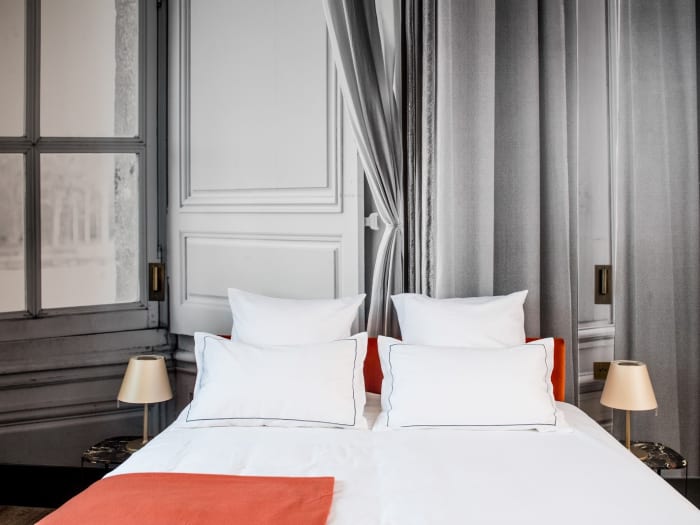
At the Relais de Chambord, the room extends the experience of the estate. Booking a room with a view of the château encapsulates the essence of the stay. Here, orientation is almost as important as category. Seeing the château from your window or bed transforms the perception of your visit. The monument accompanies the dawn, the returns from walks, and the tranquil evening hours.
The spirit of the rooms aligns with that of the common areas. The elegance is contemporary, devoid of excessive decoration. Light and landscape play a central role. In a place steeped in history, this restraint is welcome. It prioritises comfort, clarity of space, and a certain visual softness. There is a balance between discreet refinement and ease of use.
The rooms and suites naturally attract couples. They are also suitable for cultural travellers wishing to explore the surroundings of Chambord. In the evening, they return to a serene setting. Some will spend much time outdoors, in the park, gardens, or at the château. The room then becomes a calm and well-kept refuge. Others will use it as a vantage point, enjoying the views, the light, and this rare proximity to the monument.
In an establishment of this kind, perceived quality often hinges on silent details. A comforting bed after a day of walking. A thoughtfully designed bathroom. A turn-down service that marks the transition to the evening. Impeccable daily maintenance. A sense of order and serenity. The daily housekeeping and turn-down service contribute to this impression of continuous care. Nothing spectacular, but a collection of attentions that makes the stay seamless and restful.
Choosing a room at the Relais de Chambord involves deciding between different ways to experience the place. The view of the château remains the most iconic option. Others may prefer a more discreet relationship with the landscape, oriented towards the tranquillity of the village or the edges of the estate. The essence lies in the ability to bring Chambord into the intimacy of the stay without sacrificing contemporary comfort. It is this blend of monumental proximity and residential softness that gives the nights spent here their unique character.
Dining
In a place such as Relais de Chambord, dining is not merely a culinary performance; it forms part of the way one inhabits the landscape. Eating opposite a great monument, having breakfast before the estate opens, extending a walk with a leisurely lunch or returning for dinner after a day of visits: these moments structure the stay as much as the rooms or the relaxation spaces. In the absence of precise details about the culinary signature or chefs’ names, it is more accurate to speak here of a five-star hotel table conceived as a link between heritage, seasonality and the art of hospitality.
The context of Chambord naturally calls for a clear, regionally grounded cuisine without forced folklore. In the Loire Valley, the gastronomic experience is often a matter of balance: respect for produce, attention to the seasons, room for vegetables and herbs, perhaps river fish depending on inspiration, and a certain freshness of tone that suits the local light. In a contemporary property beside a historic estate, one expects less of a demonstration and more of a cuisine able to extend the elegance of the place. Service matters greatly as well. It must accompany guests who have come for very different reasons — a romantic weekend, a cultural stop, an international tour — while maintaining the same quality of presence: attentive, never heavy-handed.
Breakfast deserves particular mention. In destination hotels, it is often one of the most memorable moments because it sets the first measure of the place. At Chambord, it can take on an almost theatrical dimension if the dining room or terrace opens onto the château or its surroundings. In the morning, the light is softer, the paths are still quiet, and one feels the rare impression of having the monument almost to oneself before the day’s activity begins. In that context, a good breakfast needs no dramatic effects: it simply has to be well composed, well served and allow the landscape to take its full place.
Dinner, by contrast, accompanies the return of calm. After kilometres walked in the park or hours spent visiting the château, one often seeks a cuisine that is comforting in its precision, a serene setting and a slower tempo. Relais de Chambord, by its positioning, seems made for that kind of meal: neither too formal nor too casual, but sufficiently polished to give the evening real substance. In the best addresses of this type, the dining room becomes a second sitting room, a place to revisit the day, prepare for the next one, or simply enjoy the privilege of being there.
Dining is therefore an integral part of the experience, not as a separate chapter but as one of the stay’s essential rhythms. It connects the hotel to its territory, gives shape to the day and contributes to the sense of harmony sought by contemporary luxury travellers. At Chambord, perhaps more than elsewhere, eating well also means looking well: at the landscape, the light, the seasons, and that distinctly French way of allowing table and place to speak to one another.
Spa & Well-being
In Chambord, well-being takes on a unique tone. The estate, walks, visits, and bike rides invite an active experience. Rest then becomes a natural counterpoint. In this spirit, the Relais de Chambord lends itself to a serene interpretation of luxury.
In a five-star hotel of this calibre, well-being primarily hinges on the quality of recovery times. The calm of the spaces, thermal comfort, softness of materials, the possibility of seclusion, and a discreet service rhythm all contribute. It often begins there, even before any treatments. After a day in the estate, returning to an atmosphere of relaxation changes the quality of the stay.
Nature plays a full part in this sensation. The vast landscapes of the Loire provide a sense of breathing space. Here, the landscape already acts as a resource for regeneration. Walking in the early morning, cycling along the paths, observing the estate's perspectives, then returning to the hotel to rest creates a balanced rhythm.
For couples, this aspect is significant. The romance of a stay in Chambord is not solely about the view of the château. It also lies in the opportunity to share a slow-paced time together. A few hours of calm, returning to the room in the late afternoon, a moment of relaxation before dinner. It is often these interstices that leave the most lasting memories.
Well-being at the Relais de Chambord is thus understood as a sum of favourable conditions. A unique environment, a human scale, calming contemporary design, and direct access to an estate where nature plays a major role. Together, they remind us that a successful stay also depends on the coherence between the place, the rhythm, and the state of mind it enables.
Concierge & Services
At the Relais de Chambord, service is delivered with discretion and precision. Upon arrival, a valet takes over, ensuring a seamless check-in experience.
The concierge service enhances your stay with a flexible attentiveness that saves time. It facilitates practical requests and adjusts the pace of your day.
For both arrivals and departures, an airport transfer service is available, allowing for a smooth journey to the hotel without the hassle of multiple connections.
Room service is provided twenty-four hours a day, catering to late returns as well as leisurely mornings without a set schedule.
The hotel also welcomes pets. While this option incurs a fee, it allows guests to travel without having to separate from their furry companions.
Overall, the service is designed to be straightforward, aimed at easing logistical concerns. Here, comfort derives as much from the availability of the staff as from the simplicity of the amenities.
The Chambord art of living
Chambord is not a destination approached as a mere stopover. Even during a short stay, the place imposes a certain slowing down, a particular way of looking and moving. Relais de Chambord benefits fully from that quality. By staying here, one discovers less a town in the conventional sense than a territory organised around a monument, a park, gardens and a forested imaginary. The local art of living therefore lies in the relationship between culture and nature, between architecture of power and the softness of the Loire landscape. It is an experience that is more horizontal than urban, more contemplative than event-driven.
The Château de Chambord naturally structures everything. Yet to reduce the stay to the visit alone would be to miss the essential point. The estate invites wandering, observation and a form of availability that contemporary travellers increasingly seek. One may devote a morning to the monument, then spend the afternoon exploring its surroundings, following the perspectives, cycling, enjoying the gardens or simply stopping to look. This alternation between discovery and breathing space creates a very particular rhythm, almost therapeutic in its simplicity.
Spring and summer, already recommended in the existing description, do indeed seem the most obvious seasons for making the most of the outdoors. The light is more generous, the gardens more legible and walks longer. Yet Chambord also has an appeal out of season, when the estate regains a kind of silent gravity. In every case, the stay is best conceived not as a race through activities but as an immersion. Luxury here often consists in accepting not to do everything: choosing one route, returning to the hotel, taking time over a drink, heading out again for an evening walk, watching the château under a different light.
This art of living speaks especially to couples, which matches the guest profile already identified. Chambord offers a romance of great sobriety, far from cliché. It comes from the scale of the landscape, the presence of water and trees, the monumentality of the château, and the feeling of being slightly removed from ordinary life. Travellers interested in history find obvious cultural depth; those seeking tranquillity discover a setting conducive to refocusing; international visitors read in it a powerful image of heritage France, but without the agitation of the major capitals.
Staying at Relais de Chambord therefore means adopting, if only for two or three days, a certain discipline of looking. Looking more carefully, walking more, consuming less quickly, allowing the place to set the pace. That may be where the true art of living in Chambord resides: in its ability to make monumental exceptionality coexist with a recovered simplicity. The hotel, through its setting and tone, acts as the ideal mediator of that experience. It allows guests to enter the landscape effortlessly, and then remain within it with a sense of rightness.
Book with MyConciergeHotel
Booking Relais de Chambord through MyConciergeHotel means approaching the property not as a simple overnight stay but as a trip to be shaped with care. In a hotel so dependent on its immediate surroundings, the quality of the experience often rests on choices made in advance: room category, the value of a château view, the ideal length of stay, the best time of day to explore the estate, and the balance between relaxation, visits and walks. Well-guided booking is precisely what turns a beautiful address into a truly well-judged stay.
One of the first decisions concerns the room. At Relais de Chambord, certain options take on particular value because of the direct relationship with the monument. For a romantic trip, an anniversary, a first discovery of Chambord or simply the wish to experience the place more intensely, a château view becomes a defining choice. For other travellers, a quieter room, favouring calm or another angle on the landscape, may suit better. The role of concierge-led guidance is precisely to align the accommodation with the intention of the stay, rather than thinking only in terms of trading up.
Length of stay also deserves thought. Many travellers consider Chambord as part of a Loire itinerary, yet the hotel encourages a slower pace. One night is enough to grasp the magic of the site; two nights already provide a fuller experience, with time to visit the château without haste, enjoy the park, settle into a proper dinner and experience the changing atmosphere between morning, afternoon and evening. Booking with advice also means identifying that right tempo, the one that avoids both frustration and excess.
MyConciergeHotel also brings particular value to everything surrounding the stay. Anticipating arrival times, organising visiting windows, including a cycle ride, planning a late departure in keeping with the spirit of the trip, thinking through the needs of a couple or a wider Loire Valley itinerary: these are matters less of transaction than of staging the stay. In a place where the essential quality lies in the harmony between hotel, heritage and nature, that preparation makes a real difference.
Choosing Relais de Chambord through MyConciergeHotel therefore means favouring an editorial, accompanied approach to travel. One is not merely reserving a room in a five-star hotel; one is seeking the right way into Chambord, into its light, its calm, its château and its estate. For travellers who expect more from a booking than an automated confirmation, that approach makes sense. It restores luxury to its most useful definition: not accumulation, but relevance. And in a place as singular as Relais de Chambord, relevance changes everything.